
The Bronze Ceiling? What the Gender Gap in Public Sculpture Tells Us About the Barriers for Women in Art
Frieze Sculpture opened
in London’s Regents Park in early July to positive response, with
works by the likes of Huma Bhabha, Jodie Carey, Tracey Emin, Lars
Fisk, and Jaume Plensa. The annual exhibition is much-loved for the
accessibility of its outdoor artworks, but this year a slight sour
note marked the proceedings. Speaking to colleagues and journalists
at the show’s opening, curator Clare Lilley was frank that she would have
liked to include a 50/50 split of men and women—but had been unable
to do so.
Given the recent focus on the issue of representation and
Lilley’s awareness of the issue, the question lingers: Why? The
curator, who is also director of programs at Yorkshire
Sculpture Park, went on to explain that she saw a lack of financial
support from galleries for ambitious sculpture by women, given that
the market value of the works tended to be lower due to the gender
of the artist.
“Frieze Sculpture is, in large part, dependent on galleries
proposing work for the exhibition,” Lilley explained. “Of my
first long-list, which included all the proposed female artists,
only 23 percent were women. After working for four months talking
to galleries and artists we raised that to the current 43
percent.”
The experience, she said, made it apparent that there were
simply more already-made works by male artists available for
consideration. In the case of female artists, more often they were
being asked to do something new.
“More women than men made new work for Frieze Sculpture,” Lilley
pointed out. “In other words, with a clear understanding that the
work would be shown in arguably the best outdoor commercial
exhibition in Europe, the female artists had to seek the means to
produce, possibly with less assistance, and certainly under greater
pressure.”
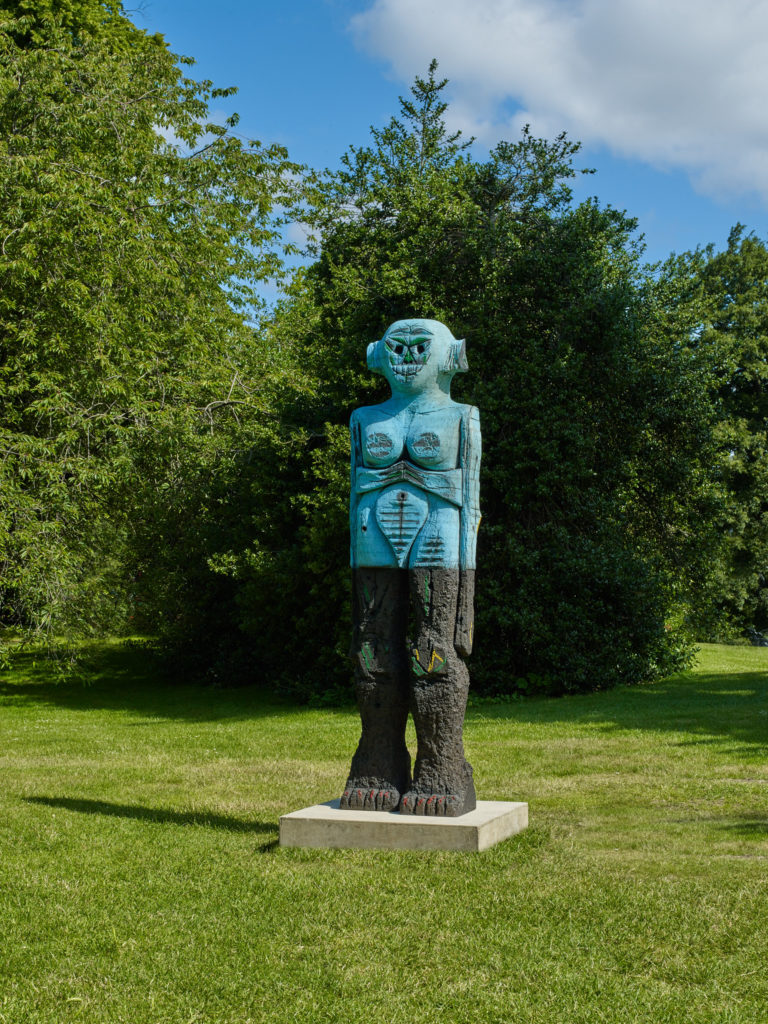
Huma Bhabha, Receiver (2019).
Courtesy of Salon 94, Frieze. Photo: Stephen White.
It is well known that women artists are still fighting to attain
equal recognition in the art industry. While Yayoi Kusama, Jenny
Holzer, and Rachel Whiteread are some of the most successful
contemporary artists working in sculpture today, they represent the
very top end of the market, selling in the millions at auction and
receiving public commissions. Their status thus may not be
representative of broader trends for women working in the
field.
For more emerging artists, the gender gap means a gap in terms
of who has access to the means to create ambitious projects.
Indeed, artists often have to wait to be able to even experiment
with sculpture, simply because the basic costs are so high. It can
cost tens of thousands of pounds to make an ambitious sculptural
commission, plus thousands more for the work’s transportation and
storage.
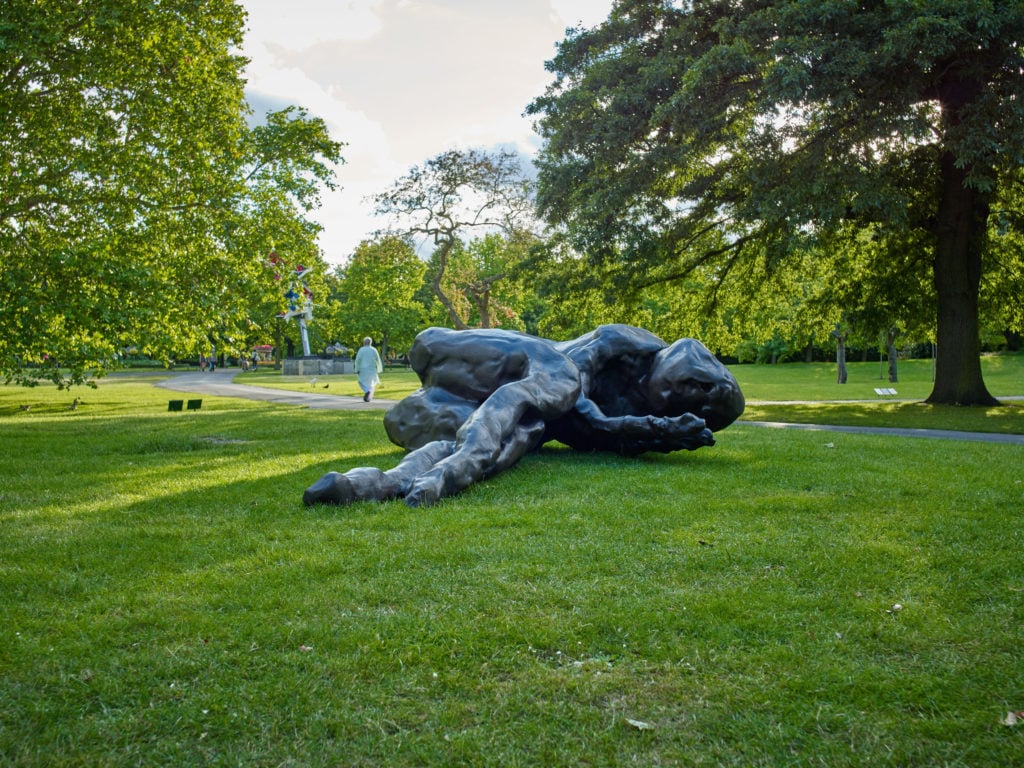
Tracey Emin, When I Sleep (2018).
Courtesy of White Cube, Frieze. Photo: Stephen White.
“It all costs,” said Abby Hignell, director of London-based
sculpture specialist Hignell Gallery. “It costs to
make it, it costs to move it.”
Hignell points out that there’s a sharp career hurdle, where
artists who are selling pieces in the “low thousands” face the
prospect of scaling up to do larger pieces involving tens or even
hundreds of times that investment. “It does tend to take an artist
awhile to make sculpture,” she says. “Hence you get artists who are
mid- to late-career [making sculpture] because they’ve got the
capital.”
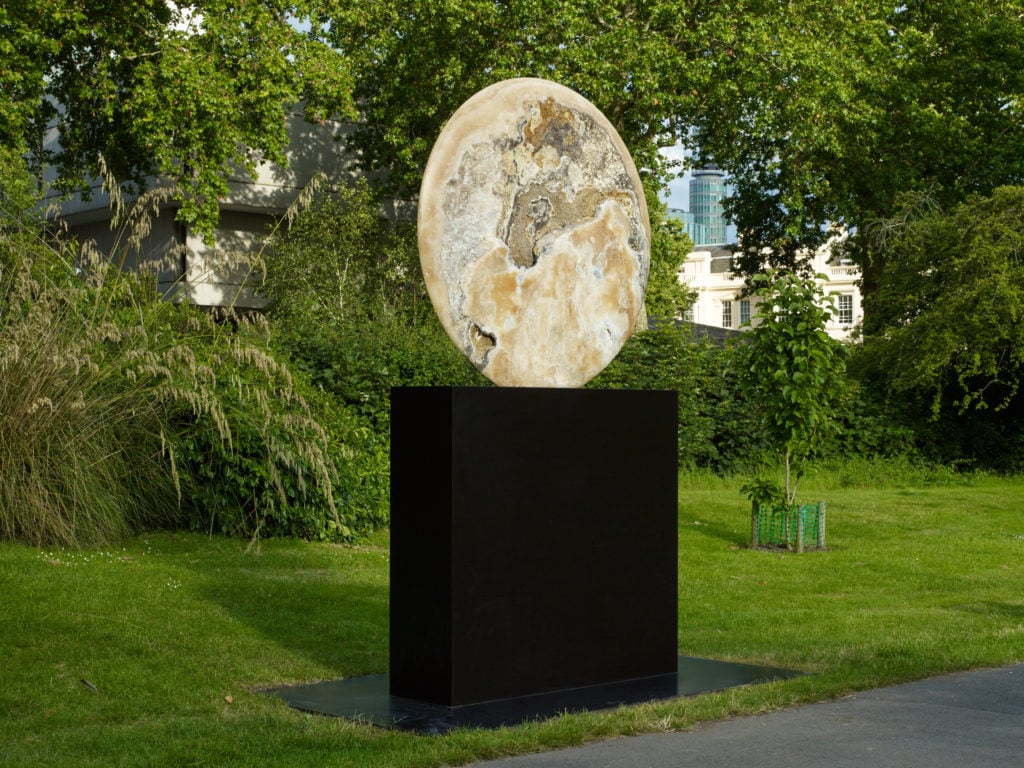
Emily Young, Bowman Sculpture
(2019). Courtesy of the artist and Frieze. Photo: Stephen
White.
Are things changing? It has never been more fashionable to be
righting historical representational wrongs through art, and there
are an increasing number of women in decision-making roles within
art, including institutional directors and senior curators.
If the key is achieving the sustained, early-career support to
allow more women artists to reach the point where they can scale up
their practice, surely a key obstacle must be that previous surges
of interest around female artists have proved fleeting. “What
happens is it’s seen as a little zeitgeist moment: ‘women artists
are really hot right now, let’s get on that,’” says Hignell. “Then
it goes quiet. The key is to keep going.”
But, she adds, perhaps things really are different this time: “I
can’t see this slowing down, because when you look behind the
scenes there are so many more women.”
There are also examples of female artists working with
large-scale and monumental works who have been steadily achieving
success for years.
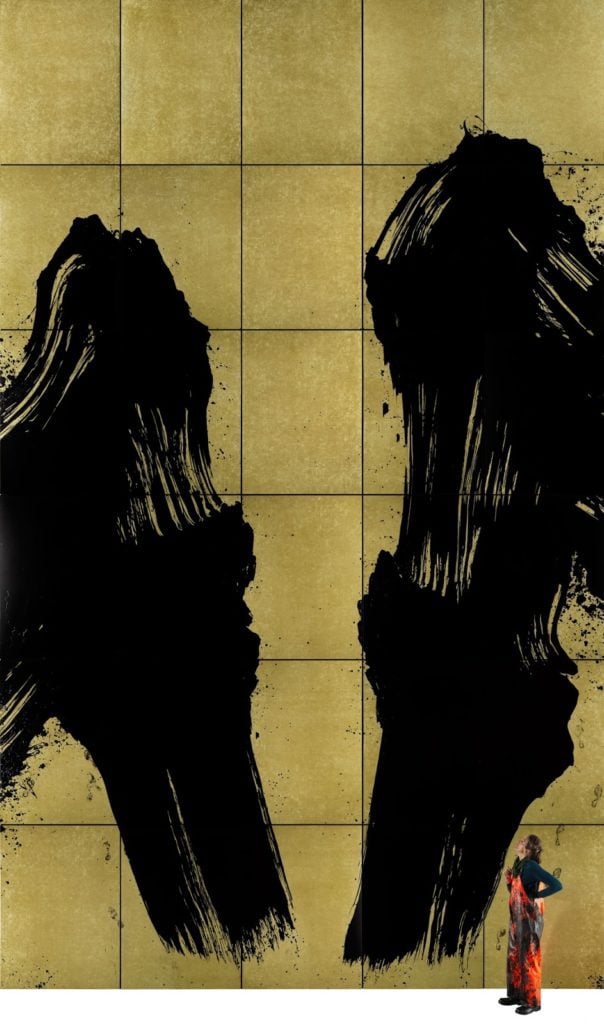
Fabienne Verdier, La Faille
(2014). Installation of a monumental painting in Majunga Tower, La
Défense. Photo: Philippe Chancel.
Waddington Custot gallery represents both Fabienne Verdier, who
makes work like the giant-sized multi-panel painting La
Faille, installed in Majunga Tower in Paris and commissioned
by architect Jean-Paul Viguier, and Alice Anderson, who makes
large-scale sculptural works using copper wire that have appeared
at the Centre Pompidou, Espace Culturel Louis Vuitton Paris,
the Wellcome Collection, London, and many other venues.
“We are coming into a new and welcome era where museums and
galleries are taking on the responsibility of showing a more
diverse program which more accurately represents artists working
today,” Waddington Custot directors Roxana Afshar and Jacob Twyford
said in a statement. “However, we are not there yet.”
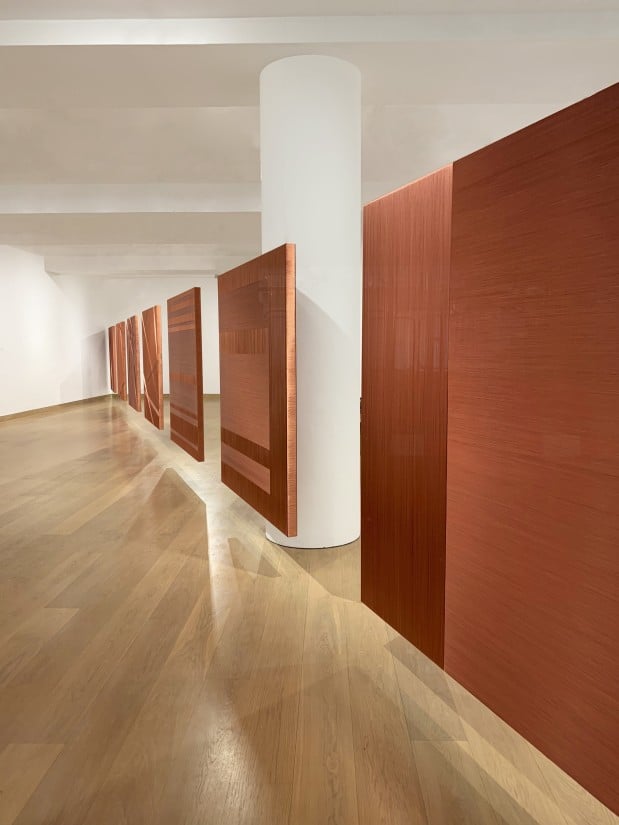
Installation view of “Alice Anderson:
Body Disruptions” at Waddington Custot. Courtesy of the artist &
Waddington Custot.
Still, all indicators point towards a sea change in the market
for sculpture by women. If the industry truly sees the momentum
extending into the future, it’s possible that the prospect might
actually lead to sustained investment. Has there ever been a better
time to invest in women artists?
The post The Bronze Ceiling? What the Gender Gap in Public
Sculpture Tells Us About the Barriers for Women in Art appeared
first on artnet News.
Read more https://news.artnet.com/art-world/public-sculpture-gender-gap-1603633
Further reading


Leave a comment