
After Damaging Collisions (and Too Many Near Misses), Venice Decides to Ban Giant Cruise Ships Once and For All
Italian authorities have decided to begin diverting cruise ships
away from Venice’s central waterway, the Giudecca canal. The
historic move follows a series of collisions and years of protest
against the giant vessels’ environmental impact on the famous
lagoon city.
On Wednesday, officials from the Italian government said that
cruise ships would be gradually diverted away from the city center
and its ecologically sensitive lagoon. Danilo Toninelli, the
Italian minister for transport, explained that the decision was “to
avoid witnessing more invasions of the Giudecca by these floating
palaces, with the scandals and risks that they bring,” according to
the Financial
Times.
Growing calls for a solution to the increasing volume of traffic
peaked this summer when five passengers were injured after the
cruise ship MSC Opera struck a local tourist boat. The collision in
the Giudecca canal in June saw the ship giant hitting a crowded
jetty. Not long after, another ship nearly hit a restaurant during
a storm.
The mayor of Venice, Luigi Brugnaro, said that a major tragedy was narrowly
avoided in the MSC Opera incident. He had already announced earlier
this year the introduction of a
€3 tourist tax aimed at day-trippers, many of whom arrive by ship.
The tax will come into effect as of December 31, a spokesperson for
the local government told artnet News.
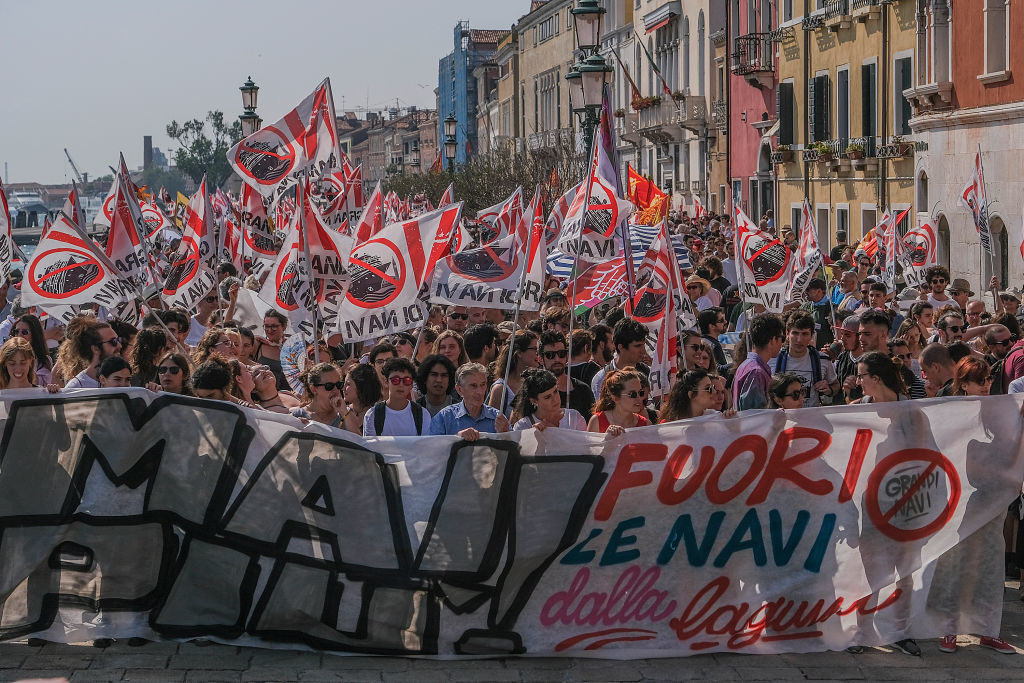
Protest in Venice, Italy, following the
incident of MSC Opera. Photo: Stefano Mazzola/Awakening/Getty
Images.
For decades, Venice has been been debating the economic costs
and benefits of cruise ships in particular and mass tourism in
general. Venice attracts 25 to 30 million foreign visitors per
year, according to the Italian tourist bureau. Less than a third of
them spend a night there. The local population is only 50,000
citizens.
Earlier this week, Venice called on other busy cruise ports in
Europe, including Barcelona, Amsterdam, and Dubrovnik, among
others, to help find ways of curbing the problem large ships pose
to local communities in historic port cities.
“The growing size of the vessels, their environmental impact on
the areas around our ports, and the pressure exerted by the
increasing number of tourists, are creating a conflict situation,”
explained Pino Musolino, the head of the Venetian port, according
to Brussels
Times. Musolino made the international request, and
it has been reported that several ports have responded
positively.
The newest initiative to begin reducing the number of massive
liners sailing through the central canal is due to begin next
month. Some cruise ships will be docked at two terminals away from
the center of the city. The Fusina and Lombardia terminals are
still inside the lagoon, however. The Italian transport minister
says that, by next year, a third of cruise ships will be rerouted
and that, in the longer term, new berths outside the lagoon will be
found at Chioggia, at the opening of the lagoon, or Lido San
Nicolo, a ferry terminal on the Adriatic side of Lido Island.
Mayor Brugnaro has other ideas, and favors the port
of Marghera, where oil tankers dock, which is inside the
lagoon.
Jane Da Mosto, who is a scientist and founder of the
conservation group We Are Here Venice, told the Financial
Times that the diversion of the liners is not enough to make a
real difference, arguing that it would just create the same
problems in a different part of interconnected and relatively small
waters.
The post After Damaging Collisions (and Too Many Near
Misses), Venice Decides to Ban Giant Cruise Ships Once and For
All appeared first on artnet News.
Read more https://news.artnet.com/art-world/cruise-ship-reroute-venice-2019-1619770
Further reading


Leave a comment