
Why Apple’s New Augmented-Reality Collaboration With Famous Artists Won’t Help Us Reach the Next Stage of [AR]T
“I’m trying to spend less time on my phone to focus on just, you
know, being present.” That statement is pretty much a
cliché of coffeeshop chatter everywhere in 2019, with awareness of
the addictive qualities of smartphone culture peaking. Just think:
the average person in the US spends something like four hours a
day looking at their phone. Even the iPhone itself now feels
compelled to warn you about how much time you spend gazing into the
black mirror.
Then again, maybe the only statement that’s “more 2019” than
that might go something like this: “Hey, did you hear that Apple is
launching a new Augmented Reality artist collab for the
iPhone??”
Dubbed “[AR]T,” Apple’s
ambitious new art initiative is fascinating to me in how
aggressively “fine art-y” the tech company is trying to be. It is
curated (if such a word applies) by the New Museum’s director Lisa
Phillips and chief curator Massimiliano Gioni. For these
Apple-specific art projects, they have assembled a crack team of
A-list artists, smartly chosen to combine some level of critical
credibility with a populist light touch: Nick Cave, Nathalie
Djurberg (with composer Hans Berg), Cao Fei, John Giorno, Carsten
Höller, and Pipilotti Rist.
The result is an iPhone-enabled tour featuring digital artworks
([AR]tworks?) by the six chosen artists that you can access at
Apple Stores in six cities: Hong Kong, London, New York, Paris, San
Francisco, and Tokyo. These you have to sign up for in advance,
and involve special phones loaded with a dedicated [AR]T app and
headphones. (You can’t just do it on your own phone).
If you aren’t lucky enough to be in one of these chosen
megalopolises or to score a tour slot, there is still something for
you. Chicago-based Nick Cave, known for his intricately decorated,
wearable “sound suits,” has conceived a separate AR art experience,
titled Amass, that anyone can encounter at any Apple Store
worldwide. All you have to do is open the free Apple Store app (which,
handily enough, also offers such other features as “Which iPhone is
Right for You?”).
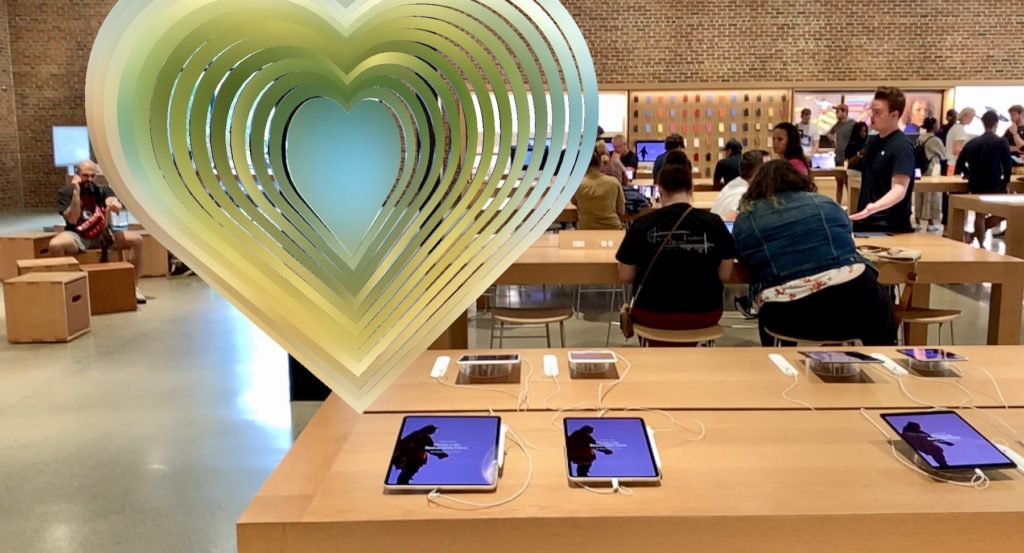
Nick Cave’s Amass at the
Williamsburg Apple Store. Image: Ben Davis.
Let’s start with this second attraction first.
What you will experience is this: Activating the work, you raise
your phone to gaze upon the Apple Store environment around you. A
series of scintillating, rainbow-colored geometric shapes hover
into view, floating across the real-life backdrop of chicly minimal
interiors and scattered customers inspecting Apple products.
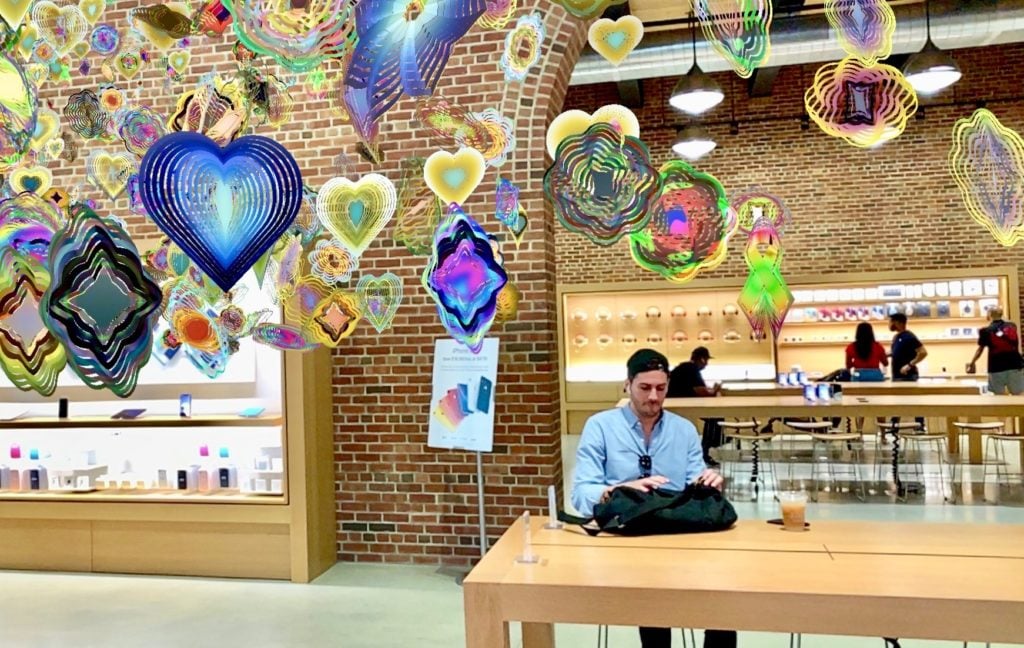
Screenshot of Nick Cave’s Amass
at the Williamsburg Apple Store. Image: Ben Davis.
As you circle the space, peering through your screen, more and
more of these unreal twirling shapes appear, resembling the “wind
spinners” you see decorating people’s porches. Finally, when a
critical mass of digital ornamentation has appeared, you are able
to hit a button that causes them all to react by changing color and
doing a kind of coordinated shimmer-dance.
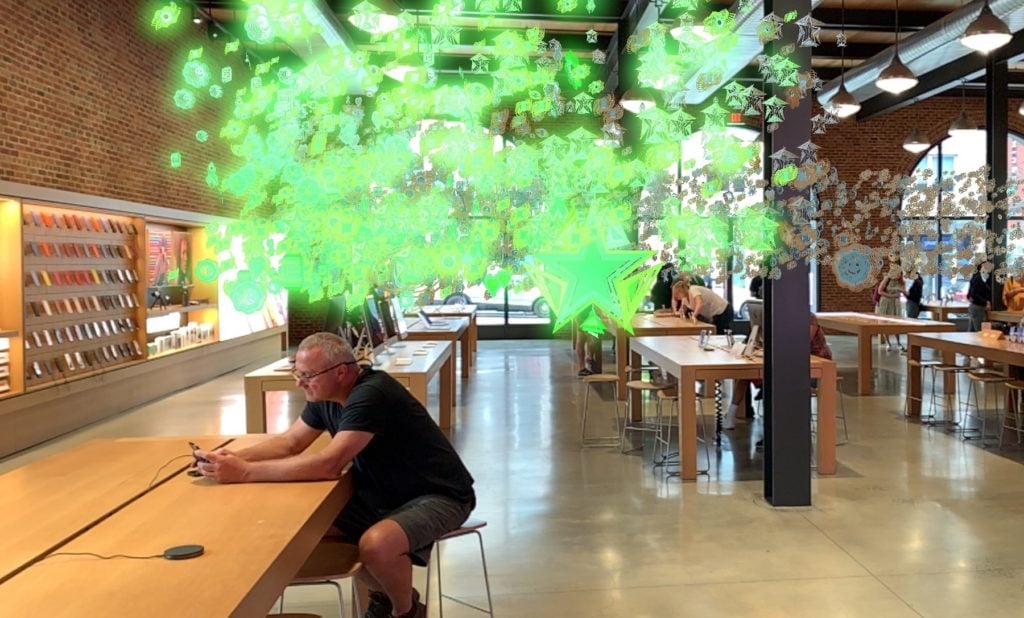
Nick Cave’s Amass doing its
shimmer-dance at the Williamsburg Apple Store. Image: Ben
Davis.
The feature works at theoretically any Apple Store, I think,
because they are all predictably open-plan. The Augmented Realty
doesn’t really register the interior architecture (if a column
intervenes, Cave’s shapes will just float right over it as if it
weren’t there, regardless of whether they are behind or in front of
it in virtual space).
I tried Amass in the Fifth Avenue Apple Store and the
Williamsburg Apple Store. It is pretty much the same at both.
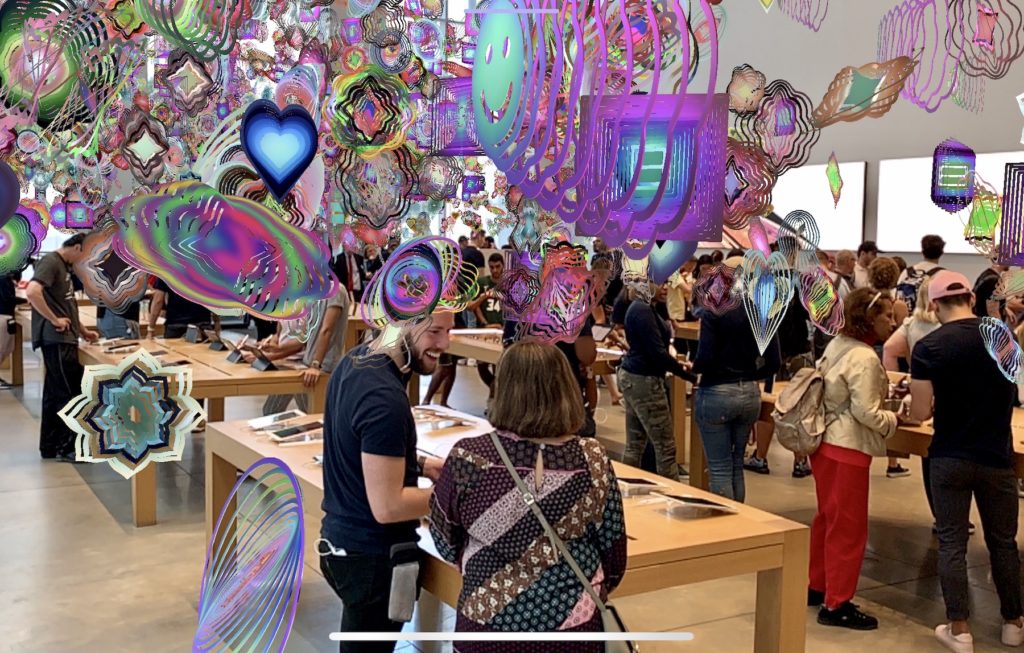
Screenshot of Nick Cave’s Amass
at the Fifth Avenue Apple Store. Image: Ben Davis.
So, in essence, Cave’s concoction allows you to realize a
fantasy of filling the Apple Store with a magical swarm of… deck
ornaments. Except they are weightless and massless and do not
respond to the real atmosphere. They just spin and pulse
automatically, literally blotting out the mundane customer service
environment around you—which literalizes its most obvious
functionality: killing time while you wait for the Genius Bar.
As for the “[AR]T” tour, which in New York starts from the Fifth
Avenue Apple Store and takes you on a two-hour journey through
Central Park, it is a more involved affair.
![Cao Fei's installation for [AR]T initiative in Central Park. Image: Ben Davis.](https://news.artnet.com/app/news-upload/2019/08/cao-fei-apple-1024x630.jpg)
Cao Fei’s installation for [AR]T
initiative in Central Park. Image: Ben Davis.
vignettes, each a few minutes long: a giant costumed man, towering
over the park, with something like a bowl for a head, courtesy of
Cave; a dark little fairytale scene that unfolds in a hollow in the
side of a tree, from Djurberg; a poem by Giorno, whose words seem
to float out of a lake and through the air before wafting away; an
unreal cartoon contraption by Cao of box-laden conveyor belts that
appears in the middle of a path, the mechanism of which you can
manipulate on your screen; a kind of game by Höller, which involves
you stepping through a portal into a parallel version of Grand Army
Plaza that appears to be rendered in black and white; and, finally,
a wailing blob-like creature, conceived by Rist and looking like
Slimer from Ghostbusters as redesigned by Lisa Frank, that
emerges from the Pulitzer Fountain, circling exuberantly through
the air.
![John Giorno's project for Apple's [AR]T initiative. Image: Ben Davis.](https://news.artnet.com/app/news-upload/2019/08/john-giorno-art-apple-1024x934.jpg)
Screenshot of John Giorno’s project for
Apple’s [AR]T initiative. Image: Ben Davis.
nifty little AR vignettes. Not because of technical glitches—though
as admirably intuitive as the tech is, there are plenty of clunky
moments that remain to be worked out. I couldn’t actually see
Cave’s magical giant because of sun was shining directly on the
screen, for instance, and the AR rainbow pathway that led me to
Giorno’s poem didn’t really synch up with the real path underfoot.
Et cetera.
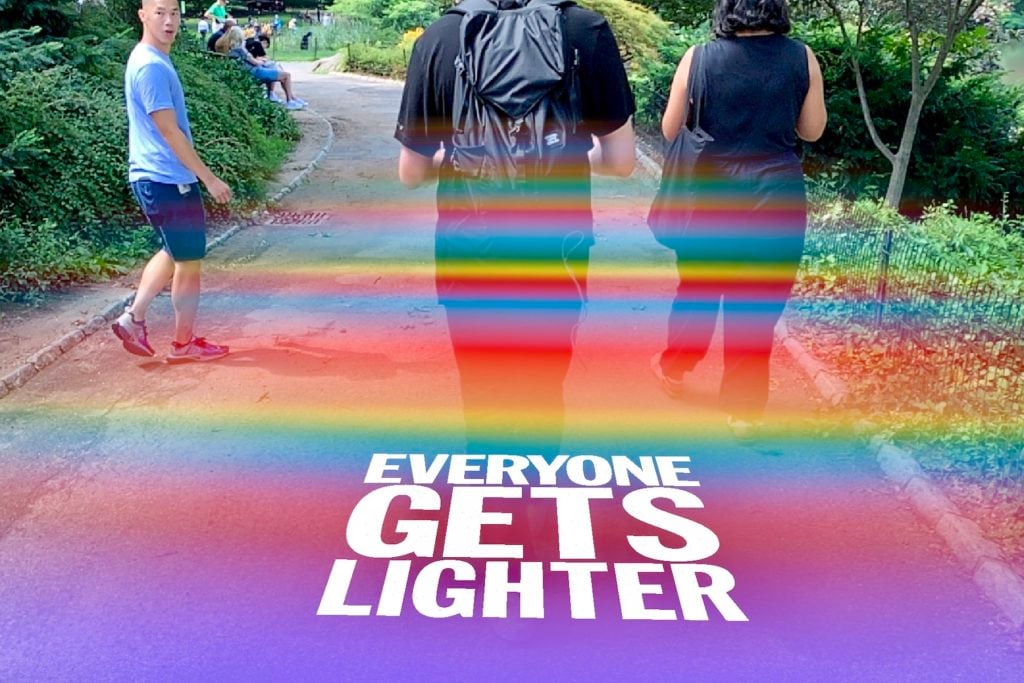
The rainbow path leading to John
Giorno’s poem. Image: Ben Davis.
The animated overlay allows for magical, only-in-AR imagery,
like Rist’s wheeling spirit or Cao’s quirky machine. But the toll
the technology extracts is that you are a bit distracted by its
niftiness. You are constantly thinking about aligning your real
space with the illusion, adjusting, moving your phone in and out to
see how whatever you are looking at holds up from different
angles.
Maybe as the novelty of the technology goes away, so will this
slight estrangement. But maybe not: What mobile AR adds is the
ability to change focus by actively moving around
a simulated object in real space. The technology wants you
to do that. So it may just not be the ideal way to experience
anything that requires any degree of sustained focus, like a poem
or a performance.
![Nathalie Djurberg's artwork for Apple's [AR]T project. Image: Ben Davis.](https://news.artnet.com/app/news-upload/2019/08/natalie-djurberg-apple-art-1024x613.jpg)
Screenshot of Nathalie Djurberg’s
artwork for Apple’s [AR]T project. Image: Ben Davis.
not.
Augmented Reality, at this point, is only truly mind-blowing if
you’re the kind of person who deliberately does not pay attention
to consumer gadget trends at all. Huge numbers of people have
already acquainted themselves with its potential uses. It’s just
that its most familiar versions are either games, like the briefly ubiquitous Pokémon GO,
or goofs, like those Snapchat filters that turn you into a sexy
human-dog hybrid.
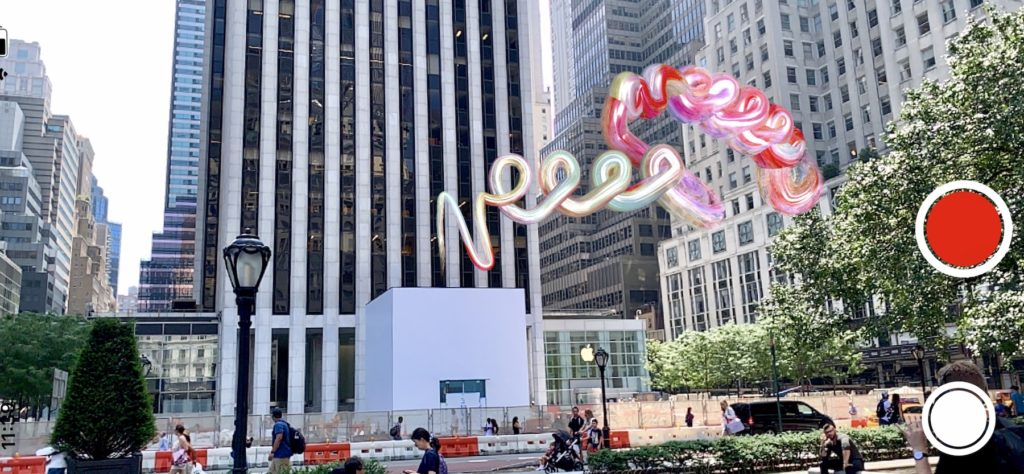
Pipilotti Rist’s installation for [AR]T
initiative in Central Park. Image: Ben Davis.
in general, but for Apple’s particular version of it, trying to get
you into its ecosystem. Here, incidentally, is how one tech analyst
framed the New Museum/Apple team-up to CNBC: “Apple in
particular has invested a lot in AR and is banking certain parts of
its future hardware lineup on AR, so these ARt walks are both a
move to accelerate AR traction and to continue feeling out the
demand signals and what will resonate with consumers.”
So, you say this Apple-branded art project is actually an ad for
Apple? No shit, Wozniak!
![Looking at Cao Fei's installation for [AR]T initiative in Central Park. Image: Ben Davis.](https://news.artnet.com/app/news-upload/2019/08/cao-fe-apple-1024x768.jpg)
Looking at Cao Fei’s installation for
[AR]T initiative in Central Park. Image: Ben Davis.
initiative to realize that the recourse to museum-approved artists
is less about supporting art, per se, and more a corollary for
Apple’s own particular brand mythology: that it is a particularly
deluxe, value-added ecosystem for the hip and monied set.
That underlying reality governs the choice of artists: They are
here for their credibility to the non-AR art world, not really
because they have something that they have to say with AR.
All of them have big careers, but none of them are centrally
concerned with digital life or virtual worlds. Cao, who made
a work in the then-trendy virtual world
of Second Life, maybe comes closest, while someone like Cave is
really best known for the intense physical craft of his soft
sculptures.
The truth is that most serious artists working on digital
technologies at least touch, in some way, on the more disturbing or
unsettling sides of them, how they are reshaping our humanity and
making us ever more dependent on corporations. A more powerful hint
of the disorientation and alarm that marks the contemporary conversation
about tech might have made the works “[AR]T” cut a bit deeper,
feel a bit more vital to the contemporary discussion and a little
less innocuous—but that’s not what this initiative is all about. As
it stands here, to borrow a term from video game criticism, you
can’t help but feel that the artistic potential has been nerfed.
The post Why Apple’s New Augmented-Reality Collaboration
With Famous Artists Won’t Help Us Reach the Next Stage of [AR]T
appeared first on artnet News.
Read more https://news.artnet.com/opinion/apple-augmented-reality-art-1624540
Further reading


Leave a comment