
A Sculpture That Was Censored From Japan’s Aichi Triennale Will Become a Centerpiece of a New Museum for Banned Art
A Spanish collector who is creating a permanent home for art
that has been censored just made his latest high-profile
acquisition. Tatxo Benet bought the sculpture censored from
Japan’s Aichi
Triennale earlier this month. Ironically, the piece was
removed from an exhibition about censored art.
The sculpture, which has caused controversy in the past, is now
destined for Benet’s planned “freedom museum” in Barcelona, a hub
for contemporary art that has been banned or suppressed in
countries around the world.
Benet moved quickly to snap up an edition of Statue of a
Girl of Peace (2011) by the South Korean artists Kim
Seo-kyung and Kim Eun-sung for his fast-growing collection. The
sculpture depicts a “comfort woman”—one of many thousands of women
sold into sexual slavery by the Japanese military during World War
II.
Immediately after the exhibition, titled “After ‘Freedom
of Expression’?”, opened as part of the Aichi Triennale, the work
drew hundreds of complaints; one person even threatened to burn
down the museum. As a result, organizers decided to close
the section of the triennial just three days later.
The backlash was swift: 85 of the nearly 100 participating
artists issued a statement requesting that the show be
reopened under proper security measures. Ten artists, including
Pedro Reyes and Tania Bruguera, also demanded that
their own works be removed from the triennial in solidarity with
the censored sculptors.
Benet told the news agency EFE that as soon as he heard about
the controversy, he contacted the artists to buy their
work. The triennial’s ban “is a double contradiction
because not only an artistic work is censored, but an exhibition
against censorship is closed,” he said.
The collector told Reuters that he now has enough material for a
permanent exhibition “and perhaps even a documentation and archive
center about censorship in the art world.” The former
journalist and millionaire businessman, who co-founded the
Barcelona-based communications group Mediapro, is planning to open
his museum in the Catalan capital in the not-too-distant future,
although no opening date has been made public.
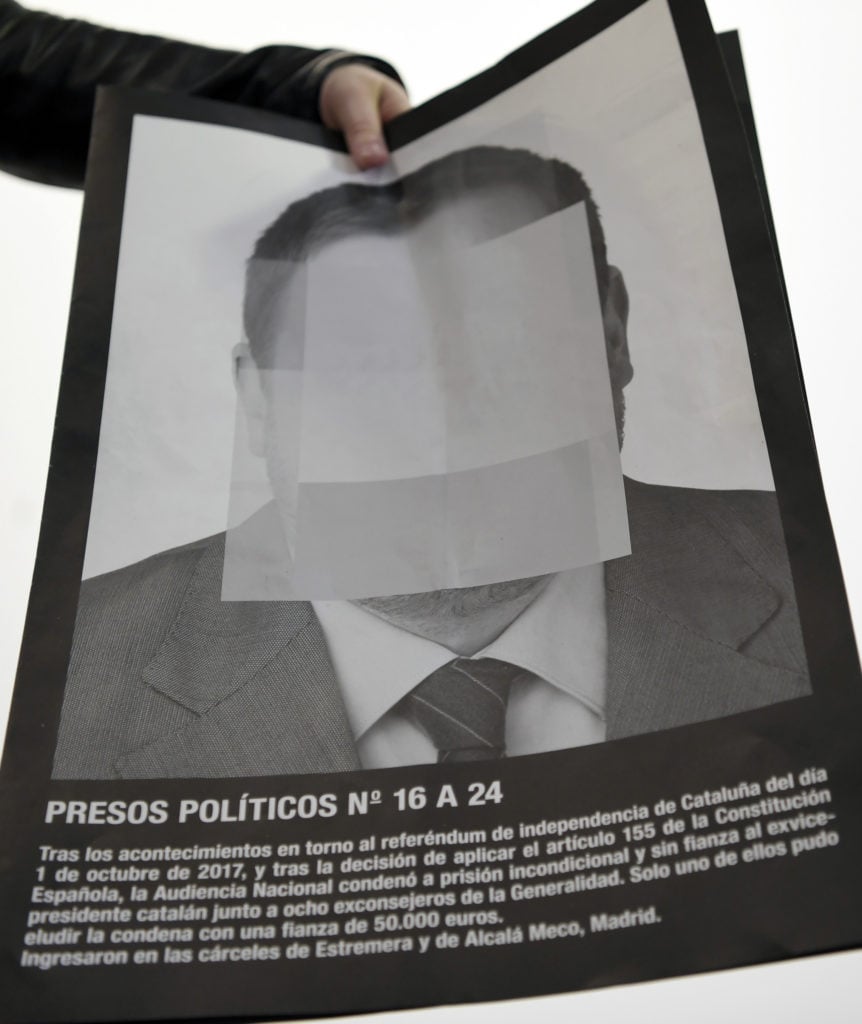
Santiago Sierra’s Political Prisoners
in Contemporary Spain, which includes jailed Catalan
separatists, was removed from the leading art fair Arco Madrid.
Photo by Gabriel Bouys, AFP/Getty Images.
Benet first came to international prominence in the art world
when he bought a work by the Spanish artist Santiago Sierra that was
censored at the ARCO fair in Madrid in 2018. The artist’s
installation featured partially obscured portraits of jailed
Catalan separatists and other political prisoners in Spain.
Benet told EFE that he has began collecting censored work less
than two years ago. He now owns more than 60 pieces, including a
video by the late American artist David Wojnarowicz that was pulled
by the National Portrait Gallery in Washington, DC, in 2010. The
Smithsonian’s decision to self-censor A Fire in My Belly
from the exhibition “Hide/Seek” after complaints by members of
Congress as well as members of the Catholic League was was widely
condemned in the art world.
Benet’s international collection
includes work banned in France, Turkey, China, England, Argentina,
the US, and from Arab countries. “All have been censored, although
the motives vary: political,
religious, sexual, social, moral,” he explained. He added that when
he contacts artists, they often lower the price of their work when
they learn it is destined for a museum championing censored
art.
The post A Sculpture That Was Censored From Japan’s Aichi
Triennale Will Become a Centerpiece of a New Museum for Banned
Art appeared first on artnet News.
Read more https://news.artnet.com/art-world/collector-censored-art-museum-1626379
Further reading


Leave a comment