
The Art Market Is Having a Party About Nicolas Party. Here’s How the Playful Young Art Star Got So Hot, So Fast
Where were you when you first
heard that Nicolas Party was the Next Big Thing? I was at an art
fair in Brussels two years ago, where the young artist had
transformed the booth of veteran Brussels dealer Xavier Hufkens
into a kind of surrealist chapel. Fairgoers clamored to get a
glimpse of the Swiss artist’s dreamy landscapes through the
installation’s arched windows.
That scene—droves of people jostling and craning their necks to
get in on the action—turns out to be an apt metaphor for Party’s
place in the art world right now. After a spate of high-priced
auction sales this spring, mega-gallery Hauser & Wirth announced in June that
it would represent the 39-year-old artist, making him one of the
youngest names on its robust roster.
Now, Party’s market finds itself in that short-lived sweet
spot for speculators and
eagle-eyed collectors: after the artist has become a safe bet, but
before his prices jump following a mega-gallery debut. Party won’t
have his first show with Hauser & Wirth until 2020, and established
collectors and new market entrants alike are scrambling to get
their hands on the work before then.
Even in the dog days of August,
when most of the art world is in Martha’s Vineyard or the South of
France, inquiries are pinging from inbox to inbox as buyers vie to
get an invitation to this particular Party.
Getting on the Guest List
In a relatively unusual move,
the Brussels- and New York-based artist has maintained his network
of smaller international galleries alongside Hauser & Wirth. Party
continues to be represented by Hufkens, Kaufmann Repetto in Milan, Modern Institute in
Glasgow, Galerie Gregor Staiger in Zurich, and Karma in New
York.
Together, they have created a
strong foundation for the artist, facilitating impressive institutional exhibitions at
public spaces like the Hirshhorn Museum and Sculpture Garden in
Washington, DC, and private museums including the Marciano Art
Foundation in Los Angeles and M WOODS in Beijing.
The market buzz around Party has
reached new heights over the past year as his work gained traction
on the secondary market. In September, Sunset (2018) sold for $330,000, eclipsing a
high estimate of $80,000, at a Phillips charity
auction. Just eight
months later, the auction house sold a comparable landscape from
2015 for nearly twice that—$608,000—setting Party’s current
record.
All told, the artist’s work has
come to auction 14 times, all in the past two years. Eight of these
sales happened in the first six months of 2019, generating a total
of $1.6 million.
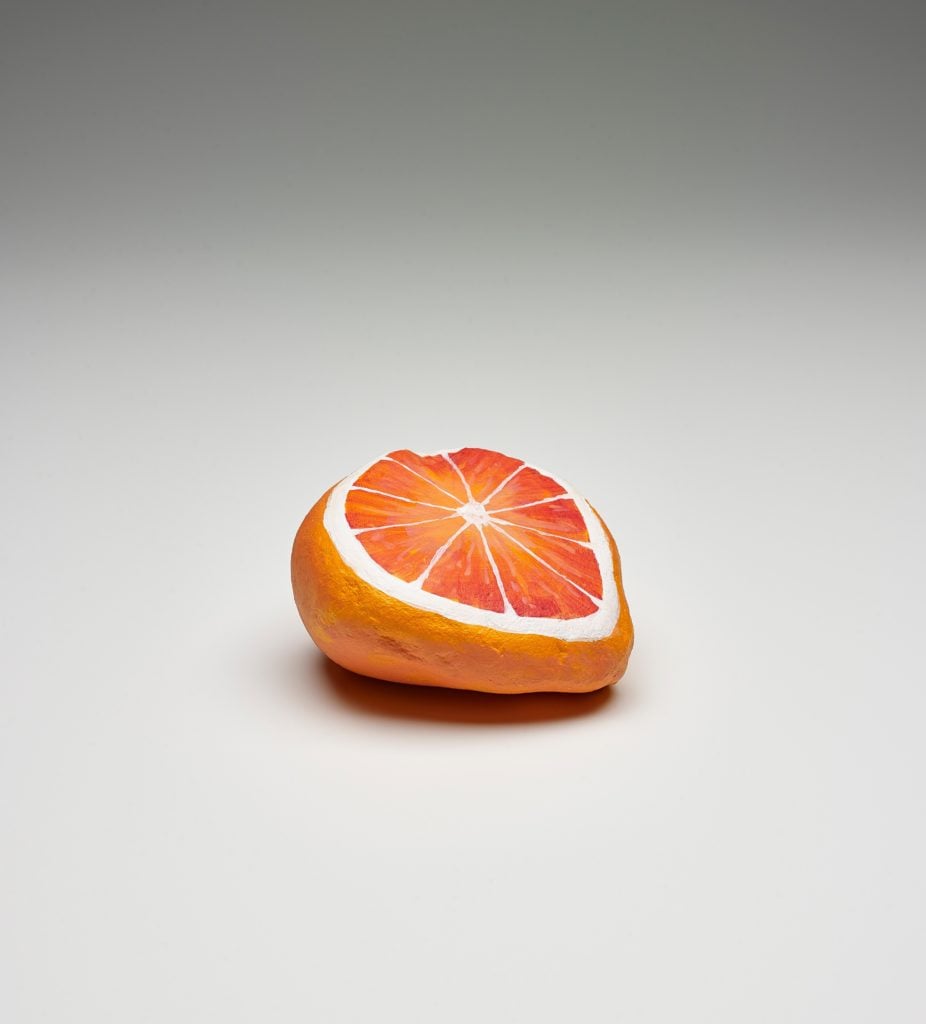
Nicolas Party, Blakam’s Stone
(Orange) (2016). Courtesy Phillips. Estimate: $12,000 –
18,000.
Now that the floodgates
have opened, we can expect much more in the coming season. Phillips
has a selection of playful sculptures—rocks painted to look like
fruit called “Blakam’s Stones”—in its current selling exhibition, and eight more works will hit the block
in September, including an early watercolor landscape and a pastel
portrait. (Works in pastel—Party’s signature medium—are his most
sought-after.)
“We’re seeing pretty strong
interest from consignors wanting to take advantage of the interest,
and I’ve also had a number of clients reaching out with works that
they would rather offer privately,” the head of Phillips’s New Now
sale, Sam Mansour, tells artnet News. “Some have even turned down
offers because they felt like there is even more room for this
market to develop.”
What is driving the flurry of
interest? Mansour attributes it to the fact that taste has turned
away from process-based abstraction (aka Zombie Formalism)
toward more dreamy and surrealist figuration. (Other examples of
artists working with a similar type of playful figuration who are
gathering market heat are Julie Curtiss, Jamian Juliano-Villani,
and Christina Ramberg.)
Party also creates immersive
environments for his exhibitions with custom wallpaper and
candy-colored walls that tap into a desire for transporting—and
Instagram-worthy—installations. At the same time, Mansour notes,
people associate the work with “very well-known, well-respected,
recognized artists” from René Magritte to David Hockney, making it
feel both new and familiar, which solidifies its appeal to new and
established collectors alike.
Party Crashers
Collector Glenn Fuhrman, the
private equity mogul who founded the Flag Art Foundation, first
learned about Party’s work nearly a decade ago, but he says it was
only after his exhibition at the Hirshhorn in 2017 that
he really fell in love.
He was initially attracted to
the artist’s skilled execution and playful use of color, which he
uses to create strange worlds populated with orange people, blue
cats, and purple bananas. Since 2017, Fuhrman has been able to
acquire several paintings and a large sculpture, although he wants
more. “Like all great artists these days, especially those who
don’t produce a ton of work, you never get offered as much as you
might like,” the collector explains.
He connects Party’s use of color
to Expressionism and the Fauvists, citing artists like Franz Marc
and Henri Matisse. He attributes Party’s wider appeal
to his ability to transport viewers to a new and different world.
“Reality is so challenging right now,” Fuhrman says. “Maybe people
are happy to look and live in a fictional landscape at the current
moment.”
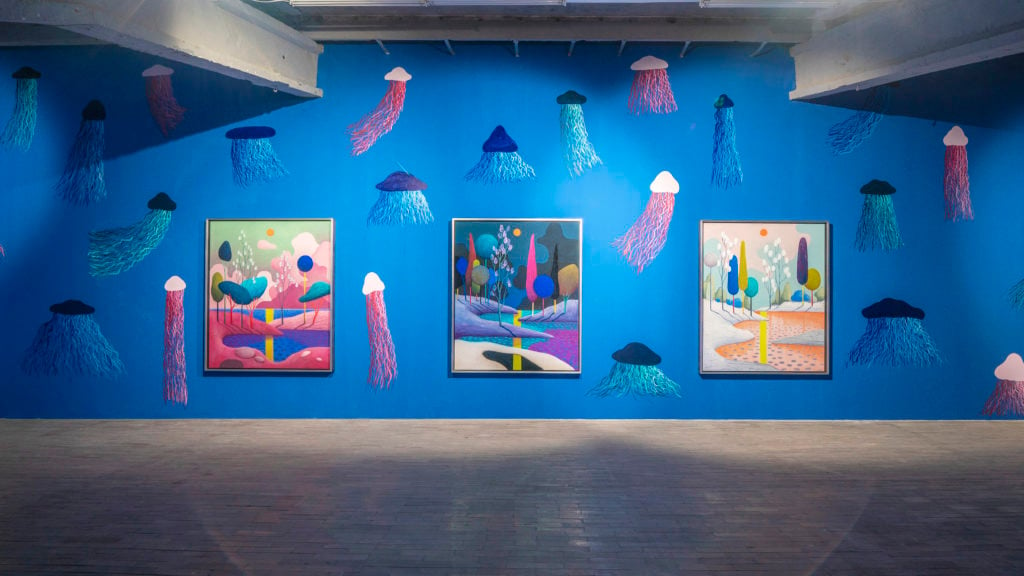
Installation view, “Arches,” M Woods,
Beijing, China, 2018. ©Nicolas Party. Courtesy the artist, Hauser &
Wirth, and M Woods, Beijing.
Others are a little more cynical
about Party’s rise. The
outspoken collector, dealer, and advisor Stefan
Simchowitz confirms
that he has seen “loads of interest” in Party, particularly after
the announcement that he would be joining Hauser & Wirth. He chalks
it up largely to collectors identifying an investment opportunity.
“I know several people
trying to get their hands on the work to collect and one day sell
for millions at auction,” he explains.
To Simchowitz, Party is the
ideal market artist: he has institutional backing and makes the
right kind of painting: “non-invasive, highly decorative…and rather
conservative.” He
continues: “The vehicle can be accessed easily by the collecting
class, so to speak, who are, as they always have been, a
middle-of-the-road, competently educated bunch of people who can
wrap their culturally non-expansive thoughts around a practice as
well-established and reasonably understandable as
Party.”
The phenomenon is not fueled by
populism, like the market for
KAWS, but rather “it is a continuation of middle-class values
in relationship to culture, in a globalized environment where
massive liquidity can fuel price spikes in cultural assets once a
narrow consensus is achieved,” Simchowitz says.
Avoiding a Party Foul
As with any rapidly rising
market, the fear is that the speculative bubble might eventually
pop. As has happened with so many artists before him, Party’s
prices could reach high enough levels that they tempt a growing
number of collectors to cash in—thereby flooding the market,
driving prices down, and souring the artist’s prospects for the
long term.
“The combination of a
time-consuming practice and the increase of interest has allowed
the auction houses to tempt a few early collectors to sell, which
creates additional market challenges,” art dealer Xavier Hufkens
admits. Asked
what measures they have in place to
thwart flippers, Hufkens
says that, due to the “overwhelming” demand for the work, the
gallery can be picky about who they sell to.
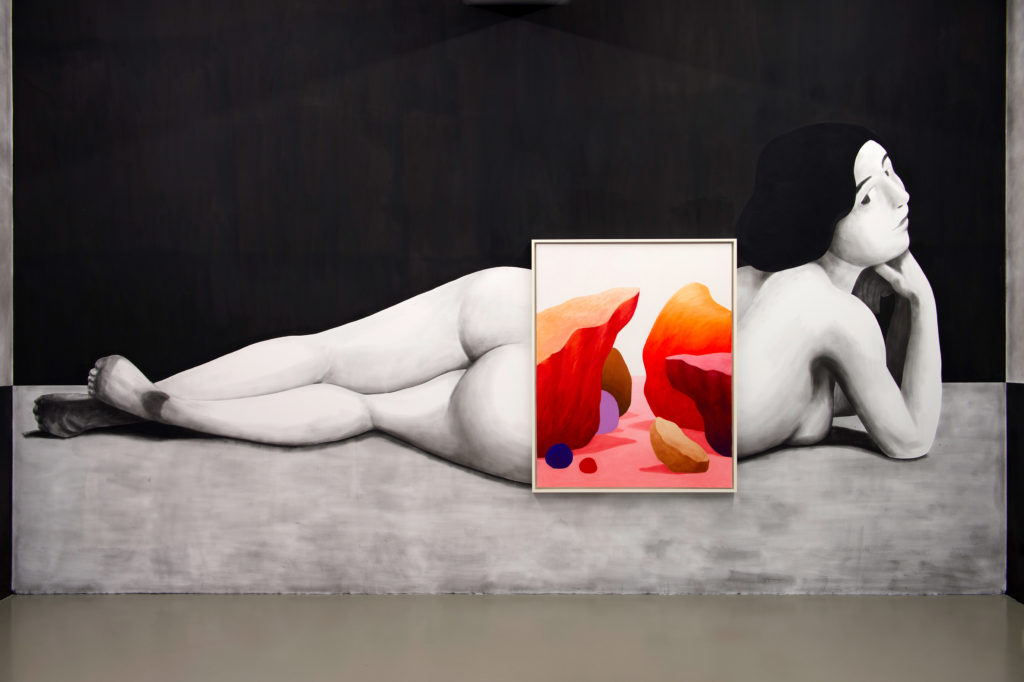
Installation view, “Pastel et nu,”
Centre Culturel Suisse, Paris, France, 2015. ©Nicolas Party.
Courtesy the artist, Hauser & Wirth, and Centre Culturel Suisse,
Paris. Photo by Marc Domage.
One of Party’s smaller dealers,
the Zürich-based Gregor Staiger, says that the gallery’s inbox was
already so inundated with requests for Party’s work that the Hauser
announcement was barely a blip on the radar.
“Market speculation is rarely healthy, but
perhaps it has become a natural part of work settling into higher
price brackets,” Staiger says. Although he can’t regulate secondary
market forces outside of his control, he notes, he can prioritize
clients he trusts. “We’ve
had the best experience working with collectors who are otherwise
invested in the gallery’s program,” he explains.
Party’s debut with Hauser &
Wirth is slated to run February 13 through April 12 during Frieze
Los Angeles next year. Moving forward, the mega-gallery plans to focus on
facilitating museum exhibitions—an armature that can help an artist
withstand market pressure.
“As with everything we do, the approach at
Hauser & Wirth will be a sustained, long-term effort that includes
exploring the relationship between Nicolas’s work and that of other
artists, both peers and predecessors,” says gallery partner
and vice president Marc Payot.
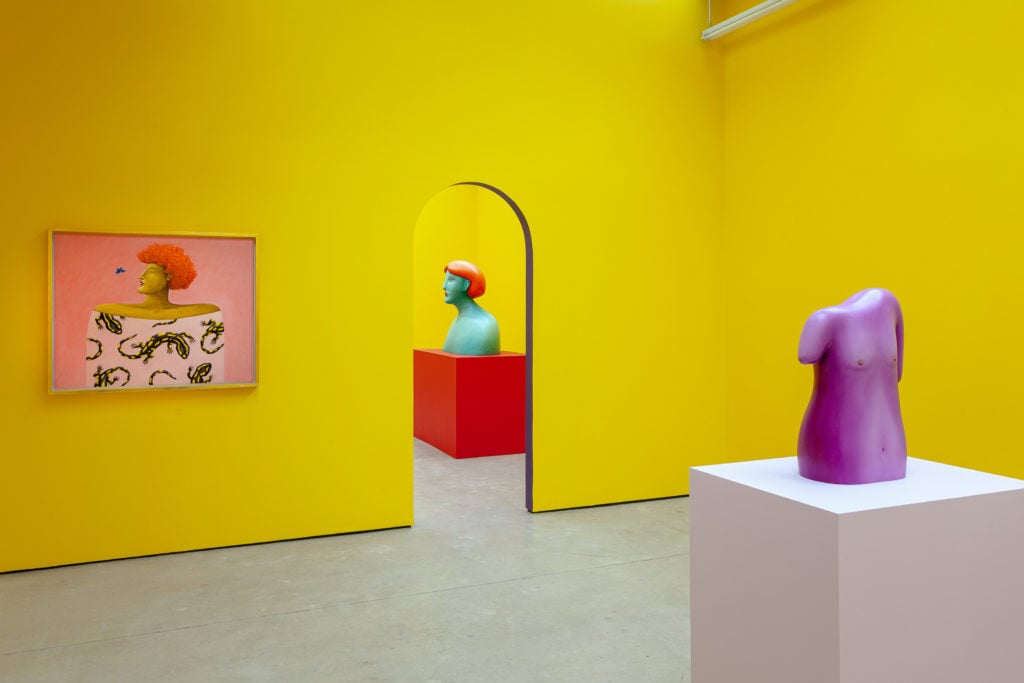
Installation view, “Polychrome,” The
Modern Institute, Osborne Street, Glasgow, Scotland, 2019. ©Nicolas
Party. Courtesy the artist, Hauser & Wirth, and The Modern
Institute/Toby Webster Ltd, Glasgow. Photo by Patrick Jameson.
The gallery is also well-versed
in how to deal with those pesky flippers, which Payot says is one
of the reasons they wanted to work with the artist in the first
place. “It’s quite common for a young artist to attract
speculators, and an early flurry of secondary market activity is
not at all unusual,” he says. “We consider it our responsibility to
help artists whose work we love and believe in to avoid such
traps.”
It remains to be seen how well
the efforts to shelter Party’s market from the pitfalls of
speculation will pan out. But the artist is keeping busy. His work
is on view at Modern Institute in Glasgow (through August 24)
and at Marble House in Rhode Island (through
September 22). Before his first outing with Hauser, he will
have exhibitions at Fuhrman’s Flag Art Foundation in New York in September, a
new solo exhibition at Xavier
Hufkens in Brussels in November, and another at MASI in Lugano, Switzerland in April
2020.
In the meantime, Party appears
to be staying sanguine about the whole market thing. He told Cultured in March: “Every artist
that starts to sell a lot will have this strange relationship with
that fact—but they’ll always take it.”
The post The Art Market Is Having a Party About Nicolas
Party. Here’s How the Playful Young Art Star Got So Hot, So
Fast appeared first on artnet News.
Read more https://news.artnet.com/market/nicolas-party-market-1626730
Further reading


Leave a comment