
Art Loans Boost Britain’s International Influence. So Why Are Three Major UK Museums Putting Them on Hold?
One of the first things the UK’s new arts minister, Rebecca Pow,
did upon taking office this month was to congratulate the country’s
national museums for lending thousands of artworks to institutions
at home and abroad. Museums lending, she said, was Britain’s “soft
power at its best.”
That power looks set to diminish just as Brexit makes it more
important than ever.
In the months to come, loans will be drastically cut back at
three major national institutions: the Victoria & Albert Museum,
which is about to impose a lengthy loan freeze; the Science
Museum, which began its loan moratorium in April; and the British
Museum, which is planning to introduce a partial moratorium as
well, artnet News has learned.
The V&A is warning would-be borrowers that large parts of
its collection will be unavailable for exhibitions from January
2020 until March 2024. The Science Museum says it will begin
lending objects again in January 2023. And the British Museum—which
will continue to consider loan requests “on a case-by-case
basis, and will continue to lend widely,” according to a
spokesperson—will nevertheless reduce its loan operations.
In sum, these changes mean that the public and hundreds of
researchers will not have access to thousands of stored objects for
years.
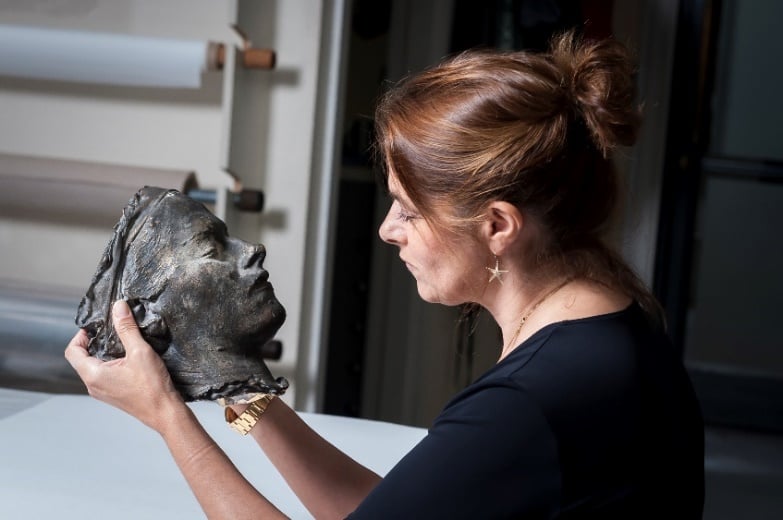
Tracey Emin with her Death Mask
(2002) at the National Portrait Gallery’s Conservation Studio.
Courtesy of Tracey Emin and the NPG.
Other Museums Will Carry the Weight
The reason for all this? Since the 1980s, the three museums have
shared Blythe House—a jointly operated facility in a Victorian-era
former postal building in West London—to store their collections.
But now, as the government prepares to sell the building, the
institutions must remove their objects, and the space must be
emptied out by 2023.
A V&A spokesperson describes the collection move as “the
biggest in its history.” Hundreds of thousands of objects, books,
and archives will be “audited, studied, photographed, conserved,
packed, and transported across London, which will mean we are
unable to loan objects currently stored at Blythe House.” She adds
that “the majority of the V&A’s loans activity will remain
unaffected.”
In the meantime, for the next three to four years, it will
be mainly up to the Tate, National Gallery, and National Portrait
Gallery to do the heavy lifting when it comes to lending works
internationally and across the UK.
They already handle hundreds of requests. Next year, the
National Gallery is due to lend an unprecedented number of
masterpiece paintings for a touring exhibition in Japan. In 2021,
the Tate is due to send works for the inaugural exhibition at
Shanghai’s Pudong Museum of Art, which is part of a long-term
partnership deal.
Closer to home, the National Portrait Gallery is lending 50
portraits to museums and institutions in famous sitters’ home towns
across the UK. Among the “Coming Home” loans is Tracey Emin’s
bronze Death Mask (2002), which is now on show
at Margate Library in the South of England.
The sale of Blythe House, however, will offer some advantages to
the V&A, the Science Museum, and the British Museum, including
a £150 million ($182 million) windfall, which each institution
is using to build new (or upgrade existing) storage buildings.
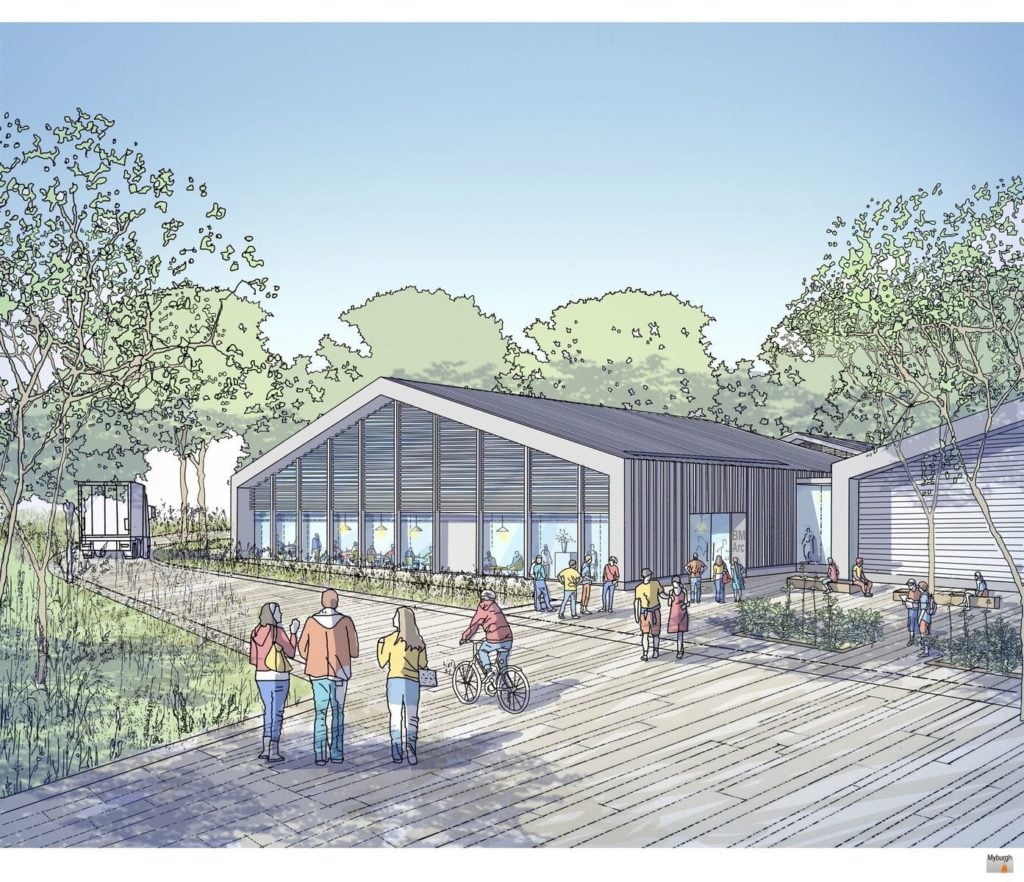
A sketch of the BM Arc collection store
and research center, which is due to open in 2023. Courtesy of the
British Museum.
The Big Collections Move
All three UK institutions stress that in the long term, access
to the collections for the general public and specialist
researchers will be improved.
The British Museum is building a £64 million mega-store around
40 miles west of London in a partnership with the University of
Reading. Called the BM Arc and designed by architects John
McAslan & Partners, it will house the museum’s huge reserves of
archaeological objects, ancient sculptures, mosaics, and historic
cast collections. A much larger part of the building will be open
to the public than was accessible at Blythe House.
Elsewhere, the Science Museum is expanding its existing store at
a former air field near the town of Swindon.
The V&A’s storage plans are the most architecturally
ambitious of the three institutions.
It is creating two venues in East London at Queen Elizabeth
Park, home of the 2012 Olympic stadium. The bulk of the collection
will be housed in the V&A East Collection and Research Centre,
an “open store” designed by leading US architects Diller Scofidio +
Renfro.
Highlights that will be on view to the public will include Frank
Lloyd Wright’s 1930s office for Edgar J Kaufmann Jr., plus
collections of fashions, textiles, furniture, and other objects.
Meanwhile, the V&A East museum, designed by architects
O’Donnell + Tuomey, will include an element of open-access storage,
plus two exhibition spaces that will also host shows organized by
the Smithsonian Institution.
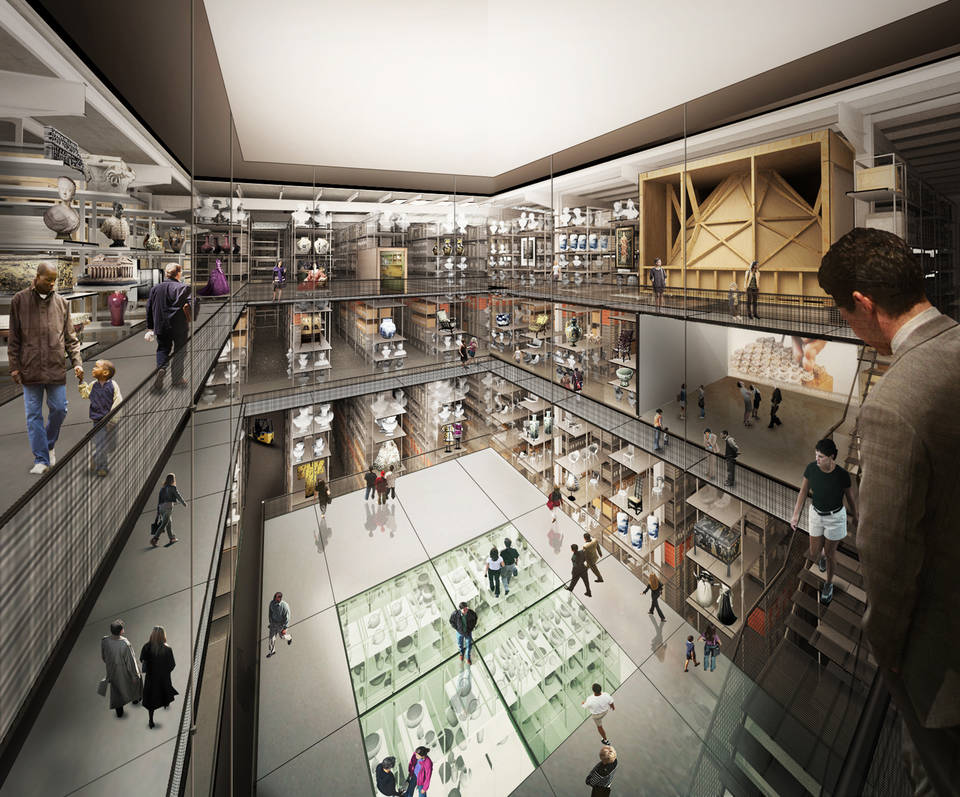
View of the collection hall in the
planned V&A East Collection and Research Center. Copyright
Diller Scofidio + Renfro. 2018.
Slowing Things Down
Some experts say the length of the loan freeze is a reflection
not only of the logistical challenges of the Blythe House sale, but
also of modern museum management.
The broadcaster and art dealer Bendor Grosvenor, who has tracked
down lost masterpieces in Britain’s stored collections for a
popular BBC TV series, calls the V&A’s loan freeze unfortunate,
but not surprising.
“In major museums, it now takes an age to move—and even arrange
to look at—objects in storage,” he says. Small tasks, which until
recently might have been done by a curator, now require a small
team. “As a result, excessive institutional time is spent on
internal processes,” he says. “There’s an inverse rule between the
size of a museum and the speed with which it operates. The V&A
has become one of the slowest.”
A spokesperson for UK’s Department for Culture, Media and Sport
says the sale of the Blythe House will eventually allow
the museums to open up more of their collections to the public and
to researchers.
“During this process there will be
a short-term impact on the museums’ ability to
loan certain items,” she says, adding that the government
is working closely with the museums “to ensure disruption is kept
to a minimum.”
The post Art Loans Boost Britain’s International Influence.
So Why Are Three Major UK Museums Putting Them on Hold?
appeared first on artnet News.
Read more https://news.artnet.com/art-world/uk-museums-loans-stop-1630786
Further reading


Leave a comment