
The Gray Market: Why Political Turmoil in the Three Largest Art Markets Proves That Governments Shape Culture (and Other Insights)
Every Monday morning, artnet News brings you The Gray Market. The column decodes
important stories from the previous week—and offers unparalleled
insight into the inner workings of the art industry in the
process.
This week, zooming out from national chaos to the global art
market…
THE CENTER WON’T HOLD
Over the past seven days, political brinkmanship pushed the
world’s three largest art markets closer to shared peril. Together,
the events should remind us that cultural exchange all too often
depends on political interests—and not the other way around.
First up: Hong Kong. The special administrative region is now
entering its fourth month of mass protests sparked by a bill that
would allow residents facing criminal charges to be extradited to
mainland China. The situation escalated again on Thursday, when
police banned a previously approved weekend rally to commemorate
Beijing’s 2014 rejection of universal suffrage for Hong Kongers—the
decision that sparked the Umbrella Movement.
Authorities arrested key pro-democracy activists on Friday in
further hopes of muting an unauthorized demonstration. Still,
hundreds of protesters took to the streets in defiance of the state on
Saturday, in some cases meeting tear gas and police truncheons with
bricks and firebombs, before hundreds more activists re-occupied Hong Kong’s
airport on Sunday.
According to Keith Bradsher of the New York Times, officials claimed that
more than 900 protesters have been arrested this summer, and that
China remains committed to ignoring all of the opposition’s formal
demands. Those demands include the withdrawal of the extradition
bill, the establishment of universal suffrage, and an investigation
into police brutality. Bradsher concludes that “the price of the
strategy could be months of acrimony, possibly stretching into
2020.”
As Vivienne Chow wrote in the Art Newspaper, that scenario could
undermine Hong Kong’s slate of major fall auctions, which begins at
Sotheby’s and China Guardian in the first week of October. It could
also endanger Art Basel Hong Kong in March 2020, to say nothing of
chilling business for the district’s galleries in the many months
between now and then, as Barbara Pollack reported in ARTnews.
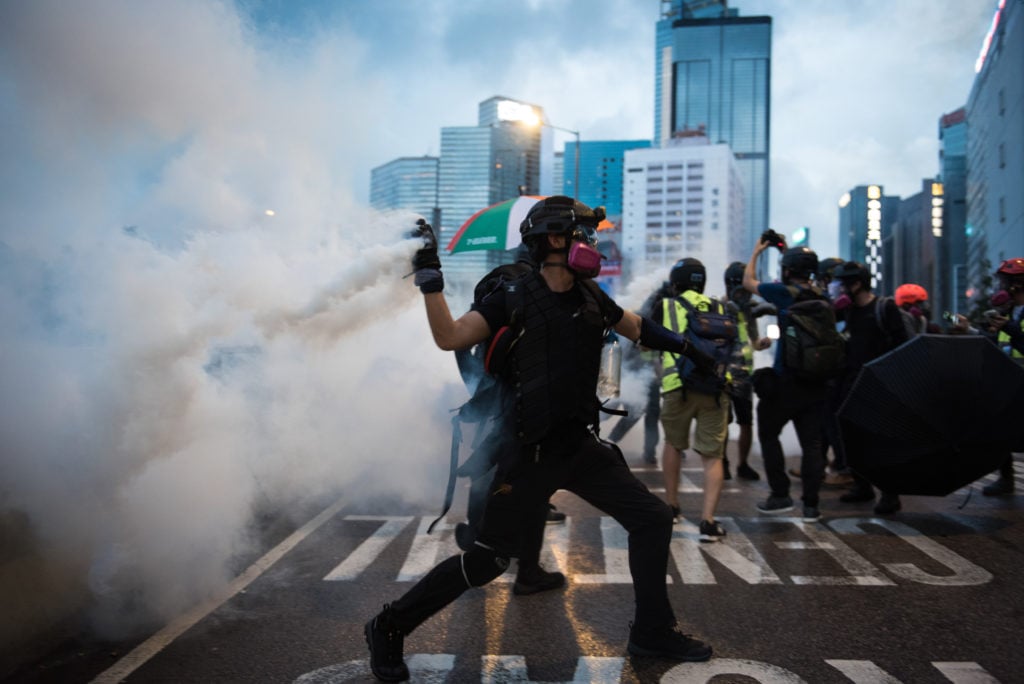
A protester in Hong Kong throws back a
tear-gas round at police during an unauthorized demonstration on
the fifth anniversary of the denial of universal suffrage to Hong
Kongers by the Chinese state. (Photo by Aidan Marzo/SOPA
Images/LightRocket via Getty Images)
Another relationship with mainland China threatened the trade in
a different way this week, as my colleague Eileen Kinsella covered the Trump
Administration’s decision to boost the proposed tariff on Chinese
art and antiquities from 10 percent to 15 percent beginning
September 1.
In Kinsella’s story, Peter Tompa, executive director of the
Global Heritage Alliance, points out that any American dealer would
have to pay the tariff up front to even consign works from
China—likely an expense only the wealthiest sellers could stomach.
This is just one reason that, after the original 10 percent tariff
was announced in June, he argued it could “drive many of China’s
American competitors out of business and further redirect sales to
Chinese dealers serving a mostly Chinese clientele.”
The UK art market didn’t escape chaos last week, either.
Wednesday brought news that newly appointed prime minister Boris
Johnson would suspend parliament for five of the seven weeks
preceding the October 31 Brexit deadline. Achieved through a
procedure known as “proroguing,” the action will—barring pushback
from the courts—leave Parliament precious little time to craft
legislation that could prevent the UK from crashing out of the
European Union without a deal.
As Anna Brady and Anny Shaw captured in the Art Newspaper, any potential
longer-term benefits of that outcome for the British art market,
such as the possible elimination of import taxes on art and
antiquities, would be offset to no small degree by a short-term
avalanche of shuttered ports, stymied customs and immigration
agents, and escalated logistical costs.
Lurking in the background, too, is the specter of Paris
capitalizing on London’s confusion to reclaim its former centrality
to the European art market—a still-remote prospect nevertheless
made at least slightly more plausible by David Zwirner’s decision
to open a permanent space there for want of a “European gallery”
instead of just a “British gallery.”
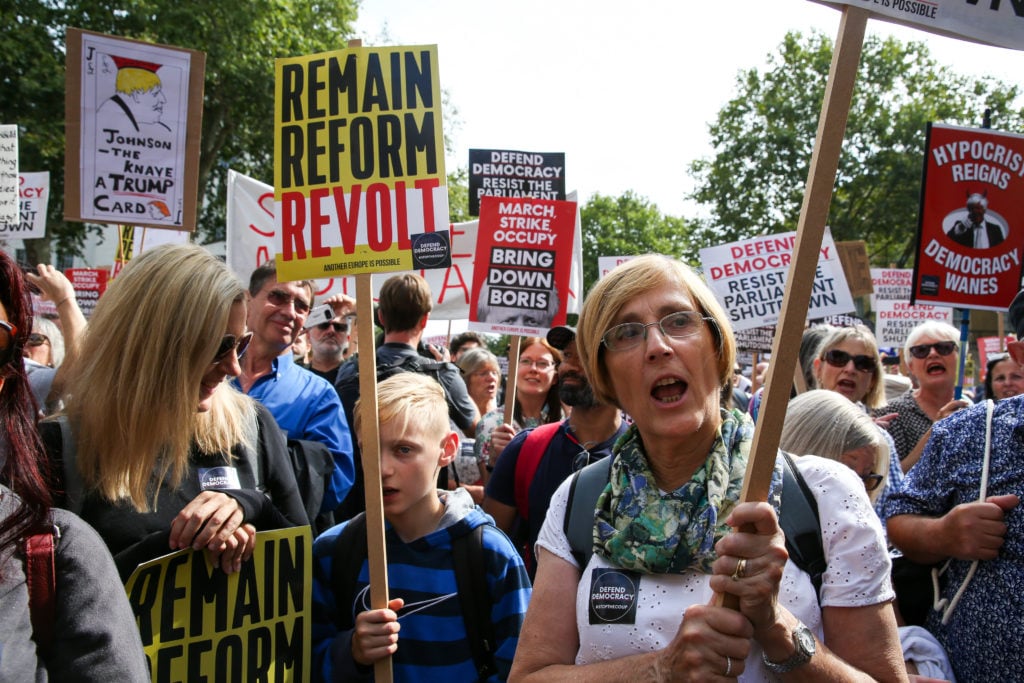
Protesters outside Downing Street in
London demonstrate against British Prime Minister Boris Johnson’s
plans to suspend UK parliament for five of the seven weeks before
the UK is set to leave the EU. (Photo by Steve Taylor/SOPA
Images/LightRocket via Getty Images)
THE BIG PICTURE
It’s standard, and important, to analyze each of these
art-market ruptures in isolation. But what do we do with them in
totality?
Without a doubt, we should begin by recognizing that the state
of the art market is only a sideshow in these events.
According to Bradsher of the Times, activists in Hong
Kong have been attacked with “sticks, baseball bats, and even meat
cleavers” for pursuing democracy. True to form, Trump seems to have
no coherent plan whatsoever in his trade war with China, especially
now that he’s realized it could tip the US economy into
recession—an outcome that would cost thousands of jobs, force
scores of everyday people to make impossible choices about how to
get through the hard times, and potentially torpedo his re-election
chances in 2020.
Much of the same economic strife could descend on a post-Brexit
UK, too, with the added human cost of untold numbers of families
being broken up and lives disrupted by the implementation of even
more restrictive immigration policies (to say nothing of the
potential for violence by xenophobic thugs emboldened by the
far-right’s most widescreen political triumph yet).
These are the places our thoughts and, hopefully, actions should
go first.
Afterward, though, it is worth taking stock of how
these unsettled (and unsettling) times affect the international
cultural landscape, and not just for those of us whose careers and
livelihoods depend on its health.
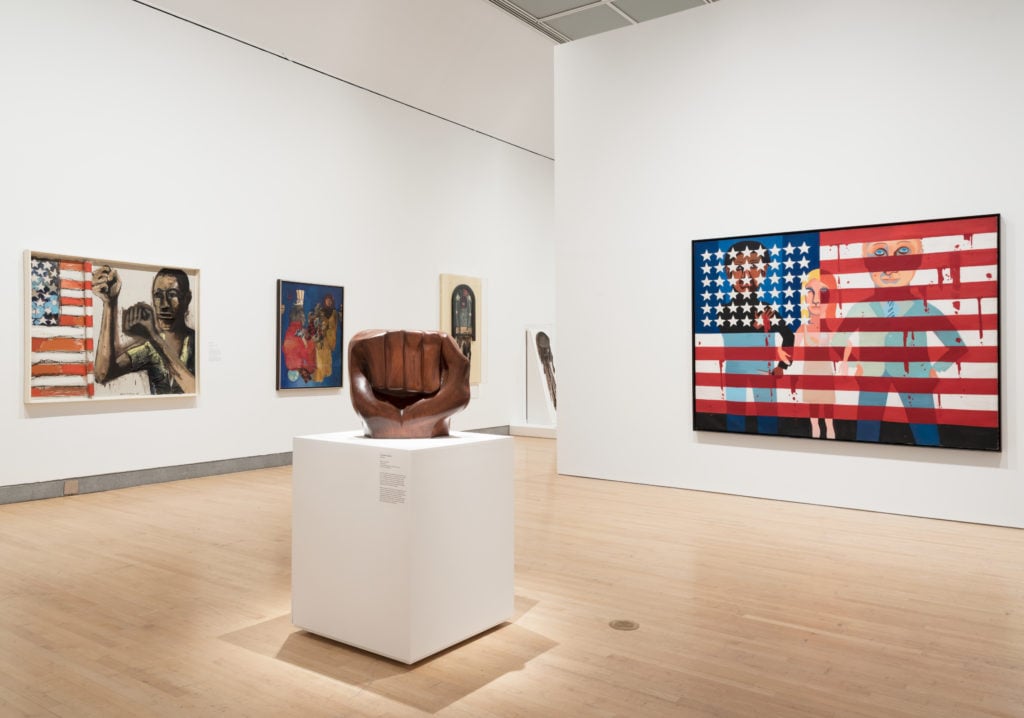
Installation view, “Soul of a Nation:
Art in the Age of Black Power” at the Brooklyn Museum. Photo:
Jonathan Dorado, Brooklyn Museum.
Although they are certainly not the only factors—the internet,
and technology more generally, are frantically waving their hands
for attention here—more open, progressive trade and immigration
policies have been two of the main drivers of cultural progress in
the arts during my lifetime. And it’s worth remembering that these
paradigms have been helping to enlighten the world for hundreds of
years, whether we’re talking about the secondary effects of
maritime shipping or the Silk Road (the literal one, not the dark-web marketplace).
Think about how much intra-art-world progress museums,
collectors, dealers, and educators have made toward recognizing the
importance of artists who live(d) and work(ed) outside the
traditional geographical, ethnic, and gender boundaries of the old
western canon in recent decades. Just as importantly, think about
how much the greater exposure of this work has contributed toward
raising awareness, if not consciousness, of the conflicts and
experiences animating these artists’ lives among
minds outside the art world. From “Radical Women: Latin-American Art, 1960–1985”
to “Soul of a Nation: Art in the Age of Black
Power,” from museums deaccessioning the work of old white men to
fund more diverse acquisitions to the market gravitating in the same direction on its
own, this theme is emerging everywhere (even if not at the ideal speed).
Do we get as many of these gains without the growth of true
global markets for all kinds of goods and services creating the
broadest geographical base of wealthy buyers in history over the
past 40 years? (Remember, a big part of the reason so many young
talents have been elevated, and so many under-appreciated artists
have been rediscovered, is that demand from new buyers and newly
founded institutions for high-quality artworks outstripped the
supply of works by the status-quo greats.) Can we expect these same
gains if buyers, sellers, artists, curators, and educators aren’t
able to easily travel, relocate, or set up nonprofit and for-profit
businesses across the borders of new and developing economies alike
during the same stretch of time?
The answer is unequivocally “no.”
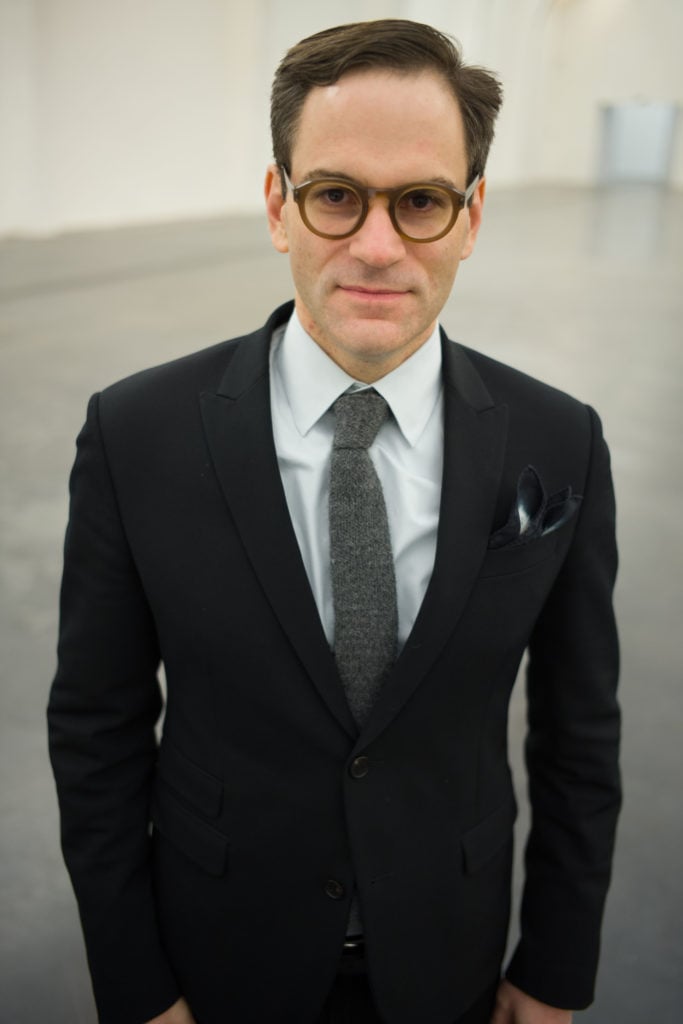
UCCA director Philip Tinari. Photo
courtesy of the UCCA.
TRADE SECRETS
One specific example from this week drives the point home.
Philip Tinari, the director of Beijing’s Ullens Center for
Contemporary Art, mentioned in an interview with artnet News editor-in-chief Andrew
Goldstein that “Picasso: Birth of a Genius,” the first-ever
grade-A blockbuster museum show of Picasso to reach China, only
happened because Beijing officials were willing to—irony of
ironies, vis-à-vis Trump’s trade war—waive a tariff on imported
artwork.
That tariff would have required the UCCA to pay an untenable
€200 million customs deposit to keep so many high-value works
inside the People’s Republic, even though none were going to be
offered for sale. It’s the type of detail no one but a wonk like me
cares about… until, say, a potentially game-changing cultural event
collapses because higher-ups are willing to make it a casualty of a
larger economic assault.
The positive outcomes I’ve referenced represent the cosmopolitan
dream of the art world in action. They prove that commercial
exchange can be cultural exchange, and that people allowed to move
freely between nations can enrich the communities they join just as
much as the inverse.
By no means am I proposing these benefits automatically
materialize from international trade and migration. But if
authoritarian states crack down on their people, if trade wars
erupt, if borders open mainly to push people out rather than to
welcome them in, these transformative cultural gains have no chance
to materialize. Everyone becomes poorer outwardly and
inwardly.
Political realities around the world are threatening to puncture
the bubble of the “global art market” after it’s had only a few
years to take shape. I doubt the damage will be permanent. But it
won’t just be to people’s bank accounts, and there’s no telling how
long it will all take to repair.
That’s all for this week. ‘Til next time remember: Hope floats,
but reality bites.
The post The Gray Market: Why Political Turmoil in the Three
Largest Art Markets Proves That Governments Shape Culture (and
Other Insights) appeared first on artnet News.
Read more https://news.artnet.com/opinion/political-turmoil-art-markets-1640455
Further reading


Leave a comment