
Why Is Everyone Obsessed With Instagram Star and ‘Art Historian’ Caroline Calloway? Her Art Writing Actually Offers Some Insight
In Richard Seymour’s new book on
social media, The Twittering Machine, he makes
the point that Instagram took off in the immediate aftermath of the
Great Recession. This fact, he hypothesizes, has shaped the culture
that has taken root in it, as the fantasies of affluence and
leisure that it trades in gained traction as compensatory fantasy
for a rising generation.
That’s why, I suppose, the relatively minor revelations
about Instagram influencer Caroline Calloway have eaten up so
gleefully much media bandwidth these last few days. A viral
story on The Cut by
Calloway’s former friend and one-time Instagram ghostwriter,
Natalie Beach, has been followed by a tidal waves of explainers, think pieces, an
“Are You a Caroline or Are
You a Natalie?” Buzzfeed quiz, a New York Times
follow-up interview
with Beach, and an NBC news follow-up with
Caroline.
That’s a lot of attention for an influencer with a few
hundred thousand “young, literary, edgy”
Instagram followers. But her content seems to have appeared at the
lower, relatable end of the “Rich Kids of Instagram” world, so her
fall from from fairytale to cautionary tale specifically gives a
kind of vent to that very-contemporary sense that the reality
behind it all was always lowered expectations and a lot of
delusional self-exploitation anyway.
The Natalie Beach piece in The Cut is a memoir version of
“Instagram vs. Real Life,” giving insight into the tawdry but
pretty ordinary details behind Calloway’s rise and fall: a
combination of preposterous outward self-confidence and lack of
inner self-confidence that led her to lean on her friend to
co-author the signature prolix captions to her Instagram; an
Adderall addiction and mental health problems; callousness toward
her less affluent and more vulnerable friend; buying Instagram
followers. Vice had already reported that she
struggled to pay the rent on her very Instagram-able apartment;
yesterday, she announced on Instagram that her father died—which
she took to NBC to talk about, and has continued to turn into
Instagram material in posts. Which either turns your schadenfreude
to sympathy, or adds to your sense that something is deeply, deeply
wrong with this culture.
Art—or a certain Instagram-filtered conception of it—does play a
particular role in this story. Calloway’s Insta bio presently identifies her
as: “Writer, Art Historian, Painter, Cool 


 .” Her very
first Instagram photo is from the Metropolitan Museum, where she
had an internship in
the publicity and merchandising department. She became
Instagram famous for
her photos of life as an American student of art history at
Cambridge University, painting it with romantic colors, gathering a
following she parlayed into a miraculous book contract.
Then she became social-media infamous for spectacularly
failing to deliver the book, and then making a botched bid to
reinvent herself as a creativity guru, teaching fans the secrets of
“living your best life” through Instagram storytelling and flower
crowns. She was brutally pilloried as a “scammer” for (among other
things) selling $165 tickets to her workshops, then cancelling
almost all of them, having never actually booked venues.
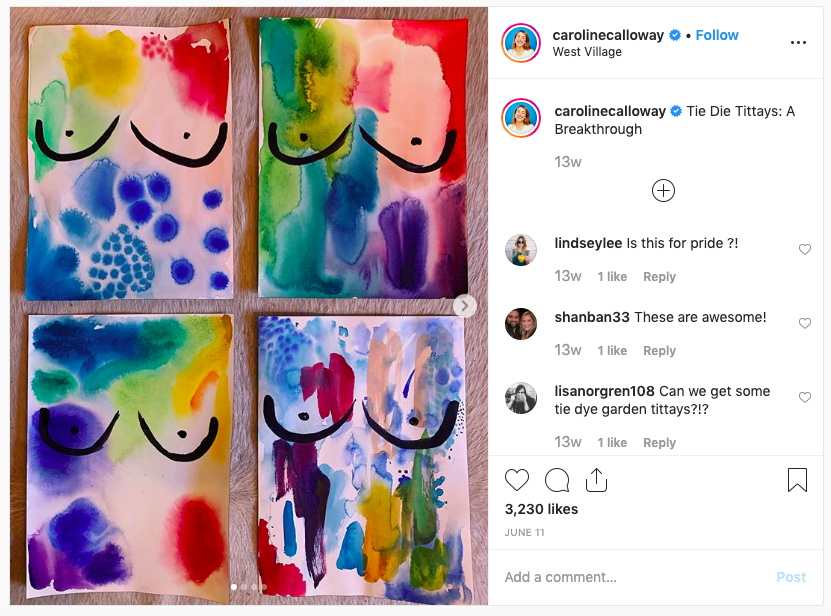
Screenshot of Caroline Calloway’s
Instagram post about her “Tittay Paintings.”
In the months since the internet went into a
furor over Calloway’s bungled tour, she has
tried her hand at selling art directly to her fans, creating
Matisse-inspired cut-outs and a line of “tittay paintings”—canvases featuring
colored backgrounds in a swirly, tie-dyed style, with a pair of
cartoon breasts then drawn in black on top. It’s meme art, designed
to be funny and iterated in bulk. For the superfans, she previously
tried her hand at merchandise, including
shirts with a HOUSE CALLOWAY crest inspired by Cambridge and ball
caps that read “SELF-OBSESSED MESS” or just “ARTIST.”
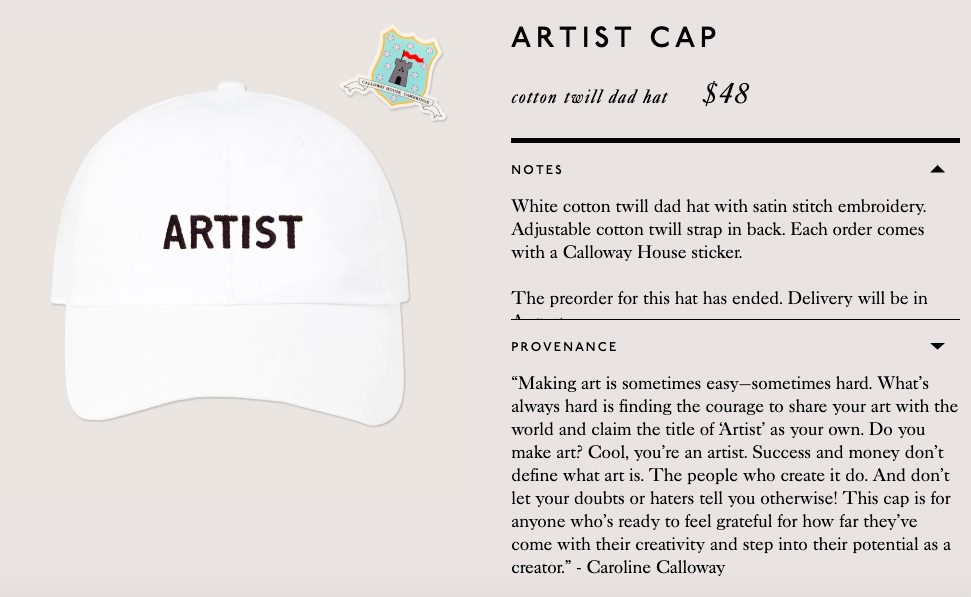
Screenshot of Caroline Calloway-designed
“dad hat” sold through Rowing Blazers.
Unlike Calloway’s more blood-thirsty critics, Beach denies that
her former friend can be described simply as “Anna Delvey with an
art-history degree.” That is, in Beach’s construction, Calloway’s
not just a “scammer,” but actually the victim of how her own real
belief in what she is doing led her to steam roll over reality
(including her own reality). Beach describes the two as being drawn
to writing on Instagram thinking that they were creating the future
of literature.
As for art, here’s Calloway’s Instagram post, from this July, on
what being an “art historian” means to her:
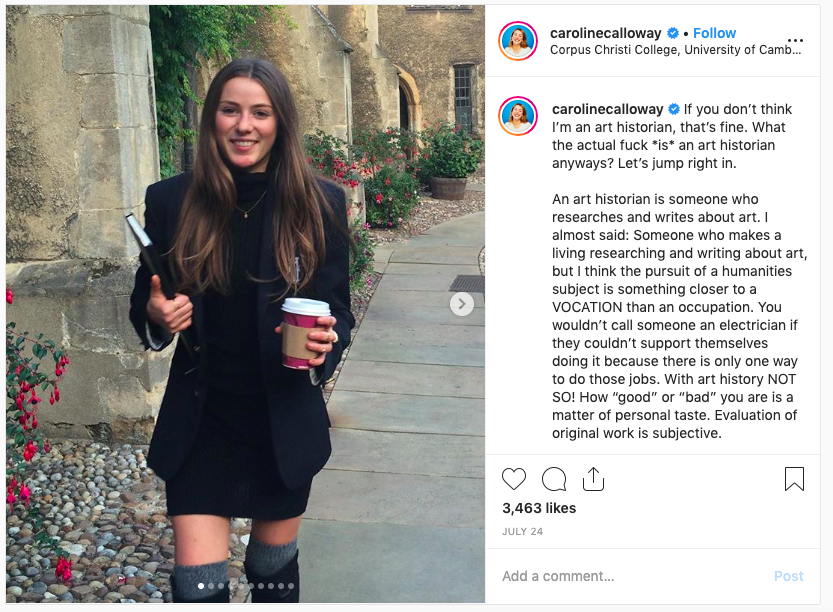
Screenshot of Caroline Calloway’s
Instagram post about art history.
In the full caption (well worth reading if you click through the full
post) she:
- claims she’s an art historian based on the fact that she
“researches and writes” about art, even though she has no real
position: “the pursuit of a humanities subject is something closer
to a VOCATION than an occupation” - then admits that she is a “bad” art historian: “I pluck my
facts from the first page of Google searches and then use my
facility with language to make it spicy!” - then, reversing weakness into strength, postulates that her own
chosen skill-set is actually the future of art history: “I plan on
getting a PhD in Art History someday, but I am going to have to
wait a couple years for Art History departments to catch up with
digital creativity. I want to write a show-stopping thesis about
why social media should be considered Art—capital A.”
The combination of the proudly crass and the wildly sincere is
just fascinating.
In the same post, she mentions that she wrote a paper on
British fashion photographer Cecil Beaton, “Artworks or
Preliminaries? An Evaluation of Cecil Beaton’s
Scrapbooks,” one page of which she posts.
It is all about Beaton as a character, not as an artist: “That
Beaton displayed a propensity towards drama in his real world
interactions is supported by Beaton himself as well as those who
knew him,” Calloway writes. She goes on to quote an observer that
Beaton “made a career of playing make-believe.” She homes in on
“his yearning to always display the most thrilling and attractive
version of himself.”
Calloway’s argument then seemingly continues to look at Beaton’s
practice of scrapbooking and making “visual memoirs” as a venue
where he created for himself a theatrical self-presentation of his
world—making, it seems, a kind of intellectual case for her own
theatrical construction of herself via Instagram feed as art.
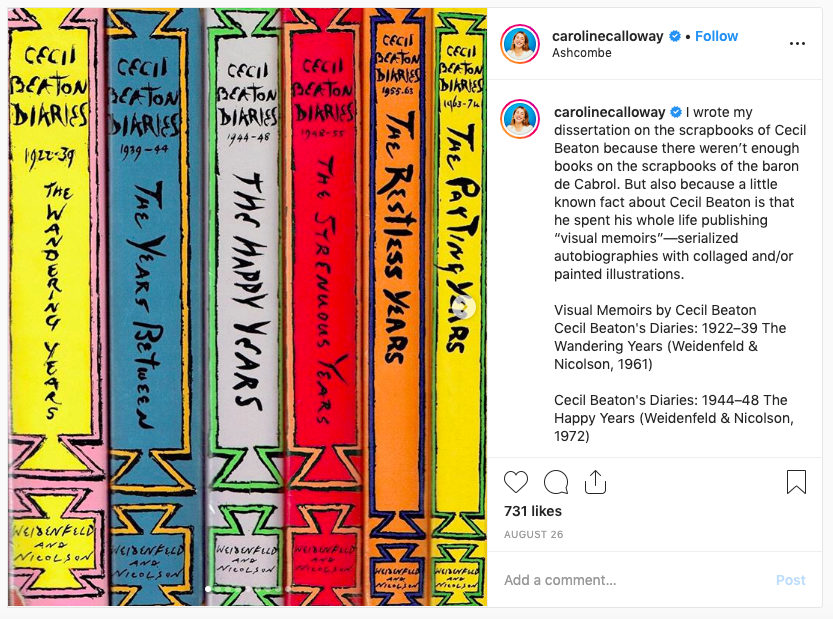
Screenshot about Caroline Calloway’s
research into Cecil Beaton’s scrapbooks.
Calloway also mentions writing an essay for a “chic gallery.”
That is easily discoverable. It is “Salvador Dalí: A Love Story,”
an online essay that accompanied ACA Galleries show of Dalí works from the Pierre Argillet
collection earlier this year (when Calloway was, in fact, in
the thick of very publicly being raked over the coals for her
failed creativity workshops).
The essay is not actually bad, though what purpose it serves the
show is a bit confounding. It doesn’t really seem to value the
Surrealist’s paintings at all (let alone the etchings and
tapestries in the show). As in that snippet about Beaton, she
introduces Dalí’s importance through the legend he has left
behind as a celebrity and a character, then explains:
Dalí even experienced such fame during his own lifetime that he
often treated large groups of friends to dinner by settling the
check with a drawing on the reverse—knowing that even a small
doodle by his hand would likely prevent the check from ever being
cashed.This degree of fame was not accidental. Dalí was arguably the
first modern artist to cultivate a personal brand in any
contemporary sense and his talent for doing so proved remarkably
skillful. Dalí displayed a natural knack for courting controversy
and intrigue. He once duped Yoko Ono into buying a single strand of
his moustache for $10,000 dollars that was, in fact, a dried blade
of grass from a nearby park. It was anecdotes like this which
endeared him to the fashionable set of Café Society in Europe in
the 1950s.
Her big point about Dalí’s Surrealism is that he was able to
spin the gold of artistic celebrity into getting away with not
having to pay for anything!
This is, it might be worth adding, a very strange read on art
history. Artistically, Dalí’s creative heyday was before this time,
mainly before he was expelled from the Surrealist movement in 1939.
“Having proclaimed himself a genius while in his 20’s, Salvador
Dalí went on to promote this notion with such relentless conviction
that the egotist eventually overshadowed the artist,” Alan Riding
once wrote of the late-period Dalí.
“By the time he died in 1989, leaving hundreds of signed sheets of
paper to spawn a fake Dalí industry, many in the art world had
turned against him.”
It’s as if the ideal of Instagram art based in “making a career
of playing make-believe” that Calloway has discovered—or that she
is a symptom of, really—allows you to cut straight to being the
late, dysfunctional, celebrity-spectacle Dalí without having to
pass through the burdensome achievement of painting
the Persistence of Memory.
There’s a detail reported in one of the accounts of
Calloway’s creativity workshops, the ones where she promised to
teach the “secret of flower crowns.” At the end, she is said to
have whispered in the ear of attendees: “The secret to flower
crowns is there is no secret.”
That, of course, is hilarious—but also actually an honest, if
unintentional, thesis about a kind of present-day aesthetic
philosophy. And clearly it is also a kind of curse too.
The post Why Is Everyone Obsessed With Instagram Star and
‘Art Historian’ Caroline Calloway? Her Art Writing Actually Offers
Some Insight appeared first on artnet News.
Read more https://news.artnet.com/opinion/caroline-calloway-art-1649530
Further reading


Leave a comment