
How Teen Climate Activist Greta Thunberg Inspired the Art World to Address the Biggest Problem Facing Humanity
Later this month, the
16-year-old Swedish climate activist Greta Thunberg will visit the
UN’s Climate Action Summit in New York. As part of the convention,
she has been invited to visit the British artist Michael Pinsky’s
work, Pollution
Pods, which will be
installed in front of the UN building and
presents six
interconnected, climatically controlled chambers that mimic the
relative air quality in cities around the world, from London to
Beijing.
Since the teenage activist began
a humble school strike for the climate a year ago, she has quickly
become a household name—and an inspiration for many in the art
world. Her message—that
we need systemic action to protect our environmental future—has
gained enough momentum to earn itself a
name: the “Greta
Thunberg Effect.”
In the culture world, she has inspired installations
like Pinsky’s; portraits by
the painter Elizabeth Peyton and the photographer Hellen van Meene;
a mural by the street
artist Jody Thomas; a multimedia work by Justin Brice
Guariglia; and an exhibition by the curator Francesca
Pietropaolo.
“What is remarkable about Greta
is that she suddenly became a huge presence slightly over a year
ago and now it seems like she has been there forever,” Pinsky tells
artnet News.
While youth movements have a
long history—Pinsky remembers protesting an exhibition that
promoted nuclear power at the National Museum of Scotland when he
was 11 years old—something about Thunberg has managed to capture
the zeitgeist in an unprecedented way.
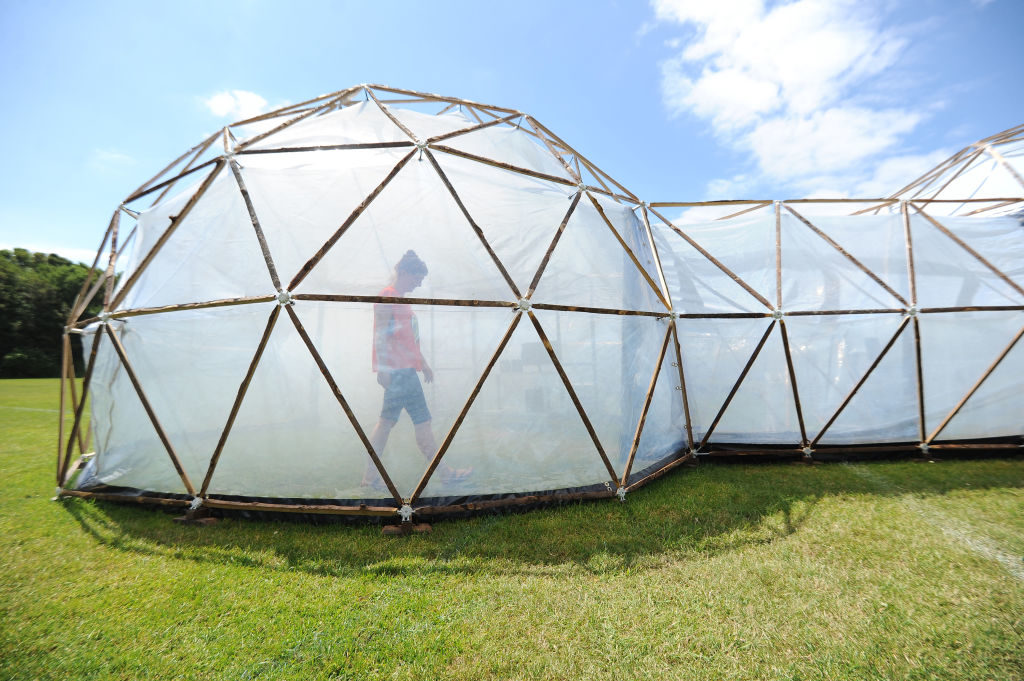
Michael Pinsky’s Pollution Pods.
Photo by Finnbarr Webster/Getty Images.
The Greta Thunberg Effect
Given Thunberg’s clear
resonance, it is no surprise that she has inspired not only
artists, but also curators.
At this year’s Venice Biennale,
where climate change is a major theme, the Italian curator Francesca
Pietropaolo co-organized a show that explores the issue
with artist and curator Phong Bui. And Pietropaolo,
perhaps unsurprisingly, cites Thunberg, who declined to be
interviewed for this article, as an influence.
“Greta is an inspiring member of the new generation,”
Pietropaolo tells artnet News. “Her voice has become an important
catalyst for change.” Pietropaolo is particularly interested in the positive tone
of Thunberg’s activism, which is in contrast to
the apocalyptic,
spectacular tone of so many others.
“I think that Greta’s activism
could also inspire a reflection, from a curatorial perspective, on
the making of contemporary art exhibitions, taking into
consideration their very process in order to evaluate their
environmental impact,” Pietropaolo
says. Curators could be
inspired, for example, to study and reflect upon the environmental
footprint they leave when they do their work. “I think of Venice in
particular, with its fragile reality.”
The practical impact of Thunberg’s voice is not limited
to Pietropaolo. The Dutch
photographer Hellen van Meene, who shot Thunberg for the cover of
TIME magazine, tells artnet News that after they met,
she decided to travel
to London and Berlin via train for a later work trip, rather than
to take an emission-heavy airplane.
“There has been a palpable
change of mood in the arts sector, with a real sense of urgency and
a desire for action being driven by artists and the wider public,”
the director of Tate Modern, Frances Morris, tells artnet
News.
The directors of the Tate
galleries recently declared a climate
emergency and laid out a
plan to improve the institution’s commitment to sustainability,
aiming to reduce its carbon footprint by 10 percent within four
years.
“An emergency of this magnitude
can easily feel overwhelming, so the voices of people like Greta
Thunberg have an important role to play,” Morris
explains. “They help provide
focus and inspiration, particularly for a younger generation whose
lives will be profoundly shaped by this crisis.”
Similarly, the curator Lucia
Pietroiusti, who organized the prize-winning Lithuanian pavilion in
Venice, has introduced a General Ecology
project at the
Serpentine Galleries in London, which has committed to reducing its
carbon footprint. In 2020, it will be dedicating its entire 50th
anniversary year to ecological concerns.
At the same time, Thunberg and others have called upon
institutions to break their partnerships with fuel companies such
as BP. While Tate Modern ended
a years-long partnership with the oil giant BP in 2017, others have
been slower to make the transition, and Thunberg’s voice is
amplifying the pressure.
“… I do not wish to be associated with BP
any more than I would with an arms dealer, a tobacco salesmen or
any company or individual who willfully destroys the lives of
others alive and unborn.”This is what a role model looks like in 2019. https://t.co/Ts4x51Skdg
— Greta Thunberg (@GretaThunberg) June 26, 2019
The codirector of the activist
group Culture Unstained, Chris Garrard, tells artnet News that even
through a tweet, Thunberg has played a powerful role.
“In just the past few weeks, the
directors of the British Museum, the National Portrait Gallery, and
the Science Museum have endorsed BP and Big Oil,” he says. “The
impact of Greta’s activism has been that their oil sponsorship
deals now look out of date and out of step with the wider sector,
and will only do damage to their reputations.”
"background: #FFF; border: 0; border-radius: 3px; box-shadow: 0 0 1px 0 rgba(0,0,0,0.5),0 1px 10px 0 rgba(0,0,0,0.15); margin: 1px; max-width: 540px; min-width: 326px; padding: 0; width: calc(100% - 2px);">
View this post on Instagram
Actions and Words
Images of the young Swedish
woman, meanwhile, have become a stand-in for her
message.
Last spring,
Peyton presented a picture of
Thunberg at Sadie Coles
HQ in London. But the visibility of that work paled in comparison
to a massive, 50-foot mural of Thunberg made in Bristol that
depicts her submerged
in rising floods, with the waterline raised high enough to sabotage
her most powerful weapon: her mouth.
“When someone gives you a wall,
they’re giving you a stage, an opportunity to step up and make an
impact,” the street artist who created the mural, Jody Thomas,
tells artnet News. When he landed on the idea of painting the young
climate activist, Thomas says “it just felt right.” He says his
proposal for the wall received the fastest approval of any mural
project he has ever done.
His image soon went viral, even
making it as far as Thunberg’s own Instagram page, where the
activist adopted it as her profile picture. “The fact that the
piece went global is testament to the fact that street artists and
artists can play a role in visualizing a tricky and contentious
issue at the moment that is very much on the minds of everyone,”
Thomas says.
Thunberg’s words have also
served as fodder for artists. The US artist Justin Brice Guariglia
included sections of a speech she delivered at the World Economic Forum in a
courtyard installation presented at London’s Somerset House in the
spring. The work, Reduce Speed Now!, was
made of nine solar-powered highway message boards, which presented
texts about climate change from Thunberg, Bruno Latour, Zadie Smith, and other
philosophers, anthropologists, and poets.
“When Greta came along, she was
like a breath of fresh air,” Guariglia tells artnet news.
“Here was this young woman
who was essentially like the Lorax,” he says, referring to the Dr.
Seuss character who speaks on behalf of trees. “She is
speaking up for the next generation, the people that don’t have a
voice.”
Guariglia says that although he
has been making art about climate change for the past decade, it
takes an “exceptionally good communicator” like Thunberg to really
convey the urgency of the problem.
“When I think about my work,
especially when I’m working with text, I’m thinking in that same
mode,” Guariglia says. “How can I be really pithy? How do you
communicate that we’re heading towards 100 million-plus climate
crisis refugees? How do you communicate these ideas in ways that
the general public would actually be concerned?”
In Guariglia’s eyes, Thunberg
successfully gives people new language with which to discuss these
“very important, very urgent, very existential” issues.
The post How Teen Climate Activist Greta Thunberg Inspired
the Art World to Address the Biggest Problem Facing Humanity
appeared first on artnet News.
Read more https://news.artnet.com/art-world/greta-thunberg-climate-art-1645336
Further reading


Leave a comment