
The Notre Dame Fire Spread Lead Contaminants Around Paris. Now, French Authorities Are Accused of Failing to Act
Five months after the fire at Notre Dame, toxic lead particles
released from the cathedral are threatening public health—a risk
French authorities continue to downplay. The devastating April 15
blaze raged unchecked for half an hour before the fire
department was called, leading to the collapse of the cathedral’s
ceiling and spire, which was clad in 460 tons of lead tiles.
Now, confidential documents seen by the New York
Times show that the authorities knew within 48 hours
of the fire that lead pollution could pose a serious problem. The
paper’s investigation describes “a failed official response” that
has put public health at risk, prioritizing instead the
reconstruction of the historic building on the Île de la
Cité.
“The state was afraid to make people afraid,” Anne Souyris, the
city’s deputy mayor in charge of health, told the Times. “They thought that
they would protect people by not communicating about the lead
issue.”
National and regional agencies delayed issuing warnings and
didn’t begin testing lead contamination levels at nearby schools
until a month after the fire. A full decontamination of the
neighborhood of the cathedral site wasn’t completed for four
months. A nearby daycare at a police station was shut down in the
aftermath of the fire, but other schools and daycare centers in the
area remained open.
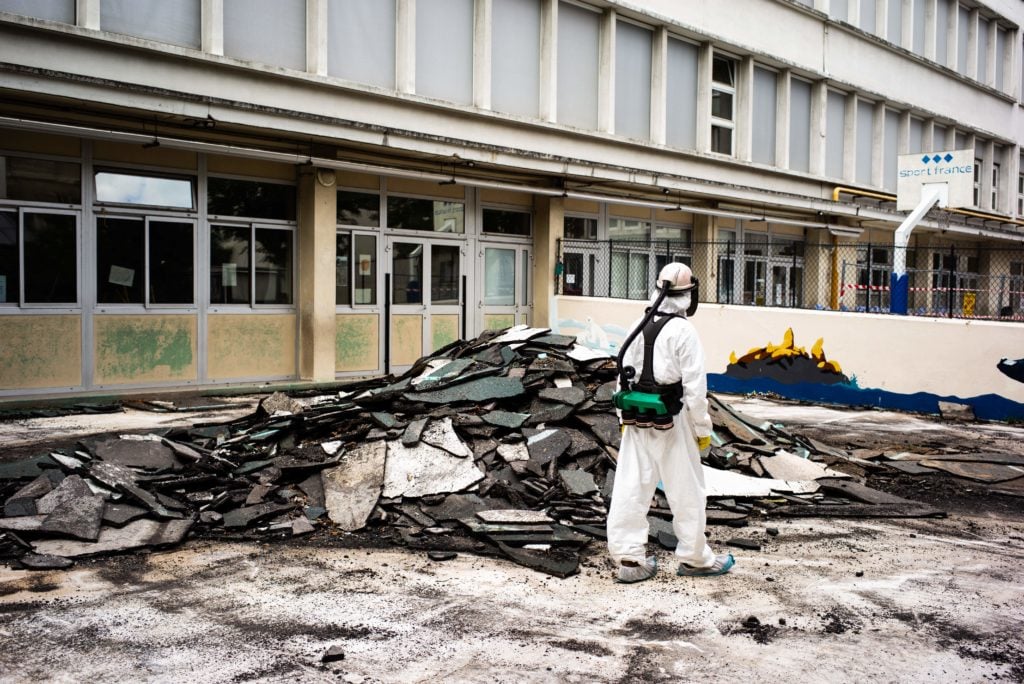
A worker stands next to asphalt waste
materials as he takes part in a clean-up operation at Saint Benoit
school near Notre-Dame cathedral in Paris. Photo by Martin
Bureau/AFP/Getty Images.
More than 6,000 children under age six live a half-mile or less
from areas that have tested positively for unsafe lead levels, but
the government has not called for mandatory testing of children.
Ingesting lead can cause serious cognitive damage to young children
and interfere with the development of the nervous system.
“What happens with lead over centuries and centuries is that the
surface converts basically to lead white paint, lead hydroxide, and
lead carbonate,” said George Wheeler, a research scholar at New
York’s Museum of Metropolitan Art, during a presentation last week
at the International Foundation for Art Research
in New York. “That material got flaked off in the fire into very
tiny particles that have covered virtually every surface—it’s the
same problem that we have with lead paint in buildings in
Brooklyn.”
Contamination of nearby parks remains the biggest risk, as lead
levels are 60 times over the level that is considered safe. Tests
results of some nearby schools also show lead levels that are
alarmingly high, although the authorities insist they are safe for
children.
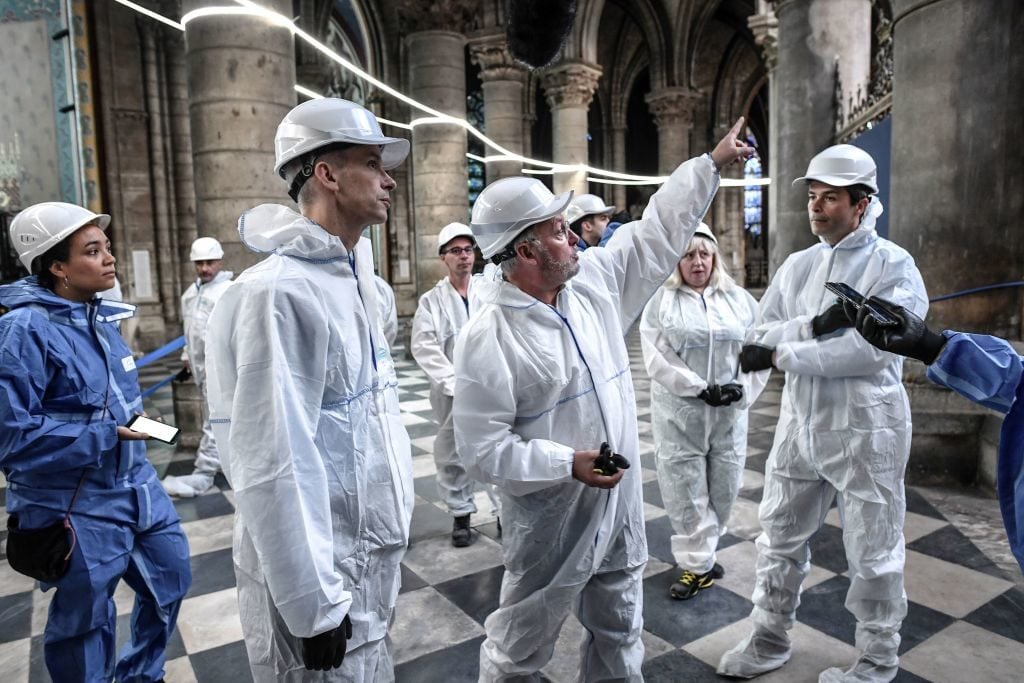
French Culture Minister Franck Riester
(R) speaks with French chief architect of historical sites Philippe
Villeneuve (L) as they visit Notre Dame during preliminary work.
Photo by Stephan de Sakutin/AFP/Getty Images.
“This is a great concern in the schools in the Île de la Cité
and the neighborhood around it because the dust has spread,” said
art history professor Michael T. Davis, the chair of
architectural studies at Mount Holyoke College, during the talk in
New York.
At even greater risk are the laborers restoring and rebuilding
the site. Despite lead levels of up to 2,300 times the regulatory
threshold, restorers and cleaning crews were not initially given
lead exposure training. They set to work without masks, gloves, or
other safety gear, not taking the necessary measures to protect
themselves from the toxins. In July, authorities halted
work. At the same time, an environmental protection group
filed a lawsuit against
Paris authorities for failing to issue sufficient warnings about
the lead contaminants.
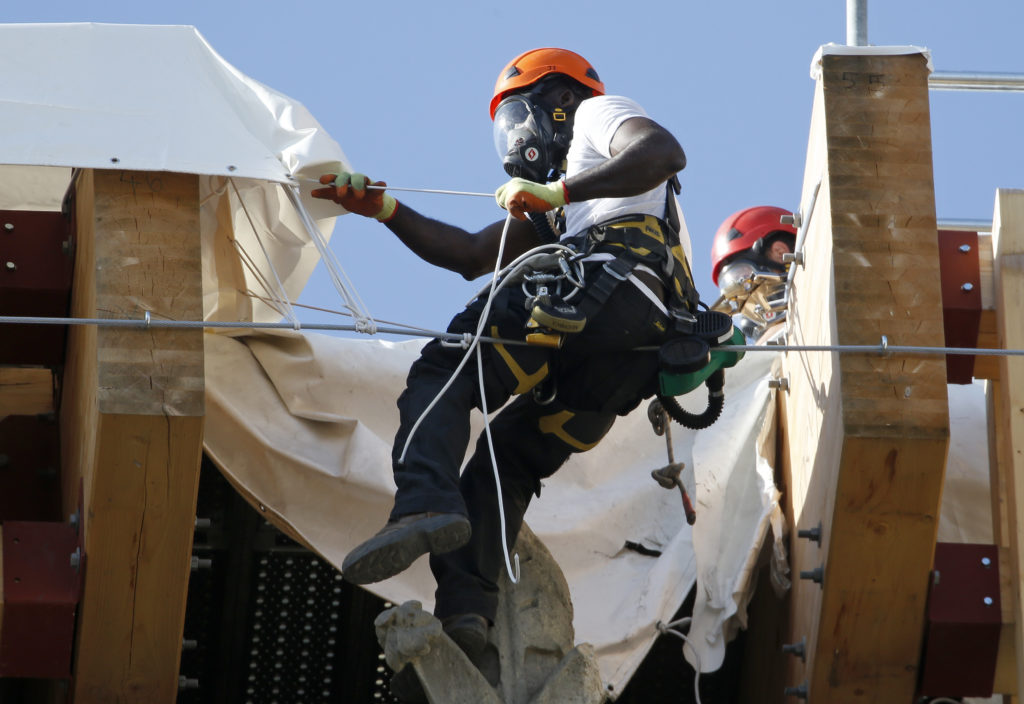
Professional mountain climbers wearing
masks work on a part of Notre Dame cathedral following the massive
fire, on September 6, 2019 in Paris. Photo by Chesnot/Getty
Images.
Beyond the risk to themselves, workers who don’t decontaminate
their bodies and clothing after leaving the site run the risk of
spreading lead dust to their homes and families. So far, three
workers have been shown to have unsafe lead levels in their
blood.
“Eventually the core emergency teams had to resume work because
there were still structural problems,” said Lindsay S. Cook, a
visiting art professor at Poughkeepsie’s Vassar College, at the
talk. “My colleagues who have gone into the building are
wearing Tyvek suits and respirators. They take showers when they
come out of the building—that wasn’t happenings the first few weeks
after the fire.”
The post The Notre Dame Fire Spread Lead Contaminants Around
Paris. Now, French Authorities Are Accused of Failing to Act
appeared first on artnet News.
Read more https://news.artnet.com/art-world/notre-dame-lead-contaminants-1651621
Further reading


Leave a comment