
‘You Have to Create the Market’: Dealer Mariane Ibrahim on Moving to Chicago and Promoting Artists From Africa, Its Diaspora, and Beyond
Mariane Ibrahim does not fear change. Roughly seven years after
founding her namesake gallery in Seattle, Ibrahim and her program
officially begin their next act in Chicago this Friday, September
20, during the latest edition of Expo Chicago. Her new 5,000
square-foot space in the city’s West Town neighborhood effectively
doubles the square footage of her gallery in the Pacific Northwest,
while her presence further strengthens the Windy City’s
increasingly influential standing in the international art
market.
But like several gallerists who have gone on to great success,
Ibrahim didn’t grow up dreaming of a career as an art dealer. She
was born in Nouméa, the capital city of the French territory of New
Caledonia, about 1,000 miles northeast of Brisbane, Australia. Her
family moved to Somalia, where both her parents grew up, when she
was five years old, then relocated to France three years later. Her
early transitions through so many different cultures gave Ibrahim a
keen understanding of how layered identity can be.
“I usually avoid the question, ‘where are you from?’, because
what does that mean anymore, to be ‘from’ a place?” she mused to
artnet News in the lead-up to her Chicago unveiling.
Today, Ibrahim’s program compels her to act as something of an
ambassador for nuance and complexity in an art world still prone to
generalization. While several of the emerging artists she
represents hail from African countries or are members of the
African diaspora, Ibrahim emphasizes that they—and by extension,
her gallery—have much more to offer than simplistic regional or
heritage-based labels could ever contain.
“I don’t see artists as ‘African artists.’ That’s why I’m
comfortable speaking on their behalf,” she says. “It’s a big
continent. It has influenced the entire world in art, music,
history, performance, and dance.” To condense such a rich variety
of nations, cultures, and traditions into a handful of
identity-based descriptors would be “very dangerous and
opportunistic.”
Challenging as these conversations are, Ibrahim says she is
excited to have the opportunity to push them forward—especially
during a period when so many art institutions and collectors are
finally beginning to admit how narrow their purview has been.
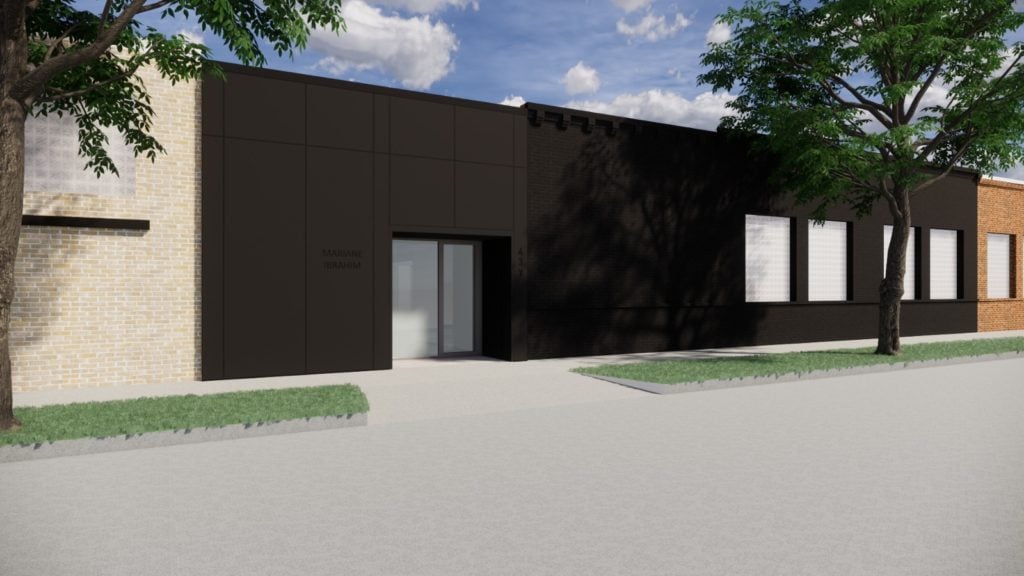
Architectural rendering of the new
Mariane Ibrahim Gallery in Chicago. Courtesy of Mariane Ibrahim
Gallery.
The Long and Winding Road
After studying in the UK and Canada, Ibrahim moved to Paris to
begin a career in marketing and advertising. She also briefly
flirted with the prospect of becoming a fine-art photographer
before pivoting into collecting what she deems “small” works of
contemporary art in the mid-2000s.
Looking back, she sees her photography and her collecting as
complementary expressions of a central passion, the same one that
eventually compelled her to launch her gallery: to correct the lack
of representation of the many artists of Africa and beyond.
She mentions the Malian photographer Malick Sidibé, best known
for his arresting black-and-white portraits of proud, stylish
everyday citizens in Bamako in the 1960s, as an early
inspiration.
“When my mom was a young woman, she and her sisters would take
film stills like that,” Ibrahim recalls. “But [Sidibé’s] photos
have a little twist. They have composition, layers. His works were
performances.” Ibrahim wanted more art with such vision and energy,
but in Paris, she collided with the same obstacle again and
again.
“Whenever I was enthusiastic about it, I’d always receive the
same answer: ‘oh, we don’t have a market,’” she says. Although this
stance frustrated her as a viewer and buyer, it was “music to [her]
ears” as a marketer and advertiser. To do something truly
game-changing, she knew, “you have to create the market.”
Ibrahim and her husband moved to Seattle in 2010, but it would
take another two years before she opened her gallery there. When
she did, the endeavor was mission-driven. “It has never been about
making money,” she says. “For me and many other people, there
cannot be any civilization without art. It is your third eye.” She
now sees her vocation as a dealer as a result of “destiny” because
of how it unites different aspects of her life: her experience
moving between different cultures, her skills as a marketer, her
passion for contemporary art, and her belief in the way that images
can enrich and expand lives.
“Anybody can open a gallery,” she says. “It matters how you
build it… How do you stay consistent, relevant, and creative? How
do you keep the trust of your artists? How do you excite them?”
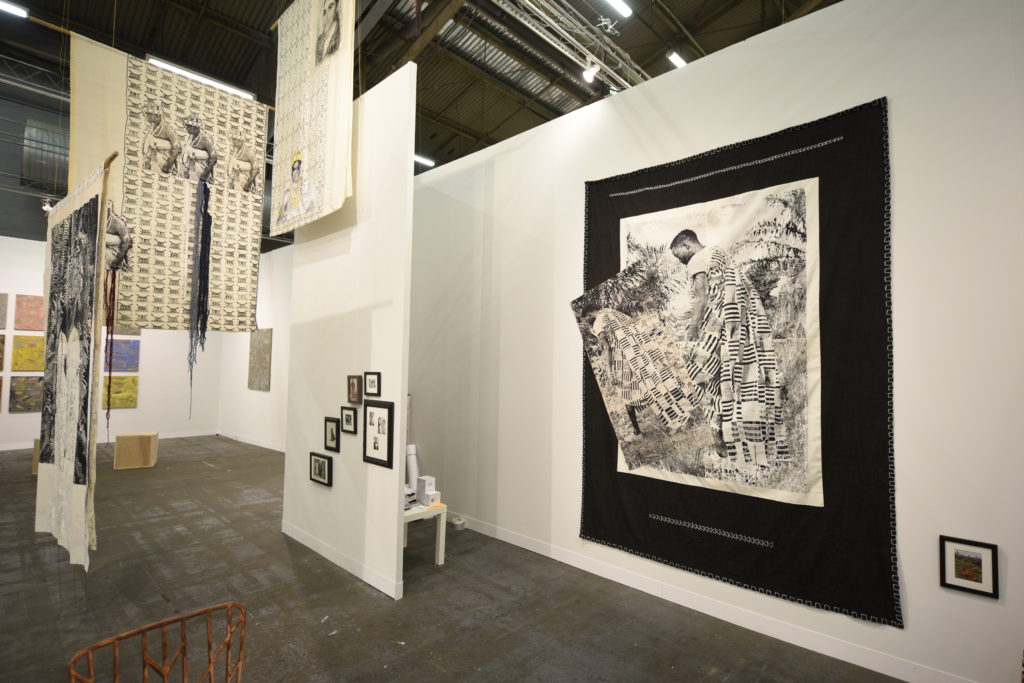
Mariane Ibrahim Gallery’s booth,
“Unraveled Threads,” featuring the work of Zohra Opoku, won the
Armory Show’s inaugural Presents Booth Prize. Courtesy of Teddy
Wolff/the Armory Show.
Community Development
The original location of Mariane Ibrahim Gallery made answering
these questions especially challenging. Because of Seattle’s
position outside the traditional network of international art
capitals, Ibrahim relied on travel and other forms of outreach to
painstakingly build a community of like-minded collectors,
curators, artists, and other dealers.
A central plank in her strategy was to exhibit far and wide on
the art-fair circuit, where she frequently sought to curate stands
that made statements. At the Seattle Art Fair in 2016, her booth
featured artist Clay Apenouvon’s installation Film Noir
(2016), which involved draping the booth’s exterior in faux film
strips made from black trash bags sliced into long ribbons. By
design, the work partially hid other works on view inside as a
comment on how artists of African heritage have historically
been treated as invisible by the art establishment. The
following March, Ibrahim won the first Armory Show Presents Booth
Prize for a stand centered on Zohra Opoku, whose work was literally
sewed together from photographs and fabric belonging to her family
members from around the world.
Fellow Chicago dealer Monique Meloche recalls her reaction to
Ibrahim’s Armory stand as being simply, “who is this woman with
this fantastic program?” Later, Ibrahim consciously embraced
collaborations with like-minded dealers as her profile rose.
Most notably, Sean Kelly approached her at a fair in 2017 to
express his admiration for her booth. The conversation eventually
turned to what Ibrahim called her “dream exhibition”: a survey of
textile-based works by contemporary artists from nations across
Africa, capturing the breadth and depth of the ways cloth informs
ideas around geography, politics, and gender.
A few days later, Kelly came back to Ibrahim. “He said, ‘Let’s
do your dream show at [my] gallery.’” The end result became
“Ravelled Threads,” organized by Ibrahim and presented at Kelly’s
main New York space last summer. The project reinforced her belief
that mutually beneficial partnerships are the best path forward.
“You can’t be successful if you don’t collaborate,” she says.
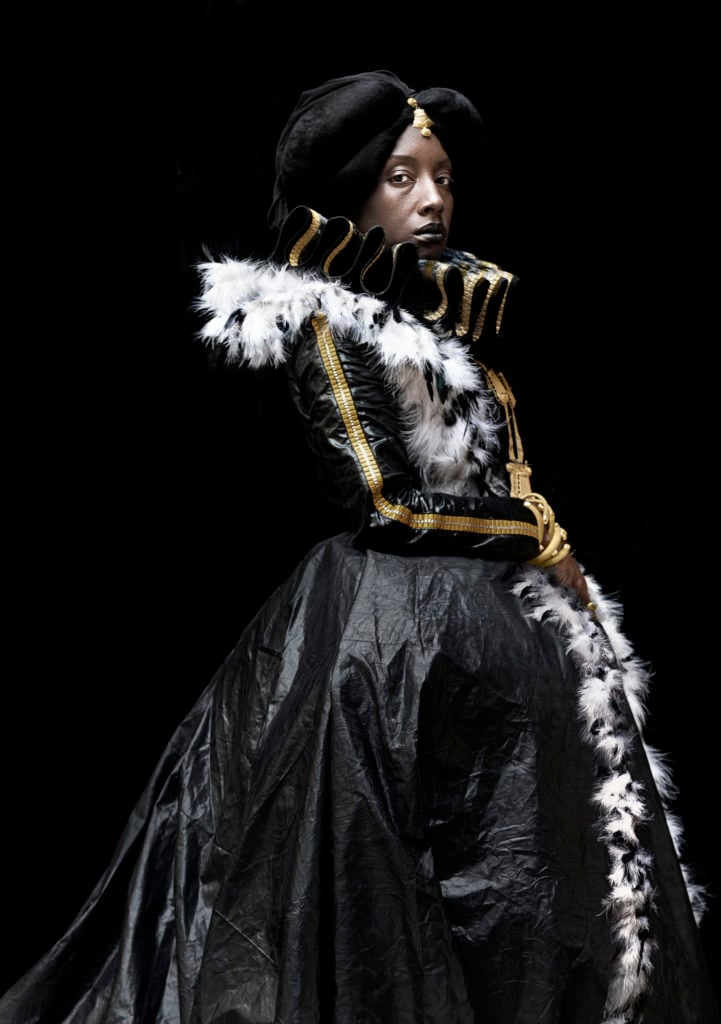
Ayana V. Jackson, Sea
Lion (2019). Courtesy of Mariane Ibrahim Gallery.
A Second Act in the Second City
Still, even collaboration has its limits. As she approached her
seventh year in Seattle, Ibrahim concluded that the only way for
the gallery to grow properly was to relocate. The question was to
where.
Ibrahim says she seriously considered Los Angeles and Mexico
City, where she had excellent experiences as an exhibitor at Zona
Maco. New York also entered her mind—but only for “half a second,”
she says. She simply didn’t believe the physical spaces or
neighborhoods of New York were the right fit.
Then there was Chicago. Although Ibrahim had never lived there,
she says her decision to move to the US was “partially connected
to” the election of Barack Obama, who adopted Chicago as his
home.“I was motivated to see a new America,” Ibrahim says. So
powerful was the kinship she felt with the 44th President that her
gallery branding uses the same font as Obama’s campaign
messaging.
Symbolism aside, Ibrahim ultimately chose Chicago for its unique
combination of advantages. “When you come from Europe, Chicago is
the epitome of an American capital,” she says, citing the Windy
City’s diversity, progressive politics, and rich cultural history.
(According to estimates by the US Census Bureau, Chicago has been
majority-minority since July 2018, and it remains the country’s
third-largest metropolis by population.) Chicago’s status as a
major domestic and international travel hub only advances its case,
making it easily accessible to collectors and artists in Ibrahim’s
international network.
And that network is now local, as well. Ibrahim’s gallery
is not only immediately next door to Monique Meloche (“I could
drill a hole in the wall and we could pass each other
notes,” Ibrahim jokes); it’s also only a short walk away from
Corbett vs. Dempsey, the Gray Warehouse (which exhibits the
contemporary program of blue-chip dealer Richard Gray), and Chicago
stalwart Rhona Hoffman, among others. Slightly over a mile further
(albeit in opposite directions) are the highly respected Kavi Gupta
and fast-rising Patron galleries, to name just a few.
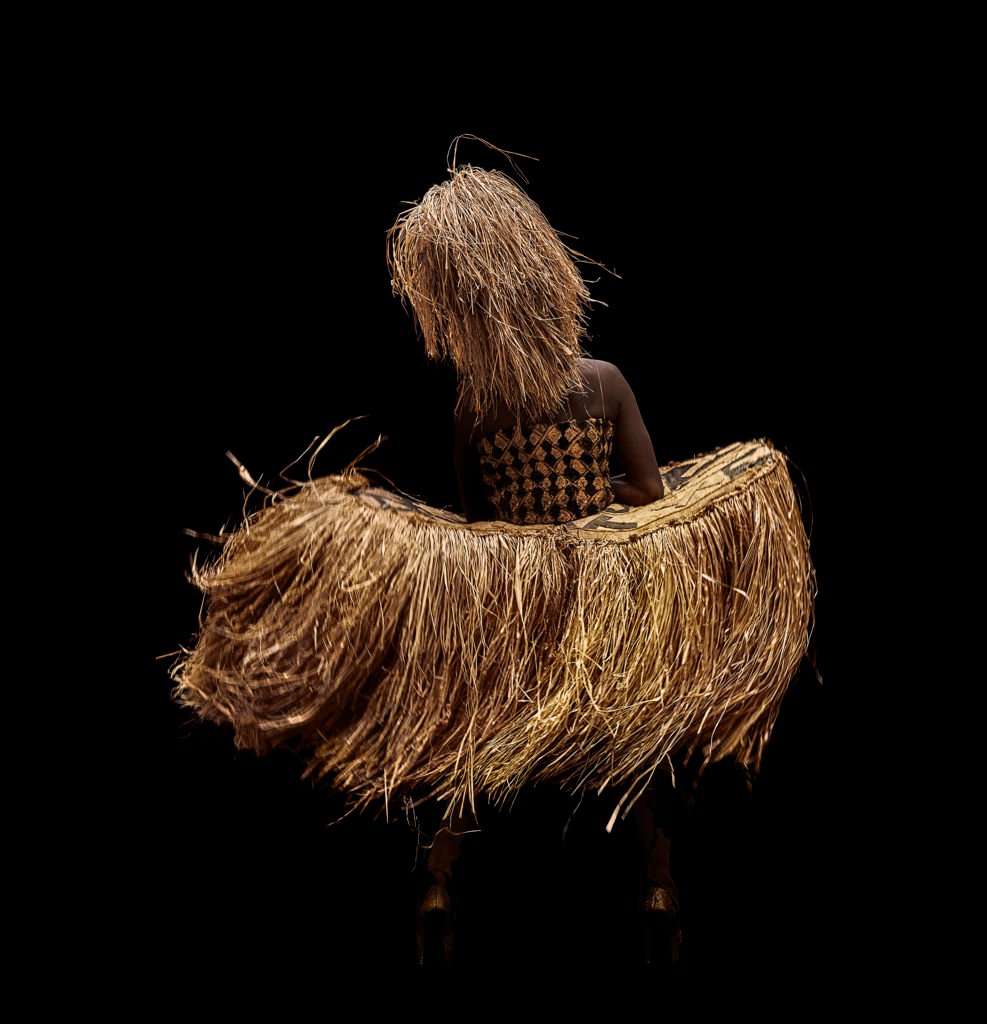
Ayana V. Jackson, The
Self-forgetfulness of Belonging Would Never Be
Mine (2019). Courtesy of Mariane Ibrahim Gallery.
Setting a Tone for the Gallery
Ibrahim’s inaugural exhibition will be Ayana V. Jackson’s “Take
Me to the Water,” a survey of the artist’s work interrogating two
centuries of colonialism in photography. Jackson will also unveil a
new body of work embedded in the mythologies and speculative
fictions of Africa and the African diaspora. The show takes its
title from the latter works, which are large-format photographs
depicting “aqua-humanoids” embodied by Jackson and derived from
tales of water spirits, such as those connected to women thrown
overboard from transatlantic slave ships.
Ibrahim says she thought of the “unbelievably talented” Jackson
immediately when it came to decide her first Chicago show. “It had
to be a female artist, and also a black American artist to add a
layer of responsibility [to] themes of identity, displacement, and
the roots of American capitalism,” she says. “This is work that is
going to inform the direction of the gallery.”
In their third solo exhibition together, Jackson credits Ibrahim
for her ability to walk the fine line that great dealers walk.
“Mariane enjoys being privy to my process of making the work, but
does not insert herself. I think she intuitively understands how
her artists work,” Jackson wrote in an email. “It’s a delicate
dance and she has the right rhythm.” And with a 10-year lease on
her new gallery and nearly a decade of hard-won momentum behind
her, there’s no telling how much ground Ibrahim will eventually
cover.
The post ‘You Have to Create the Market’: Dealer Mariane
Ibrahim on Moving to Chicago and Promoting Artists From Africa, Its
Diaspora, and Beyond appeared first on artnet News.
Read more https://news.artnet.com/art-world/mariane-ibrahim-gallery-chicago-1652671
Further reading


Leave a comment