
Sorry, Anish Kapoor: MIT Scientists Made the Blackest Black Ever Invented, and an Artist Just Used It to Do Something Magical
In a remarkable new mashup of art and science, an artist has
used the blackest black ever created to make a 16.78-carat yellow
diamond completely “disappear.” The result of the intensive 5-year
long project called The Redemption of Vanity, the
result currently sits on view in an unlikely, but—as explained to
artnet News—very fitting venue: the New York Stock Exchange on Wall
Street.
The project is a collaboration
between German-born, Boston-based Diemut Strebe, an artist-in-residence
at the MIT Center for Art, Science, and Technology, and Brian Wardle, professor of aeronautics and
astronautics at MIT, along with Wardle’s group, necstlab. The diamond—graciously supplied
by jeweler LJ West after the artist was turned down by a string of
famous diamond merchants over branding concerns—sits in a glass
vitrine inside the NYSE’s elaborate Federalist-style boardroom. It
has been coated with ultrablack carbon nanotubes (also called
CNTs), microscopic filaments of carbon that capture at least 99.995
percent of any incoming light, making it the blackest material in
existence.
The effect is stunning. The normally sparkling gem appears to
the viewer as a flat, black void. As an added flourish, large
magnifying glasses set on either side of the vitrine allow viewers
to peer through to get an even better look at… well, nothing.
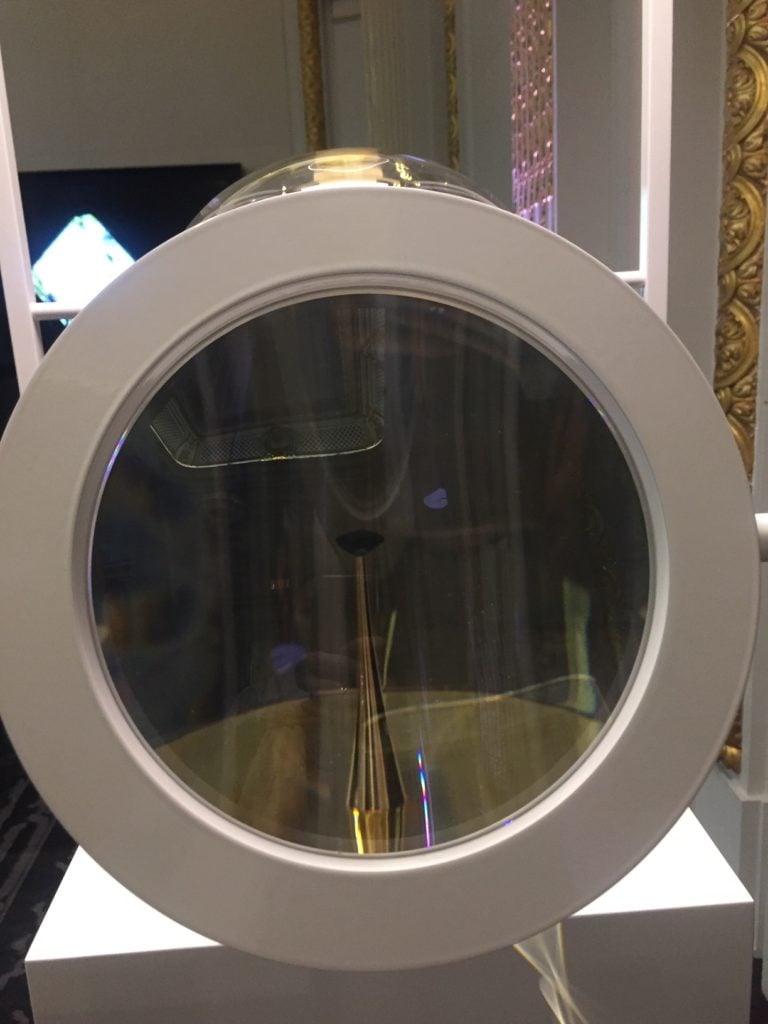
A magnifying glass on the side of the
vitrine holding the diamond. Photo by Eileen Kinsella
“Everybody knows that diamonds are the most reflective material
on earth,” Strebe told artnet News during the unveiling this past
Friday (September 13). “This diamond, which is valued at $2
million, is covered with the blackest black on earth and kind of
makes the diamond disappear.”
Professor Wardle, who has already received inquiries about CNTs
from several artists in the US, praised the artist for helping push
the boundaries of the technology. “Strebe’s art-science
collaboration caused us to look at the optical properties of our
new CNT growth, and we discovered that these particular CNTs are
blacker than all other reported materials by an order of magnitude
across the visible spectrum.”
In the future, the MIT team is offering the process for any
artist to use. “We do not believe in exclusive ownership of any
material or idea for any artwork and have opened our method to any
artist,” he explained.
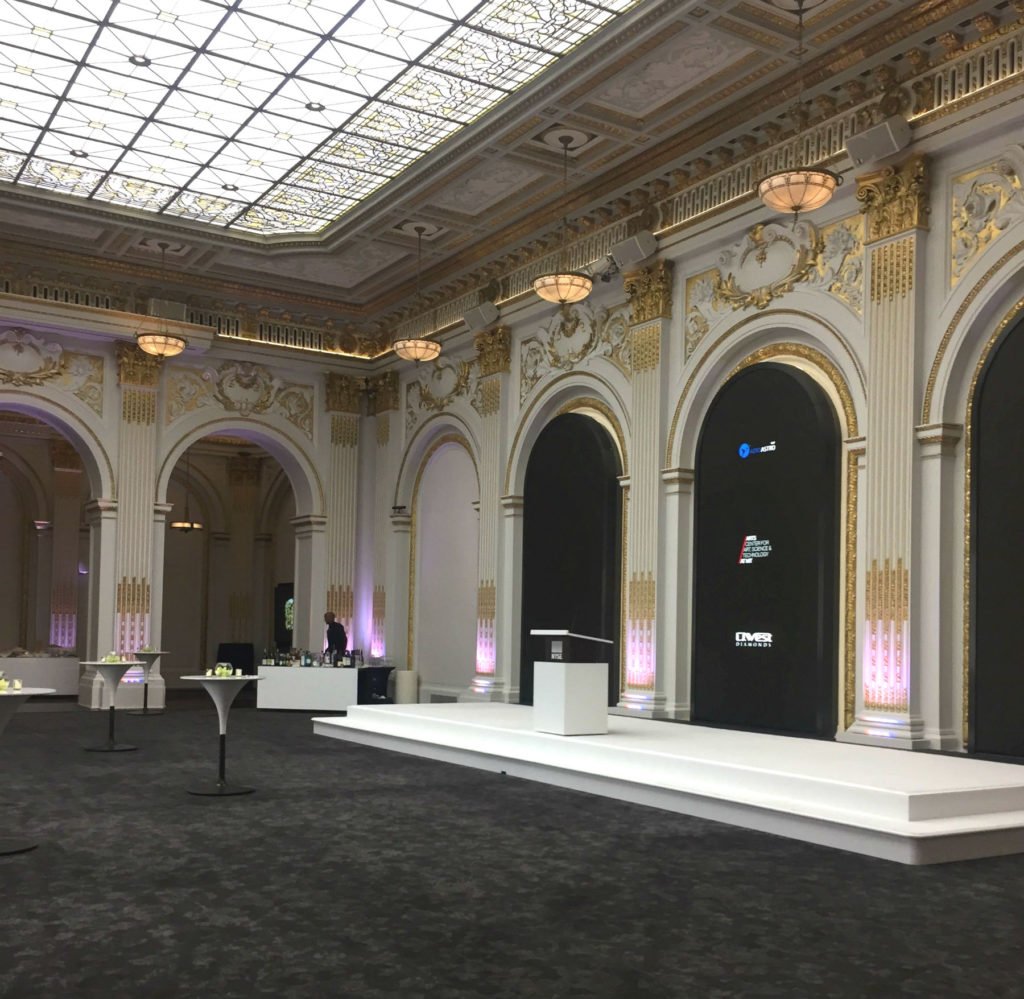
The boardroom at the New York Stock
Exchange. Photo by Eileen Kinsella
The scientist also told artnet News that he is also currently in
talks with NASA about applying the technology to telescopes for
searching out exoplanets. “There are many scientific
instruments—particularly optical ones—where stray light interferes
with the sensing, so they need ultra-black materials to absorb
unwanted light,” Wardle explained.
In a statement from MIT, the team behind The Redemption
of Vanity also took a swipe at British artist Anish Kapoor,
who had moved to get exclusive
rights to “Vantablack,” a previous form of light-swallowing
paint: “The project can also be interpreted as a statement against
British artist Anish Kapoor’s purchase of exclusive rights to a
formula of carbon nanotubes as a material for artworks. Strebe and
Wardle use a different composition of carbon nanotubes, which will
be available for any artist to use.”
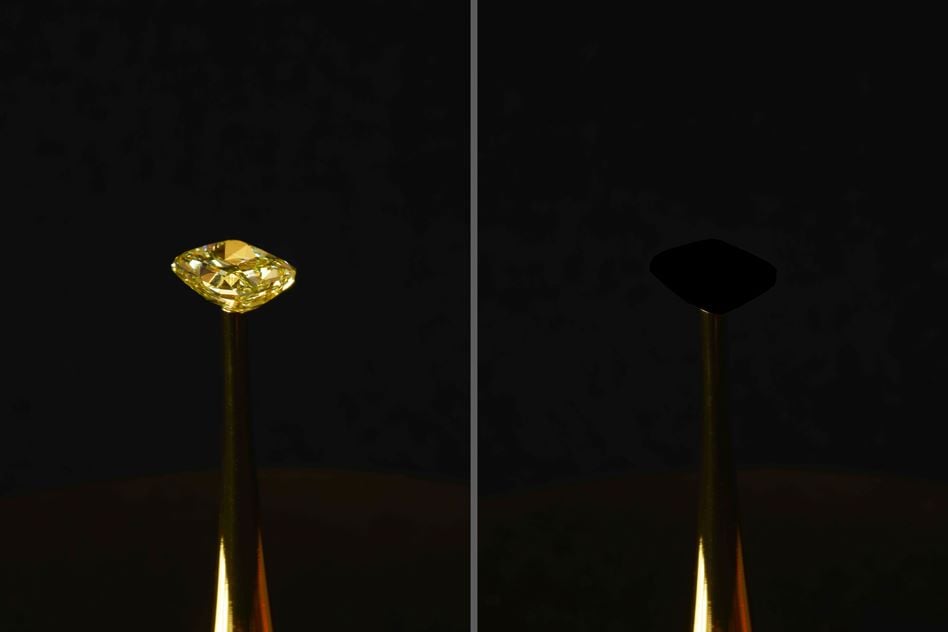
The yellow diamond before and after
coating with carbon nano-tubes. Image by Diemut Strebe
Uniting Extremes
Strebe describes the current art project as “the unification of
the most opposite extremes,” in this case the transformation of a
diamond, prized for its brilliance and meant to be shown off, into
a kind of non-presence.
The carefully chosen venue—the largest stock exchange in the
world—also plays a key role in the concept behind the project. “I
thought it would be interesting to present the object here—the holy
grail of value determination and generation—which is much different
than a museum. This is an interesting place to contemplate value
and its man-made arbitrary character.”
Anyone familiar with Strebe’s work and her interest in both
science and philosophy will not be entirely surprised at this
innovative new presentation. Her previous work,
called Sugababe, was
also a multi-year undertaking. It involved creating a living
replica of the ear of Vincent van Gogh, grown from
tissue-engineered cartilage, using cells from a male descendant
that she says contained natural genetic information about the
artist, and mitochondria from a female descendant of the artist’s
mother.
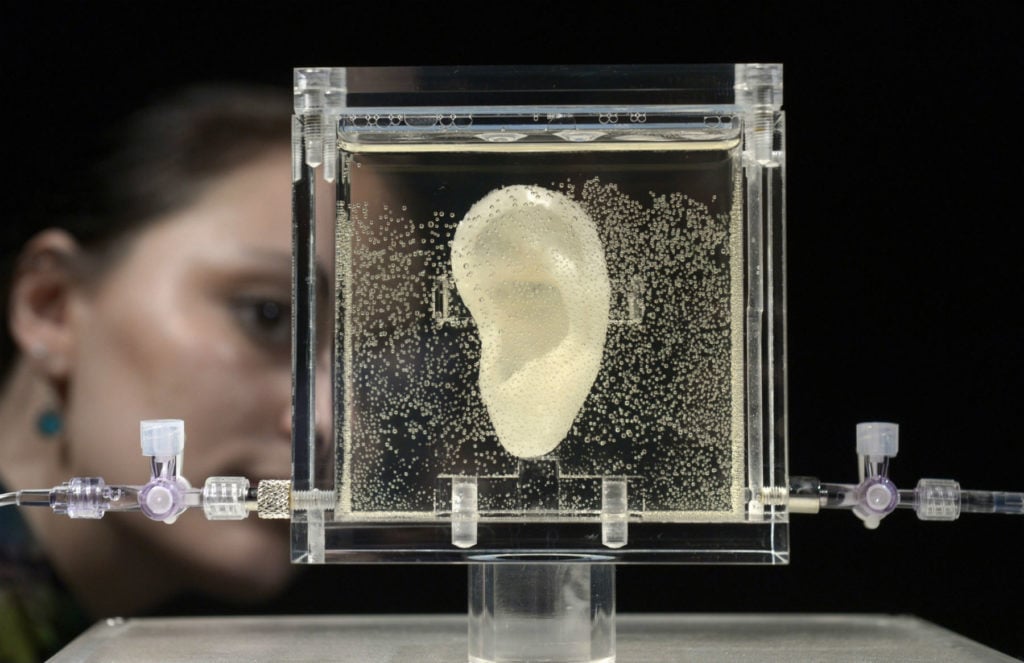
A woman looks on the living replica of
Dutch painter Vincent van Gogh’s famously severed ear which is
displayed at Culture and media museum ZKM, in Karlsruhe,
southwestern Germany, on June 4, 2014. Photo: Thomas
Kienzle/AFP/Getty Images.
Strebe has also collaborated with several other MIT faculty
members, including Noam Chomsky, Robert Langer, and Regina
Barzilay. Yet as immersed as she is in the realm of art and
science, she told artnet News, she also envied those working in
less experimental media: “Sometimes I’m very jealous of painters.
The duration of art and science projects is very complicated and
long.”
The Redemption of Vanity remains on view at the New York
Stock Exchange through November 25, by appointment.
The post Sorry, Anish Kapoor: MIT Scientists Made the
Blackest Black Ever Invented, and an Artist Just Used It to Do
Something Magical appeared first on artnet News.
Read more https://news.artnet.com/exhibitions/diemut-strebe-diamond-1653130
Further reading


Leave a comment