
Artist Antony Gormley Is Worried About the Carbon Footprint He’s Leaving Behind With His Enormous and Energetic Royal Academy Show
Antony Gormley is understandably concerned about his carbon
footprint, he confessed to the Times of London
newspaper recently.
The British sculptor’s epic survey at the Royal Academy of Arts
in London probably caused a bit of a carbon-emissions spike, he
understands, with the walls and floors of the RA’s main gallery
reinforced for his monumental new works made of steel (98 percent
of it is recycled).
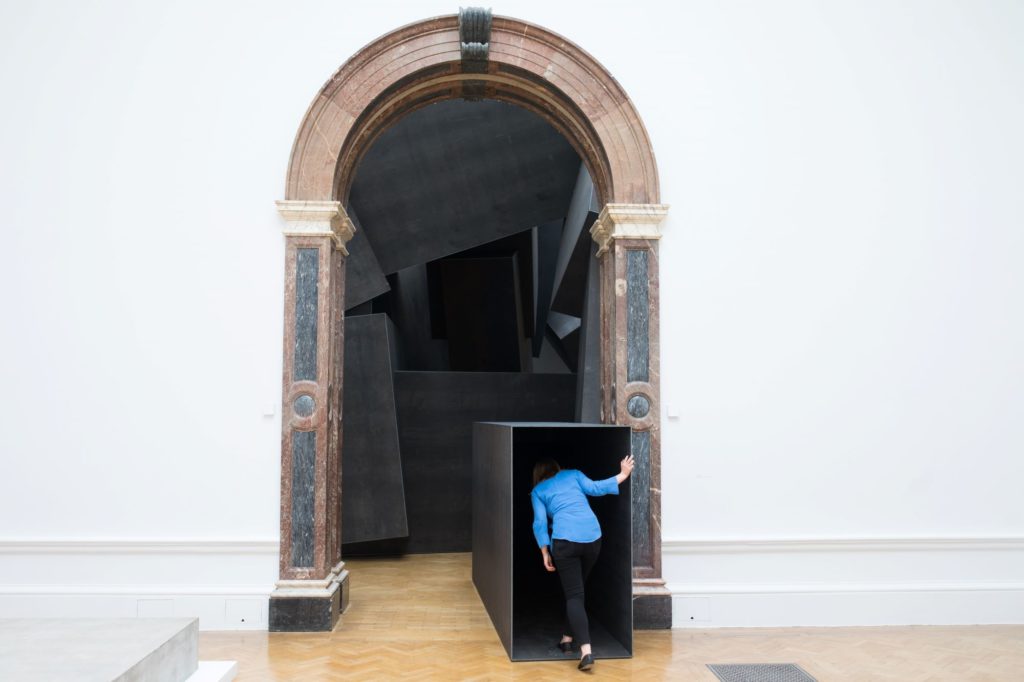
A visitor enters Antony Gormley’s
Cave (2019) at the Royal Academy of Arts. © the Artist.
Photo: David Parry.
The scale of the show makes sense, because the stakes are
high. “He is definitely aware that he is following
[exhibitions by] Anish Kapoor, Anselm Kiefer, Ai Weiwei,” says
Martin Caiger-Smith, the show’s curator. Gormely “wouldn’t be
a human being,” if he did not feel a bit of extra pressure. (Marina
Abramovic, the first female artist to be honored by a solo show
across all of the RA’s main galleries, is next up in 2020.)
Gormley, who became a Royal Academician in 2003, is best
known for his epic outdoor works, but the exhibition underlines
that in the great game of sculpture, he is an
all-rounder. Simply titled “Antony Gormley,” the exhibition
fills 13 rooms in every sense of the word. Showstoppers
include Cave (2019), a new work on an architectural scale
inspired by the artist’s visits to prehistoric cave art sites for a
TV documentary. Visitors to the RA can explore the dark and winding
tunnel, which is made from 27 tons of steel (the faint-hearted can
squeeze around its edges).
In the biggest room, viewers can stand beneath six tons of
steel-reinforcing mesh suspended from the ceiling. The
site-specific sculpture, Matrix III (2019),
has an inner core resembling, in size and shape, a typical bedroom,
a reference to the fact that half the world’s population now lives
within an urban jungle or grid.
Elsewhere, visitors have to duck and dive to get past the latest
iteration of Clearing, a looping aluminium tube
almost five miles long that almost completely fills one room. The
show also includes a new iteration of
Host (2019), a room filled with clay and
flooded with seawater, its murky surface reflecting gilded details
and skylight.
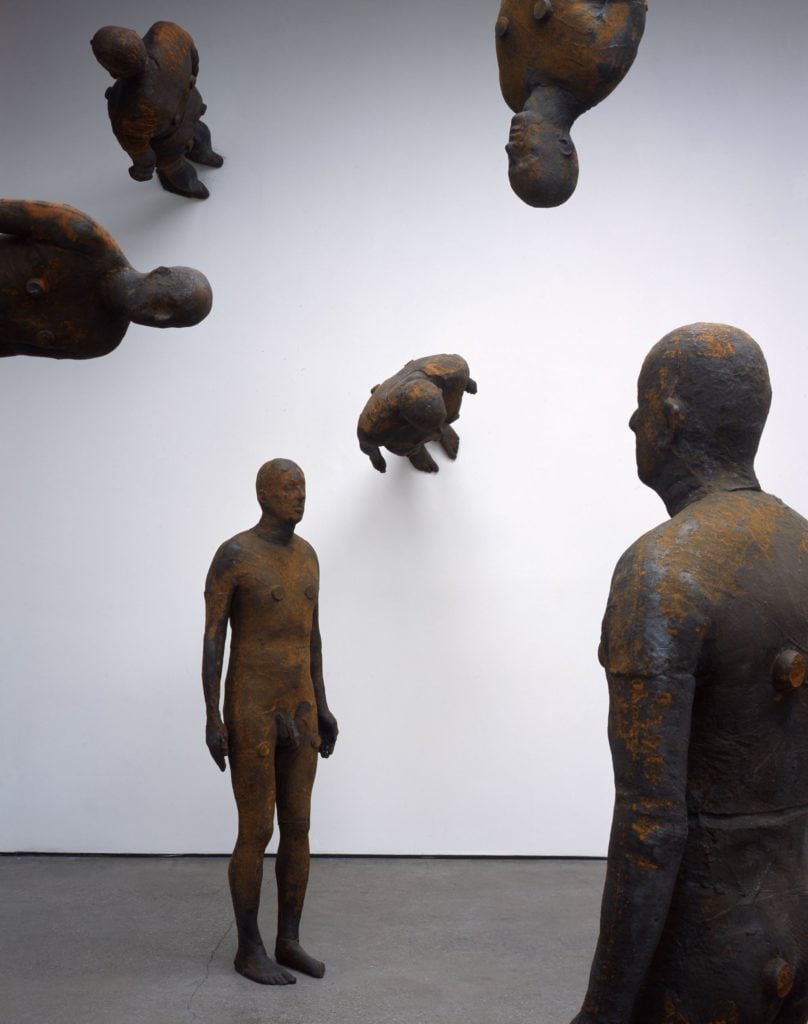
Antony Gormley Lost Horizon I
(2008). © the Artist. Photo: Stephen. White, London
In the three decades since Gormley first
created Host, he has become a one-man
regeneration business. He commissioned a David
Chipperfield-designed studio near King’s Cross station in North
London when the area was still a twilight zone (Google’s London
headquarters is now around the corner). Twenty-five studio
assistants now work with the artist, who even bought the iron
foundry he had worked with for years in the Northeast of England
when the business was on the brink of closing. That added another
20 staff members to his team.
So the RA show is appropriately big. But as far as major
exhibitions go, this one is probably less hard on the environment
than most. Lost Horizon I (2008) did make the trip
from billionaire Victor Pinchuk’s Kiev-based art foundation, and
some other concrete works dating from the early 1990s were shipped
from other private collections. But there are fewer long distance
shipments than you might expect. The clay for Host
comes from the Home Counties just beyond London, and the seawater
was shipped from Dorset on the South Coast of England. Matrix
III was welded together in London.
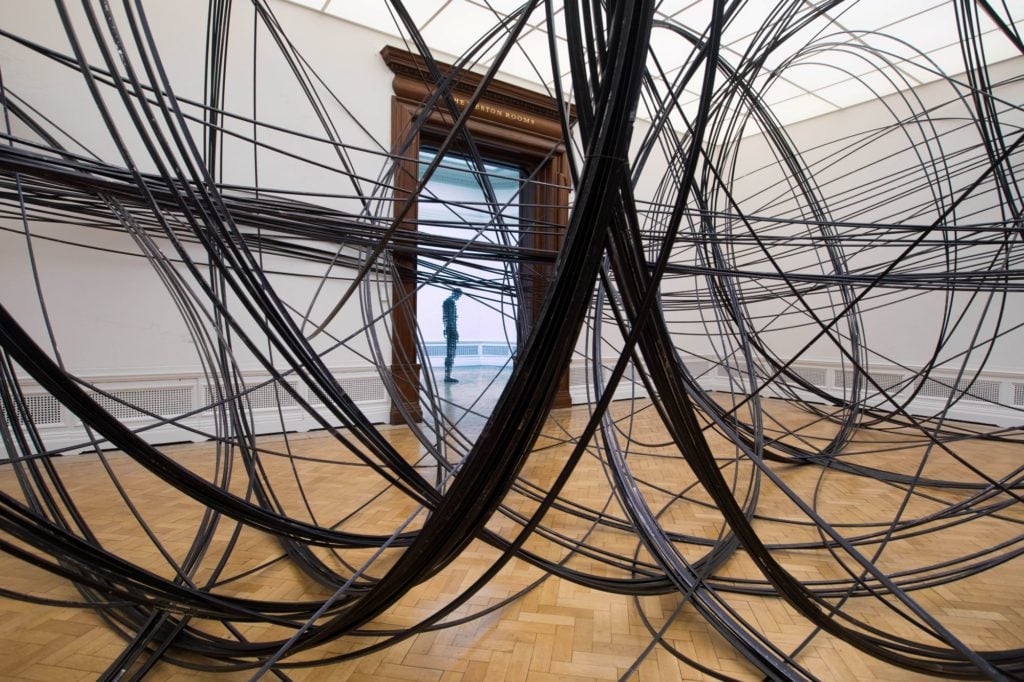
Antony Gormley, Clearing VII
(2019) at the Royal Academy of Arts. © the Artist. Photo: David
Parry.
Gormley’s monumental works, and his signature, cast-iron bodies,
can at times feel relentless, but Caiger-Smith has created a sense
of variety by changing the pace of the show to include more modest,
early works. He has also filled vitrines with the artist’s
“workbooks” that are full of ideas for works. Some of them, such
as Angel of the
North, the landmark in the North of England that cemented
his reputation 20 years ago, have been realized. Others show ideas
for sculptures that might one day loom over some city or landscape.
(One intriguing sketch shows a string of giant spheres bridging an
urban highway.)
Among a presentation of early works made from materials such as
lead, slices of bread, and a blanket, Gormley has recreated a
delicate wall drawing in red chalk. The lightest and certainly the
most colorful work in the RA show, it originally dates from 1979.
In 1981, it formed part of the artist’s first significant solo
museum show, at the Whitechapel Gallery, where the curator was none
other than a young Nicholas Serota.
The drawing, titled Exercise Between Blood and
Earth, looks like a giant’s fingerprint, although its
maximum dimension was dictated by how far Gormley’s (admittedly
long arms) could reach while he stood stationary. It is about the
body as an energy field, Caiger-Smith says. And as he nears his
70th birthday, Gormley shows no signs of resting or slowing down.
Far from a retrospective, this feels more like a super-charged,
mid-career survey.
“Antony Gormley” is on view at the Royal Academy of
Arts, London, from September 21 through December 3.
The post Artist Antony Gormley Is Worried About the Carbon
Footprint He’s Leaving Behind With His Enormous and Energetic Royal
Academy Show appeared first on artnet News.
Read more https://news.artnet.com/exhibitions/antony-gormley-royal-academy-1652611
Further reading


Leave a comment