
The Gray Market: Why Opaque Pricing in the Gallery Sector Makes Museum Collections Less Diverse (and Other Insights)
Every Monday morning, artnet
News brings you The Gray Market. The column decodes important stories from the
previous week—and offers unparalleled insight into the inner
workings of the art industry in the process.
This week, linking freedom of
information to freedom of expression…
MINORITY REPORT
On Thursday, my colleague Julia
Halperin and Charlotte Burns of In Other Words, Art Agency,
Partners’ newsletter
and podcast, published a
multi-part special report titled “Women’s Place in
the Art World.” The
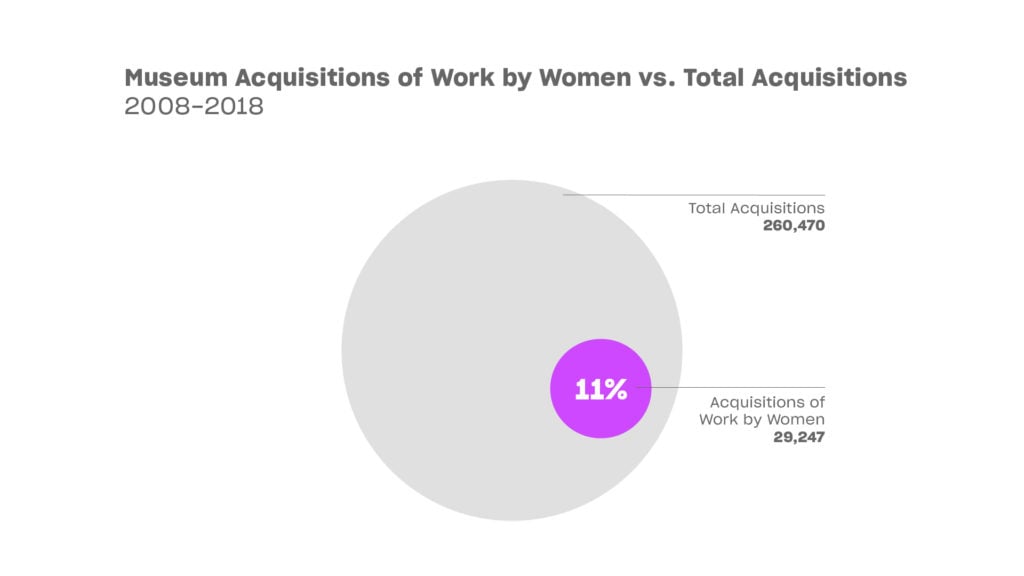
project combines rigorous reporting with quantitative analysis of
acquisitions and exhibition data from 26 American museums between
2008 and 2018. The headline finding is valuable precisely because
it’s so startling: Despite a flotilla of rhetoric about the
importance of correcting decades of extreme gender bias in art
institutions, only a measly 11 percent of works bought by, or
donated to, the museums in this sample in the past decade were by
artists identifying as women.
The main report in the series
(linked above) gives roughly equal coverage to the jarring facts of
this situation and the reasons those facts exist. The latter
entails both legitimate issues and bogus excuses thrown up as a
would-be smokescreen against criticism for such disappointing
progress. And while there is a lot (and I mean
a lot) buried in the vapors that deserves further
investigation, I want to focus on one target that has both
quantitative and qualitative implications.
Courtesy of artnet News and In Other
Words at Art Agency, Partners.
The section in question concerns
a frequent tension between curators, who are responsible for
recommending works for acquisition, and the committees who decide
whether to accept or reject those recommendations. Halperin and
Burns write:
Curators say they struggle to
convince their acquisition committees to pay up for work,
particularly by older, overlooked female artists, who frequently
lack an auction history that might be used to validate the asking
price. “It can be difficult to defend the value of the work,” says
Connie Butler, the Hammer Museum’s chief curator. “There is this
weird disconnect that even while people are happy to support a
show, the lack of auction records for female artists is a problem
when you’re trying to support acquisitions.”
This Catch-22 can lead to
infuriating outcomes for proponents of gender diversity:
One curator described a
meeting in which she pitched the work of an elderly female artist
whose exhibition the museum had recently staged to great success.
The committee decided against it, feeling that there were not
enough market comparables. Instead, they bought a work by a “hot”
young male artist.
This is a textbook example of
how a narrow viewpoint and blind devotion to procedure can lead you
to bad ends. It’s the permanent-collection equivalent of following
a navigation app’s directions deeper and deeper into a known
wildfire just because you know for certain the route happens to be
free of traffic. (No, this is not
just an ironic thought experiment.)
But there’s a larger point to be
made here than the eternal face-palm trigger that is human
nature.

At $11.1 million, a work by Jean
Dubuffet was the top lot of the night at Christie’s London’s
post-war and contemporary evening auction in June. Image courtesy
of Christie’s.
THE GHOST OF PRICE TRANSPARENCY
What enables the maddening
resistance in Connie Butler’s anecdote is, once again, that auction
results comprise the only reliable, comprehensive, and easily
searchable data on art sales. (Remember, art-fair sales
reports are rife with opportunities for distortion, and
while the amount of information available via online-sales platforms
is growing, it still has yet to be centralized in a
user-friendly way.)
This fact means individual and
institutional buyers consistently overrate auction results’
applicability to private sales, particularly those on the primary
market. Which creates a colossal market inefficiency, since prices
on the private/dealer market and the public/auction market can, and
often do, substantially deviate from one another.
Would widely available
primary-market sales data completely eliminate the problem?
Probably not. Certainly, there are cases where a
historically-important-yet-historically-ignored artist lacks a
strong record of primary sales, too. Some may not even have had
gallery representation for much of their careers.
But there are many others who
managed to sell just enough new works through various dealers to
scrape by for years, even decades. Supply and demand simply never
reached a level that warranted the development of an auction market
for their output. Without a repository of those private transaction
records, then, it’s dramatically easier for potential buyers to
pass over an artist on the basis of unfulfillable due
diligence.
Why am I highlighting those two
excerpted paragraphs from Halperin and Burns’s piece? Because they
reveal a consequence of price opacity that seldom enters the
debate
about the damage it does or doesn’t
do to art, artists, and art history.

Installation view of Julie Mehretu’s
HOWL eon (I, II) (2017) at SFMoMA. Photo: Matthew Millman
Photography.
MATCH
POINT
The debate I just mentioned
usually unfolds like this: Critics of greater price transparency
argue that exclusivity and myth-making are necessary to infuse value into artworks,
which, from a cold practical viewpoint, are objects, spectacles, or
concepts that have little to no tangible use.
Advocates of greater price
transparency tend to counter this rationale by arguing that it only
works as long as you’re content to keep selling to the few thousand
existing initiates of contemporary art willing to abide by the trade’s idiosyncrasies
and asymmetries of information. But the strategy cripples the art
market’s potential to meaningfully expand its client base with a
large number of new buyers, particularly younger ones and
tech-sector leaders accustomed to devouring data at every
opportunity—and, as
a result, trained to detest anyone and any scenario that thwarts
their ingrained hunger for information.
But the savviest defenders of
price opacity have a counter-punch to this move, too. They fire
back that greater transparency would corrode one of the only
firewalls that makes art a unique, exalted space. Widely
publicizing asking prices, let alone sales results, from the
primary market would drag the transcendent ideals of contemporary
art into the same grubby bog of transactionalism as grocery stores,
used-car dealerships, and your local Walmart. By winning many more
customers—and the
loaded term “customers” is truer to this argument than the refined
rubric “collectors”—art
loses something much more important: its soul.
The excerpt from Halperin and
Burns’s report emerges as the next rebuttal in this back-and-forth.
It shows that price opacity doesn’t just affect the size of the art
market or the amount of revenue it generates. It also affects the
makeup of the institutional canon and the effectiveness of attempts
to roll back long-standing preferential treatment of a small subset
of overwhelmingly male, overwhelmingly
white artists.
Whether they’re pursuing
legitimate due diligence or just wielding a convenient excuse to
camouflage retrograde thinking, then, members of museum
acquisitions committees will be meaningfully more likely to
slow-walk needed change as long as auction results are the only
robust resource for price comparisons in the art market. And this
imbalance of information isn’t just a blow to dealers’ and artists’
bank accounts. It’s a blow to the visitor experience, art history,
and the culture at large.
[artnet News x In
Other Words]
That’s all for this week. ‘Til next time,
remember what Thom Yorke once sang: just ‘cause you feel it doesn’t mean
it’s there.
The post The Gray Market: Why Opaque Pricing in the Gallery
Sector Makes Museum Collections Less Diverse (and Other
Insights) appeared first on artnet News.
Read more https://news.artnet.com/opinion/price-transparency-museum-diversity-1658107
Further reading


Leave a comment