
Did Forensic Architecture Prove That Police Unlawfully Killed a Man? The Collective’s New Work Breaks Down a Tragedy, Frame by Frame
On July 14, 2018, Harith Augustus, a 37-year-old barber, was
walking down the street in Chicago’s South Side when the five
police officers stopped him for carrying a gun. Within seconds,
officer Dillan Halley shot Augustus five times—four times in quick
succession and once after a short pause, when Augustus was already
on the ground—and killed him.
Soon after, the investigative collective Forensic Architecture and the Invisible Institute, a non-profit platform
for human-rights journalism, teamed up to look at how such a
tragedy takes place by analyzing it from every angle.
The resulting research and video work is now on view at the
Chicago Architecture
Biennial. “It’s one of the closest analyses of any police
shooting ever done,” Israeli architect Eyal Weizman, Forensic
Architecture’s founder and director, told artnet News. “We’ve
modeled the actions of each actor [the police and the man who was
killed] frame by frame from footage from four different
cameras.”
Since its founding in 2010, Forensic Architecture has worked to
expose human-rights violations through 3-D animations, interactive
maps, and models that help viewers understand complex and
controversial events as they unfolded. The Invisible Institute,
which Kalven co-founded in 2000, is versed in more traditional
reporting skills, such as sourcing government documents, filing
Freedom of Information Act requests, and interviewing
witnesses.
Forensic Architecture is also featured in the current Whitney
Biennial. The collective was among the participants that asked that
their work be withdrawn from the
exhibition in protest of the museum board’s vice
chair, Warren Kanders, who was
targeted by
activists for owning the tear-gas manufacturer Safariland,
and who later resigned.
Forensic Architecture’s work in the biennial, a video
titled Triple Chaser, takes
Kanders’s company as its subject by investigating businesses that
have links to Safariland and have committed human-rights violations
around the world.
Forensic Architecture also earned a surprise
nomination for the 2018 Turner Prize for its work mapping
London’s devastating Grenfell Tower
fire of 2017.
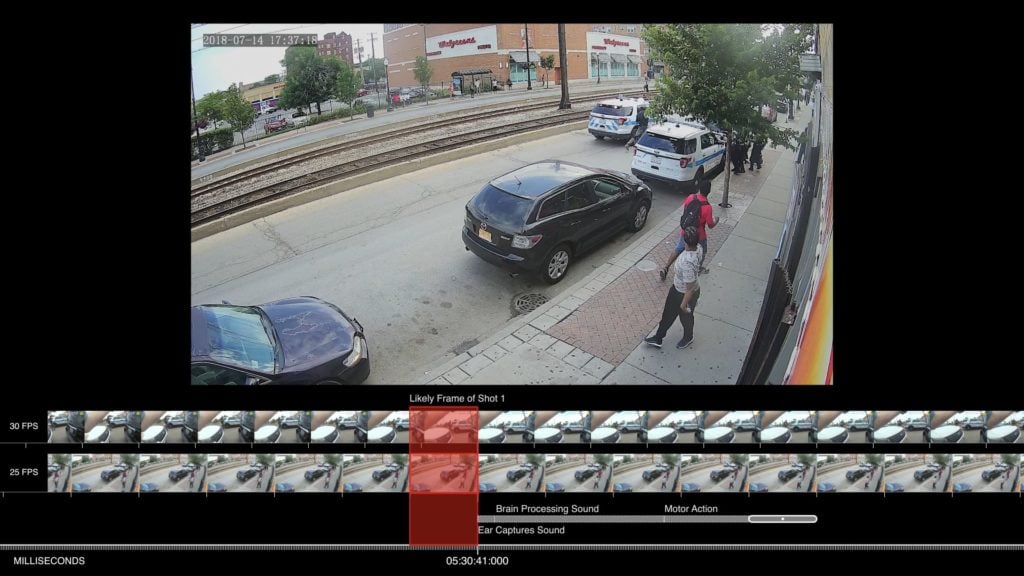
Forensic Architecture and the Invisible
Institute, still of Six Durations of a Split
Second: The Killing of Harith Augustus (2019). Photo
courtesy of Forensic Architecture and the Invisible Institute.
Breaking down a split second
The people of Chicago have responded with suspicion and anger to
the killing of Augustus, who is far from the first black man to be
gunned down by police in recent years. Within 24 hours, the police
publicized a video from officer Halley’s body cam,
which “speaks for itself,” police superintendent Eddie Johnson
said. “Decisions to use lethal force are made in a split
second.”
Forensic Architecture disagreed. “It is much more complicated
than that,” Weizman said. The video was released under the title
“Aggravated Assault to a Police Officer,” zooming in and pausing
the frame to show Augustus’s holstered gun. It framed the encounter
from the perspective of the officer, casting Augustus in the role
of suspect and therefore helping shape the narrative most favorable
to police.
Following a Freedom of Information Act lawsuit, filed by local
activist Will Calloway, police identified and released an
additional 18 video sources capturing the event. By analyzing
all the footage, Forensic Architecture was able create an animated
3-D model of the fatal encounter.
“We came up with the idea of interrogating the notion of the
split second, which is always invoked by the military and the
police in instances of state violence against a civilian,” Kalven
said. The resulting work, titled Six Durations of a
Split Second: The Killing of Harith Augustus,
includes six videos that each consider the events in a different
time scale, from milliseconds, to seconds, minutes, hours, days,
and years.
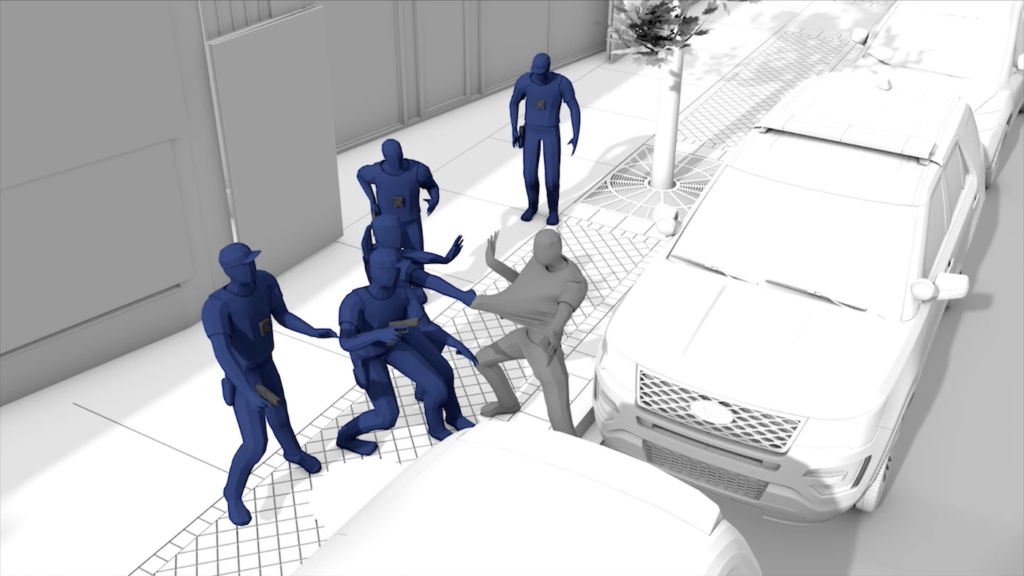
Forensic Architecture and the Invisible
Institute, still from Six Durations of a Split Second: The
Killing of Harith Augustus (2019). Courtesy of Forensic
Architecture and the Invisible Institute.
A rapid escalation
Not shown in the original video released by the police is the
beginning of the encounter. As Augustus was walking down the
street, police noticed that it appeared he was carrying a gun under
his shirt (a fact that would not have necessarily been illegal in
Illinois, which grants concealed-carry permits).
One officer made an investigative stop, asking Augustus if he
had a gun license. As Augustus took the card out of his wallet,
another officer approached from behind, without saying anything,
and tried to handcuff him. Alarmed, Augustus tried to flee, his
shirt flying up to reveal the gun as he stumbled into the
street.
As he turned, Augustus’s hand went toward his waistband,
possibly to pull up his sagging pants or possibly to reach for the
gun. Only Halley, one of five officers on the scene, made the
decision to shoot. Immediately after, he radioed in, saying “Police
shot. Shots fired at the police,” although Augustus’s gun had
remained holstered.
“We clearly show the story of the split second,” Weizman said.
“The attempt to arrest Augustus was undertaken wrongfully, without
any warning, coming from behind. It provoked him and put the whole
incident in motion—we show that the police created the incident
they were responding to.”
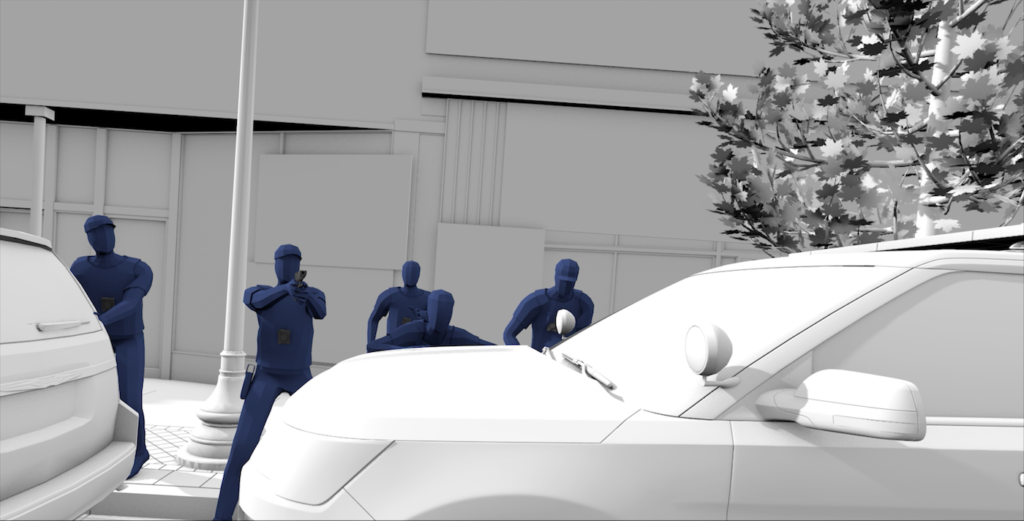
Forensic Architecture and the Invisible
Institute, still of Six Durations of a Split
Second: The Killing of Harith Augustus (2019), recreating
Augustus’s point of view right before he was shot. Photo courtesy
of Forensic Architecture and the Invisible Institute.
And just how long was that “split second” that led Halley to
raise his gun and pull the trigger? The new research concludes that
Halley must have decided to shoot moments before Augustus’s hand
brushed against the holster of his gun, and that he took two steps
before firing again, after Augustus was on the ground.
“We believe it was not a lawful killing,” Weizman said.
As afternoon turned into evening, footage captured by cell phone
shows the police leaving the crime scene to confront a crowd that
had gathered across the street, beating them with batons and
arresting four people. Among the crowd was Trina
Reynolds-Tyler, an Invisible Institute researcher, who speaks on
camera in one of the videos about the harrowing experience.
“The community is just watching in mourning and the
police are charging at them with batons. It’s a level of violence
that was completely disproportionate and unmerited,” Weizman
said.
None of the videos are actually on view in the biennial, which
instead presents a stark, black-and-white room offering a written
description of the project and the decision to remove the visual
elements of the piece. Should visitors want to engage further, they
can watch the video online, or at the Invisible Institute’s
headquarters in Chicago, not far from the scene of the
shooting.
“It began to feel more and more problematic to show this
incredibly sustained, multi-perspective investigation of the
killing of yet another black man by white police,” Kalven
explained. “On the one hand, it’s imperative to share this
investigative reporting. On the other, there are real
implications to looking, and it should be a choice to look.”
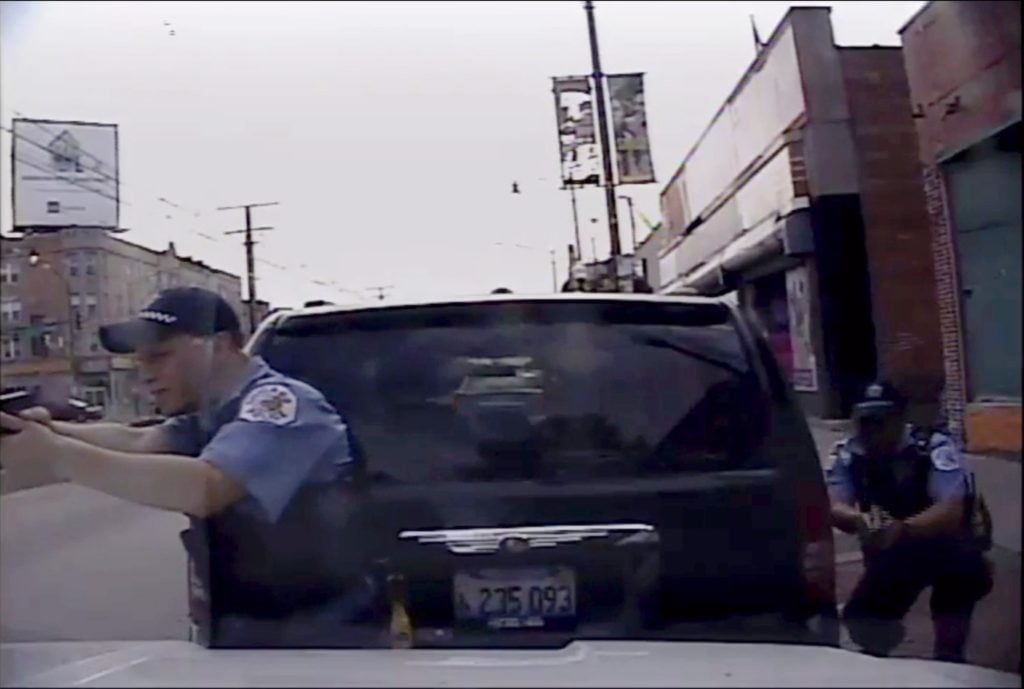
A still from dashcam footage released
just three weeks ago showing officers in pursuit of, and
subsequently shooting, Harith Augustus. Photo courtesy of Forensic
Architecture and the Invisible Institute.
Art in the pursuit of justice
Even though much of the work is on view now, the project is
still ongoing. Despite court orders, researchers discovered that
three additional video sources that documented the event had not
been made public. Just three weeks ago, the police finally released
dash cam footage showing Halley shooting Augustus as he fled. “We
got the video literally as we were finishing editing the file,”
Weizman said.
Calloway, the local activist, has filed a followup in his
lawsuit asking that the police be held in contempt of court. The
footage from two additional CCTV cameras with a clear overhead view
of the shooting have yet to be released.
Official investigations into Augustus’s death are still ongoing,
including a wrongful death lawsuit filed by his family against the
police. “The Citizen’s Office of Police Accountability is
investigating and it hasn’t released its findings yet,” Kalven
said. “It’s unlikely that there will be a criminal proceeding
against the officer, but we’ll see.”
Ultimately, Weizman hopes that Forensic Architecture’s
techniques will be used more widely and find application in similar
cases. “If any of the work that we’ve done is helpful in pursuing
legal remedies we certainly want to help with that in any way we
can,” he said. “But all the conditions that contributed to this
completely unnecessary death still exist right now, and make it all
but inevitable that there will be more avoidable deaths of this
nature. We just want people to pause and take in this knowledge
with the sense that you incur responsibility when you know these
things.”
The Chicago Architecture Biennial is on view at 78 East
Washington Street, Chicago, Illinois, September 19,
2019–January 5, 2020. Six Durations of a Split
Second: The Killing of Harith Augustus is on view at
the Invisible Institute, at the Experimental Station 6100 South
Blackstone, Chicago, Illinois, September 19, 2019–January 5,
2020.
The post Did Forensic Architecture Prove That Police
Unlawfully Killed a Man? The Collective’s New Work Breaks Down a
Tragedy, Frame by Frame appeared first on artnet
News.
Read more https://news.artnet.com/exhibitions/forensic-architecture-chicago-shooting-1659529
Further reading


Leave a comment