
Vienna Contemporary Has a New Look and New Leadership, But It Remains a Staid, Regional Fair
What’s in a name? The art fair
viennacontemporary has emerged from an exercise in dramatic
renaming and rebranding, but years on—not to belabor the
Shakespearean analogy—is the aroma really any
different?
The preeminent Austrian art fair, which closed today after a
four-day run in the capital, has gone through name changes, power
changes, and dates changes in recent years as it searches for just
the right spot and identity within a competitive fair calendar.
However, despite all the
transformations in recent years, when the fair opened last week, it
remained decisively regional, its raison d’être continuing to be a strong central and eastern
Europe profile, plus a singular-minded core of Austrian
galleries.
When the fair closed yesterday,
some questions remain about just how feasible a format a regional
fair continues to be amid a contracting market. But Vienna’s
powerhouse of institutions could just be its saving
grace.
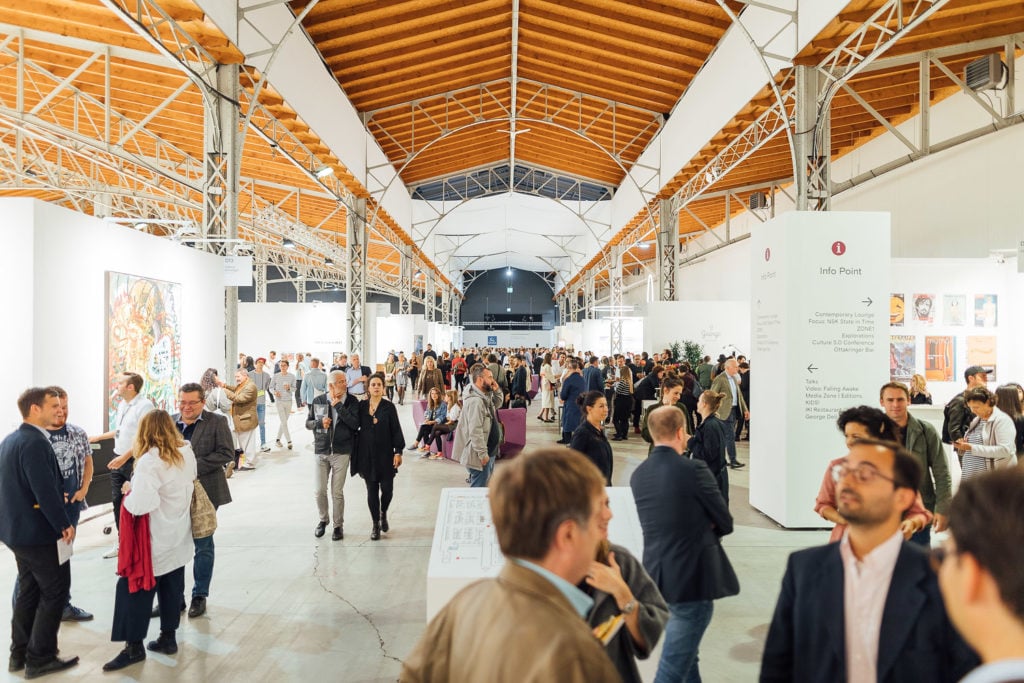
View from viennacontemporary. ©
kunst-dokumentation.com
A Viable Regional Fair?
In 2015, VIENNAFAIR rebranded
itself viennacontemporary and, at the same time, fixed a new
September date and moved locations to Vienna’s Marx Halle, a former
cattle market. Meanwhile, management changed hands, and the company VF
Betriebsgesellschaft mbH took it over from FIAC and Paris Photo’s
owners, Reed Exhibitors. The change of hands shifted its long-held
focus on central and eastern European art in favor of
internationalization—but, not atypical of Austria, it was all
buoyed by Russian investment, in this case, from arts patron Dmitry
Aksenov.
Despite its more international
appeal, the scales are still tipped: This year’s edition comprised
110 galleries in total, with 38 percent coming from Austria and
another 35 percent from nations in central and eastern Europe.
Managing director Renger van den Heuvel emphasized that this
continued gaze eastward is what “makes the fair unique.” In a
time of complaints of fatigue from collectors, press, and art
enthusiasts alike over a too-crammed fair calendar, maybe
specificity is a strong suit and van den Heuvel has a
point.
However, the booths felt
undaring, with conservative hangs of painting and sculpture
pervading as dealers tried to play it safe within a tentative
market.
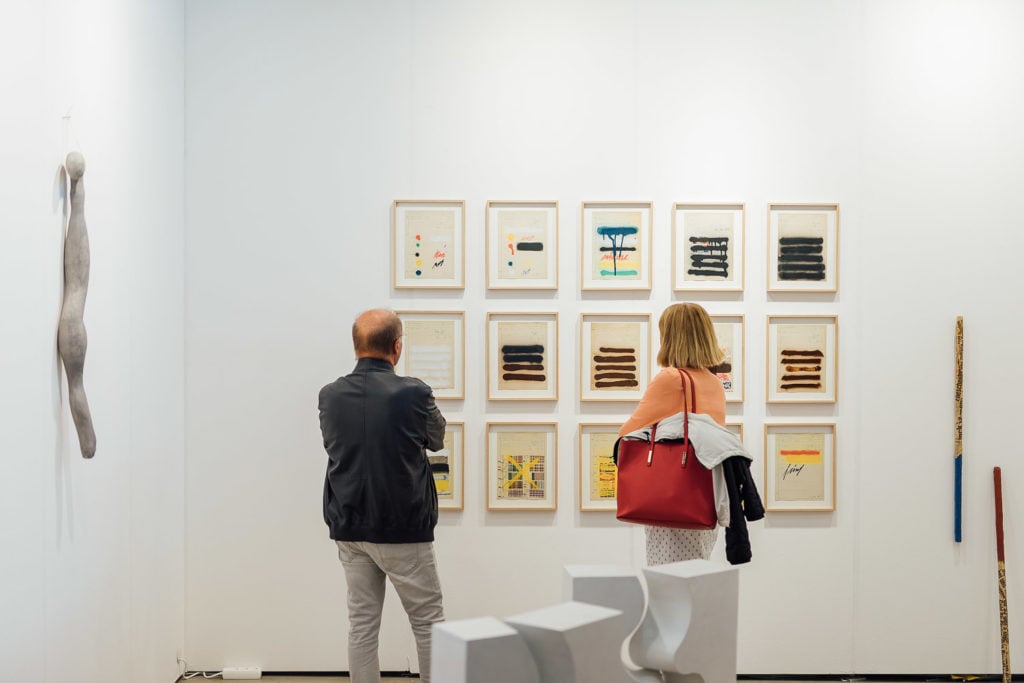
View from viennacontemporary. ©
kunst-dokumentation.com
Vienna mainstays included
Christine König Galerie, which showed a cross-section of the
gallery’s stable, highlighting collages by Bosnian artists Radenko
Milak and Roman Uranjek, Dates for a Subjective Timeline of the Climate
Change (2018), of
which Greta Thunberg might be proud. It also showed
a “project space” wall of works,
each priced under €3,000 ($3,270) by Ovidiu Anton and Maruša
Sagadin.
König’s perception of the fair
this year? “More viewers, less buyers.” She added that her presence
is not so much a swift turnaround business decision, but that,
rather, as Vienna dealers, they “have to support the Vienna art
scene.”
A less than lucrative time was
also had by Piera Ravnikar, whose Ljubljana gallery is under two
years old and which received a grant from Slovenia’s ministry of
culture for its 270-square-foot booth, which was priced
at €7,500 ($8,177). (The nation was the official
focus country at the fair this year.) The dealer showed work by
three young artists, including paintings by Nina Čelhar priced at
€800 to €4,800 ($872–$5,233), none of which sold. “You need to
fight a different battle [in Slovenia] to convince people to buy
art,” she said. “We’re here to start the journey.”
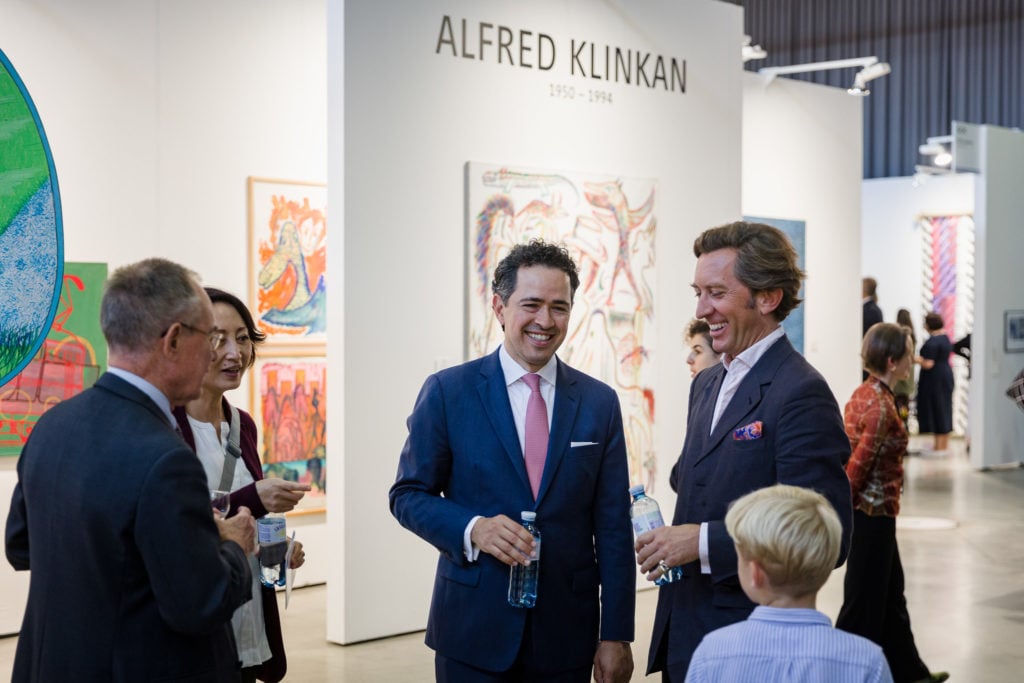
View from viennacontemporary. ©
kunst-dokumentation.com
On the other side of the
spectrum, Galerie Thaddaeus Ropac reported the sale of a photograph
by Vienna-based artist VALIE EXPORT for €35,000 ($38,160).
Elsewhere, at the
Romanian-focused, Berlin-based gallery Plan B, a work by Horia
Damian sold to a Berlin-based collector for €16,000 ($17,445).
Relatively “large” sales included a monotone abstract painting by
Rudolf Polanszky, going for €120,000 ($130,835) at Vienna-based
gallery Konzett, while at the lower-end of the price range, Jecza
Gallery sold two works by Ciprian Radovan for €3,200 ($3,489) and
€2,850 ($3,107), respectively.
So does viennacontemporary
remain viable as a regional fair? As a general rule: yes. Galleries
come with conversations already in play, and many manage to close
those deals. But collectors won’t be having to fight it out for the
big hitters. This fair isn’t exactly soaring on the Richter
scale.
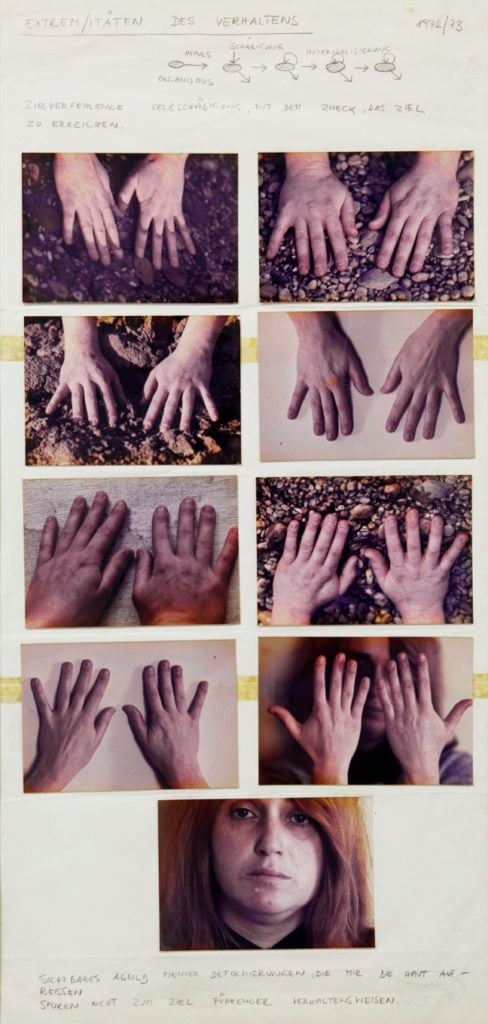
VALIE EXPORT EXTREM / ITÄTEN DES
VERHALTENS (1972). Photocollage courtesy of Galerie Thaddaeus
Ropac, London, Paris, Salzburg. © VALIE EXPORT/Bildrecht Wien,
2019
The Institutional Edge
Visitors from Belgium, France,
Switzerland, and Germany bolstered the local collector scene on
preview day last Thursday, although sales were slow and measured.
However, what Vienna may
lack as an independently pumping international art market, it
certainly has in museum edge. Sales hastened when the artist was
aligned with some of Vienna’s well-known art centers: At Galerie
Emanuel Layr, a work by Tillman Kaiser—who’s currently showing at
Vienna’s Secession museum—went for an undisclosed sum between
€7,000 to €10,000 ($7,632 to $10,903).
Another strong moment at the
fair was the “Explorations” section, curated by the Belvedere’s
chief curator Harald Krejci and showcasing works made between 1945
and 1980. Highlights from the booth included the forgotten Georgian
artist Vakhtang Kokiashvili at Window Project. Known during his
lifetime for making stained-glass windows in Soviet architecture,
two of his small-scale tempera-on-cardboard paintings sold at the
fair within a modest price range of between €700 and €8,000 ($763
and $8,722).
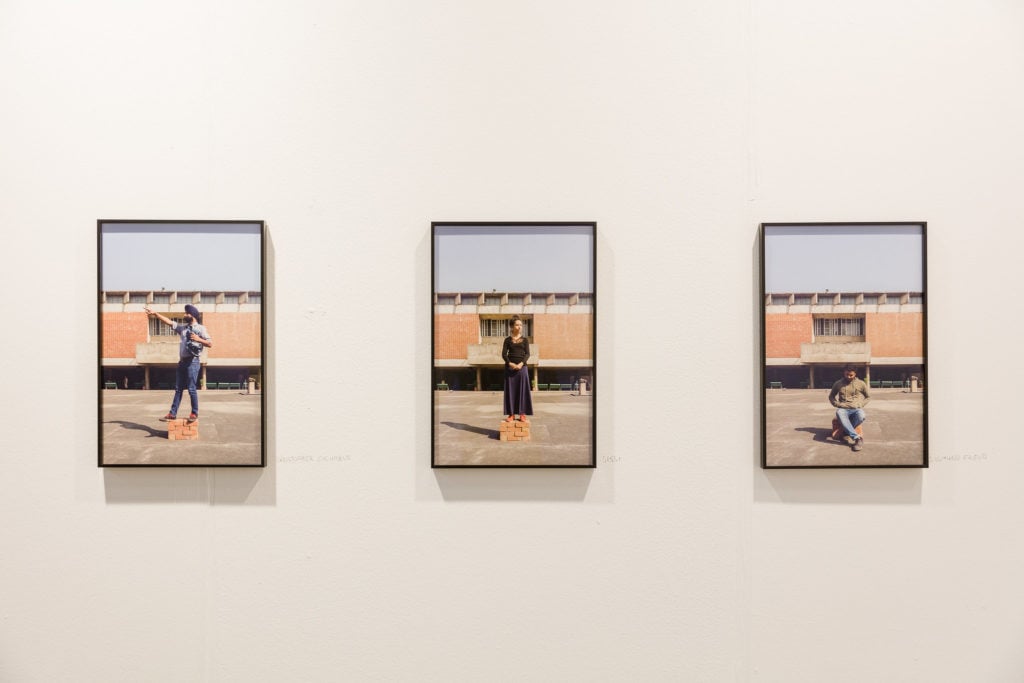
SPERLING, Thomas Geiger. ©
viennacontemporary, photo: kunst-dokumentation.com.
Kunstverein Graz’s director Kate
Strain and the director of the Salzburg International Summer
Academy of Fine Arts, Hildegund Amanshauser, were also seen
wandering through Zone
1, an area of the fair curated by Fiona Liewehr and funded by the
BKA, Austria’s ministry for arts and culture. Liewehr chose to
dedicate the section to artists under the age of 40 who had some
connection to Austria, saying that “it gives younger artists
visibility within the fair.”
While Galerie Raum mit Licht
sold six works by Titania Seidl for between €1,000 and €4,000
($1,090 and $4,361) as part of the section, its strongest artists remained unsold,
including an installation by Julian Turner at Filiale, which
playfully recreated the mausoleum of benevolent Yugoslav dictator
Josip Broz Tito.
Over the weekend, the ballots
were counted for Austria’s federal election, and the tenuous
political climate could occasionally be felt within the fair’s
walls too. Austrian and Berlin-based Markus Proschek’s paintings
and sculpture at SVIT, priced at between €3,600 and €7,500 ($3,925
and $8,177) probably cut a little too close to the bone
politically: a toppled male torso wearing a Fred Perry shirt—a
brand favored by members of the far right—and a speared Saint
Sebastian dripping with blood.
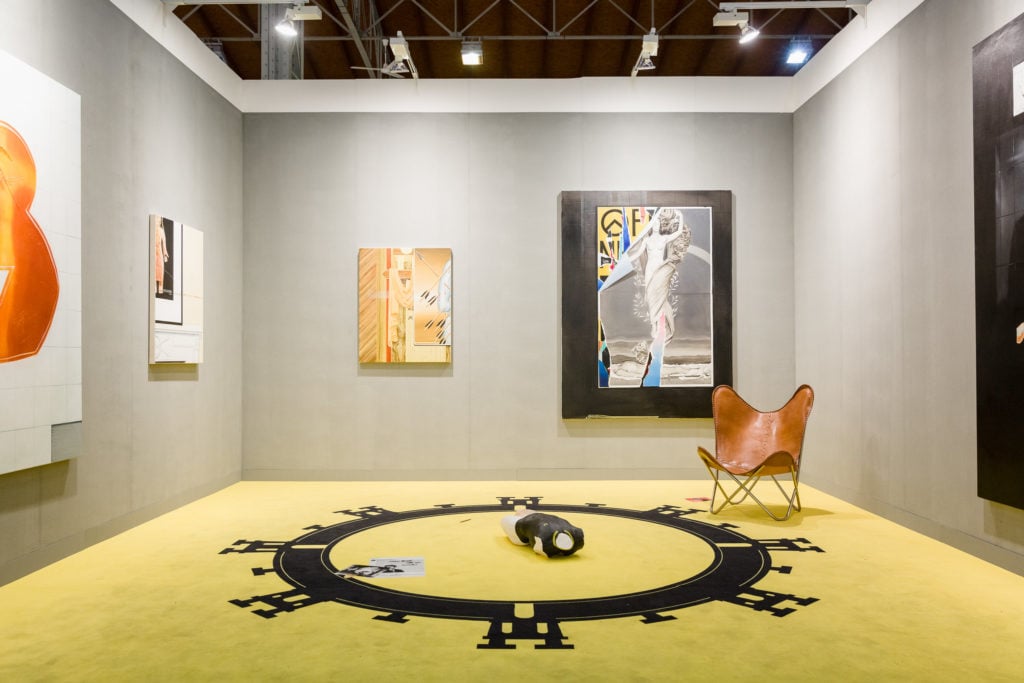
SVIT, Markus Proschek, ©
viennacontemporary, photo: kunst-dokumentation.com.
Around closing time at the fair
on Sunday, the center-right People’s Party and its leader,
Sebastian Kurz, reclaimed Austria’s leadership with 37 percent of
the vote, while the far-right Freedom Party, tarnished by a
corruption scandal, sharply declined. It remains unclear who Kurz
will form his coalition government with this time around, but
there’s some fear that his party reeks of the same political
rhetoric as before.
As with viennacontemporary, so
goes the old adage: new frame, same game.
The post Vienna Contemporary Has a New Look and New
Leadership, But It Remains a Staid, Regional Fair appeared
first on artnet News.
Read more https://news.artnet.com/market/vienna-contemporary-2019-1665337
Further reading


Leave a comment