
Robert De Niro Joined Robert Storr to Talk About the New Monograph They Worked on Dedicated to His Artist Father’s Legacy
Actor Robert De Niro might just be the biggest fan of his late
father’s painting. But there’s still plenty he’s learning.
In a lively conversation with former Yale School of Art dean and
former MoMA curator Robert Storr, held at the 92nd Street Y theater
on Monday evening, the packed audience repeatedly burst into
laughter when De Niro shrugged or answered questions about
particular aspects of his dad’s oeuvre with a blunt “I don’t
know.”
“I appreciate everything you tell me about my father,” De
Niro conceded to Storr. “I didn’t study art or art history.”
Apart from these frequent moments of levity, the event was a
moving tribute to De Niro’s father and his lifelong dedication to
painting, which is also the subject of a new book released by
Rizzoli, Robert De Niro Sr.: Paintings, Drawings,
and Writings: 1949-1993. The monograph includes essays by
art historian Susan Davidson, Storr, author Charles Stuckey, and
painter Robert Kushner.
“What he accomplished in his art was uniquely his and will carry
on, as far as I’m concerned, forever,” De Niro writes in the
introduction. “I remember as a kid being in his studio and
listening to him talk about dealers and artists, and the great
works of art and literature he loved, and I understood, even at
that young age, that my father was passionate about what he
did.”
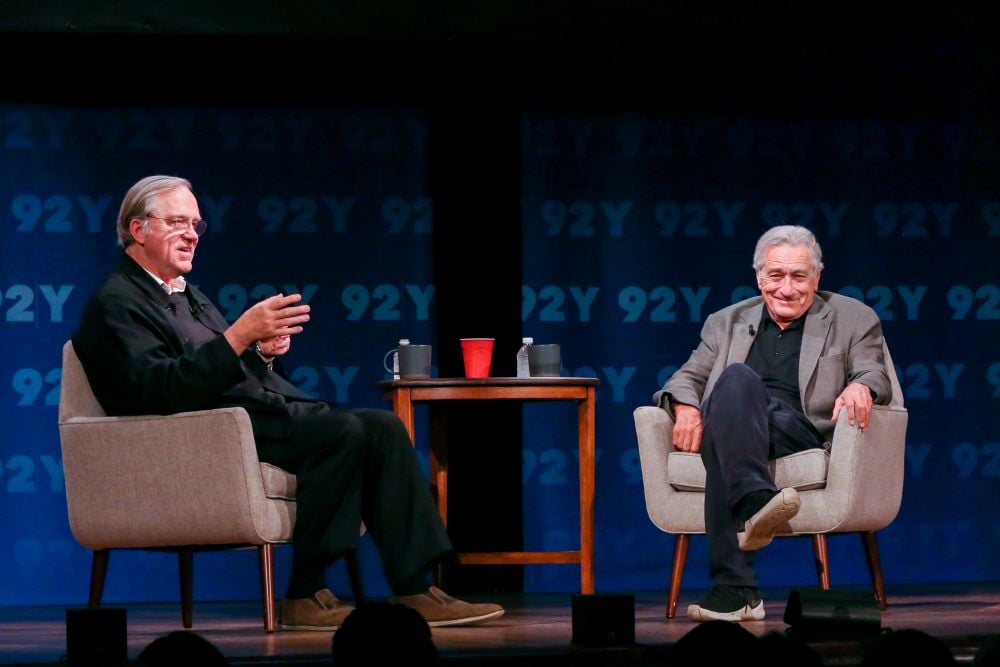
Robert Storr in conversation with Robert
De Niro at the 92nd Street Y. Photo: Andrea Klerides/Michael Priest
Photography
At the 92nd Street Y, De Niro told Storr that his father was
often wary of dealers, except for “one guy he said was okay… Larry
Salander, who turned out to be ‘not right’ to say the least.”
In one of the biggest art world scandals in recent years,
Salander filed for bankruptcy in 2010, pleading guilty to fraud and
grand larceny. He was sentenced to six-to-twelve years in prison.
Several of DeNiro’s father’s paintings were among works caught up
in the fallout, since Salander had sold them without permission and
kept the proceeds. After years of lawsuits and bankruptcy
proceedings, the younger De Niro was eventually able to retrieve
some of the works.
(The artist’s estate is now represented by DC Moore gallery in
Chelsea, where a show of six works will
open next month.)
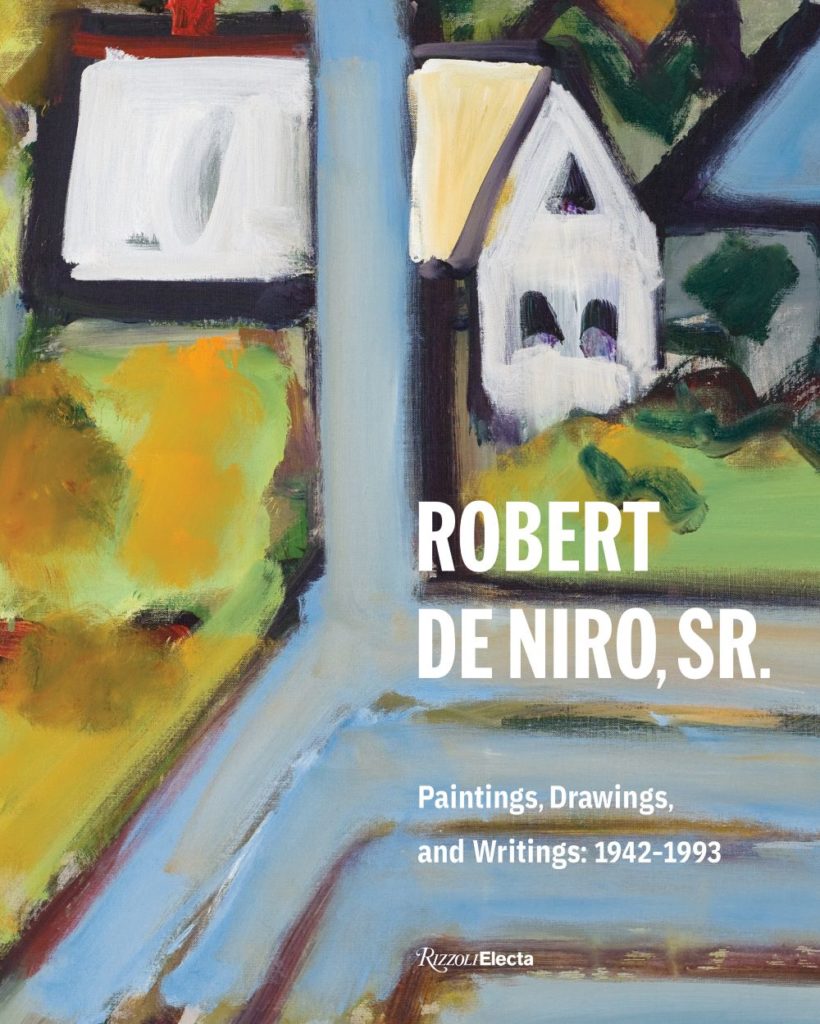
Image: Courtesy Rizzoli
Born in Syracuse in 1922, Robert De Niro Sr. enrolled in Hans
Hoffmann’s art school in Provincetown, Massachusetts, in the late
1930s before heading to Black Mountain College in 1939-1940. By the
early 1940s he had set himself up in New York City, where he
continued to study under Hoffmann. He met fellow painter Virginia
Admiral, De Niro’s mother, in New York, though the relationship was
short lived and the artist’s later writing in his personal journals
revealed that he was gay.
His work garnered recognition throughout his lifetime, including
from Peggy Guggenheim, who debuted his paintings at a 1945 show at
her famous Art of This Century gallery, alongside Mark Rothko and
Jackson Pollock. De Niro Sr. had a solo show at the gallery in
1946. His work continued to evolve, though he remained loyal to a
form of figurative painting at a time when pure abstraction was
becoming more and more dominant. His fame and success never reached
the heights of some of the contemporaries with whom he he
showed.
De Niro lit up when Storr pointed out that the expanded MoMA is
reconsidering the canon of art, and that his father’s paintings
might have another entryway into art history: “The works have aged
well.” That level of reconsideration may seem unlikely (though the
new MoMA’s regular reinstallations do promise to shed more light on
the previously overlooked). His son has been the champion for
his late father’s work himself, placing Robert De Niro Sr.
paintings in the numerous restaurants he is involved with,
including Tribeca Grill, Locanda Verde, and Nobu (New York and
Japan), as well as the Greenwich Hotel.
His father also actually created the design of the menu for the
Tribeca Grill, and coasters for the Greenwich Hotel. “I’ve never
changed it,” said the actor of the designs.
In addition to keeping and preserving his father’s original
downtown New York studio, the Oscar-winning actor helped create a
2014 documentary for HBO, titled Remembering the Artist
Robert De Niro, Sr. At the Y, De Niro said it is
important to him to preserve his father’s legacy and tell the story
of his life and art to his own children and grandchildren. It’s a
sentiment echoed in the film: “I just want to see him get his
due,” De Niro Jr. says. “That’s my responsibility.”
The post Robert De Niro Joined Robert Storr to Talk About
the New Monograph They Worked on Dedicated to His Artist Father’s
Legacy appeared first on artnet News.
Read more https://news.artnet.com/art-world/robert-de-niro-painter-book-1673155
Further reading


Leave a comment