
How New York’s MoMA Raised More Than $400 Million for Its Expansion in Just Four Years
At a time when many art institutions
are struggling to meet ambitious fundraising goals, New York’s
Museum of Modern Art has done what others have deemed
impossible.
In the past four years alone, the
institution raised more than $400 million from a concentrated
cluster of super-wealthy patrons. On October 21, it will unveil the
fruits of that effort to the public: 40,000 square feet of
additional exhibition space, a new wing, and a rehang of its entire
collection that will prompt a major reconsideration of the story of
Modern and contemporary art. MoMA’s supporters “want the museum to
be a work in progress,” the museum’s director Glenn Lowry told
artnet News in a recent interview.
The funding feat is even more impressive when considered against
the backdrop of Manhattan’s ultra-competitive landscape. While MoMA
was on the fundraising trail, no fewer than five major New York
museums were also in the midst of expansion or striving to expand:
the Whitney Museum of
American Art, the Frick Collection,
the New Museum,
the Studio Museum in
Harlem, and the Metropolitan Museum of
Art. (The Met postponed plans for its
Modern and contemporary wing as fundraising stalled in 2017; it has
since resumed the
project with a narrower scope.) At the
same time, the Los Angeles County Museum of Art has struggled to stay on
schedule to raise $650 million for a major expansion of its
own.
MoMA, meanwhile, even took the bold step of
closing its doors for for the past few months—sacrificing its
highly lucrative, high-traffic summer season—in order to accelerate
the renovation timeline. How did they pull it off?
Friends in High Places
Fundraising is like war, says Adrian Ellis, the founder of AEA
Consulting: “You need a strategy and a timetable.”
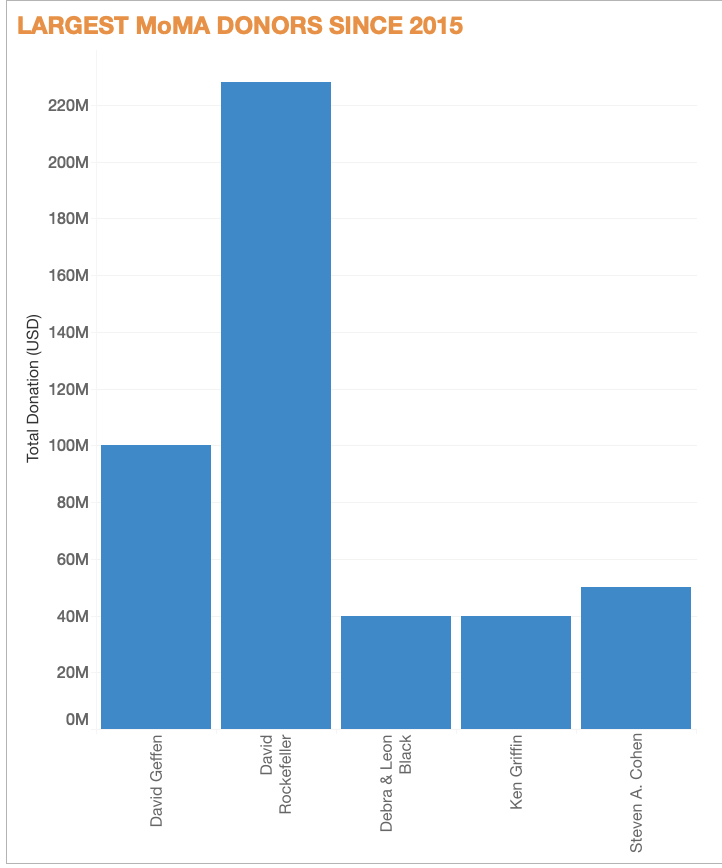
MoMA raised funds at a breakneck speed. According to various reports,
updates from MoMA, and a Chronicle of
Philanthropy database search, the museum accrued the
following gifts: $40 million from hedge-fund manager Ken Griffin in
2015; $100 million from entertainment mogul David Geffen in 2016; a
$125 million bequest from the late banker and heir David
Rockefeller in 2017; $50 million from hedge-fund manager Steven
Cohen and his wife Alexandra, also in 2017; $40 million from
private equity tycoon Leon Black and his wife Debra in 2018; and
another $103 million estimated bequest from Rockefeller dated 2019.
(It remains unclear exactly what portion of the bequest applied
directly to the expansion; MoMA did not respond to repeated
requests for clarification.)
That marks a total of $458 million, well in excess of the $400
million reported capital campaign target.
Source: Chronicle of Philanthropy,
artnet News Research. Graphic: artnet News.
MoMA’s pitch found sympathetic ears among some of the country’s
wealthiest. The museum has undoubtedly benefited from the trends in
wealth distribution that make the rich richer—and more comfortable
giving their fortune away.
“The trends in fundraising follow the same trends as wealth
distribution—the giving that we know about is growing steeper and
steeper, where smaller amounts of people are giving larger amounts
of funding,” Ellis said. MoMA’s own campaign reflects this trend:
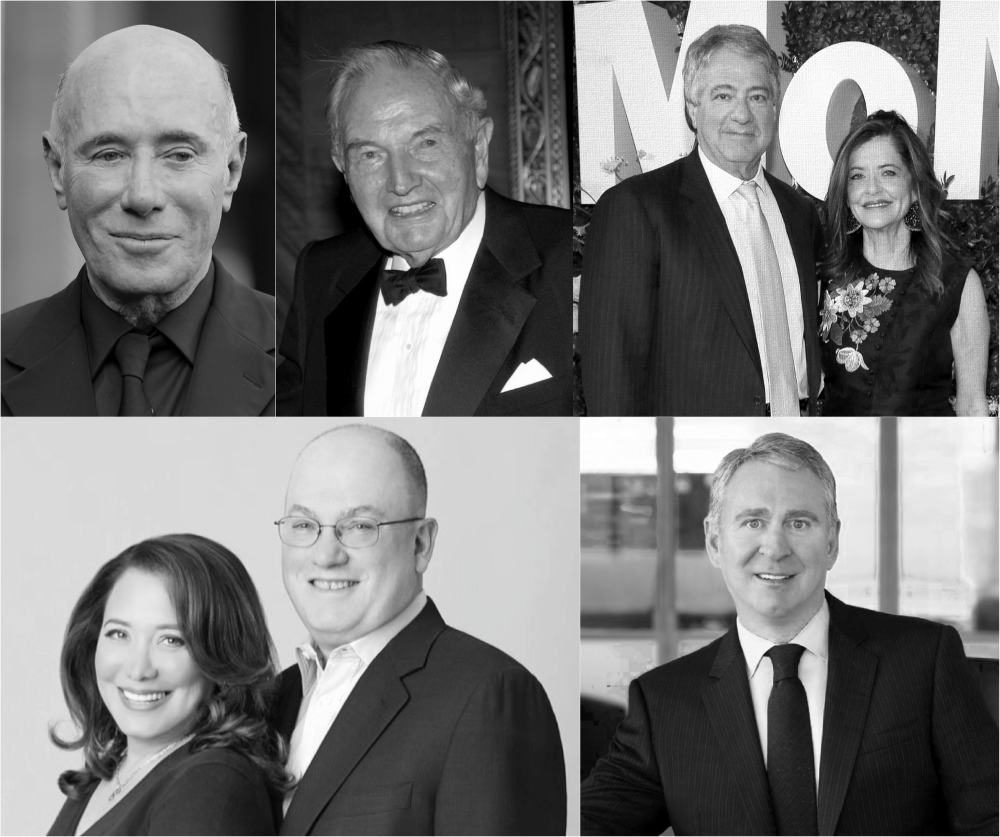
Just four people—Leon Black, David Geffen, Ken Griffin, and Steve
Cohen—gave more than 50 percent ($230 million) of the target
sum.
Crafting the Perfect Pitch
Several elements are crucial to a money-raising effort of this
magnitude, according to Ellis. First, a compelling pitch or
“argument” for why donors should give to you over other deserving
causes; second, wealthy prospects to pitch to; third, people who
can ask for money in an effective manner; and, fourth, a
sophisticated development department to support the people making
the ask. “If you look at MoMA, they’ve got all that,” Ellis
says.
One could imagine the pitch might still be difficult. The new
MoMA unmoors the solid narrative of Modernism (whose titans are
well represented in the collections of its biggest donors).
Instead, it offers a consistently changing display that better
integrates artists of different generations, races, media, and
nationalities.
How did those who supported the museum 15 years ago become
advocates for this version of art history? MoMA pitched it as an
extension of the vision of its vaunted founder Alfred Barr, whose
most closely held value was progress. (Barr famously depicted the
museum’s collection as a torpedo moving through time.)
“They want to feel that they are
contributing to that idea of Alfred Barr’s—that the museum is a
laboratory in which the public is invited to participate in the
experiments,” Lowry told artnet News. “I
think what they’ve bought into was a
sense that they could add a new chapter to that, enable
a new set of conversations to take
place. So we were very lucky.”
Clockwise from top left: David Geffen;
David Rockefeller; Leon and Debra Black; Alexandra and Steven
Cohen; Ken Griffin.
Reynold Levy, a consultant and former president of Lincoln
Center, notes that “organizations like MoMA have very committed
boards,” while its development teams do a really good job of
getting donors involved and excited.
Surprisingly, however, not every major MoMA donor is a board
member, while many serve in leadership positions on other museum
boards at the same time. Black, whose wife Debra is on the board of
the Met, was named chairman of MoMA’s board in spring 2018; Cohen,
who is also on the board of LA MOCA, became a MoMA board member
that same year. Neither Geffen nor Griffin is on MoMA’s board
(though Ken’s wife, Anne Dias Griffin, is).
“It becomes a competition among the nonprofit organizations,”
says Maria DiMento, a staff writer at the Washington, DC-based
Chronicle of Philanthropy. “There is so much crossover
especially when so many donors are involved with more than one
cultural group.”
Some donors may have been convinced by the fact that MoMA
offered naming rights in exchange for hefty gifts. In a nod to
Geffen’s $100 million donation, MoMA will now have a David Geffen
Wing, comprised of three floors of new galleries in a residential
tower designed by French starchitect Jean Nouvel. An existing
fourth-floor exhibition space is also set to be named in honor of
the mogul. Meanwhile, the museum announced in 2017 that MoMA’s
largest contiguous gallery will be called the Steven and Alexandra
Cohen Center for Special Exhibitions.
In addition to those bragging rights, it’s no secret that the
close association with a museum focused primarily on modern and
contemporary art also comes with added perks and access to the
white-hot contemporary market. “The vast
majority [of board members] are collectors of modern and
contemporary art so they live and breathe what we do,” Lowry said.
“They’re incredibly generous and they believe in the
staff.”
Goal Oriented
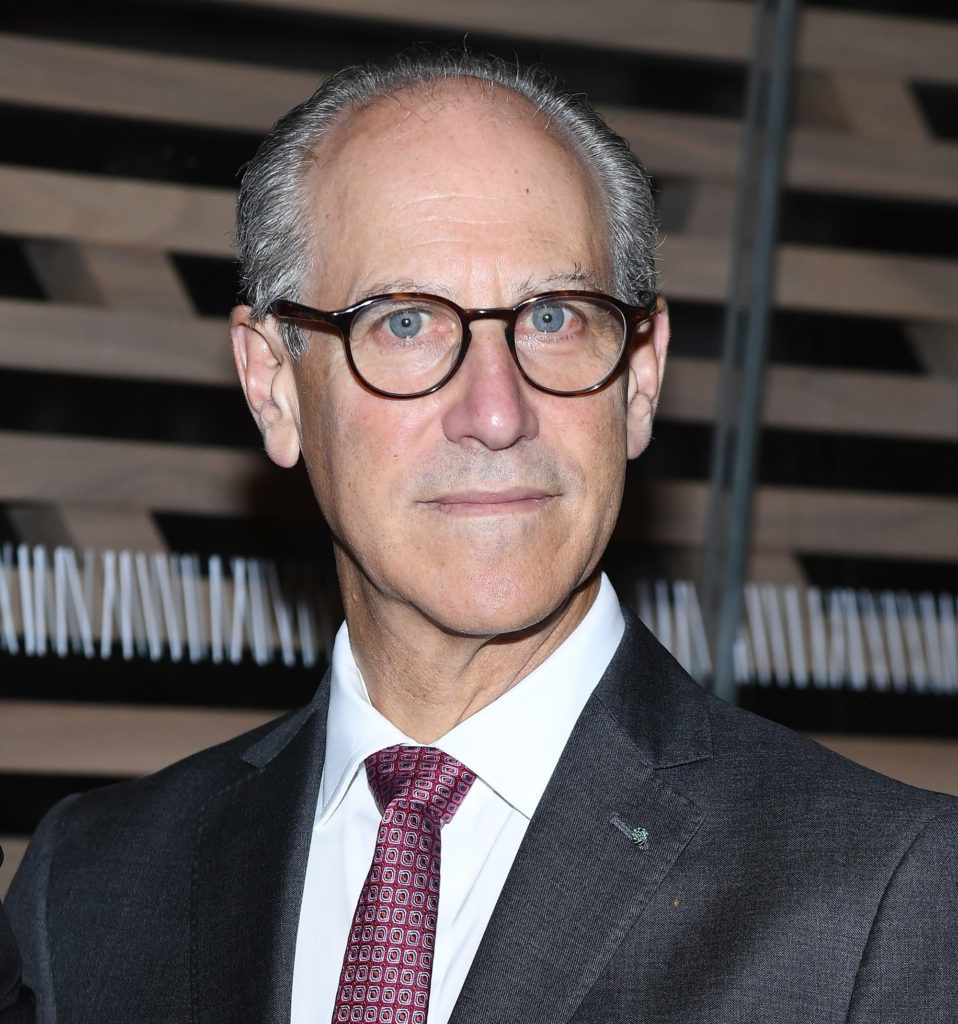
MoMA also has the benefit of experience: This is Lowry’s second
monumental capital campaign (following the $800 million-plus revamp
in the early 2000s).
“There is no magician pulling a rabbit out of a hat, there is
terrific leadership at MoMA,” Levy says. “It’s no accident Glenn
Lowry has been with the organization for as long as he has.”
Glenn D. Lowry attends “Etre Moderne :
Le MoMA A Paris” exhibition at Fondation Louis Vuitton on October
9, 2017 in Paris, France. (Photo by Pascal Le Segretain/Getty
Images)
Indeed, part of Lowry’s skill undoubtedly involves aligning
donors’ deepest aspirations with those of the museum. When Geffen’s
$100 million gift was announced in 2016, the entertainment mogul
fondly recounted his personal connection to the institution—visits
to the museum when he was starting out at an entry-level position
at William Morris Agency.
“When I worked in the mailroom at the William Morris Agency, I
used to brown bag it at the sculpture garden of the Museum of
Modern Art,” Geffen—who is friends with MoMA’s president,
Marie-Josée Kravis—said. “It’s where I developed my interest in
post-World War II art.” Now, his name will adorn that same
institution in perpetuity.
The post How New York’s MoMA Raised More Than $400 Million
for Its Expansion in Just Four Years appeared first on artnet
News.
Read more https://news.artnet.com/market/moma-secret-weapon-massive-400m-expansion-1671187
Further reading


Leave a comment