
The Gray Market: Why the Trump Tax Cuts Are Killing the Art Market Despite Coddling the Richest American Families (and Other Insights)
Every Monday morning, artnet
News brings you The Gray Market. The column decodes important stories from the
previous week—and offers unparalleled insight into the inner
workings of the art industry in the process.
This week, stringing up the
trickle-down fantasy…
CUT ME DEEP
On Sunday, David Leonhardt of
the New York
Times held forth on
a bombshell conclusion about American class disparity with a blast
radius that impacts everyone. According to research by economists
Emmanuel Saez and Gabriel Zucman, the 400 richest families in the
US paid a lower total tax rate in 2018 than everyone else in the
country. And while Leonhardt never draws a specific link between
this ghastly stat and the art market, I think the consequences are
very real… but not necessarily in the way you might
think.
Saez and Zucman’s data appears
in their forthcoming book, The Triumph of
Injustice: How the Rich Dodge Taxes and How to Make Them
Pay. To elaborate a
bit, the duo claim that the 400 plutocratic families in question
benefitted from a total total tax rate—meaning a combination of
federal, state, and local levies—of just 23 percent last year. In
comparison, the poorest half of Americans paid a total rate of 24.2
percent, and the other income brackets’ rates rose
higher.
While some other pedigreed tax
dorks (such as Howard Gleckman of
the non-partisan Tax Policy Center) dispute the details of the finding, no one
with a shred of credibility contests the distressing macro
situation it manifests: namely, that the wealthiest citizens have
managed to warp the system in their favor to achieve stunningly low
rates on their historically stacked fortunes, while all other
earners have lagged far behind.
Another point on which nearly
every serious analyst agrees is that Donald Trump’s Tax Cuts and
Job Act has had a plump orange hand in creating this state of
affairs. Passed through a conservative-controlled Congress at the
close of 2017, the bill reshaped the American tax code to
plutocrats’ disproportionate benefit effective January 1 of last
year. (Leonhardt succinctly defines the law as “largely a handout
to the rich.”) In fact, Saez and Zucman contend that these
Trump-sponsored changes provided the last bit of force needed to
plunge the 400 wealthiest families’ rates below those of the rest
of the US.
You might think that this
situation automatically benefits auction houses and galleries,
especially those at or near the apex of the sales hierarchy. After
all, their richest American clients were allowed to keep a stupid
amount of money in their pockets after taxes last year, with
similar savings in store going forward. That should translate to
more sales and resales of high-dollar work… right?
Well, not
exactly.
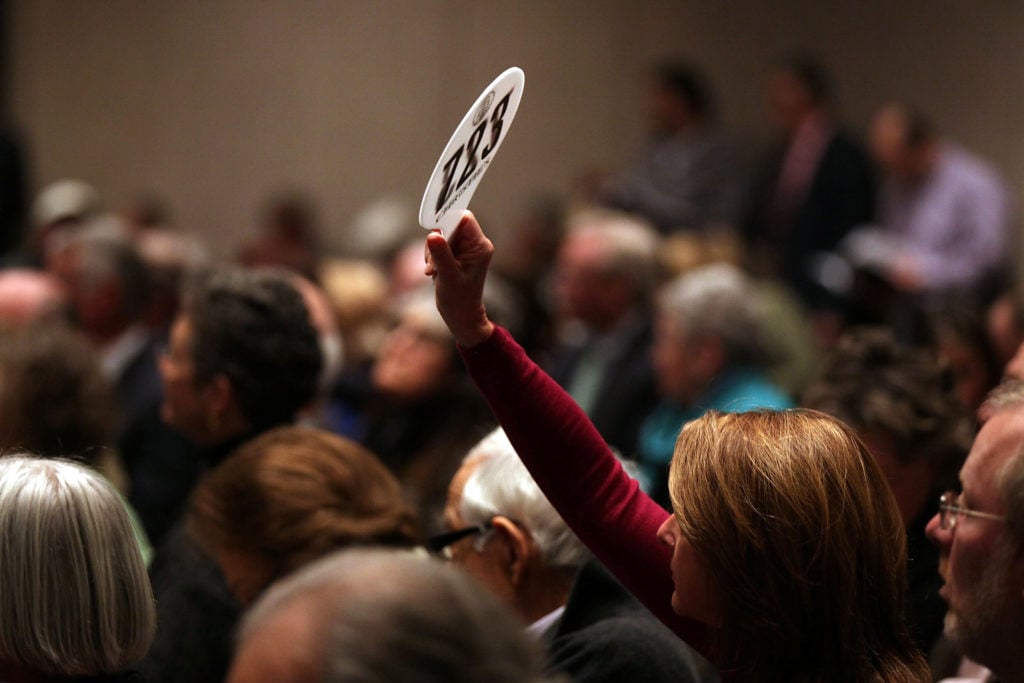
Bidders at Christie’s New York. Photo by
Spencer Platt/Getty Images.
EXCHANGE STUDENTS
Although the Trump tax cuts
were, and continue to be, an extended open-mouth kiss to the
wealthiest Americans, they also took away a crucial contributor to
several years of obscene growth in the art trade, especially at the
top end. The Tax Cuts and Jobs Act wiped out so-called 1031 (or
“like-kind”) exchanges for every asset class except real estate,
and the art market has been suffering because of it ever
since.
For the uninitiated, the 1031
exchange is a provision that allows certified investors to avoid
capital-gains taxes when they flip certain assets, provided that
they put the sales proceeds into the purchase of one or more assets
of the same type within a short time frame. On paper, the logic is
that the subsequent purchases boost the economy more than a tax
payment on the prior sales would. In practice, it is just another
policy ushered in to aid the very wealthy at the expense of
everyone who would benefit from a better-funded federal government.
(Remember: complexity always favors the rich, because they’re the
only ones who can pay accountants and attorneys to hunt down and
capitalize on every loophole.)
Until Trump’s tax regime took
effect, artworks were among the assets qualifying for 1031
exchanges. This fact was especially valuable because, without
making these hallowed swaps, art sales were taxed at the maximum
capital-gains rate of 28 percent. (There were, and still are,
multiple capital-gains rates triggered by different
factors.)
It wasn’t the tax shield alone
that made 1031s so vital to the art market; it was also the speed
they demanded. Resellers had to file paperwork identifying their
replacement asset(s) within 45 days of offloading the original
one(s) and complete the new acquisition(s) within 180 days. These
stipulations created urgency and velocity in the trade. Sure, you
could hold a work for as long as you wanted. But once you decided
to flip it, you had to get the replacement(s) in house
fast.
This situation was especially
good for dealers. Because of the short fuse and the number of
moving parts in these transactions, collectors who wanted to use
1031 exchanges had incentive to minimize the number of middlemen
involved. In other words, the safest, most efficient way to execute
a tax-free swap was to sell to (or sell through), and buy from, the
same source.
When this happened, dealers got
a double bonus. On the front end, they received either a valuable
artwork for their own inventory, or a fee for arranging a sale to
the end client. And on the back end, they either made a sale
themselves, or took another advisory fee for arranging the deal
that yielded the replacement work. (Private-sales departments at
auction houses could enjoy the same advantages.)
Regardless of the exact
machinations, though, the point was that everybody won—and kept
winning. 1031s kept the art market churning, throwing off millions
of dollars for American collectors, dealers, and auction houses to
catch like they were all inside a money
machine that blows
a tornado of $100 bills around a glass
cube.
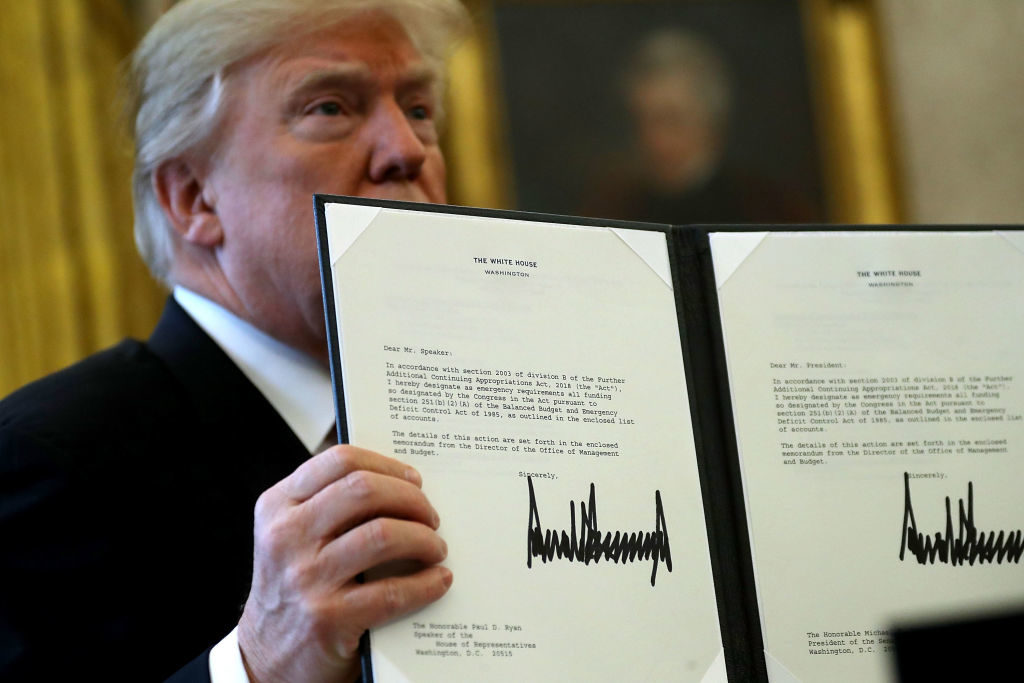
Donald Trump holds up a copy of
legislation he signed before before signing the tax reform bill
into law in the Oval Office December 22, 2017. Photo by Chip
Somodevilla/Getty Images.
DOUBLE TROUBLE
Unfortunately for the art
market, Trump’s tax-cut bill took a sledgehammer to the 1031 money
machine, and the so-called opportunity
zones that were
established as a replacement haven’t provided anywhere near as much
juice to the trade. Nearly two years on, the high-end dealers and
directors I trust the most have been lamenting the old loophole’s
closure with a poignance normally reserved for homeowners who have
lost everything in a fire. In other words, we’re not talking about
a minor inconvenience. We’re talking about serious pain.
Auction results tell part of the
tale. Fine-art sales in the US declined by 18 percent in the first
six months of 2019 versus the equivalent period last year,
according to the latest artnet Intelligence
Report. The first half
of 2019 also saw a 35 percent worldwide drop-off in sales of works
priced at $10 million and up, AKA the pieces most likely to have
been involved in 1031 swaps previously.
As I pointed out a few weeks
ago, multiple factors
contribute to these contractions. I didn’t call out 1031s at the time because,
weirdly, auction sales were up over 20 percent in the US in
2018 per my colleagues
at artnet, suggesting
that the loophole didn’t make much of a dent in the market early
on.
Maybe American collectors and
dealers were just more willing to stomach the capital-gains tax as
the cost of doing business back then, before the economy started
experiencing more intense drags resulting from
the US-China trade war,
worsening Brexit chaos, and continued unrest in Hong
Kong. (Remember, in a
global capitalist economy, problems anywhere can become problems
everywhere.) But whatever the motivation, things have shifted, and
I’d wager that the death of 1031s play at least a supporting role
in the drama.
As a result, it’s safe to say
that Trump’s Tax Cuts and Jobs Act has been doubly damaging to the
art market. On one hand, it has obliterated what had been a major
contributor to growth at the top of the market. On the other hand,
it has (predictably) failed to deliver any significant savings to
the middle and upper-middle classes, whose retreat from the
art trade during our era
of widening wealth inequality has helped starve out many modestly
sized dealers and mid-career artists.
So whether or not you buy Saez
and Zucman’s headline stat about the 400 richest American families
getting a better deal from the IRS than the rest of us, it’s
undeniable that the Trump administration has been a “yuge” problem for the art market in the US… and
thus, the world. And if the ever-worsening impeachment saga doesn’t
remove him from office before November 2020, every American in the
art business—or driven out of it for financial reasons—should keep
that in mind when the ballot box opens again.
That’s all for this week. ‘Til
next time, remember: with wealth as with all things, hoarding is an
ugly habit.
The post The Gray Market: Why the Trump Tax Cuts Are Killing
the Art Market Despite Coddling the Richest American Families (and
Other Insights) appeared first on artnet News.
Read more https://news.artnet.com/opinion/gray-market-trump-tax-cuts-1678015
Further reading


Leave a comment