
‘Only the Important People Get to See It, and That’s a Problem’: Turner Prize Nominee Tai Shani on the Inaccessibility of Performance Art
The eye-popping pink
sculptural installation at this year’s Turner Prize exhibition,
held at the Margate gallery Turner Contemporary, marks a new
chapter in artist Tai Shani’s “Dark Continent” series, which
has occupied her practice for the past five years. It is a mythical
apatriarchal universe created through a mash-up of sculpture,
performance, and text, namely an epic novel that’s narrated by
an actor who appears on a screen.
“I’m incredibly honored that the
politics in this work are being placed in the context of the Turner
Prize,” Shani tells artnet News during a recent visit to
her cramped studio in South East London. While the 43-year-old
artist’s work is formally very different from the other three
nominees—Helen Cammock, Oscar Murillo, and Lawrence Abu Hamdan—she
says there is actually a lot of overlap between all four
presentations. “We’re all looking at inequality and power in
different ways, and that’s quite unique I think for a Turner
Prize.”
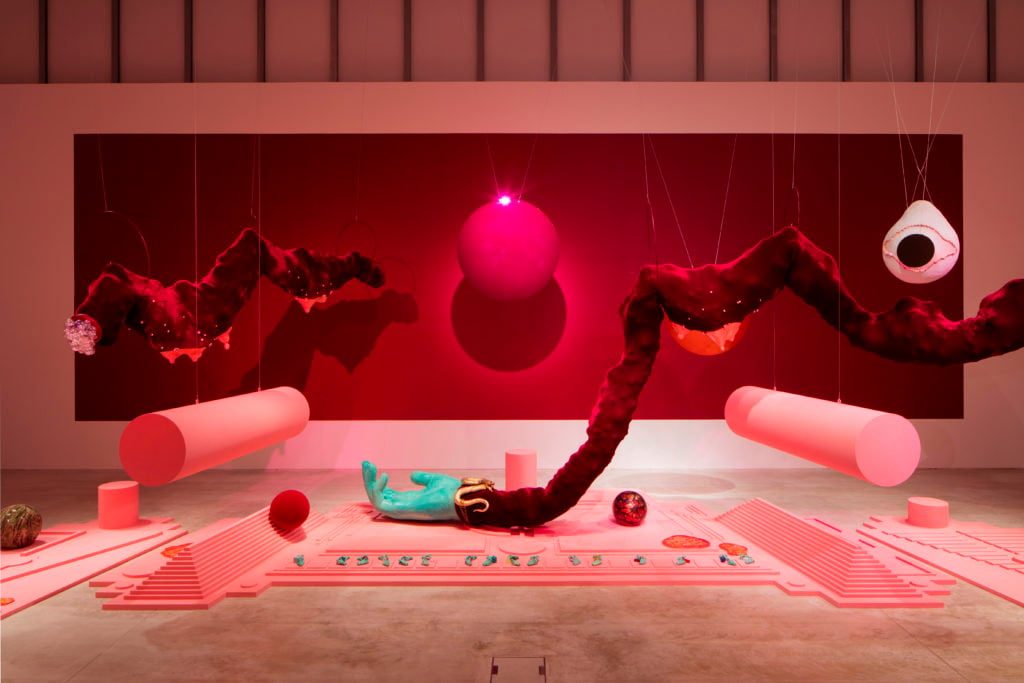
Tai Shani, DC: Semiramis (2019).
“Turner Prize 2019” at Turner Contemporary. Photo by David Levene.
Courtesy the artist and Turner Contemporary.
It takes seven hours to watch
the whole cycle of Shani’s work, and it isn’t easy to understand
because it’s told through Shani’s florid, purple language. “I
didn’t know where to start because I felt very weighed down by the
monolith of white Western male thought,” Shani says. Her writing
draws on texts ranging from the medieval mystics (texts she likens
to “the Rosetta stone of experimental literature”) to speculative
and science fiction, particularly feminist sci-fi written by
authors like Marge Piercy, Ursula K. Le Guin, Octavia Butler, and
Donna Haraway.
A 15th-century text by Christine
de Pizan, The Book of the
City of Ladies, was the
work’s starting point, though Shani emphasizes that her city is a
21st-century update, which does away with gender norms and the
patriarchy. It is instead an inclusive space for all “womxn,”
including trans and non-binary people. She sees the work as a sort
of philosophical thought experiment, or a platform to think about
transformative politics. “This is a created mythology,” she says.
“But so is patriarchy—it’s just one that huge numbers of people
have collectively bought into.”
Some of Shani’s fans have
bemoaned the absence of live performance in her Turner
presentation. Performance has been an important part of Shani’s
practice for the past 15 years, but more recently she has been
focusing on installations and a more sculptural practice. She says
this is partly a natural evolution, but also due to a lack of
institutional support when it comes to funding performance
art.
“When I found out I was
nominated it became clear that I’d have to rethink what would work
in that setting.” For starters, she says, the space is smaller than
she is used to working with, so rather than presenting an element
of her world at the same scale, she decided on a zoomed-out version
of the city instead. But the bigger issue was how to fund a
performance for the run of a three-month-long
exhibition.
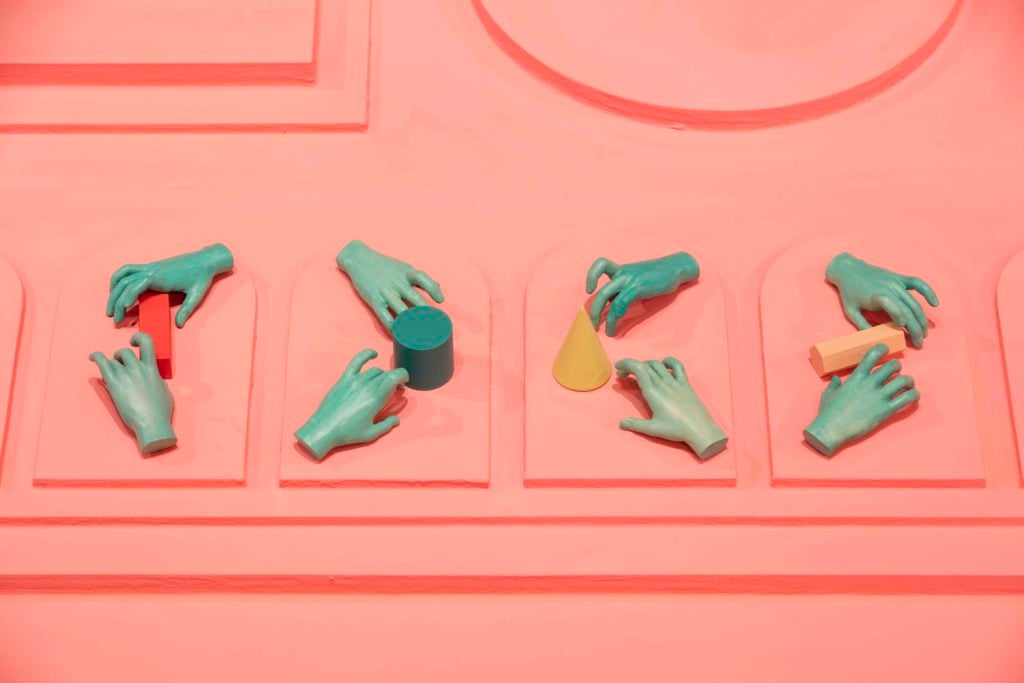
Tai Shani, DC: Semiramis (2019).
“Turner Prize 2019” at Turner Contemporary. Photo by David Levene.
Courtesy the artist and Turner Contemporary.
“The way that the art world is
structured doesn’t support performance very well,” Shani says.
“[Institutions] don’t have the resources to be able to sustain
three months of everyday performance with a cast of 13.” Costs
include performer fees, accommodations, travel, technical
assistance, and beyond. “So for me I knew that I wanted to make an
installation that would function and be autonomous.”
While there will be a number of
performances throughout the run of the exhibition, they will be
ticketed, and due to the unsettling nature of some of the text,
they will also be age-restricted and viewable only after Turner
Contemporary’s regular opening hours.
While there have been some
strides toward encouraging collectors to invest in performance,
such as a new performance
art fair, it is rare for
a collection to acquire performance. Shani says she was “extremely
fortunate” that Arts Council England acquired the protocol for her
performances, which, she explains, is kind of a manual for how to
stage the work, consisting of 12 videos of the performances, the
script, some of the hand-made costumes, the 3D plans for the floor,
and some of the hand-made sculptures.
The financial realities of
staging performance also limits where it is shown and who gets to
see it. Even with the healthy budget of Glasgow International,
Shani could only do performances for the first three days of the
festival, accessed mainly by the VIPs. The performance program at the
Venice Biennale this year faced the same issue. Despite funding
from Arts Council England, biennale curator Ralph Rugoff said the
cost of running the performances beyond the opening week and
closing weekend, was prohibitive.
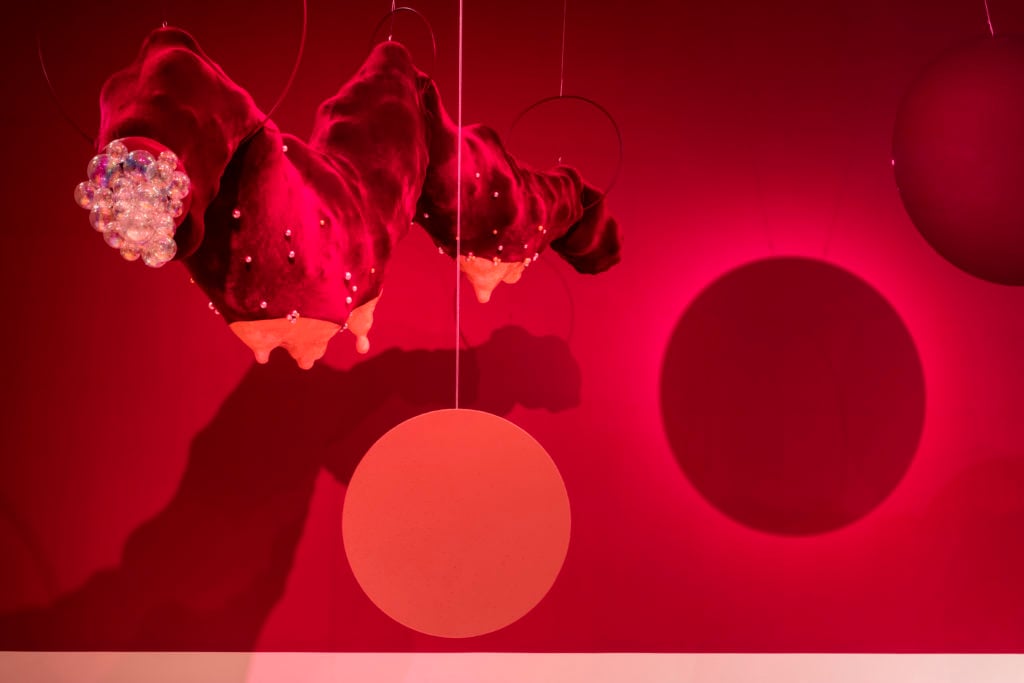
Tai Shani, DC: Semiramis (2019).
“Turner Prize 2019” at Turner Contemporary. Photo by David Levene.
Courtesy the artist and Turner Contemporary.
Similarly, Anne Imhof’s Golden
Lion-winning performance in Venice, Faust, could only be shown in its full five-hour
version during the opening week in 2017. It was then reduced to a
two-hour performance with the full version only show on the
weekend. This year’s Golden Lion winner, the Lithuanian pavilion’s
climate change opera Sun, Sea, Marina, had to confront a similar problem:
It cost a whopping $3
a minute to run. Even
with the support of crowdfunding, after the vernissage week, it has
been running just once a week on Saturdays.
“Only the important people get
to see it, and that’s a problem,” Shani says. “Because then
ultimately what happens is that the fallout of that is on the
artists and not on a kind of critique about how we finance these
things. It becomes, like, ‘Oh I went to see it and it was empty and
it was shit,’ as opposed to a recognition that this artist couldn’t
be supported.”
Shani hopes the art world shifts
from making massive investments in single works of art toward
sustaining the livelihood of performers. “You’re not just putting
financial investment into objects,” she says, “you’re investing in
people.”
The post ‘Only the Important People Get to See It, and
That’s a Problem’: Turner Prize Nominee Tai Shani on the
Inaccessibility of Performance Art appeared first on artnet
News.
Read more https://news.artnet.com/exhibitions/tai-shani-on-performance-art-1676260
Further reading


Leave a comment