
Experts Anticipate Paris’s Art Market to Benefit From a Brexit Bump, but the City Is Also in the Midst of a Cultural Renaissance All on Its Own
The art market is rife with
speculation as Brexit hangs in the balance ahead of FIAC in Paris,
which opens to the public on Thursday. But regardless of any
tailwind to be had from the UK’s messy divorce from the European
Union, the French capital is charting its own course to becoming
revitalized as a major art market hub.
Inside the vast glass and iron
exhibition hall that is the Grand Palais, exhibitors are seeking to
satisfy the expectation of museum-quality presentations at the
French fair. Some promised highlights will be a large
sculptural work by Yayoi Kusama, on view at Victoria Miro’s
booth, which will be echoed outside the fair as the Japanese artist
takes over the Place de la Vendôme with a giant inflatable polkadot
pumpkin.
Muscular works by blue-chip
artists are a mainstay for art week in Paris, a city that is
steeped in institutions and deep-pocketed collectors. After the
successful presentation of a work by Louise Bourgeois at Hauser &
Wirth last year, which went for a whopping $2.5 million, the
Swiss-owned gallery returns with yet another installation by the
French sculptor.
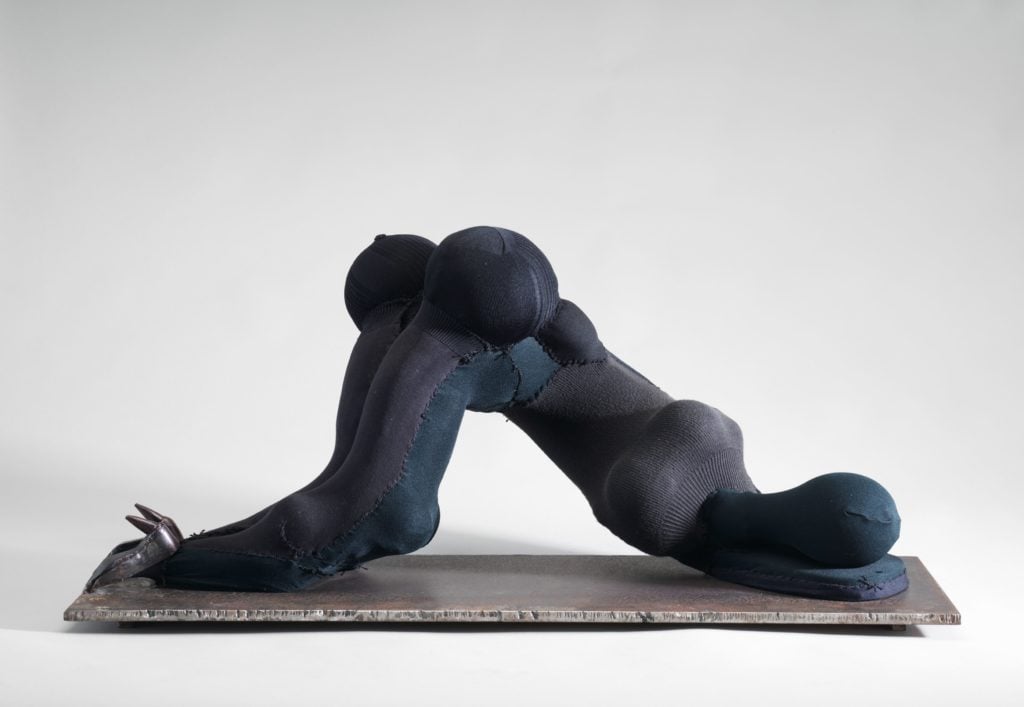
Louise Bourgeois, High Heels
(1998). ©The Easton Foundation/ DACS 2019. Courtesy The Easton
Foundation and Hauser & Wirth.
“Paris is a hotspot right now,
but it has always had an enduring appeal,” Hauser & Wirth president
Iwan Wirth tells artnet News. “The profile of the fair has become
more international because discerning collectors are drawn to the
city by the outstanding institutional exhibitions.”
Wirth says that the gallery is
anticipating conversations with foundations and museums again this
year. “They respond so well to the refined atmosphere and singular
focus of FIAC,” he adds.
May You Live in Turbulent Times
For those passing by the
impressive façade of the Grand Palais this week, a statement
billboard by the Nigerian artist Emekah
Ogboh will take pride of place. It reads “Quand il y a un, ça
va…” (“when there is one, it’s fine…). The saying, (the second half
of which continues, “…It’s when there are many that there are
problems”) calls out the racist rhetoric that has taken hold in
Paris and elsewhere in Europe in recent years. The public piece
will be in dialogue with another work by Sylvie Fleury, a neon
that, as if responding to Ogboh’s quoted provocation, reads “YES TO
ALL.”
For many, Fleury’s work might
also conjure up the looming specter of Brexit. Uncertainty has been
haunting collectors and dealers who are trying to predict whether
the UK’s imminent exit from the European Union might destabilize
London’s stronghold over the European art market in favor of the
French capital. A
Eurostar train ride away in Brussels, Brexit negotiations are
pushing ahead, and many in Paris are voicing the opinion that the
city might be an incidental winner if new tax hurdles and delays at
the border end up shifting European trade there instead of
London.
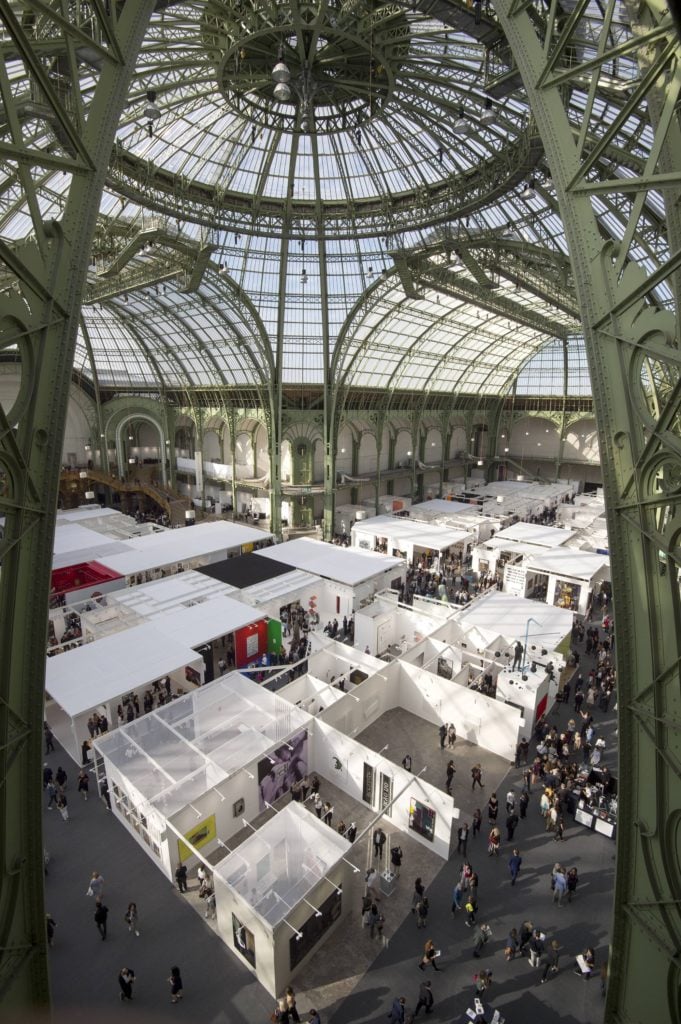
FIAC at the Grand Palais. Photo by Marc
Domage.
“It has been clear for a while
that Paris is a big winner of Brexit,” Maya Mikelsone, a
Paris-based curator and art advisor, tells artnet News. “It is
becoming more international. Just to mention that David Zwirner,
White Cube, and Pace are opening new spaces in Paris. I guess they
are not doing this without a reason.” While the Pace space is not
yet confirmed, ARTnews reported recently that the mega-gallery was
looking for a building in the French capital. A spokesman for Pace
declined to comment on the matter when reached by artnet
News.
However, Belgian art collector
Alain Servais is not convinced by the idea that London’s turbulent
politics will teeter the market towards the French capital. “The
art market is global and is very handy at going around ‘local’
constraints like customs and exchange rates,” Servais tells artnet
News. “Therefore, I don’t see there being much fuss to be had with
Brexit before we know the exact consequences.” He adds that the art
market will probably find a way around the new limitations that
Brexit might pose.
Give Paris a Chance
The Belgian collector also
underscored the fallacy of pitting Frieze London and FIAC against
each other. “It is more and more a mistake to want to create
competition or comparison between both,” he says, explaining that
London and Frieze are much more business-oriented, contemporary
art-focused, with more branding clout and higher price ranges than
their French counterparts.
On the flip side, Paris and FIAC
have more prestige, which is appealing to international visitors,
and especially US collectors. “The atmosphere is much easier-going
in Paris: less business, more culture, good food, and drinks.
Frieze and FIAC are two different fairs
in different cities for
a different public,” he
adds.
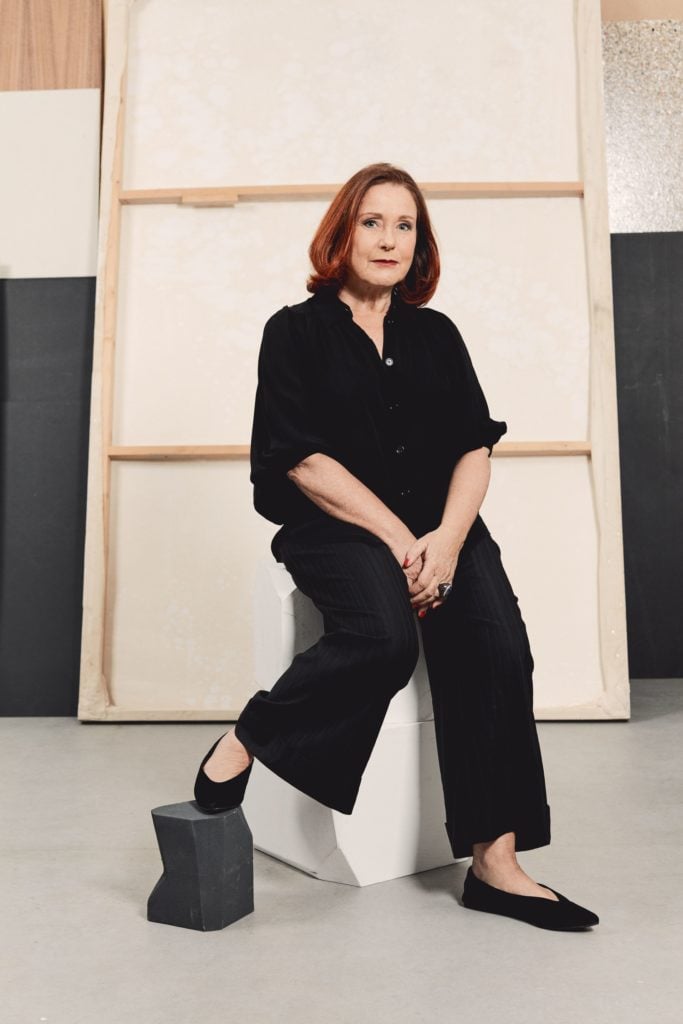
Jennifer Flay. Portrait by Max
Tetard.
FIAC’s director Jennifer Flay is
of the same mind. The two fairs are different beasts, and there’s
no reason they can’t stand side-by-side. “It is possible that Paris may benefit from a
Brexit, but at this point, no one is certain of the conditions in
which Brexit will occur, and therefore even less of its potential
impact on France and other European countries,” Flay says. While
many of the French feel a “deep sadness” about the situation, she
says it is “disheartening” and “not constructive” to think of one
city benefiting at the expense of another.
“If there is what is perceived
as a cultural renaissance in France and in Paris—I believe this is
the case—it has nothing to do with the as yet undetermined effects
of Brexit,” Flay says.
Indeed, Parisian galleries are
experimenting with new formats, for which we cannot credit Brexit.
In an expansive site in the borough of Romainville, five
Parisian contemporary art galleries are opening exhibition spaces
as part of a new initiative called “Komunuma.” Galleries Air de Paris, Galerie Sator,
Galerie Jocelyn Wolff, and In Situ’s Fabienne Leclerc will be part
of the complex. Elsewhere, fashion and art’s continuous overlap in
the stylish capital can be found at the Centre Pompidou, where Rick
Owens has created a series of monolithic beds on which living
statues will take part in an evening of performance.
So, whatever storms are brewing
across the channel, Paris is making headway on its own. “[Paris’s
renaissance] is the result of a gradual transformation that has
been underway for the past 15 to 20 years, which results more from
a renewed self-confidence rather than an unfortunate external
event,” Flay says. “It is inherent to the dynamics of the French
cultural world as they have developed over the last three
decades.”
The post Experts Anticipate Paris’s Art Market to Benefit From a
Brexit Bump, but the City Is Also in the Midst of a Cultural
Renaissance All on Its Own appeared first on artnet
News.
Read more https://news.artnet.com/art-world/fiac-brexit-1677328
Further reading


Leave a comment