
How Painter Gerald Murphy Infused the Mark Cross Company With the Spirit of European Modernism
Across three centuries, Mark
Cross has stood for luxury—but not the kind that money can buy.
Instead, the distinguished leather-goods company—which was created
as a hand-stitched saddlemaker in 1845 by the Boston entrepreneur
Henry W. Cross, who named it after his baby son—represents the more
rarefied luxury of life well lived: of wit, sophistication,
effortless cosmopolitanism, and unbounded travel.
Its pedigree is knowingly
referenced in classics of American culture. When
The Catcher in the
Rye’s
Holden Caulfield arrives at the
Elkton Hills prep school, his Mark Cross luggage casts him as
upper-crust (to his chagrin). When Grace Kelly’s socialite comes to
stay the night with Jimmy Stewart’s injured photojournalist
in Rear Window, she means her Mark Cross overnight bag to show
her skeptical husband-to-be how practical she is (despite the fact
that it contains nothing but a silky nightdress).
But the best expression of the
Mark Cross esprit may well have been embodied by its legendary
onetime president, Gerald Murphy, the American painter, bon
vivant, and irrepressible creative catalyst whose life at the
center of France’s artistic world in the 1920s suffuses the brand
to this day.
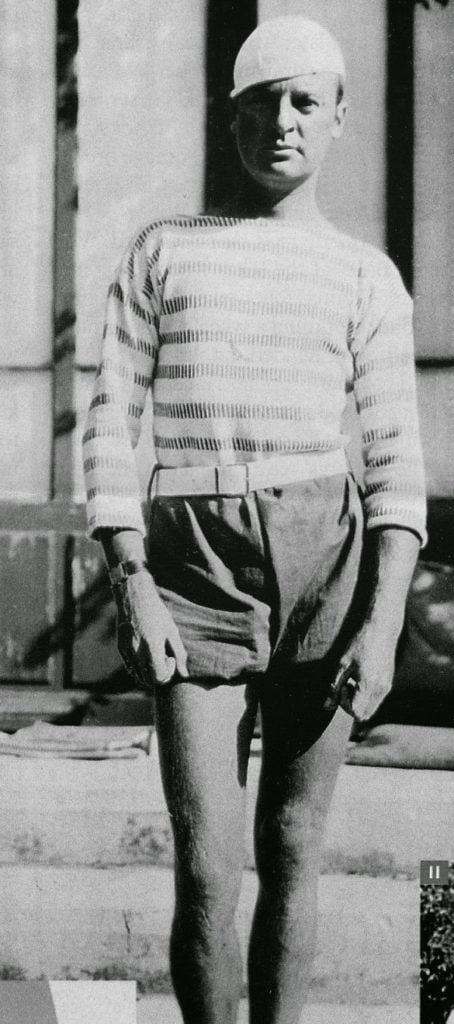
Gerald Murphy. Image courtesy Mark
Cross.
The subject of a biography by
Calvin Tomkins entitled Living Well Is the Best Revenge,
Murphy was the son of Patrick Murphy, the brilliant businessman who
had purchased Mark Cross and transformed it into a transcontinental
brand with lavish stores in London and New York. (It was the father
who introduced American audiences to English-cut crystal, Scottish
golf clubs, Minton China, and Sheffield cutlery.) But business did
not come naturally to Gerald Murphy, whose sparkling cultural life
kept him from the family firm for several decades. Before he
inherited the company, he wanted to change the world.
After rooming with songwriter
Cole Porter at Yale, Murphy married Sara Wiborg, a beautiful
Cincinnati heiress whose nonconformist spirit made her every inch
his match. The couple moved to Paris to evade the gaze of their
disapproving parents and instantly fell into the center of the
city’s avant-garde. Murphy, a landscape architect by training, took
a job helping design sets for the Ballets Russes, then at its
creative apogee under the impresario Sergei Diaghilev. At the same
time, Murphy’s burgeoning interest in painting was nurtured by the
Russian artist Natalia Goncharova, who taught him how to approach
the canvas as a Modernist.
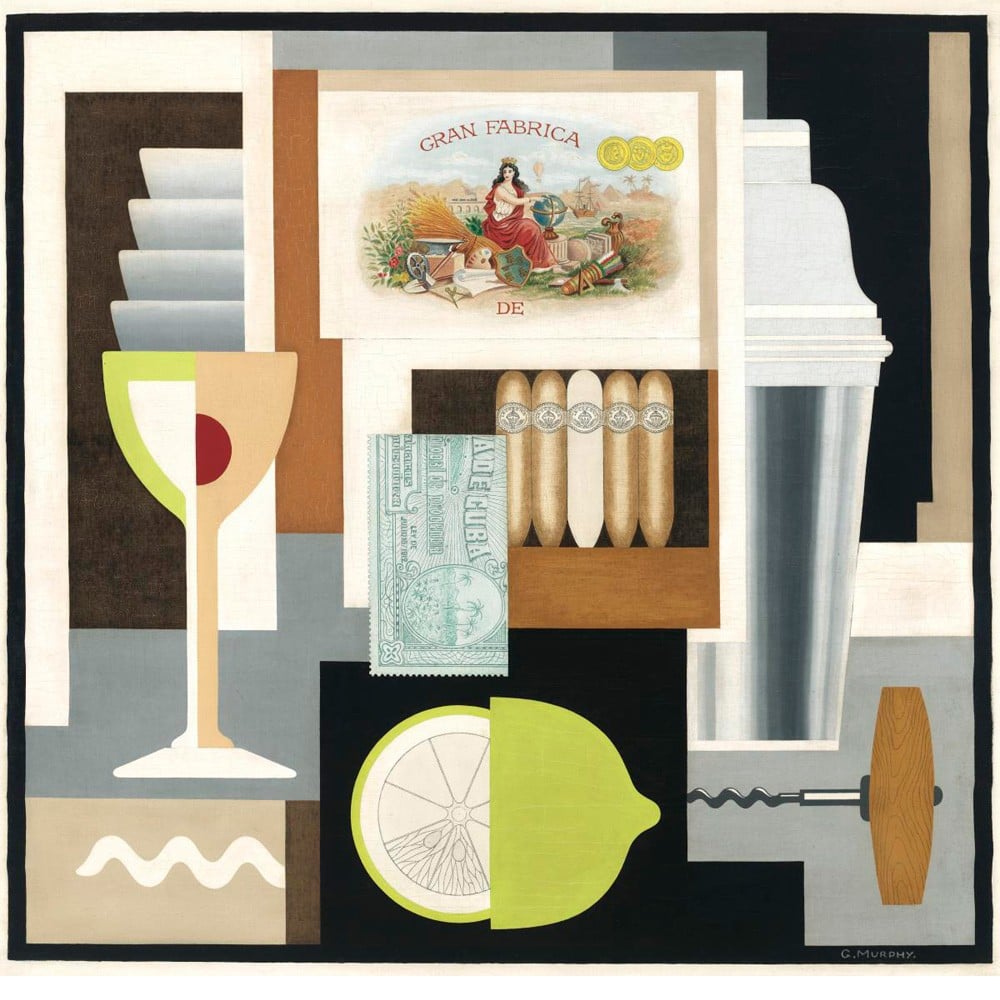
Gerald Murphy, Figure 5.
Cocktail (1927). Image courtesy Mark Cross.
Amid the swirl of a social
milieu that grew to include Picasso (whose wife at the time, Olga
Khokhlova, was a ballerina), Léger, Gris, and other groundbreaking
artists of the time—some of whom the Murphys once entertained
on a notorious floating party in the Seine to celebrate a new
Stravinsky ballet—Murphy found the time to paint, and paint
beautifully. The canvases he turned out (some now in MoMA and other
museums), combined the rigors of hard-edged Cubism with the spatial
finesse of set design, with each object precisely placed to evoke a
world of ordered refinement. He approached his art with the same
offhand lightness he brought to other aspects of his life,
eventually losing track of many of his paintings. One of his
largest works, the 18-by-12-foot Boatdeck, stunned
audiences at the 1924 Salon des Indépendants with its assertive
scale, as if the ship were about to crash into the viewer, and was
deemed a masterpiece. Tragically, it disappeared.
The most mythical chapter of the
Murphys’ lives unfolded when they bought a seaside house in
Antibes, named it Villa America, and hosted an ever-changing influx
of artists, filmmakers, and literary luminaries including Jean
Cocteau, Man Ray, Dorothy Parker, Archibald MacLeish, Ernest
Hemingway, and F. Scott and Zelda Fitzgerald. “Person after
person—English, French, American, everybody—met them and came away
saying that these people really were mastering the art of living,”
MacLeish later wrote of the couple. This was particularly true for
Fitzgerald, who saw in Gerald and Sara a beautiful—if flawed—ideal,
and took them as the inspiration for Dick and Nicole Diver
in Tender Is the
Night.
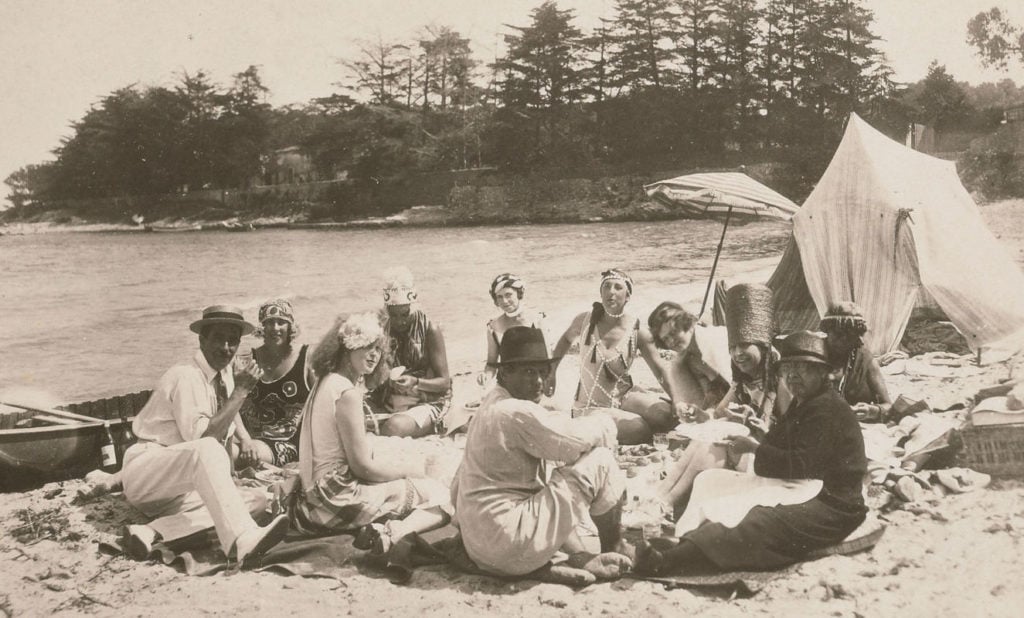
The Murphys and friends in Antibes.
Image courtesy Mark Cross.
The Murphys had a daughter,
their firstborn, Honoria, and two sons, Baoth and Patrick. When
Patrick developed tuberculosis, the family moved back to New York
in 1934. Gerald putting aside his life of painting and bohemianism
to take over Mark Cross, which he ran from 1934 to 1956. He moved
its headquarters to Fifth Avenue and invested his unusually refined
taste into the creation of new signature products. His way of
winning illustrious confidants also opened doors for the business.
It was through his friendship with Hitchcock, who used Mark Cross
desk accessories and luggage exclusively, that the company’s
overnight bag ended up in Kelly’s hands in Rear Window. The classic, box-shaped bag was soon called
the “Grace bag,” and became a hit among shoppers. It remains one of
the brand’s most popular items.
A company that has always been
handed down from one generation of innovators to another, Mark
Cross is currently carrying its storied heritage into a new era,
where its cultivated, worldly-wise approach to luxury is as
relevant as ever. Earlier this year, the brand launched an
artist-in-residence program to support young, emerging talents,
beginning with Alberte Skronski, a Danish sculptor who recently
crafted a series of papier-mâché display models for the Mark
Cross Rue Saint-Honoré store in Paris. This fall, in time to
anticipate its 175th anniversary, the company also will open its
first shop on Madison Avenue, an occasion that will celebrate its
history while also turning a fresh page.
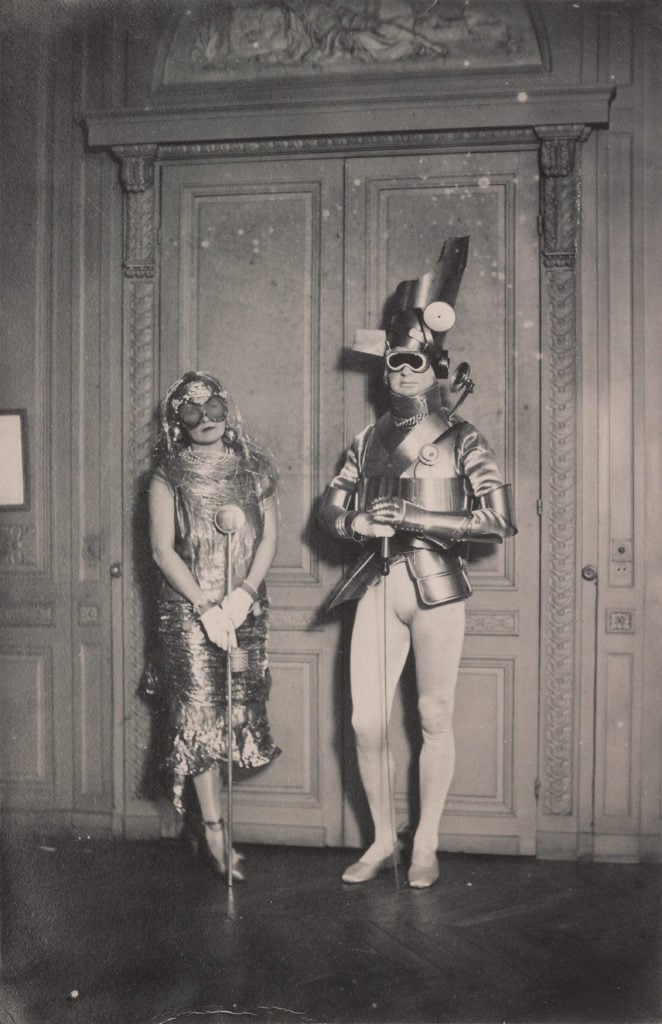
Sara and Gerald Murphy at a costume
party in Montparnasse, photographed by Man Ray c.1922. Image
courtesy Mark Cross.
To honor the moment and pay
tribute to the brand’s deep roots in modern art and culture, Mark
Cross has partnered with artnet News to present “From One Woman to
Another,” a five-part series featuring candid, intimate
conversations with 10 of the art world’s most prominent women, from
RoseLee Goldberg, the savvy founder of the Performa biennial, to
Mariane Ibrahim, the powerhouse dealer behind the eponymous Chicago
gallery. Although Gerald and Sara Murphy are long gone, we imagine
them being part of the conversation as well, as if carried out one
lively night on the terrace of Villa America.
The post How Painter Gerald Murphy Infused the Mark Cross
Company With the Spirit of European Modernism appeared first on
artnet News.
Read more https://news.artnet.com/art-world/mark-cross-from-woman-to-woman-1678762
Further reading


Leave a comment