
These Historic Maori Carvings Were Taken From New Zealand 130 Years Ago. Now, They May Finally Go Home
Historic Maori carvings are set to return to
New Zealand after a 130-year staycation at an English country
house. England’s National Trust, which owns Clandon House, has
agreed in principle with the heritage organization Historic England
to an exchange of the historic artifacts for modern carvings. The
first restitution in the history of the charity, it has the tacit
approval of the National Trust’s president, Prince Charles, who
last month returned a Maori cloak that was given by a chief to
Queen Victoria.
The
move could be seen as a breakthrough by those who have long
campaigned for the restitution of cultural artifacts as well as
human remains in the UK’s museums and cultural institutions. The
decision by the National Trust comes at a time when institutions,
such as the British Museum and the Victoria and Albert Museum in
London, face growing pressure from Indigenous communities and
source countries to redress the legacy of
colonialism.
“The
decision hasn’t been taken lightly but it seems a win-win
situation,” says John Orna-Ornstein, the director of culture and engagement for
the National
Trust. He explains that the
carvings, which were originally part of a historic Hinemihi
meeting house, are important for
the Maori community in New Zealand as well as expat Maoris living
in Britain. They have been using the meeting house, which is in the
grounds of Clandon, since the 1980s. “It is considered a ‘living
being,’” he says.
The
meeting house and its contents were brought to England by William
Hillier, the 4th
Earl of Onslow, who was Queen Victoria’s governor of
New Zealand in the early 1890s. The aristocrat shipped the
oversized souvenir back to his ancestral home at Clandon Park
House, a Palladian mansion in Surrey, in the South East of England.
The only Maori meeting house
in the UK has stood in
the grounds of the country house ever since. The house itself,
which is being rebuilt after a devastating fire in 2015, has been
in the National Trust’s care since the 1950s, along with its
contents.
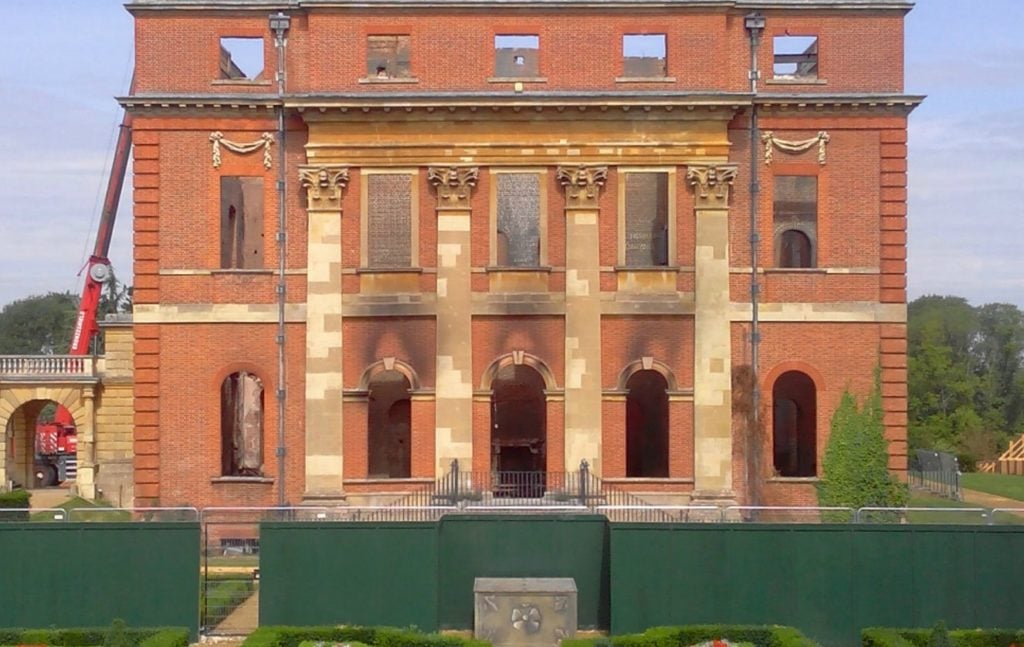
Clandon Park House under restoration.
Photo courtesy of the National Trust.
The
carvings are among the artifacts that survived the fire. They are
now in storage for conservation treatment. Two years ago, the
National Trust received a formal restitution request from Historic
New Zealand on behalf of the people of Rotorua. The meeting house
has an added significance for the Maori community because it was
the place where some of their ancestors took shelter during a
deadly volcanic eruption of Mount Tarawara in 1886, which destroyed
villages and killed more than 120
people.
The
current Earl of Onslow backs the exchange of new carvings for the
historic artifacts. In a statement he
says, “The decision to
swap [the Hinemihi] and return her to her homeland is fantastic
news, because it will increase the interest in Maori culture here
in Great Britain.” He adds that he is proud to be a descendant of
the family that recovered and then restored Hinemihi after the
volcanic eruption in the 19th century.
While the agreement has been made in principle, the National
Trust says that it is at the start of a long process. The
Hinemihi has listed building status and the relevant UK authorities
need to give consent. The National Trust, which is a charity, is
also seeking the formal assistance of the Charity Commission.
The post These Historic Maori Carvings Were Taken From New
Zealand 130 Years Ago. Now, They May Finally Go Home appeared
first on artnet News.
Read more https://news.artnet.com/art-world/england-returns-maori-carvings-1724853
Further reading


Leave a comment