
What Would It Cost for the Art World to Offset Its Enormous Carbon Footprint? We Did the Math
Before the opening of Art Basel Miami Beach last week, as
dealers and collectors prepared to board planes and leave hefty
carbon footprints in their wake, fair organizers promised
to pay to offset the carbon
emissions of their team, VIP representatives, external
consultants, partners, speakers, and invited press.
So what is carbon offsetting?
The basic idea is that individuals and organizations can fund
emissions-reduction initiatives in an effort to “balance out” their
own carbon footprints. Money can be invested in projects to plant
trees and protect forests, or to fund renewable-energy programs.
Often, these take place in developing nations.
Carbon offsetting is a
relatively recent corporate strategy. In September, the Kering
Group, which is owned by the French billionaire art collector
François Pinault, announced it was going carbon neutral by committing to
offsetting its annual greenhouse-gas emissions.
In Miami, Art Basel undertook
additional efforts to reduce waste by offering digital VIP cards,
reusing architectural elements from years past (such as its wall
system), and discontinuing the print catalogues for its Kabinett,
Survey, and Meridians sections. It also hosted a panel on
climate-change denial and introduced biodegradable and compostable
utensils to its restaurants and cafes.
But critics say that offsetting
is just a way to avoid addressing the real problem: that emissions
need to be zeroed out, and not simply maintained at their current
levels. They point out
that offsetting privileges those who can afford to do
it.
So how big is the art world’s carbon footprint, really?
To put it in real terms,
we enlisted Ian
Garrett, associate professor of
ecological design for performance at York University and director
of the Center for Sustainable Practice in the
Arts,
to help us estimate the carbon
footprint of a few major art-world activities.
We ran his numbers
through Climatecare’s carbon calculator
to determine how much it might cost
to offset these activities. Here is what we found.

Photo courtesy Wikicommons.
Sending a team of five on a
round-trip flight from New York to Miami Beach on a commercial
airline
If they fly
economy… the group will
emit between the equivalent of 2.43 and
3.3 metric tons of carbon dioxide.
If they fly business or first class… the
group will emit between the equivalent of
4.2 and 7.06 metric tons of carbon
dioxide.
The cost to offset their
footprints? Between $24.60
and $71.48. And that’s total
for the entire group of five flying both ways, depending on their
seat class.
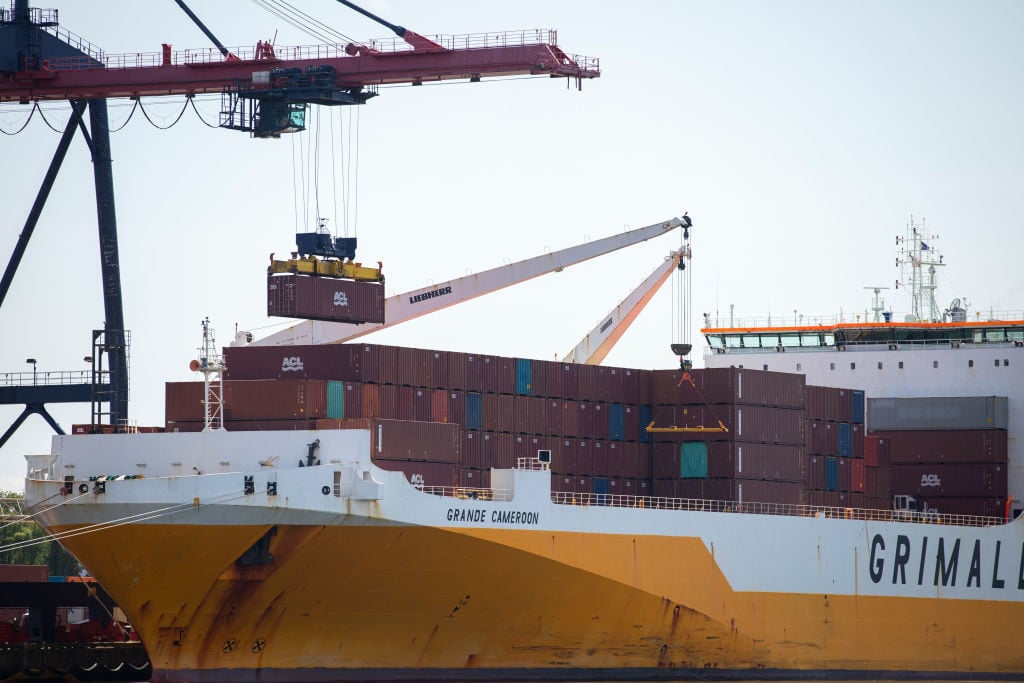
Photo by Drew Angerer/Getty Images.
Shipping a work that weights 100
pounds, with an additional 40-pound plexiglass frame, in a
200-pound crate from London to Basel
If the work travels by air freight… it will emit the
equivalent of 0.15 tons of carbon dioxide.
If it’s sent via ground… it will emit the
equivalent of 0.02 tons of carbon
dioxide.
The cost to offset its footprint? For air
travel, only $1.49. For ground
transportation, it can be offset with a
measly $0.22.
Shipping the same work from
London to Miami
If the work travels by air
freight… it will emit the equivalent of 1.4
tons of carbon dioxide.
If the work travels
on a cargo ship… it will emit the equivalent
of 0.05 tons of carbon
dioxide.
The cost to offset its footprint? For air
travel, just $14.17. Offsetting the
sea route would only cost $0.47.

Photo courtesy Wikicommons.
Getting From Heathrow Airport to
Regent’s Park for Frieze London
If you took a cab… you would be emitting the
equivalent of 0.005
tons of carbon dioxide (based on the fuel efficiency of a
2015 Toyota Prius).
The cost to offset that
footprint? Just
$0.05.
If you took public
transportation… you would reduce your emissions
equivalent to 0.0009 tons of carbon
dioxide.
The
cost to offset that footprint? A
meager $0.004.

Photo by Myung J. Chun/Los Angeles Times
via Getty Images.
A carne asada dinner for 20
people at arteBA in Buenos Aires
If you have a hungry group… and each person were to
eat the equivalent of a large porterhouse steak, that would be
around 700 ounces of beef in total, which would emit the equivalent
of 0.54 metric tons of carbon
dioxide.
The cost to offset that
footprint? Not much:
just $5.47.

Image courtesy of BitBoy via Flickr.
Shipping the eight 40-ton steel
blocks that make up Richard Serra’s Equal (2015) from
his fabricators in Wetzlar, Germany, to the new MoMA in New
York
Getting the works across the sea by cargo ship…
would result in the emissions equivalent of
around 73.5 tons of carbon dioxide. But you
also have to get the work to and from ports in Hamburg and New
York, which would emit
another 20 tons of carbon dioxide
equivalent.
And to offset all that? It would cost
you $1,012.50.
The post What Would It Cost for the Art World to Offset Its
Enormous Carbon Footprint? We Did the Math appeared first on
artnet News.
Read more https://news.artnet.com/art-world/carbon-offset-art-world-1720782
Further reading


Leave a comment