
The Gray Market: 3 Takeaways From the 2019 Edition of Art Basel Miami Beach (and Other Insights)
Every Monday morning, artnet News brings you The Gray Market. The column decodes important stories
from the previous week—and offers unparalleled insight into the
inner workings of the art industry in the process.
This week, breaking with our usual format to cap off the year in
art fairs…
BEACH COMBING
Well, folks, we’ve reached that milestone again: Miami Art
Week—AKA the seven-day blitz of trade fairs, pop-ups, brand
activations, museum openings, parties, dinners, and generally
questionable life decisions surrounding Art Basel Miami Beach—is
officially over. And before I have to shift into predictions mode again, let’s bullet-point a
few takeaways from the industry’s latest pilgrimage to south
Florida.
1. The Impending Death of Miami Art Week Was Greatly
Exaggerated
In the days leading up to my flight to Miami Tuesday morning, I
saw a lot of chatter online about how this was going to be the year
that Art Basel Miami Beach and its many satellites finally jumped
the shark—or got mauled by one.
The European buyers weren’t going to show up. The parties had
gotten so out-of-control that they were smothering business. The
somewhat ground-bound fall auctions reflected that
buyers were uncertain about an American and global economy queasy with political volatility. There was
even a chance that anyone who came could contract dengue fever, for Pete’s sake!
Some of those things may have been true (as we’ll get to in a
minute). But it didn’t matter. Sure, some dealers pounding their
chests about big sales were just full of smoke. But there were too
many data points to ignore: the trade was strong enough across the
board that there isn’t really any way to write about it without
sounding like a press release.
As I’m sure you’ve read or heard already elsewhere, from ABMB to
NADA, the fairs were active from the jump. A collector I talked to
midweek—one who, as far as I can tell, had no incentive to snow
me—was disappointed that everything he saw at the opening of
Untitled on Tuesday was sold out when he came back the next day.
There were some well publicized multimillion-dollar sales at the top of the
market, a feeding frenzy around young painters at the
main fair, and even a good amount of business being done south of $10,000 over on the mainland.
Did business regularly get to “spectacular” territory? No. But
“steady” is a good problem to have.
Bottom line: As one veteran dealer told me with a chuckle at
ABMB on Friday when I mentioned the pre-fair talk of impending
doom, “They’ve been saying that for 10 years.” In other words, go
ahead and book your hotel for next year, kids. Miami Art Week is
here to stay.
That said…
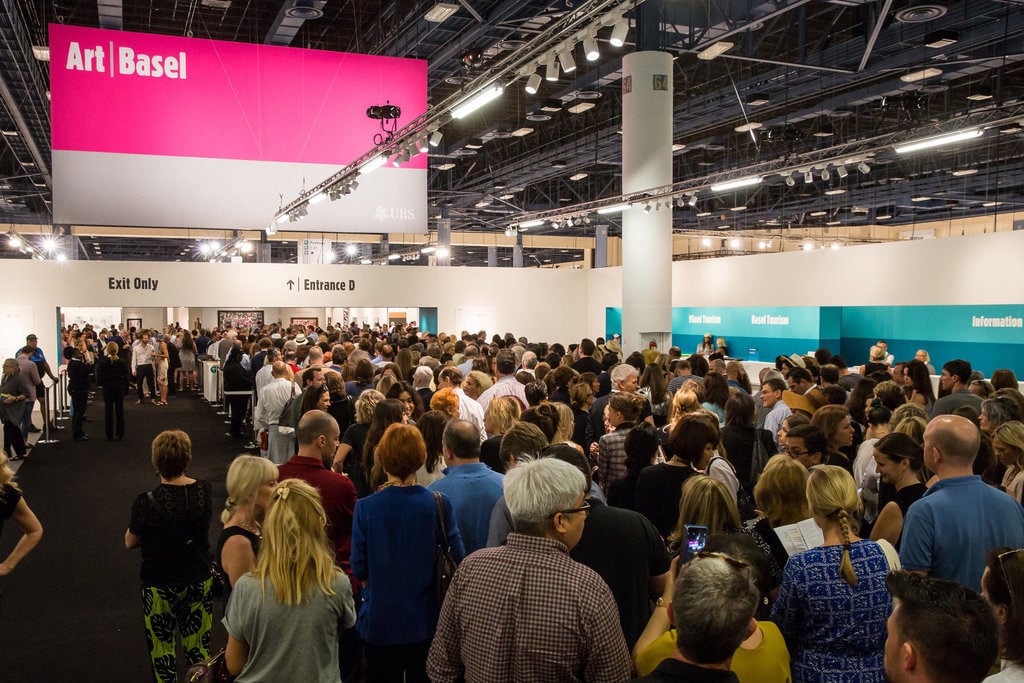
The lines to get into Art Basel in
Miami. Courtesy of Art Basel.
2. We May Be Experiencing a Generational
Shift
The Miami Art Week cynics weren’t completely off base about
their predictions on an individual level. Dealers I talked to at
the main fair did note that at least some major European collectors
had opted out of the trek to Miami this year. Advisors including
Lisa Schiff were also open with my colleagues about being the boots
on the ground for European and American clients alike (although
some of them were still transacting remotely).
Another well-placed gallery source told me that the
dealer-to-dealer gossip on ABMB’s opening days was
uncharacteristically mild. Perhaps that was an indication that this
December’s scrum was missing a few key players on the buy side
willing to make splashy moves—and maybe even play a little dirty to
box one another out—for prized works.
By no means am I saying these signals mean nothing. I just also
think that it’s important to ask the follow-up question: Is the
participant pool for Miami burning out… or just turning over? And
there was at least some evidence that the answer was the
latter.
A curator at a renowned US institution told me they were in town
strictly to escort new board members getting their ABMB baptism
this year. North American, Latin American, and Asian buyers all
seemed to be out in force—and skewing younger. A prominent dealer
at the main fair relayed that, after a longtime client gave a
heads-up that they’d be bringing by a group of 40-something
hedge-funders still in the early stages of their collecting lives,
they’d tapped a trusted gallery director in their late 30s to be
the point person because the two groups would speak the same
language—and could build a relationship that might benefit the
business for decades after its namesake retired.
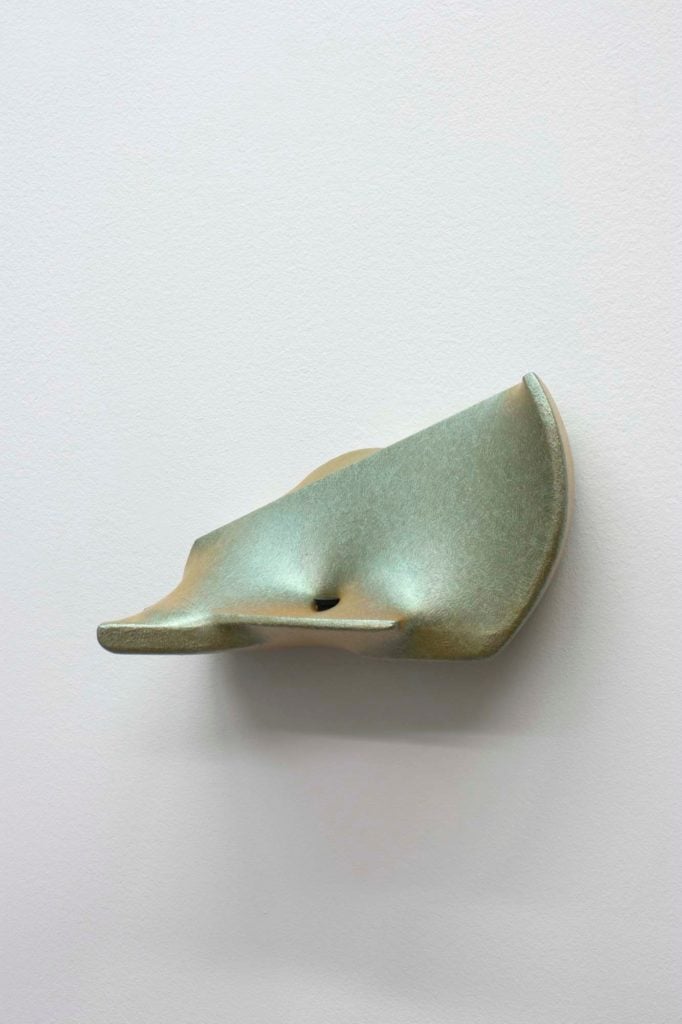
Zach Meisner, Untitled, 2019.
Courtesy of New Art Dealers Alliance.
Nor were signs of significant churn restricted to the buy side.
The 2019 edition of NADA Miami welcomed 28 first-time exhibitors,
meaning over 20 percent of the sales floor shifted from last year.
Some of that fresh water undoubtedly had the opportunity to flow
into the Ice Palace because a set of 2018’s galleries, or at least
their fair budgets, evaporated in the intervening 12 months. But
other vacancies resulted from alumni galleries, such as Karma,
leveling up to ABMB and other pricier fairs for the first time—not
least because Art
Basel doled out booth discounts to new initiates that brought
their costs in line with those at the nearby Miami edition of
Untitled.
Ultimately, then, whether it was because of their own age, the
travails of cross-continental travel, or distaste for the beach’s
bacchanalia, the disappearance of a few tony European collectors
from Miami Art Week begs the question: Who cares, as long as the
opt-outs are replaced by opt-ins from elsewhere?
After all, isn’t recalibrating the proportion of regional buyers
and sellers kinda the whole point of Art Basel running an East
Asian fair, a European fair, and a North American fair every year?
Wouldn’t fretting about a reduced number of gray-haired Europeans
coming to ABMB be a little like worrying that Martin Scorsese thinks Marvel movies are soulless,
assembly-line dreck? Of course they’re not interested; it’s not
really designed for them!
It’ll be a few years before we know for sure whether there
really is a full blood transfusion happening in Miami Beach, as
well as whether the new buyers will spend as much as the old ones
after they’ve taken over the system. But until we know for sure,
it’s too early to say this year’s absentees were a troubling loss
for either the fair or the larger market. If we’re going to see
genuine growth in either one, not every event should be for
everybody anyway.
2.5. We Should Probably Cool It on Talking About How
Wild Miami Art Parties Are
Granted, some industry insiders will disagree with this
assessment. But a longtime resident told me on Sunday morning
that he and his fellow Miamians actually think that the ABMB party
scene is one of the tamest the city sees on its annual
out-of-towner-driven calendar of events… and I can’t say I’m
surprised. I mean, let’s be real, it’s mostly a bunch of dudes in
blazers drinking wine in hotel venues. If you want to bet me our
industry is in the same league of the debauchery derby
as Ultra’s
subwoofers-and-glow-sticks crowd, or Rolling Loud in an era
where hip hop is defined by artists sing-rapping about mega-luxury
nihilism, the bank is open, my dudes.
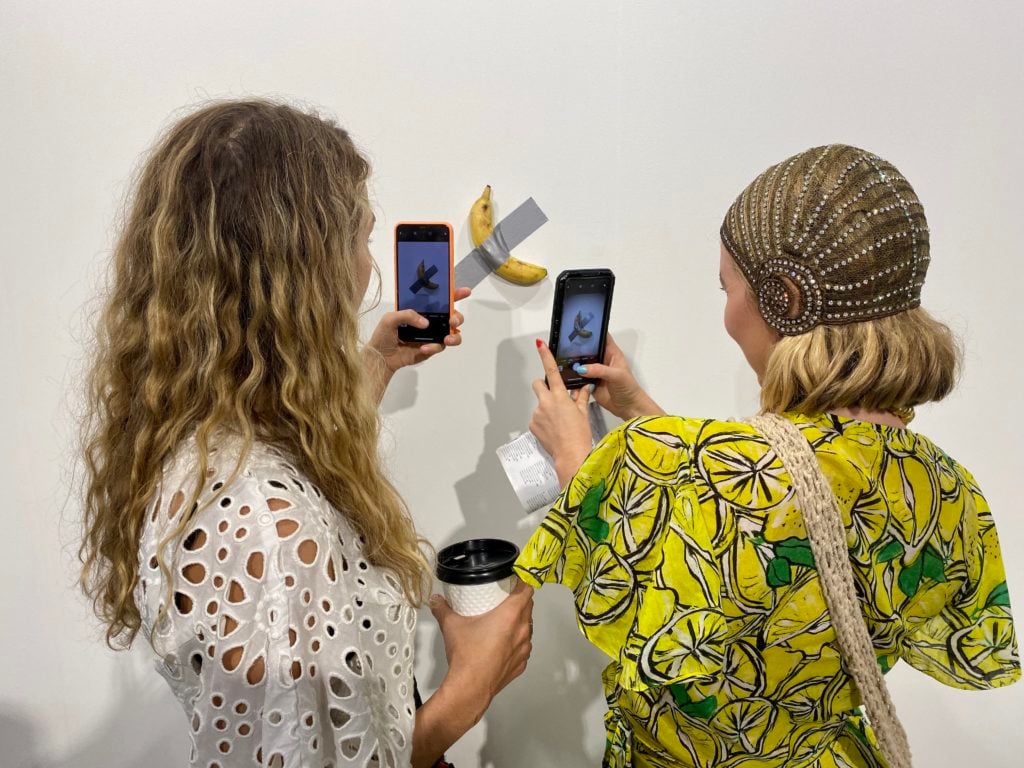
Fairgoers take pictures of Maurizio
Cattelan’s Comedian, for sale from Perrotin at Art Basel
Miami Beach. Photo by Sarah Cascone.
3. A Rising Banana Lifts All Boats
Look, I don’t especially want to talk about Maurizio Cattelan’s Comedian, the
editioned banana that was duct-taped to a wall in dealer Emmanuel
Perrotin’s booth, sold for $120,000 (twice), and subsequently
eaten by an unaffiliated performance artist on
Saturday. But doing a takeaways column about ABMB 2019 without
mentioning it would be like writing a takeaways column about
Fyre Festival and not mentioning that the
ticket-buyers promised a swanky music festival got nothing but the
experience of being stranded on an island in leaky tents by a guy
whose previous big idea was a metal credit card. It’s the thing
that everyone is going to remember the event for, so let’s just get
it over with.
Was the work willfully dumb? Yes. Does its sale justifiably
reinforce every negative stereotype about contemporary art? Yes.
Could the hundreds of thousands of dollars spent on its various
editions have been put toward far more valiant causes? Obviously.
Are all of your relatives going to ask you about it during the
winter holidays? You better believe it.
Here’s the thing, though: seeing multiple collectors (and
possibly an institution or two) blow six figures on a piece of
stunt artwork will probably inspire as much, or more, confidence in
other buyers going into the new year than the glowing US jobs report released Friday. Like a
sports car with a stupid-looking fin on the back, it’s not the kind
of acquisition people make in a genuinely uncertain time—or at
least, that’s what other people see. And in a trade based on
myth-making and subjective evaluations, perception is reality.
“Wait,” you might say, “weren’t a bunch of other higher-priced
works sold at Art Basel Miami Beach this week?” Yes, but none of
them make the type of zeitgeist-puncturing statement this one does.
Even if you think that statement is, “Several morons are ready to
spend far too much money based on a decent sales pitch,” I mean,
what better opportunity could an art dealer ask for?
I’m exaggerating a little. Of course most dealers would rather
the business be sustained by thoughtful collectors carefully
selecting works with lasting aesthetic merit. I would too.
But if I learned nothing else from my time in the gallery
sector, it’s that noble ideals unite from all sides of an art sale
far less often than they need to in order for galleries and artists
to make rent every month. No matter how appalled, amused, or
unaffected you might be by the sale of Comedian, it’s
going to pressure other rich people’s wallets to open a little
faster for art—and for everything else—in the weeks ahead, and
that’s no joke for anyone.
That’s all for this week. ‘Til next time, remember: If logical
arguments mattered more than well-crafted narratives, it isn’t just
the art market that would be a lot different.
The post The Gray Market: 3 Takeaways From the 2019 Edition
of Art Basel Miami Beach (and Other Insights) appeared first on
artnet News.
Read more https://news.artnet.com/opinion/top-takeaways-from-art-basel-miami-beach-2019-1716024
Further reading


Leave a comment