
‘There Hasn’t Been a Lot of Improvement’: Feminist Artist Valie Export on Why She’s Rebooting Her 1980 Venice Biennale Pavilion
The artist Valie Export sits
across from me in an apartment above Thaddaeus Ropac’s London
gallery, which is currently hosting an exhibition of her
work.
Export, whose given name is
Waltraud Lehner and married name was Waltraud Höllinger, shed her
previous male-oriented names back in 1967. She began to call
herself Valie, a nickname for Waltraud, and appropriated a new
surname from a popular brand of cigarettes
Export and artist Maria Lassnig
were the first women to represent Austria at the Venice Biennale,
in 1980. Then 39 years old, she had made a name for herself through
provocative films and performances in the 1960s and ‘70s, during
the heydey of the transgressive interventions of the Actionists.
Most famous were her performances of what she termed “expanded
cinema,” a group of works that took on the sexualizing male gaze
which had framed the way women were treated in film and
society.
These radical interventions
included the historic performance TAP and TOUCH CINEMA (1968), in which Export invited passersby on
the street to reach into a small curtained theater box constructed
around her naked torso. But she is best known for another
performance, Action
Pants: Genital Panic, which saw her enter an art-house movie theater
in Munich wearing crotchless pants and defiantly stare down the
audience.
These actions shocked
conservative Austrian society, as did her avant-garde biennale
presentation which included a black-and-white film of the ritual of
the eucharist. It played on a television perched near a pair of
splayed female legs, from whose crotch erupted a red neon strip.
This Birthbed
was surrounded by photographs from
Export’s “Body Configurations” series, and “HOMOMETER,” in which
she restaged religious scenes featuring women and domestic
appliances (advertising during the period often positioned these
appliances as the housewife’s “salvation”).
Forty years on, Export’s entire
Venice presentation has been restaged at Galerie Thaddeus Ropac in
London. The now 79-year-old artist sits down with Artnet News to
reflect on how things have changed—and haven’t—in the decades since
the work was first exhibited.
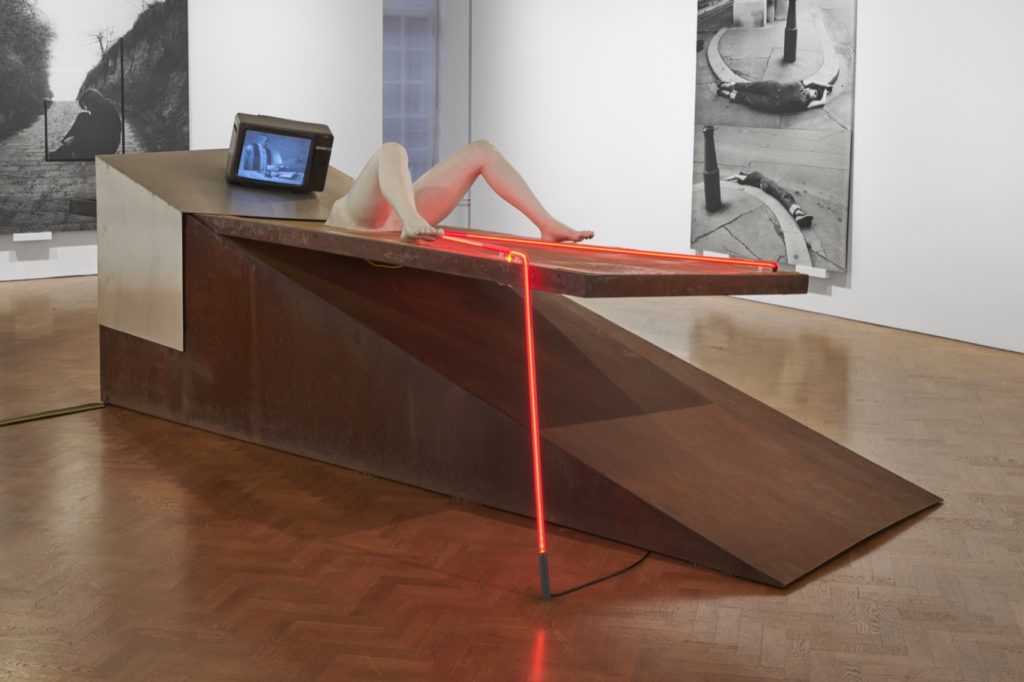
Valie Export, Geburtenbett
(1980). Photo: ©Valie Export/Bildrecht 2019. Photo by Ben Westoby,
courtesy of Galerie Thaddaeus Ropac.
This installation was first staged in Venice 40 years ago.
Why do you think it is important to show it again now,
at the end of 2019?
Every installation has its own
language, its own expression. It’s an ongoing question,
of course, especially
if you go back in the history of painting and sculpture. You
wouldn’t ask the same
question if one were to re-exhibit a Rodin sculpture or a Kiefer
painting. In my case it
is an installation.
It is always interesting to go
back to a work of art and see how the reactions might have changed
or the message that was initially sent out is received in a
different way. For me it is very interesting to regard these works
for the first time and again, to see what the actual new voice of
the installation is. It’s normal and legitimate to exhibit
so-called historical works again and I would dare to say this is a
historical work.
The original reaction to the work was quite strong. What was
that like for you? Were you expecting it?
In Venice I did not expect
anything. I worked with media, I worked with feminism,
I worked with my body.
I decided to make two installations. I had another installation
in another room, and
then I had Birthbed. For me it was great to show the context of
birthing, of the female body. It’s not my own body
though.
It was the combination I found
intriguing, in the sense that it was both the birth of the female
body, incarnated by the sculpture through the spread legs, neon
lights, the blood coming out, the blood with its own different
symbolic meanings. And on the other hand, it was the host, the
bread from Catholic mass, which symbolizes the creation of the male
body.
The work is now being exhibited in a commercial gallery. Do
you have an idea where you would like to see it go after
this?
I had [Birthbed]
outside once at the Mumok in Vienna. But the full installation is
not fit to stand
outside. You would have to repair it all the time, of course. The
material is durable,
but you do have to maintain it for it to stay exactly the
same. I would wish to see it
in a museum
permanently—to have the work in its own room. Although it can also
be shown alongside
other works. The sculpture also works without the “Body
Configurations.” You could show it on its own, you could show it with
other works—or with other works by other artists.
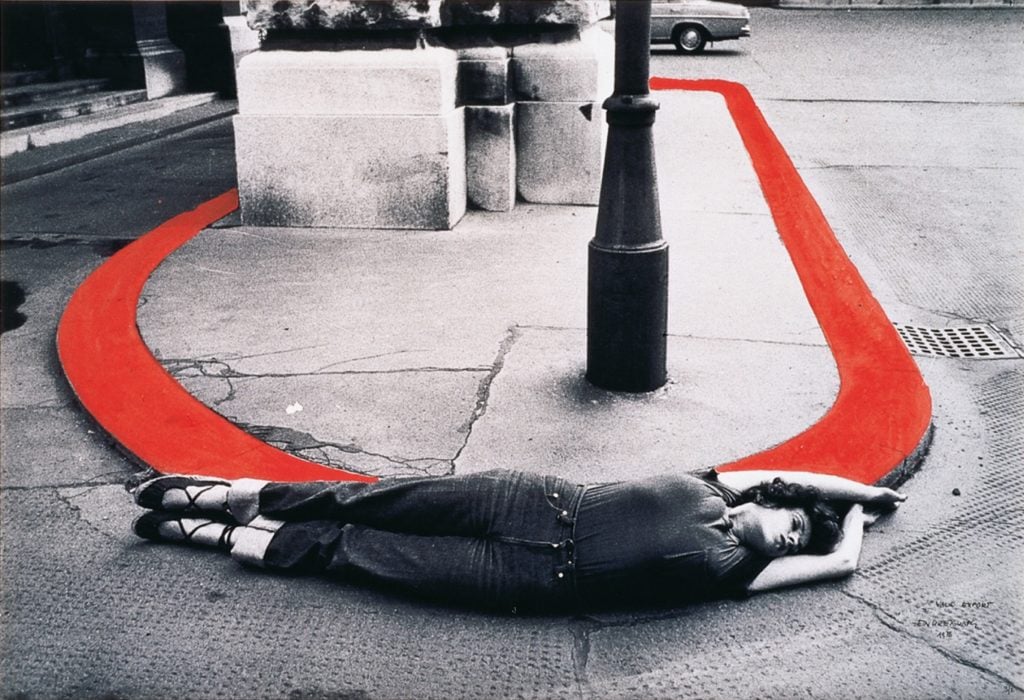
Valie Export, Einkreisung
(1976). ©Valie Export/Bildrecht 2019. Photo by Ben Westoby,
courtesy of Galerie Thaddaeus Ropac.
In “Body Configurations” you contort your body, which is
visibly female, to fit in with the inflexible male architecture of
the city. How do you think that both physical and social
architecture has evolved to accommodate women in the years since
you first made the series?
There have been changes,
certainly. There are two parts of architecture in the series,
or possibly even more.
There are the traditional buildings such as the Ministry of
Justice, the parliament, the public library. And then there
are buildings from the post-war period. Of course things have improved, not that the
female body is better represented throughout society,
but women are increasingly
part of the new structures that are created through
architecture.
There were almost no female
architects at the time I created the series; now there are more
female architects. Nevertheless, it is very curious to observe a
certain glass ceiling in architecture. Female architects are not
invited to build historic buildings, with historic meaning or
symbolism, and they often don’t build on the most prominent sites.
The buildings they build are often not in the right environment.
Female architects often don’t win the final competition to realize
a project.
In addition, the jury of these
competitions is very often male dominated. It might be an inherent
thinking structure in these mostly male juries that they consider
men as better at those historic categories. It reflects the fact
that women are not part of history. We don’t let them build the
buildings that define the way we see history. We deprive women of
the language and of forms of expression. In a way, male
architecture has its own language.
During [pavilion commissioner] Hans Hollein’s introduction to
your Venice Biennale presentation, he noted how women’s role in art
was being better recognized, which is a conversation that feels
like we are still having today. When it comes to women’s role in
the art world, how do you think things have changed since the
1980s?
I don’t want to be so negative,
but there hasn’t been a lot of improvement. An
image has been created
to suggest things have changed but really they haven’t. It’s just
an image.
There is a certain community of
male collectors who solely support male artists.
These circles strive to
perpetuate the male power structures. There is very little support
in male structures toward female artists unless maybe someone
thinks that the prices might go up in the future. It’s often in the
future with female artists, while for the male artists it’s often
already interesting in the present. With female artists it’s a
speculation. Maybe it will “go up” in the future.
Your relationship with Thaddaeus Ropac is just a few years
old. Why didn’t you have gallery representation before?
It was not like I didn’t have
galleries. There were galleries in the past and I still work
with certain galleries
along with Thaddaeus Ropac. I have to say, at the very beginning I
was not so much interested in working with galleries because I
wasn’t sure I’d fit into their policies. Every gallery has its
certain policy and its certain program. I didn’t want to adapt
because I wanted to be independent from these kinds of political
decisions, such as where to exhibit. From the very beginning I was
not very keen to develop a big network of galleries around me.
Later, when Thaddaeus came to me and offered a possibility to work
together, I considered it and accepted it quite quickly because
Thaddaeus is an Austrian gallerist but on an international scale,
which would give me the possibility to exhibit my work
internationally. It makes sense to open up to an international
gallery and to have representation that brings my work abroad. Of
course, this is also in his interest.
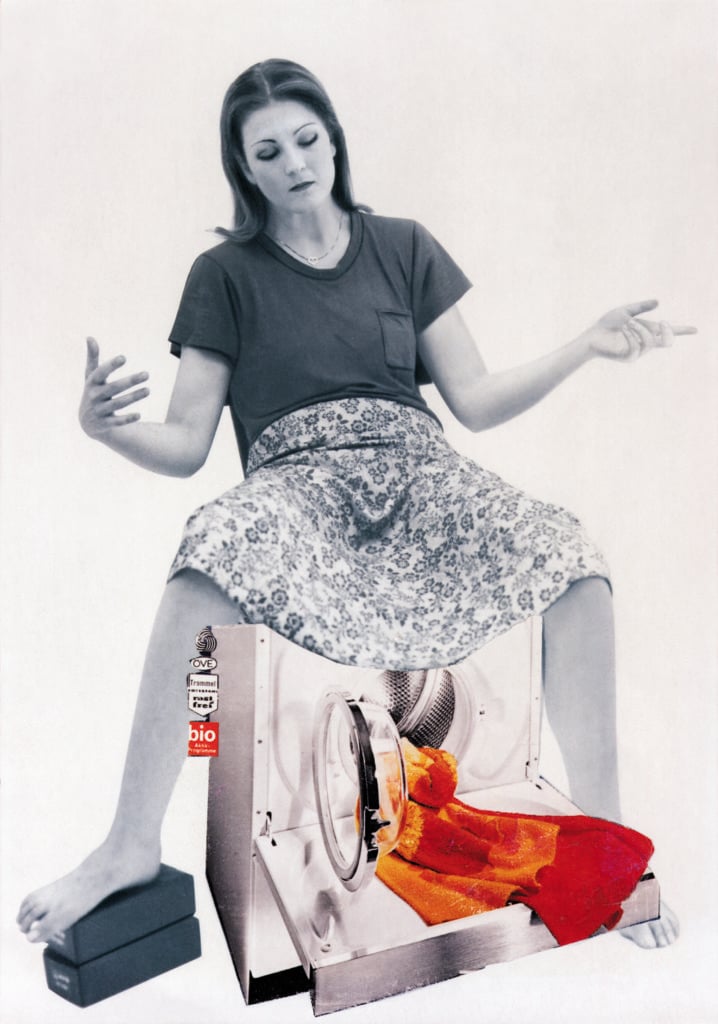
Valie Export, Die Geburtenmadonna
(1976) (after Michelangelo Buonarroti’s Pietà, Madonna
della Febre, 1498-99). Photo: ©Valie Export/ Bildrecht 2019.
Courtesy of Galerie Thaddaeus Ropac, photo by Ben Westoby.
I can give another example, I
was a filmmaker—still am a filmmaker—and when I
produced my first film
it was very underground, without a license. But the trade chamber
came to me and said if
I made films I couldn’t travel with them unless I had an official
license to feature films—there were too many obstacles. I would
have had to go through various diplomatic stages to obtain support from the cultural
institution. It wasn’t feasible commercially. Then,
for my second film, I
went to a production company and co-produced my film with them.
But then I was told
what I had to cut and how long a shooting day could be, what could
or couldn’t be added.
The producer intentionally spoke so quietly that I could
barely understand him.
It was such a hassle to work with this production company, I didn’t
like it. And so I
decided to make my own production. In two weeks, I learned
everything. I wasn’t familiar with running a company and the
regulations but I learned to adapt. I was one of the
first female film
producers with a diploma.
In the exam there was this
question about the triangles. The triangle is this procedure where
you have three different negatives to make copies of the film. While I was thinking about
what a triangle is, the male jury member
was already giving the
answer before I could say a word, telling me “you don’t need to
know this because a
triangle is not something you will ever experience, this is more
for films with a bigger
scope. It’s for filmmakers with a certain international
distribution.” In the end the jury said to me, “you would
technically pass with distinction because this was a very good
presentation but since you are an artist and on top of this a
woman, you won’t get the distinction.”
I want to say another thing
about Ropac—I was very happy with the start I got at the
gallery because as soon
as it was decided that I would join the gallery, they immediately
started to exhibit my
work and the ideal of my work is to export it into the world. We
had a show in Paris, in
Salzburg, and now in London. It worked immediately and that is of
course very pleasing.
You were part of a wave of feminism that was invigorated
during the summer of 1968. I have heard people talking about how
the spirit of 1968 is alive today, through the yellow vest protests
in France, the unrest in Hong Kong, and movements such as
#MeToo. Do you feel the energy of 1968 today?
That time is gone. There is no
student revolution, there is no revolution or
rebellion against the
state or state laws—no revolution in the air. There is not much
going on in Europe. But
in small groups—or when you talk to people, as I recently did in
Florence when I visited
the anti-violence convention—the resistance of women
manifests much more
strongly. Young men also embrace the mission of feminism. I hope
that the young
generation will closely observe the sociopolitical,
cultural-political situation in their countries and take it to a global level. We are
now in a global society so we should address these issues together.
“Valie Export: The 1980
Venice Biennale Works” is on view at Galerie Thaddaeus Ropac,
London, through January 25.
The post ‘There Hasn’t Been a Lot of Improvement’: Feminist
Artist Valie Export on Why She’s Rebooting Her 1980 Venice Biennale
Pavilion appeared first on artnet News.
Read more https://news.artnet.com/exhibitions/valie-export-interview-1726011
Further reading


Leave a comment