
Where’s Inigo? As a Furious Art World Searches for the Disappeared Dealer, Kenny Schachter Finds Him… on Instagram
The only thing more scrutinized than the whereabouts of the
Salvador Mundi—which I happened to locate on a certain
boat in the Middle East—is the art world’s new game of “Where’s
Waldo”… I mean Inigo, as in the vanished accused art swindler Inigo
Philbrick. And guess what? I found him too! Before the reveal, let
me share the most fantastical of events that unfolded in a
breathless 24-hour span the day after I left Art Basel Miami
Beach.
Seething at losing so much money due to my “friend”
Philbrick’s well-publicized dastardly
art dealings (to put it mildly), I Instagrammed a faux
reward poster for information leading to his arrest. I received two
direct messages from one steve_irwin_pets, the first being: “I hope
he’s ok and safe and sound!” This was followed by “Innocent til
proven guilty!” to which I, um, might have replied, “Are you
fucking joking?” (You try losing a small fortune and see how it
tastes.) I then let go of the convo—only to pick up the thread a
few hours later.
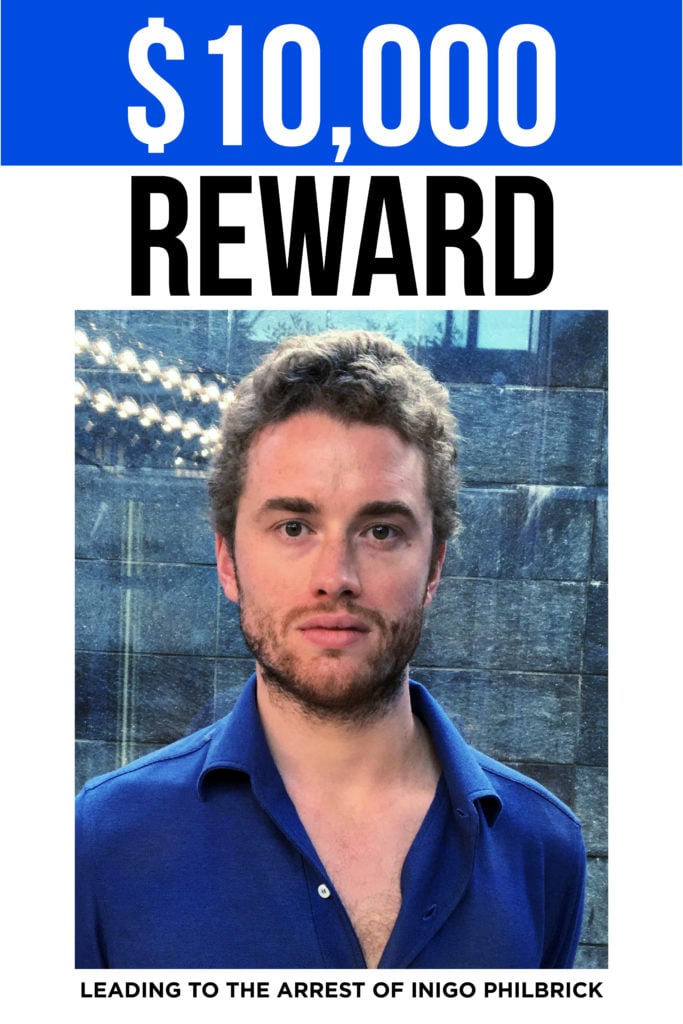
One victim just volunteered to kick in
another $10,000, and I lost enough already to raise the offer
myself, so call it $20,000 and rising…. Wanted poster courtesy of
Kenny Schachter.
I began to push “steve” and push, and push harder still. At
first, his responses spoke of Inigo in the third person (and
thankfully I saved more than 80 screen shots of text before the
account vanished liked its holder):
“Nothing is irreparable. Hopefully everybody will see the fact
he was a young man in an immense position of responsibility out of
nowhere who wanted to make everybody happy and over promised and
under delivered in the end but to no personal benefit….”
“If he’s smart enough to do it in first place he’s smart enough
to make good on it.”
“It will get sorted and this is not meant to cause hurt. It’s
not one man’s fault and you know it [I do?]. Right now it’s about
rebuilding rather than any further pain.”
Three-hours-without-pause later, as it became obvious, he let
his guard down:
“It’s no big deal, I did nothing wrong and It will all be
forgotten soon.”
“Much better idea is to mediate and find a way forward.”
“Nobody was stiffed, it was just a few bad deals. Things will be
made good.”
Stay tuned… there’s a hell of a lot more (gnarly) background
detail I know here, but I’m saving that for the screenplay I am
shopping. And when The Wolf of Wall Street meets
American Psycho, what a movie that will be.
Admittedly, most art movies are so awful and off the mark that the
competition isn’t exactly daunting, but this could be the film to
change that.
Once my blood pressure levels returned to earth, and I drifted
to sleep, I was awoken at 3 a.m. by a call from Adrian, my
23-year-old son, as he’s wont to do. When my screaming relented, he
said, “I know where Inigo is.” What kind of dream is this I
thought? “I just spoke to a friend who had lunch with a kid who was
bragging that he met some crazy guy who stole a fortune from the
art world.” “Where is he?” I muttered in my phlegmy, half-awake
stupor.

Steve was fatally stabbed by his
favorite fish, and Inigo believes the art world is out to get him
too. Screengrab courtesy of Kenny Schachter.
Speculation as to Inigo’s location has varied wildly, almost on
a daily basis: Thailand, South Africa, South America, the Bahamas,
Cuba, among other locales. But the truth was in fact Sydney,
Australia, where he had been visited by his girlfriend Victoria
Baker-Harber en route to a micro-island in the Pacific, and I have
a hunch which one—a hunch that was confirmed by a local bar/club
owner. In any case, Australia explained the Steve Irwin moniker,
the Aussie naturalist speared to death hundreds of times by one of
the stingrays he cared about so deeply. Get it? Call it a holiday
getaway-getaway. And, by the way, in this story, Inigo is the
stingray.
Let me say this for the man, who indeed is innocent in the eyes
of the law until proven guilty—although the cards are certainly
stacked against him—the art world is built on lies and sleazy
behavior. I’ve yet to meet a single participant in the market with
totally clean hands—except, okay, Marian Goodman. There were
auction houses that lied about being paid on time in a factually
incorrect Philbrick expose in ARTnews
that kind of threw me under the bus for the closeness of my former
relationship with him—a weird strategy for a company trying to woo
me to switch allegiances from Artnet News—and dealers that denied
the closeness of their relationship with him. Yes I’ve been Inigo’d
to the tune of well over $1,000,000, which isn’t the best feeling
ever, but he also did loads of business with Hauser & Wirth, Lévy
Gorvy, Gagosian, and Zwirner—whether they knew it or not (he often
employed proxies to do his bidding)—and Jay Jopling, his former
mentor.

I’ve been Inigo’d and it wasn’t fun—or
cheap, but the t-shirt is. (No Cattelan relation.) Artwork by Kenny
Schachter.
What is inexcusable, big-time, is Philbrick’s debt to a real
shark—not a hard-edged, pissed-off money mogul, but, worse: a
hard-working art photographer named (for real) Shark Senesac, who
shot Dana Schutz’s Unicorn just before Philbrick’s
downfall went (very) public and got stiffed as a result. You can’t
make this shit up. The Art Loss Register needs to open an Inigo
Philbrick division. Another annoyance is Jeremy Hodkin, the
28-year-old publisher of a newsletter ingeniously entitled the
Canvas, who neither knew Philbrick nor participated much in the art
world (yet the market). He wrote the following poem:
‘His business was hollow, built on a bed of lies,
With a bit of a reputation as a prick.
As dull as a hammer, he’s our least-favorite scammer,
Of course it’s the reviled Inigo Philbrick.
OK. Here’s my version:
His business started great, but that
wasn’t his fate.
Sure he was arrogant—but funny and smart.
He bit off more than he could chew. I hope this won’t happen to
you:
To get fucked by a friend and lose all your art.
Art Basel Miami Beach
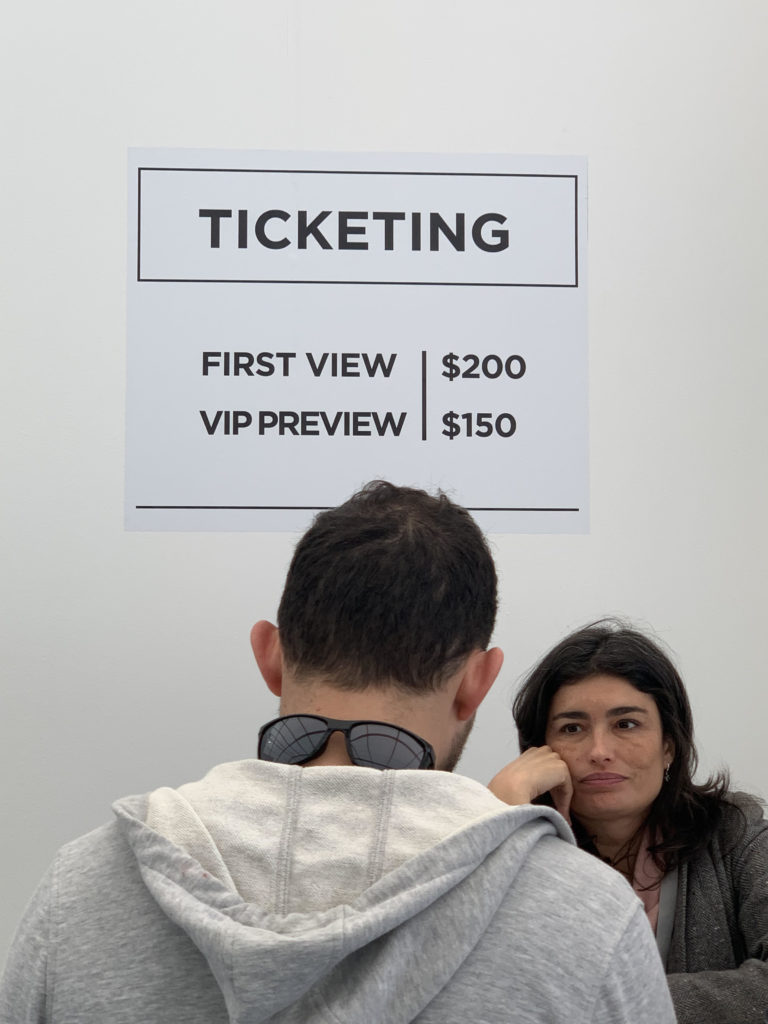
Scope admission. As John McEnroe used to
say, “Are you fucking joking?” Photo by Kenny Schachter.
Now, off the races! By which I mean Miami’s art fairs, 2019
edition. I’m no elitist—far from it—but I was early for a meeting
and dipped into the “emerging” Scope Art Fair, which gave me a rash
before I made a hasty retreat. A daily ticket was $200 for the
preview and up to $150 per day, versus $65 for Basel. Pff. Further
along the beach was a mechanized vehicle emptying garbage
cans—which I thought would make a good vetting machine to clean up
the crap art that litters most fairs. UNTITLED is the new NADA. At
the former, the quality seems to improve from fair to fair; at the
latter, the energy seems to be fading, with less discoveries at
hand.
I bought three works at UNTITLED for a grand total of
$12,375—reflecting my diminished financial standing after Ini-go up
and left (with all my money). One work was a black-and-white canvas
from Steve Turner of Los Angeles by one Brittany Tucker. The artist
was—gasp—born in 1996. (Christ, so is Adrian, one of my kids—how
did I get so old?) Another was a work by Spanish painter Bel
Fullana, born 1985, from New York’s Freight + Volume. I’m a sucker
for good-bad paintings, and that one may be the worst! (It’s called
Booty Twerking.) And lastly, Homework in the Cafeteria
Wrestlers, a painting by Jenna Gribbon (b. 1978) from New York
stalwart Fredericks & Freiser, which has been bucking the mid-tier
gallery malaise since 1996 and doing is as well as ever.
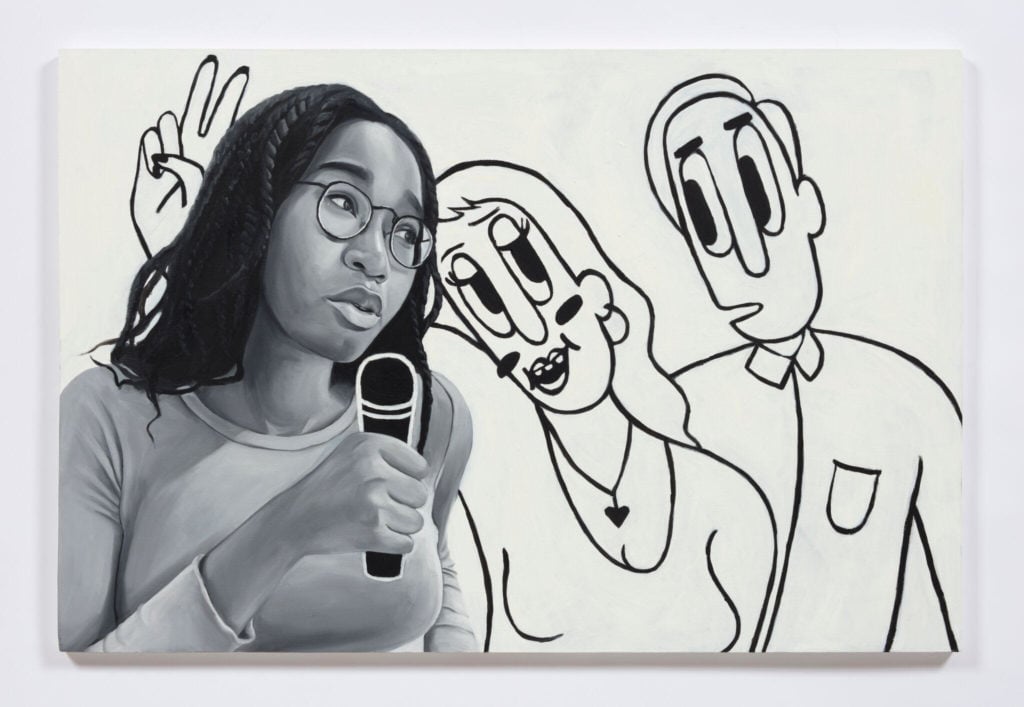
Brittany Tucker clowning around about
some not-too-funny issues. She’s all of 23 and, in my estimation,
just great. Photo by Kenny Schachter.
It wouldn’t be a Basel without art attorney Aaron Richard Golub
verbally acting out in my direction, screaming at the top of his
robust 76-year-old lungs—yet again—in a widely witnessed display of
personal animus. For some odd reason, it always seems to happen in Simon
Lee’s booth. (There need to be onsite anger management
attendants, with nifty Art Basel-branded arm bands perhaps.) The
fair itself was status quo, a little quieter than in the recent
past, with the usual suspects succeeding as ever—and the rest
not.
Success has proven more elusive for MCH Group, the parent
company of the fair, which in dire financial
straits due a downturn in the watch industry and other
components of its business. (To such an extent, in fact, that MCH
was even the subject of a Page Six entry
speculating on the eminent sale of the Art Basel fair division.) I
can’t deny I’d be slightly amused if the omnipotent Basels went
belly-up and there was a jolt of anarchy injected into the staid
fair hierarchy.
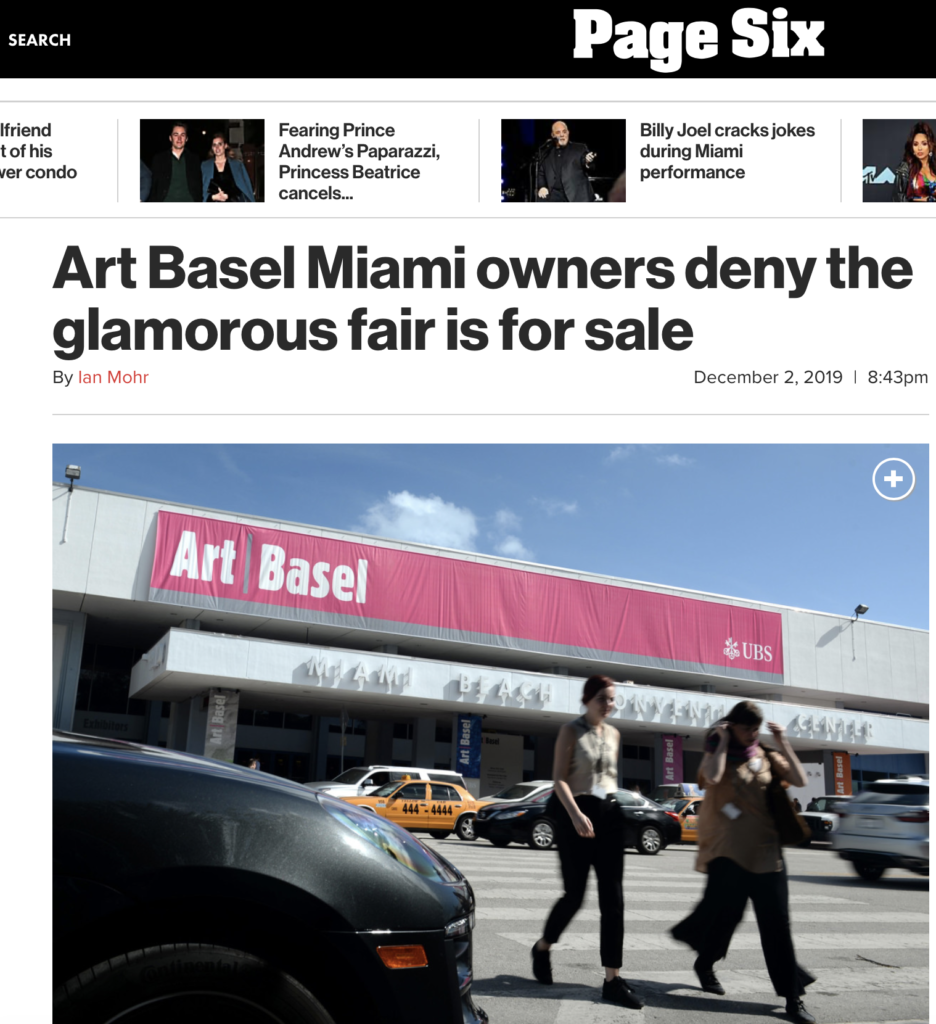
Going, going…. Could it be bye, bye
Basel in its present ownership form? Screengrab courtesy of Kenny
Schachter.
With Hong Kong demonstrations as large as ever, a letter was
circulating among dealers—with around 20 gallery signatories to
date—trying to get Art Basel HK cancelled. But the dealers
chickened out, fearful of the repercussions: skip one Basel, don’t
bother applying for the rest, is the unspoken threat of the strong
arm of fair management. My gallery friends (and I have more than
you think, thank you very much) also told me of a pronounced
Midwestern vibe in Miami, with collectors escaping the bitter winter of
flyover country and helping generate better business than the
galleries saw for the last two years. Another fair exhibitor spoke
of the rise of “third-rate collectors and an over-the-top influx of
(even more than before) art advisors”—yuck. Overall, I’d say there
was a chilled atmosphere—not just because of the beachfront
locale’s colder-than-usual temperature—with lower price points and
smaller crowds.
After I told my dear frenemy (aren’t they all?) Gavin Brown one
night that I was working with his artist Bjarne Melgaard for the
Felix Art Fair in LA during the upcoming Frieze Week, he responded
that me and Bjarne deserve each other, before madly kissing my
face, biting my cheek, and departing in a flash with a mouthful of
my flesh. I picked an opportune time to quit drinking this year,
and was likely the only sober person in Miami.
A friend tried to buy Gagosian’s Jeff Koons metallic dolphin
before the fair for pretty much the full ask—$4.5 million, after a
10 percent discount applied to $5 million ticket price—but when a
dealer asked the artist’s rep, she refused to play ball (I’d gather
because she was gunning for a commission of her own when it sold at
the fair). It didn’t, last I checked. I’m sure Larry G. will be
thrilled when he reads this.
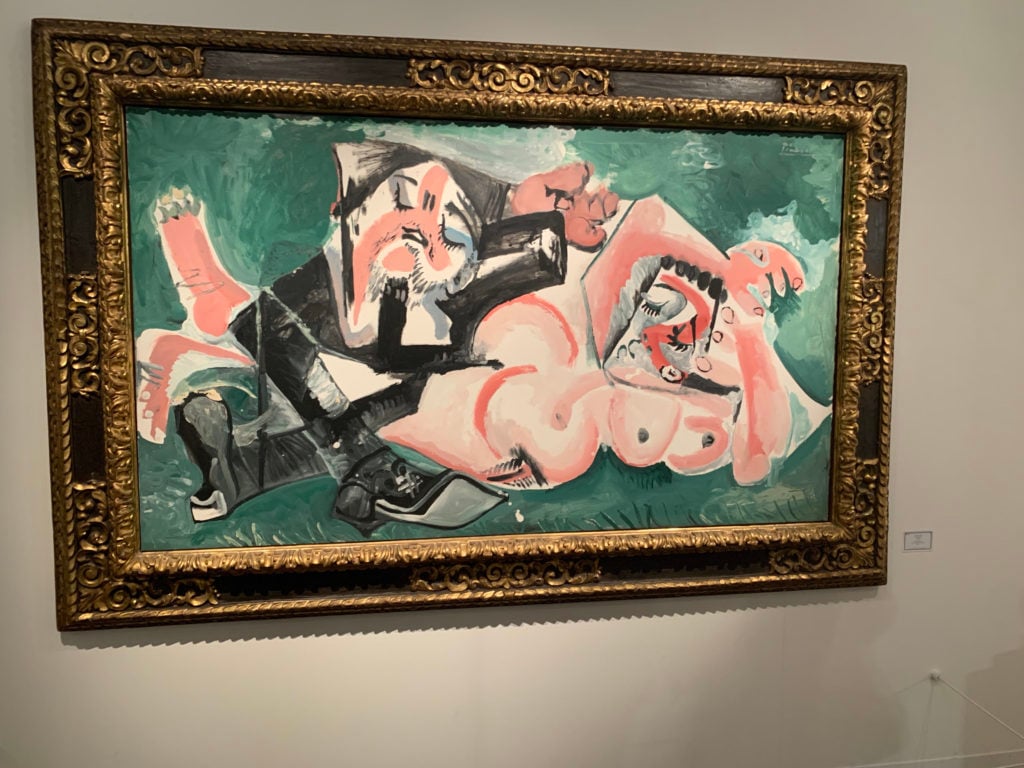
Give this Picasso a break— it’s been to
so many fairs it’s exhausted, in more ways than one. Photo by Kenny
Schachter.
The art game would give any competitive contact sport a run for
its money. Landau Fine Art has had an oversized eyesore of a green
Picasso on show at no less than 15 to 20 fairs for a price that has
escalated from around $15 million (when I first asked) to the
present-day $36 million price tag. I guess the sum goes up in
proportion to the painting’s accumulation of frequent-flier miles:
an art-fair orphan.
Special mention goes out to the elegant, inimitable—if
grumpy—connoisseur of connoisseurs, Karsten Greve. There will never
be another of his caliber (and demeanor), and that is far from a
good thing. I once spied him hiding behind an upside-down copy of
the Financial Times at a FIAC so he wouldn’t
have to engage with fair riffraff. I aspire to such
larger-than-life levels of reticence. He bought his first Twombly
in college (he may very well be the world’s most knowledgeable
expert on the artist) and proudly showed his father, who wrote him
off then and there as a hopeless cause and black sheep in their
family of physicians.
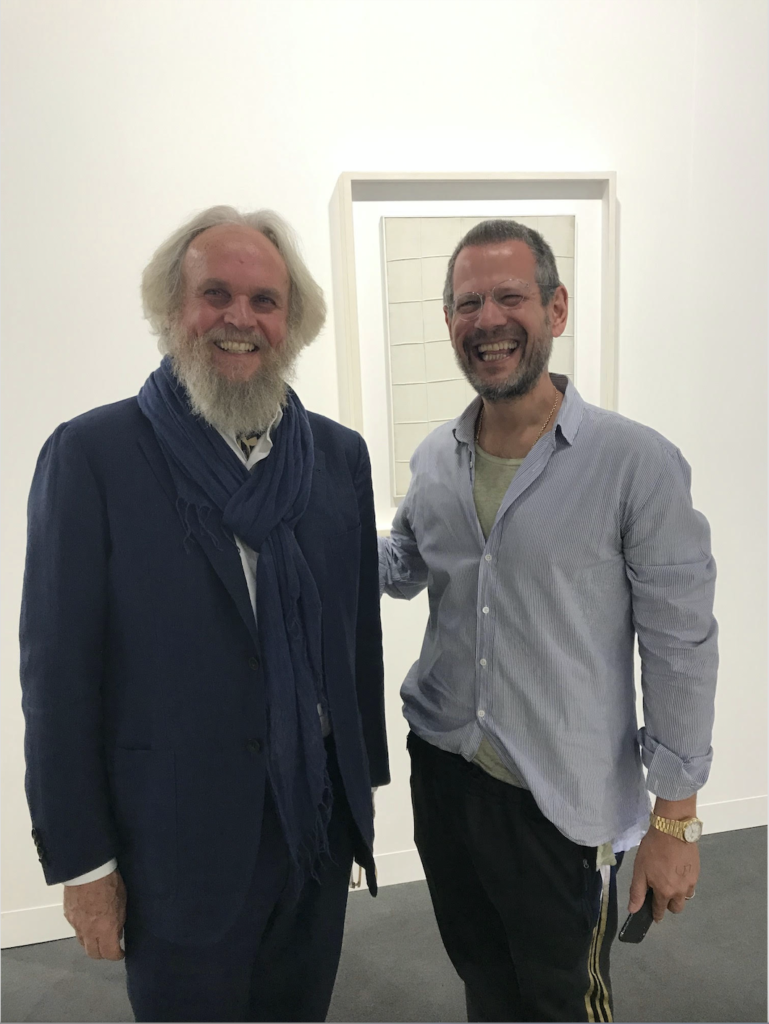
K&K. The last time Karsten Greve
kracked a smile was probably at his first Basel 50 years ago, and I
am in love with him because of it—and his amazing tenure as ace
gallerist/connoiseur/collector. Photo by Kenny Schachter..jpg
The Rubells, meanwhile,
are prescient and outright brilliant professional collectors, and
their new museum occupies a peerless position in the realm of
post-Saatchi privateers, period. If there’s one criticism I’d level
(I gotta be me), it would be that some of the loosely themed
groupings of artworks, like artists of color, artists of China, or
artists of the ’80s. Why not chuck it all into a mix less obviously
delineated? Also, while they’re at it, can they please use their
Miami clout to pass a law mandating imprisonment for people who
look at art wearing sunglasses? They should be outside—of the
museum.
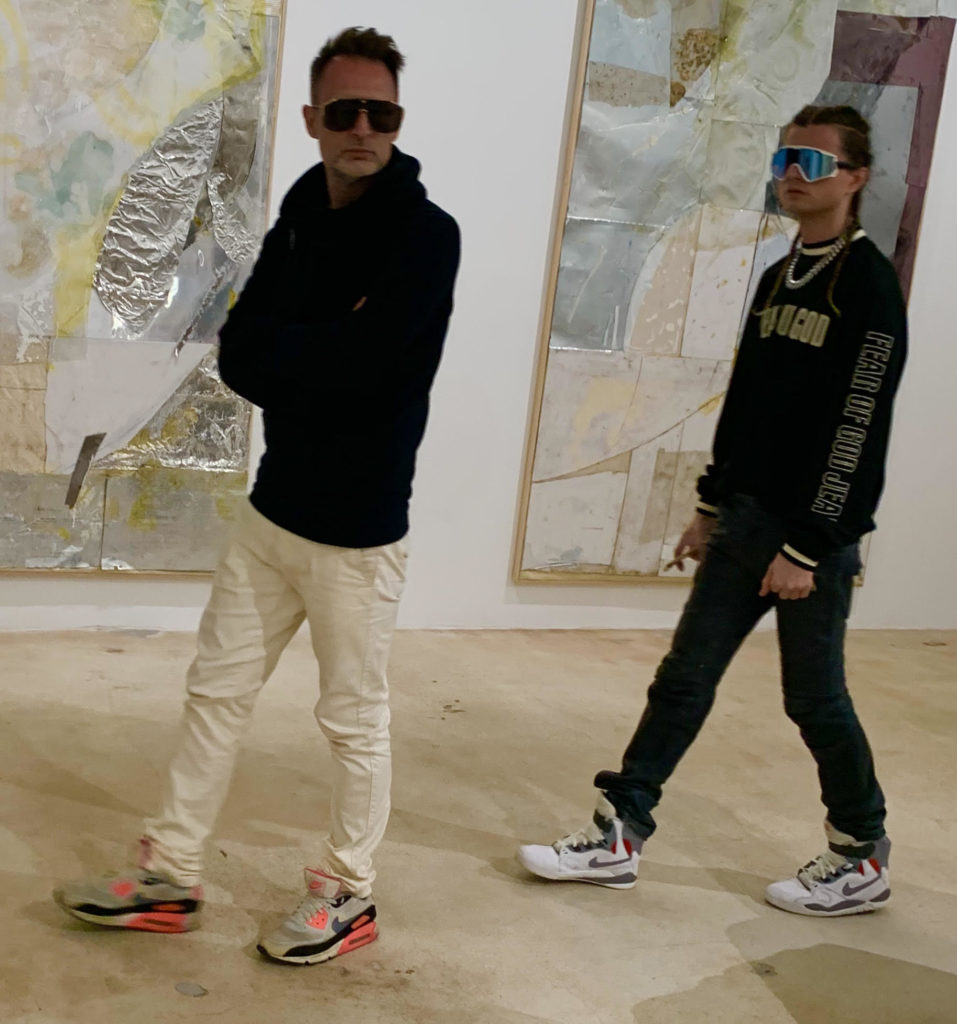
Award for worst sunglasses infraction at
Rubell Museum, nothing like going to a museum to not-see art! Ugh.
Photo by Kenny Schachter.
Finally, my condolences to the legendary and fervent collector,
investor, and philanthropist Don Marron who, a matter of days
before he died, looked me straight in the eyes at Miami Basel and
said, simply, “Kenny, you must keep writing.” Don was an art lifer
to the last day, literally, and an inspiration to us all. I will
never stop, Don, and hope to drop at my keyboard—or better yet, in
the aisles of an art fair or auction, disrupting the proceedings to
the bitter end.
Bonus Banana Video
The post Where’s Inigo? As a Furious Art World Searches for
the Disappeared Dealer, Kenny Schachter Finds Him… on Instagram
appeared first on artnet News.
Read more https://news.artnet.com/opinion/kenny-schacter-on-inigo-philbrick-1727460
Further reading


Leave a comment