
An Ornate Shield Found in a Celtic Warrior’s Grave Is Challenging What We Know About Ancient Combat
In a story seemingly fit for
Game of Thrones, an ornate Iron Age shield that was
unearthed from a “warrior grave” is now being deemed “the most
important British Celtic art object of the millennium,” according
to Dr. Melanie Giles, of the University of Manchester’s archaeology
department. The sweeping proclamation comes after two years of
extensive conservation work was conducted on the bronze shield, the
results of which found design features—the most prominent being its
scalloped border—never before seen in any other Iron Age
object.
Measuring 30 inches, the piece
of armor boasts an elaborate, detailed pattern, which would have
required its maker to hammer from the opposite side in order to
render the asymmetrical formation of mollusk shells that culminate
at the shield’s raised center. Experts categorize this swirling
design as early Celtic art, estimating its date between 320–174 BC,
and say it is typical of the La Tène culture that dominated Europe
during the late Iron Age.
Moreover, conservators
identified a sword puncture hole and signs of repair work on the
artifact, suggesting that the object was functional and practical.
Such discoveries have the potential to debunk opposing theories
suggesting that sumptuous shields were decorative items
only. “The popular
belief is that elaborate metal-faced shields were purely
ceremonial, reflecting status, but not used in battle,” said Paula
Ware of MAP Archaeological Practice, who oversaw the excavation.
“Our investigation challenges this….Signs of repairs can also be
seen, suggesting the shield was not only old but likely to have
been well-used.”
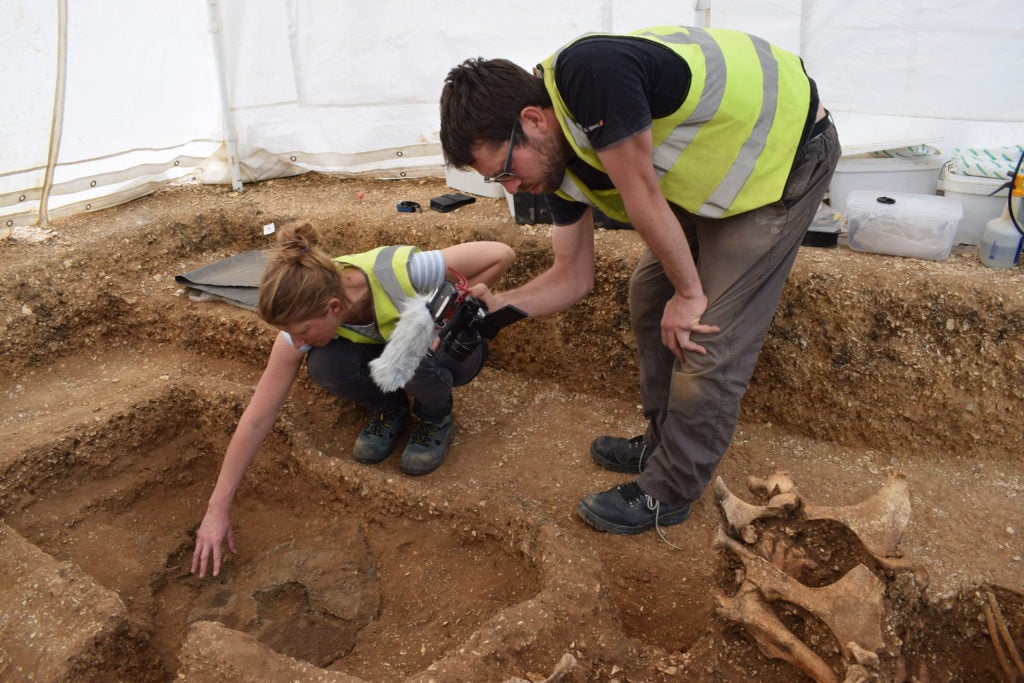
Pocklington Iron
Age shield conservation during excavation. Courtesy MAP
Archaeological Practice.
It indeed appears that the
shield was a cherished belonging; it was initially found underneath
the skeleton of a man—presumably that of the “warrior” for which
the grave is nicknamed—with its prominent location next to the body
suggesting great value and personal significance.
The burial site itself was
originally discovered in 2017 in a housing development near the
town of Pocklington in Yorkshire, United Kingdom. In addition to
the so-called “object of the millennium,” archaeologists found an
upright and intact chariot; a brooch of bronze and red glass; and
the remains of six sacrificial pigs and two horses, which were
arranged so as to appear to be caught in mid-leap. Experts believe
the warrior was over 46 years of age, and that the extravagance of
his grave propounds that he was a highly respected member of the
community.
“The magnitude and preservation
of the Pocklington chariot burial has no British parallel,
providing a greater insight into the Iron Age epoch,” Ware
concluded. For those seeking more details on the warrior grave, a
detailed compilation of the research will be published by Oxbow
Books in spring 2020.
The post An Ornate Shield Found in a Celtic Warrior’s Grave
Is Challenging What We Know About Ancient Combat appeared first
on artnet News.
Read more https://news.artnet.com/art-world/celtic-shield-warrior-grave-1725090
Further reading


Leave a comment