
France Released a Groundbreaking Report on the Restitution of African Art One Year Ago. Has Anything Actually Changed?
The French president Emmanuel
Macron shocked the world two years
ago when he made a historic declaration that the former
colonial power would strive to return objects looted from Africa to
their homelands. In a landmark speech, Macron promised to set the
conditions for the restitution of African artifacts held in French
national collections within five years.
But two years after that
momentous occasion, little concrete action has been
taken. “I have the
feeling that Macron is not keeping his word,” Patrick Mudekereza,
the director of Waza Centre d’art de Lubumbashi in the Democratic
Republic of Congo, tells Artnet News.
At first, it seemed as if things
were moving swiftly. On the heels of his dramatic speech, Macron
commissioned two academics, the art historian Bénédicte Savoy and the economist
Felwine Sarr, to advise him on how to proceed. Eight months later, the pair delivered a report with a shocking
verdict (but few practical guidelines): France should
permanently and immediately restitute all art taken from Africa
“without consent” during the colonial era.
Following publication of the
bombshell report, Macron appeared to waste no time in promising to
return objects, starting with 26 looted artifacts to
Benin. Before long, a fierce debate ignited among French museum
professionals who feared this move was a sign that their precious
collections would be gutted; around 90,000 objects from sub-Saharan
African are held in national collections.
But concerned curators have
since piped down: a year after the release of the groundbreaking
Savoy-Sarr report, the Benin treasures have still not been sent
back. In fact, in the full two years since Macron’s declaration,
only one object—a 19th-century saber that returned to
Senegal last month—has been restituted from France at
all.
Slow Movement
Mudekereza says he was initially
“very happy” about how far the Savoy-Sarr report went in addressing
the issue of looted objects, as well as those taken without
sufficient consent or adequate compensation.
“It has opened many possible
doors to people who want to work on the topic,” Mudekereza says,
praising the academics’ emphasis on the need for a new relational
ethics between Western nations and their former colonies. “It’s not
just about an exchange of objects, but to understand that it’s
mutually beneficial to overcome this burden in history with a new
relation that is very fair and transparent.”
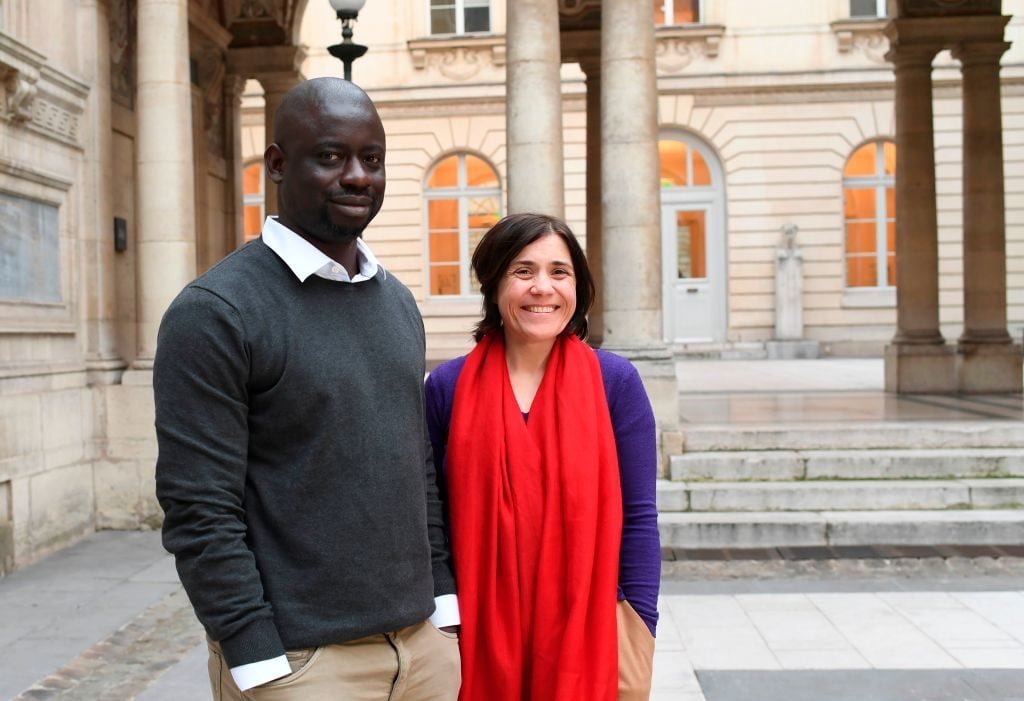
Felwine Sarr, at left, with Benedicte
Savoy. Photo: Alain Jocard/AFP/Getty Images.
Concrete action, however, has
been minimal. A year ago, Macron called for the rapid establishment of an online
inventory of French museums’ African collections—but thus far, no
such inventory has been made accessible to the public. A promised
symposium of museum professionals and politicians, which was slated
to occur in the first months of 2019, also did not
materialize.
“What we are waiting for now is
the moment when the politicians on both sides will open discussions
with the professionals, and that is not happening,” Mudekereza
says. “And after one year, I think it’s a big problem.”
Inquiries from Artnet News to
the French Ministry of Culture, the presidential palace, and the
report’s authors Savoy and Sarr went unanswered. But the
French minister of culture, Franck Riester, recently
implied that the prospect of colonial restitution was
proving more complicated than it might have sounded at the
outset.
“Let’s not reduce this question
to saying, simply, that we will transfer ownership of objects,
because it’s much more complex,” he told the New York Times, adding that the
French state is looking into the question of restitution as
countries make official requests.
Challenges Remain
Experts cite a variety of challenges that have slowed progress
since the report was published. First, there is the pesky issue of
French law: Under the current
legal system, French
national collections are protected with clear-cut “inalienable and
imprescriptable” rights, prohibiting museums from permanently
handing over accessioned objects. Although the law could be always
changed, it remains in place today. (The saber returned to Senegal
last month is on permanent loan—currently the only way to restitute
an object while getting around the law.)
“The Sarr-Savoy report was
inadequate from historical, ethical and practical angles,”
says Nicholas Thomas, the director of Britain’s Museum of
Archaeology and Anthropology and a professor of art history at
Cambridge University. In addition to the legal hurdle, some critics
say the report did not address the role that French museums play in
conservation—and that African institutions might not have the same
resources to preserve these objects. (This particular quibble has
been contested by a number of African museum leaders.) Skeptics
also note that it is not always clear who is the rightful owner of
an object if its original source is a tribe that has since died
out.

Cast brass plaques from Benin City at
British Museum. Photo: Andreas Praefcke [Public domain], from
Wikimedia Commons.
within the field: there is a “notable disconnect,” Thomas says,
between the discourse of activists and cultural
professionals. “For the activists, the only thing that matters
is restitution. But curators, artists and Indigenous people are
often most interested in partnerships, in joint research, in access
to artifacts, and in sharing knowledge,” Thomas explains. “And
what’s most important is that this is not just talk: ethical
cultural exchange is happening now. It will certainly involve the
return of heritage, but much else as well as that.”
Another factor slowing progress, according to Mudekereza, is indecisiveness on the African
side. “It’s a problem when African leaders themselves don’t
have a kind of clear opinion of what they want,” Mudekereza
says. “The discussion among African professionals is not really
going at the same level as the discussion between Western museums.”
He notes, for example, that although the most immediate
concern for the Congo is the return of human remains held in
Belgian museums, the Congolese president Felix Tshisekedi has yet
to petition the Belgian government for restitution.
A Global Issue
France is not the only country
that is hoarding valuable treasures plundered from African nations
in its collections, although it has done more than any other to at
least officially acknowledge the issue. Objects are also scattered
in museums throughout Europe as well as some in the US—and France’s
declaration has put pressure on them to wrestle with their own
responsibilities on the matter.
In the UK, the British Museum
alone holds around 73,000 objects from sub-Saharan Africa,
including around 400 objects looted from Benin. Like in France, the
objects are protected by law from being deaccessioned from the
museum’s collection, and the institution seems unlikely to push
against that rule.
“We believe the strength of the
collection is its breadth and depth which allows millions of
visitors an understanding of the cultures of the world and how they
interconnect,” a spokeswoman for the museum tells Artnet
News.
Over the past year, the museum
has continued its efforts to develop and build “equitable long-term
partnerships with museums and colleagues across Africa,” the
spokeswoman says. Currently, it is focused on the loan of a group
of objects to a new culture and heritage centre
being developed in Lagos, the JK Randle Centre, which is slated
to open in 2020. The objects will initially be loaned for three
years with the possibility of extension.
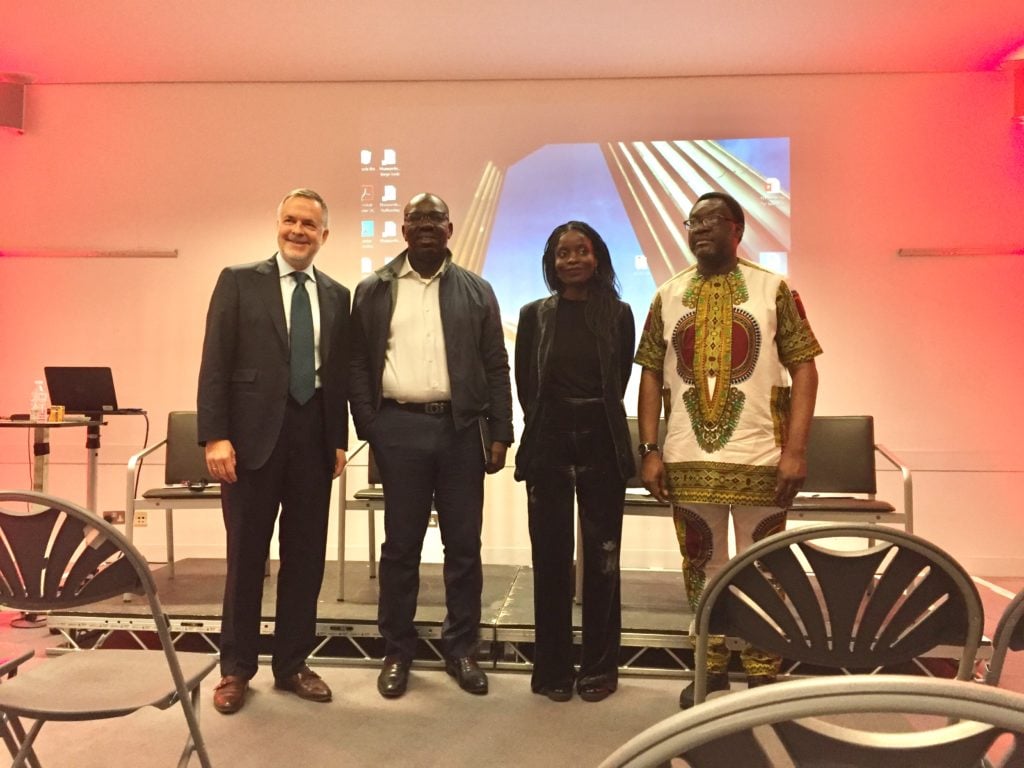
British Museum director Hartwig Fischer
with the governor of Edo State Godwin Obaseki, curator Nana
Oforiatta Ayim, and the Lagos State tourism commissioner Steve
Ayorinde presenting new museum projects in Benin City, Accra, and
Lagos. Photo by Naomi Rea.
The museum is also collaborating
with the Benin Dialogue Group—a collective of museums from Europe,
partners from Nigeria, and representatives of the royal court of
Benin—to negotiate long-term loans to the forthcoming Royal Museum,
expected to open in Benin in 2023.
In November, the British Museum
also organized a three-day workshop in Accra, Ghana, for UK and
African museum and heritage professionals, artists, and academics,
on the theme of “Building Museum Futures.”
Meanwhile, over in Germany, the
country’s federal government has agreed on a set of guidelines to
repatriate objects removed from former colonies in “legally or
morally unjustifiable” ways, and has set aside €1.9
million ($2.1 million) for provenance
research. It has
restituted human remains to Namibia as well as a number of other
artifacts including a stone cross and a whip.
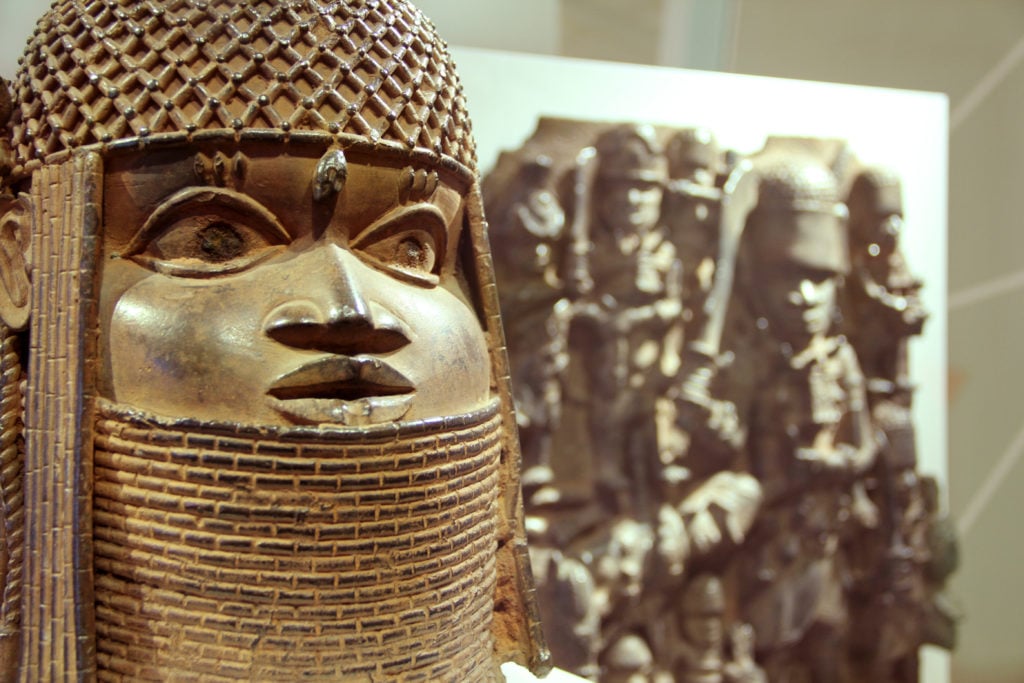
Exhibition view of “Looted Art? The
Benin Bronzes” at MKG in Hamburg. Photo by Michaela Hille
Across the Pond
Across the Atlantic, in the US,
efforts to fund restitution have been ramping up as well. A
grant-making organization founded by the billionaire George Soros
recently announced a $15 million,
four-year initiative to support the restitution of looted African
cultural heritage. The
money, overseen by Soros’s Open Society Foundation, will go to
African lawyers, archivists, and museum directors working towards
restitution as well as NGOs that raise awareness of the
topic.
Across the globe, academics and
museum professionals are now engaging in these conversations more
explicitly and forcefully than ever. Zoë Strother, a professor of
African art at Columbia University in New York, organized a
major conference on the
subject of restitution with the university’s Institute of African
Studies in October. But, Strother notes, considering the US has its
own laws and precedents, “it remains to be seen how much traction
the debate provoked by the Macron Report will have in the American
context.”
And in the wake of the slow
response to the Savoy-Sarr report, the most concrete actions
surrounding restitution may take place outside of official
government channels. “The new frontier lies in finding some means
for institutions to address ethically claims across international
boundaries without necessarily involving nation states,” Strother
says, “which do not always have a good record of respecting the
perspectives of indigenous peoples.”
Whether museums and experts can translate discussion into
action, however, is a question that has yet to be answered.
The post France Released a Groundbreaking Report on the
Restitution of African Art One Year Ago. Has Anything Actually
Changed? appeared first on artnet News.
Read more https://news.artnet.com/art-world/french-restitution-report-global-1728216
Further reading


Leave a comment