
Plaster Casts of the Elgin Marbles Are Actually Better Preserved Than the Marbles Themselves, According to a New Study
Lord Elgin didn’t want to lose any more Parthenon marbles. The
ancient temple atop the Athenian acropolis had already been through
an ordeal: marred by a 3rd century AD fire, damaged when the temple
was converted into a church around 600 AD, and partially blown up
in 1687 while used for gunpowder storage.
The 19th-century Scotsman’s methods for preserving the marble
sculptures created by Phidias and his workshop are famously
controversial, and still make headlines. In 1802 Elgin removed
around half of the Parthenon marbles, shipping them to England (later to be sold to
the British Museum, where they’ve been on permanent display since
1817). But what many don’t know is that he also cast several of the
marbles that he left behind, in plaster.
Dr. Emma Payne, a Classics department fellow at King’s College,
recently analyzed these casts and the results grant Elgin a bit of
good press, revealing that his reproductions preserved details lost
from the in situ originals over the past two centuries.
Elgin’s plaster casts are a time capsule of how the sculptures
appeared in 1802, whereas the originals remained outdoors,
suffering some damage until they were transferred to the Acropolis
Museum in 1993. In the interim, those Parthenon marbles were
subjected to vandalizing Victorian-era tourists and air pollution
(surprisingly, the former took a greater toll on the artworks).
Payne produced 3D scans of both the plaster casts and the
Parthenon originals, overlaying the images for comparison. “The
19th-century casts reproduce the marble sculptures more accurately
than expected and they definitely preserve some features lost from
the originals,” Payne told Artnet News. “We need to study
them very closely to understand exactly what it is that they
preserve.”
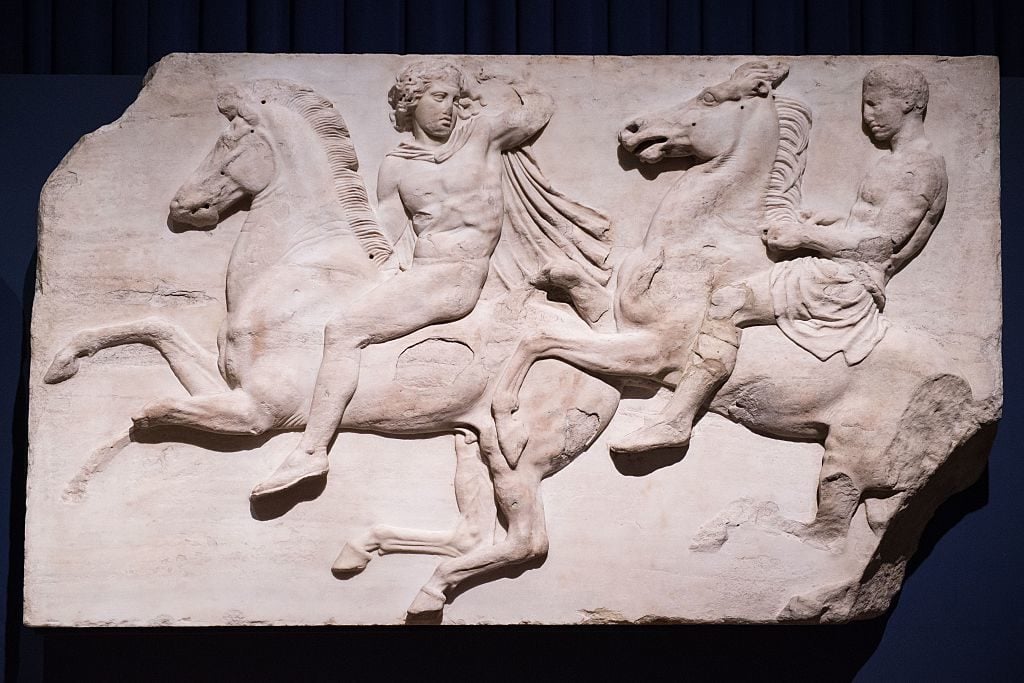
A section of marble frieze sculpture
(438-432 BC) from the Parthenon in Athens, part of the collection
that is popularly referred to as the Elgin Marbles. Photo: Leon
Neal/AFP/Getty Images.
Payne’s research ironically reveals that in some cases, fragile
gypsum plaster can leave a more durable art historical record than
marble left to the mercy of the elements. Her study is part of a
renewed interest in plaster casts as art objects, evidenced by a
growing number of scholarly conferences on the subject and the 2018
reopening of the Cast Courts display at the Victoria & Albert
Museum in London.
Present-day efforts to preserve ancient monuments no longer
involve plaster. “It is much rarer for such casts to be made today,
particularly because we are now much more aware of potential
conservation issues that can arise during molding processes,”
explains Payne. “Nowadays for recording on site, we would more
typically use non-contact 3D imaging.” Two years ago, a Reproduction of Art and Cultural Heritage
conference attended by 19 leading international cultural
institutions encouraged the use of such technology. While Elgin
converted the Parthenon’s west frieze into plaster molds, the 21st
century equivalent—3D scans—provides new tools to save artwork and
artifacts from the ravages of time.
The post Plaster Casts of the Elgin Marbles Are Actually
Better Preserved Than the Marbles Themselves, According to a New
Study appeared first on artnet News.
Read more https://news.artnet.com/art-world/plaster-elgin-parthenon-sculpture-1728849
Further reading


Leave a comment