
It’s Not All in Your Head—the Art World Really Is Unfair. Here Are 9 Reasons Why
If you’re in the art world, you’re here for a reason. You
believe artists have a unique perspective to offer the world; you
find museums to be treasure troves of artifacts of the greatest of
human efforts. But we all know that the art world doesn’t offer a
level playing field. While it may think of itself as enlightened,
the art industry tends to reproduce the same inequities that we see
in any other field.
The wealthy and powerful run the show. Aspiring art collectors
find themselves shut out of the market. Colonialism casts a long
shadow, with artists from formerly colonized countries still
underperforming their Western counterparts in market terms. Art
schools charge astronomical tuition and don’t offer any practical
teaching.
These are just some of the many reasons that the artists,
dealers, gallery and fair directors, and art educators we surveyed
said the art world was unfair. (To speak frankly, most of them
asked to remain anonymous.) Below, we rounded up their
answers.
1. Sellers Profit When They Sell
Works at Auction, and Artists Don’t (at Least in Most of the United
States)
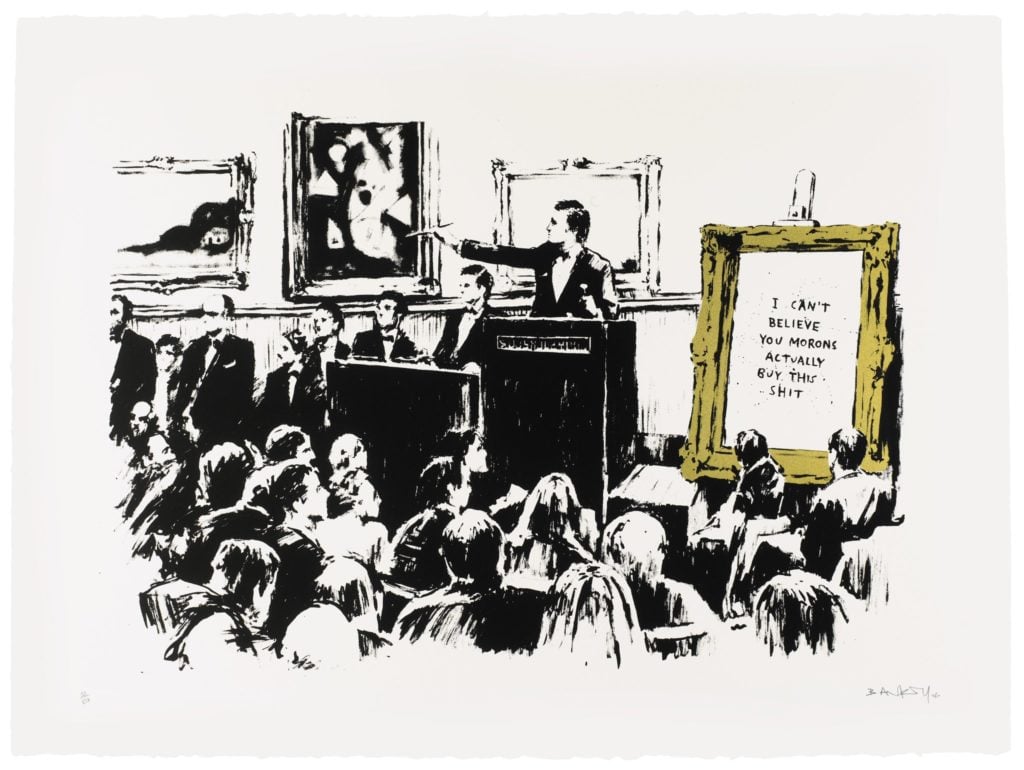
Banksy, I Can’t Believe You Morons
Actually Buy This Shit (2014). Courtesy of Sotheby’s.
This one has been a raw nerve for a long time.
The art world has long debated whether artists ought to get a
royalty when buyers profit from the resale of their work. Back in
1973, Robert Rauschenberg shoved Robert Scull after the taxi
magnate made a huge profit by auctioning off his work at Sotheby’s
Parke-Bernet. Scull paid just $900 for Thaw (1958) in the
late 1950s; he offloaded it for $85,000 in 1973. “I’ve been working
my ass off for you to make that profit,” Rauschenberg said.
(There’s a postscript, as Art Market Monitor has reported, but that’s
another story.)
People complaining about this situation have called for a
federal resale-royalty right in the US, in which artists would get
a percentage of the proceeds. (Such laws are already on the
books in California and in parts of Europe.) They say that writers
and other creative people get royalties when their work sells well,
so why shouldn’t they?
2. Speculators Can Ruin an
Artist’s Market
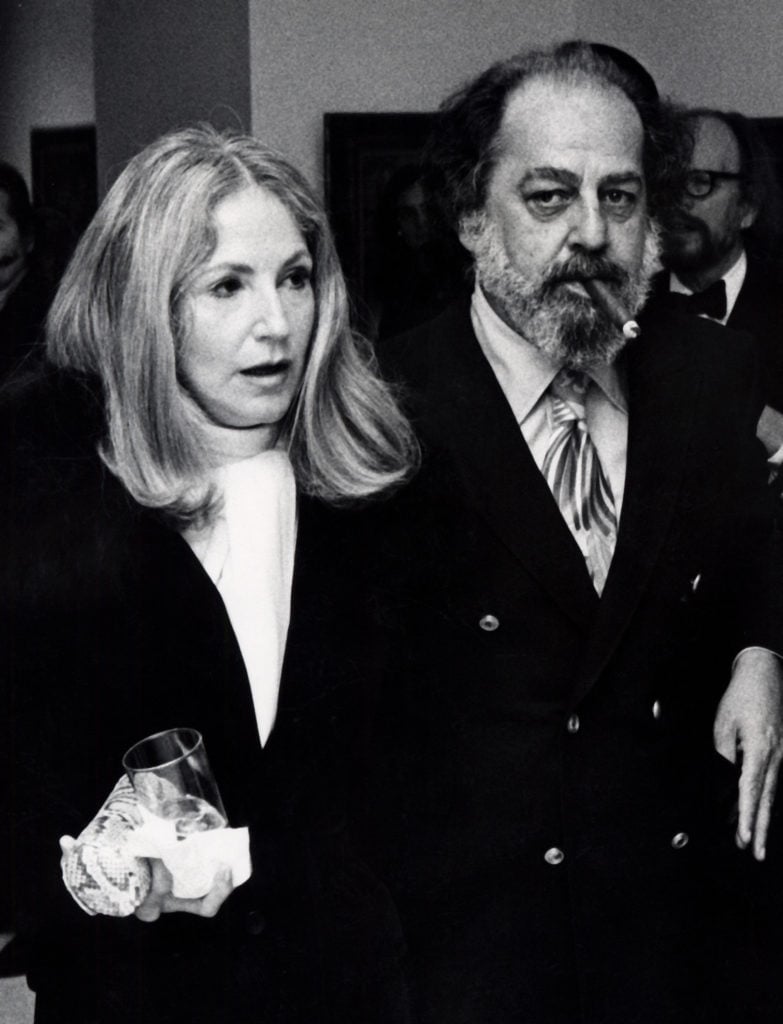
Ethel Scull and Robert Scull. Photo by
Ron Galella/Ron Galella Collection/Getty Images.
Possibly even worse for artists and their dealers: if
their work scores big at auction, it can actually have disastrous
results.
“You can’t stop a 34-year-old artist’s work coming to auction
and the price going skyward,” says a dealer. “Then, you can’t stop
the prices from crashing down when the speculators move on. Heaven
forbid the artist does a body of work that’s slightly different,
and people don’t understand it and so they don’t like it.
“Ross Bleckner is an excellent example,” the dealer goes on.
“His primary market is okay, but his work doesn’t trade at prices
anywhere near those of his contemporaries. His market went up in
the ‘80s and then collapsed at the end of the bull run.”
Bleckner’s auction high, achieved at Christie’s New York in
2006, is $192,000, and only about a dozen works have sold in the
six figures. Eric Fischl’s auction high, meanwhile, is $1.9
million, set at the same house in the same year; David Salle’s
record is $795,000, set at Christie’s London in 2017.
For more recent history, just ask some of the stars of the
Zombie Formalism movement, like Lucien Smith, Parker Ito, and Ryan
Sullivan, whose prices and auction presence have gone down and
stayed down since the heady days of the early 2010s.
3. You Need Family Connections to
Make It

Martin Margulies and his daughter,
Elizabeth. Photo: Angela Pham/BFA
There may be plenty of progressive-minded people in the art
world, but if your heels are worn down and your coat is frayed, you
may find certain doors are closed to you.
“It’s supposedly so democratic and open to people but in reality
it’s cliquish and elitist, so it’s impossible for many people to
gain access,” said a gallery director. Echoing her sentiments, her
boss, the gallery principal, added, “You never really escape your
parents’ level of status, do you? You are who your parents
are.”
Adds an artist-educator, “Getting a job in the art world is much
easier if you already come from the ruling class and have family
connections, speak three languages, and feel comfortable ordering
subordinates around while making polite conversation with curators,
collectors, and celebrities.
“It’s much easier to succeed in almost every role if you can
subsidize your own participation, from $140,000 Columbia tuition to
entry-level gallery jobs that pay $30,000,” says the
artist-educator.
4. Colonization Casts an Enormous
Shadow

Touria El Glaoui. Photo Victoria
Birkinshaw.
The art world is just one part of a larger system that
disadvantages populations that have long been exploited on a global
scale, points out one art fair founder.
“Founded on—and playing a significant role in—colonial,
capitalist, and patriarchal structures, the art world undoubtedly
favors those from particular demographics with influential networks
and financial wealth,” said Touria El Glaoui, founder of the 1-54
Contemporary African Art Fair.
“Anyone without these privileges is
faced with an unjust and steep battle for recognition,
opportunities, and stability. 1-54 was initiated in response to
these disparities, providing a much deserved and overdue platform
for artists from Africa and its diaspora. Although inequalities in
the art world are slowly being eroded, they need to continue to be
challenged and dismantled to create a space that works for
all.”
5. Art Schools Are Part of the
Problem
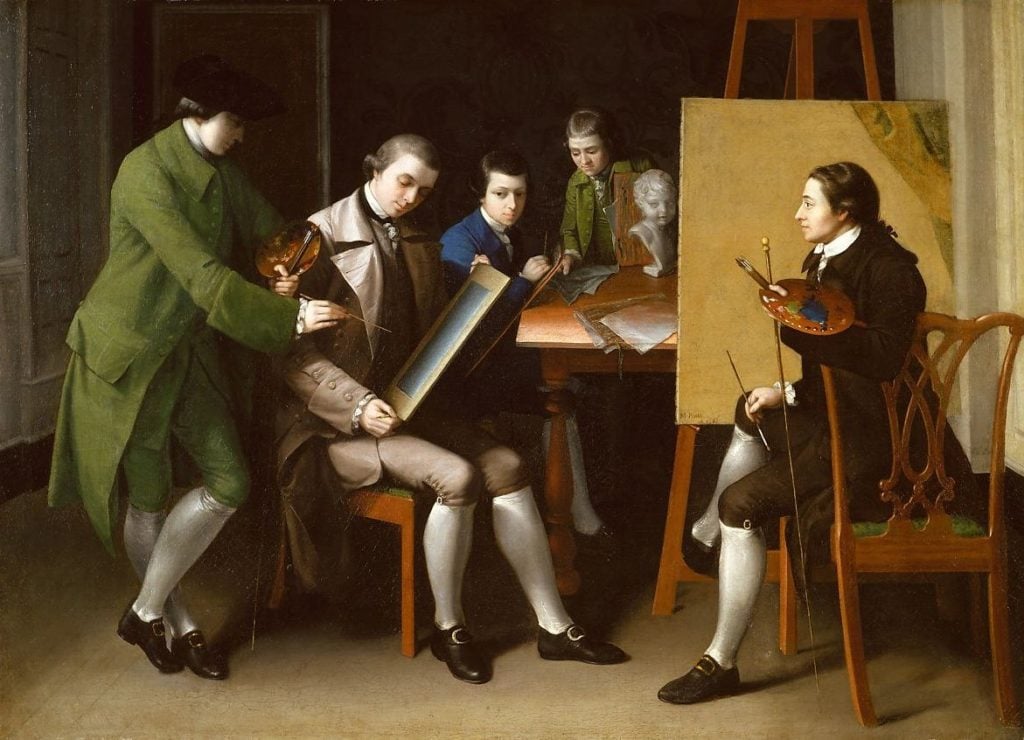
Matthew Pratt, The American
School (1765).
Intergenerational resentment is simmering in the art academy,
just as it is in the rest of the world.
“Baby boomer full-time faculty have no idea what the
contemporary job market or economy are like, and they give
completely useless advice that has no basis in any reality that’s
existed for at least 25 years,” says one artist-educator. “And they
earn twice as much as the millennial faculty who actually know
what’s going on socially and culturally, even though the
millennials are in catastrophic debt.”
And the only ones not going into debt for art school, adds an
art fair director, are the privileged, because “art schools are so
expensive that they are only drawing the children of privileged
families, who went to private schools, because art-education
budgets in public schools have been zeroed out.”
Another artist-educator sees a different problem: “The basic
model for art schools is to train 100 students, [from which] one
artist will employ the other 99.”
6. Museums Are Also Part of the
Problem

Guerrilla Girls, Guerrilla Girls’
Code of Ethics for Art Museums Monument, 2019. Courtesy
Guerrilla Girls.
One of the most significant developments in the art world this
year was the vociferous protest over the Whitney Museum of American
Art’s board co-chair, Warren Kanders, who owns a company that makes
weapons that have been used on protesters and asylum seekers. While
those on the side of progressive causes may count that as a
victory, for one artist, the very difficulty of ousting Kanders
highlights the enormous power such wealthy board members have in
these institutions.
It’s unfair, says the artist, that “it took a letter from
Whitney staff members, nine weeks of protests organized by Decolonize
This Place, a letter signed by over a hundred academics published by Verso,
Artforum’s ‘Teargas Biennial’ essay, nine artists withdrawing from the Whitney Biennial,
numerous articles, and a rumored call from the Ford Foundation’s
Darren Walker to get one [person] off the board of the Whitney Museum.”
It isn’t just tear-gas money that has been funding museum
operations. Funds from the Sackler family, which drew inconceivable
wealth from the opioid crisis, has long supported museums
nationwide, though protests and lawsuits are now beginning to
convince museum directors to turn away Sackler money and even relabel galleries that have carried their
name. Activists say the family’s influence represents just one of
the ways that the deep-pocketed have pulled the strings at
museums.
7. The Art Market is Profoundly
Opaque

Elmgreen and Dragset, Tanya! Tanya!
Tanya! (2004). © Elmgreen & Dragset, courtesy of Perrotin.
Though it’s required by law in New York State for retailers to
display the prices of their wares, how many New York City art
galleries actually offer a price list? Ask at the front desk and
you’ll typically get a cold shoulder.
This creates a highly asymmetrical balance of power favoring the
dealer over the prospective buyer, says one fair director,
especially if that potential buyer is new enough to the art
collecting game not to have a network of friends and colleagues to
help her figure out what the prices might be—and what price is
fair.
“There’s no transparency on primary-market pricing or curatorial
credibility to evaluate new art,” says a fair director. “If I’m a
collector and I’ve been vetted by a gallery and then offered a
work, I get a price from the gallery but I don’t understand where
it fits within the ecosystem of the artists’ peers, and I don’t
know what the prices were at the artist’s previous show or what
they will be at the show after. I don’t know what’s coming down the
pipeline curatorially that might make some career milestones for
that artist.
“These extreme asymmetries have led to a lack of confidence in
the market, and that has stymied a lot of collectors from
committing to new artists,” the fair director continues. “It’s not
just the pricing but the bigger picture. If the art world were more
transparent, it would be far more beneficial to collectors. I think
they would collect a greater diversity of artists.”
8. Women Still Don’t Get a Fair
Shot
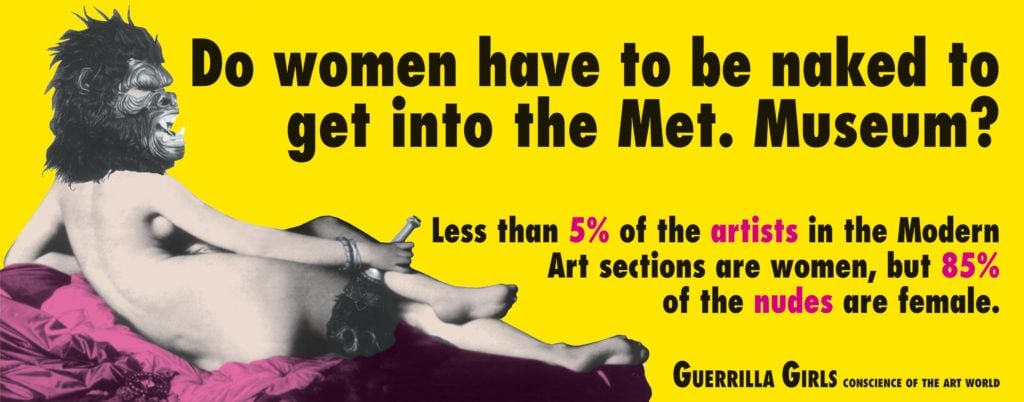
Guerrilla Girls’ Do Women Have to be
Naked to Get into the Met. Museum? (ca. 1989). Courtesy of
Cooper Hewitt.
The Gorilla Girls’ striking indictment of the Metropolitan
Museum of Art in 1989 (see above) came some 18 years after
pioneering art historian Linda Nochlin’s 1971 essay “Why Have There
Been No Great Women Artists?” In the article, Nochlin pointed out
the structural boundaries that block women from achieving the same
successes that men do.
Thirty years after the Guerrilla Girls’ outraged question, the
situation hasn’t improved much.
The numbers tell a bleak story: according to a recent report by Artnet News and In Other
Words, of the nearly $200 billion spent on art at auction since
2008, just $4 billion, or 2 percent, was spent on works by women
artists. While galleries may do better in terms of promoting women,
their rosters still fall dramatically short of parity: “A 65:35
ratio is repeated over and over—that’s still almost twice as many
men as women,” says Micol Hebron, who has studied the data for
years.
Another part of the same study devoted to
museums found that just 11 percent of acquisitions and 14 percent
of exhibitions at 26 prominent American museums were devoted to
women artists.
“The Guerrilla Girls,” one artist said, “may never be able to
retire.”
9. There Seem to Be No Clear
Reasons for the Way Anything Works

Courtesy Wikicommons.
“Why is there only ever one black artist at a time?” asked one
black artist in his 40s.
“Why is it that, although performance artists are really hot
when they’re young, after that, no one knows who they are for 20 or
30 years? Why is it that if young women artists are doing work
involving their bodies, everyone is around for it when they’re
young, but then years later, [they say], ‘I can’t believe
nobody has shown their work in 20 or 30 years’? Why do museums
act as though paying artists is an afterthought, or even fight not
to pay artists, when artists are the foundation of
institutions? Why are museums always ‘wishing’ they could pay
you for your labor? The market wants artists to do the same thing
over and over. ‘You should be really expressive, in this same way…
for 20 years!’”
The post It’s Not All in Your Head—the Art World Really Is
Unfair. Here Are 9 Reasons Why appeared first on artnet
News.
Read more https://news.artnet.com/art-world/9-reasons-art-world-is-unfair-1726653
Further reading


Leave a comment