
Facing Pushback From the Left and Right, the Baltimore Museum’s Director Defends His Decision to Buy Only Women’s Art in 2020
Under the leadership of director Christopher Bedford, the
Baltimore Museum of Art has set itself ambitious goals and has
taken unconventional steps to get there. Last month the institution
proclaimed that since its own collection is grossly weighted in
favor of work by male artists, the museum will buy work by women artists exclusively during 2020 in
order to “rectify centuries of imbalance.” What’s more, in order to
fund those acquisitions, the museum has sold off a number of works by white men,
including Andy Warhol and Robert Rauschenberg to fund the
purchases. While the museum’s acquisitions budget has previously
been about $475,000 a year, this time around the museum will devote
$2 million dollars toward buying women’s work in a single year.
The resolution was hailed in some quarters, with Bianca Kovic,
director of New York’s National Association of Women Artists,
telling the Baltimore Sun that “What the Baltimore museum is
doing is so cool. We think all museums should do it.” But for what
one might have expected to be solely a feel-good announcement, the
initiative—dubbed Vision 2020—has met with spirited pushback from
both men and women.
In BMore Art, some twenty-seven women in the arts
weighed in with skepticism and tough questions as well as some
praise. Some were concerned that the museum was doing too little;
artist Betty Tompkins warned against tokenism, while Jackie
Copeland, director of the Reginald F. Lewis Museum of Maryland
African American History and Culture, wrote, “I know Chris’s heart
is in the right place, but is this enough to change the entire
culturally biased art establishment?”
Elsewhere online, the complaints were even more vociferous,
which might have been expected in a moment of toxic masculinity and
online hazing of women. “Baltimore Museum of Art to Officially
Discriminate Against Men in 2020,” reads the headline at A Voice for Men. “Baltimore Museum of
Art Reaches New Level of Virture Signaling,” writes The Western Journal, whose author
dismisses the museum’s link to the centennial of (white) women
getting the right to vote, asserting that “art has never excluded
women in the same way as American politics have.” (The statistics tell a different story.) Bringing some humor to the
mix, Red State declares that by the end of 2020, “Baltimore
Will Have Bought-A-Less.”
Bedford spoke to Artnet News about whether the museum would be
able to change direction so quickly, and about the pushback from
vocal critics.
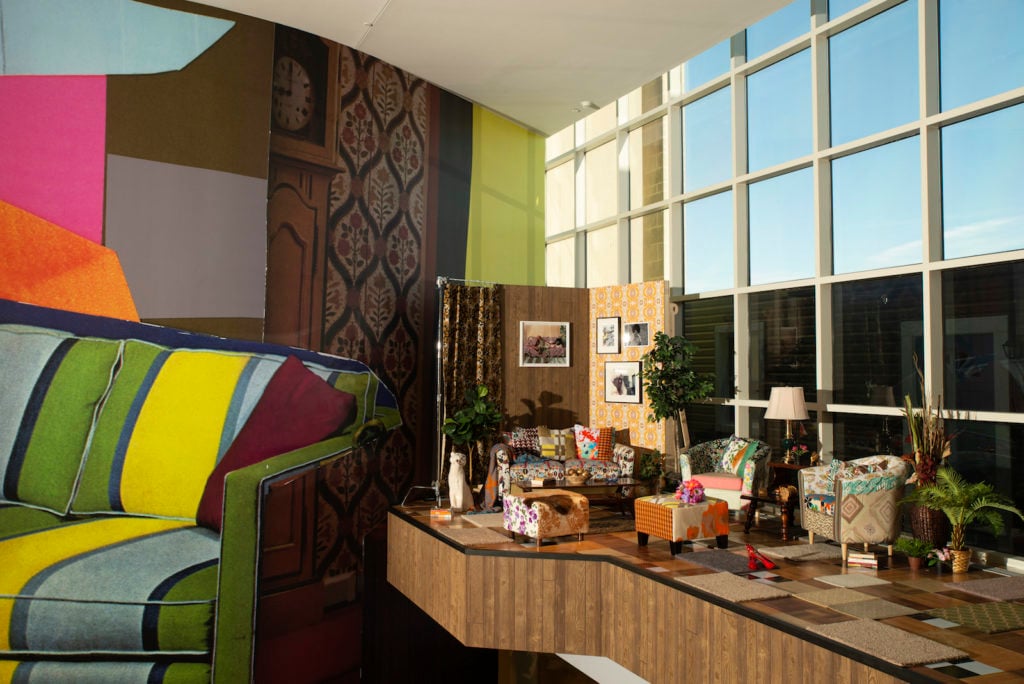
Installation view of “Mickalene Thomas:
A Moment’s Pleasure” at The Baltimore Museum of Art. Photo by Mitro
Hood.
You sought institution-wide approval for your plan to sell
works by white men in order to fund buying works by women. I
imagine there will be a magnifying glass on the new acquisitions.
Will there be more consensus sought within the museum than there is
for routine acquisitions?
In big institutions like the BMA, the process of proposing an
acquisition, then presenting it to the accessions committee, the
executive committee, and the full board, is an incredibly rigorous
process anyway. While in the insular museum world there’s a common
understanding of how acquisitions processes unfold, I’m not sure
that understanding prevails beyond museums’ walls. Given the extent
of public interest, we have a good opportunity to reveal the
process by which we make these determinations with more
transparency and candor than you usually see.
You’ve said that just 4 percent of the museum’s holdings were
created by women. Do you have any idea of what percentage change
you’ll be able to achieve by the end of 2020, or will you just
assess that at the year’s end? I imagine it would be difficult to
set a goal since you’ll also accept gifts, including works by male
artists, right?
Right. But while I don’t think the percentage of works in the
collection is going to shift that radically, we do have a
commitment toward buying major works that are presentation-worthy
on a near-constant basis. We will be going after major things that
theoretically will become hallmarks of the collection, and while
those hallmarks might not shift our numbers radically, they will
shift what we present to our public on a day-to-day basis. If a
wall changes completely, that’s at least as significant as upping
the percentage by one or two points.
Considering that, as you said, there is already such a
process in place for getting purchases approved, it seems like it
might be administratively difficult to spend about four times as
much money on acquisitions, subject to the same sort of process,
no?
curators have a great deal of vim and vigor. They are not short on
ideas, and they are not short on ambition. They want to populate
their galleries with major works. They’ve probably been waiting
their entire careers for a moment like this. Curators are very
acquisitive. That’s why they are good at their jobs.
In the responses to the news in BMore Art, Betty Tompkins writes
about museum acquisitions processes that “this kind of
process and presentation is enormous, and it can take years to
reach a verdict.”
I would respectfully push back on that. The metabolism at
museums is much more a matter of habit than of mandate. We have
very incredibly willing partners in dealers and auction houses. The
metabolism of both of those is quite different from a museum.
Might there not be a painful moment if an irresistible work
by a male artist came on the market at a price you could afford?
Wouldn’t it be difficult to pass that up?
I think the rightness and the virtue of the direction that we
have assumed for ourselves will be the balm to that pain.
Inevitably there will be something fabulous, but our commitment
rests on a bigger picture for the development of the collection,
and I would prefer to stand by the principle than give in to the
temptation of a single object.
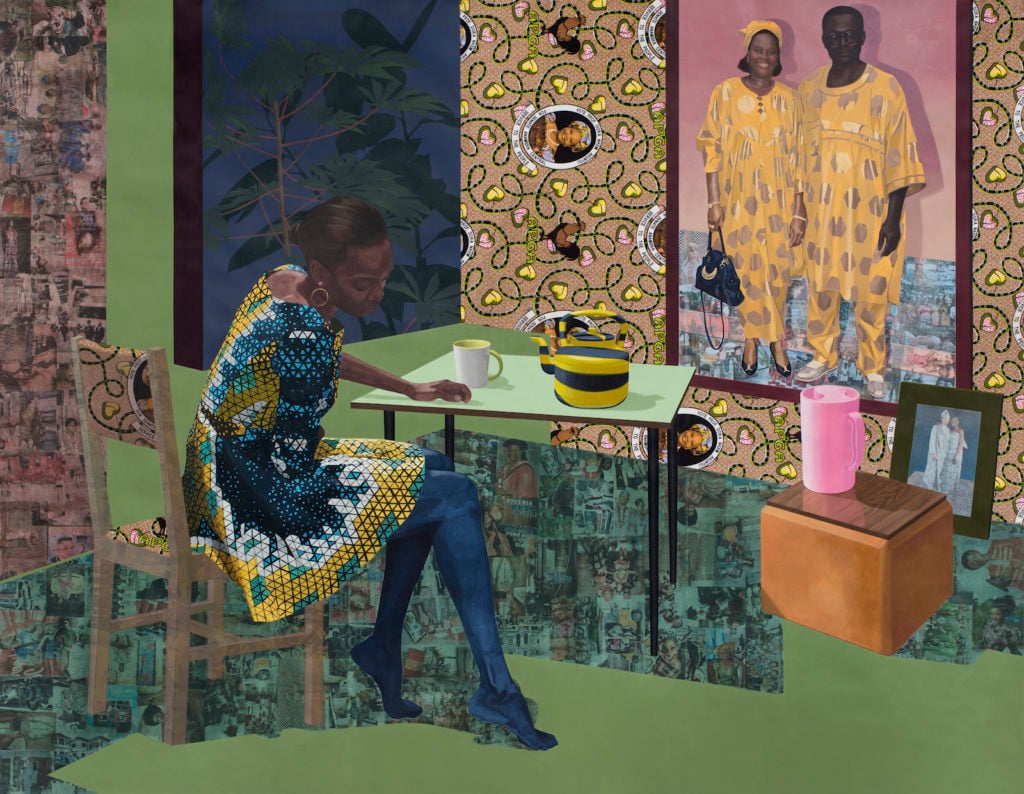
Njideka Akunyili Crosby, Dwell: Aso
Ebi, 2017. The Baltimore Museum of Art.
You’ve planned a year of temporary exhibitions devoted to
female and female-identifying artists. Will the display of
collection works reflect the same vision within 2020 too, or will
it take a little more time to integrate the new works?
It’s my expectation that the curators are buying
presentation-worthy and presentation-ready works, and if they’re
not acquiring in anticipation of immediate placement, they will
have a plan for the incorporation of those works in the calendar
year. Of course there will be some exceptions. But there is a
collective understanding that while there is not a definitive plan,
they’re buying for the galleries, not for storage.
Without quoting anyone, of course, can you comment on what
the response from other museum directors has been?
The healthy questions that other curators and museum directors
have are less about the virtuousness of the direction and more
about, How do you engineer a successful realization within the
bounds of institutions that have traditionally moved very slowly
toward change?
One thing the BMA rests on, and I think this is enormously
important, is that it is a museum built largely by women. The first
director was a woman, as was one of the most notable directors,
Adelyn Dohme Breeskin, who was responsible for bringing the Cone collection to the museum. She was also the
commissioner for the Venice Biennale in 1960. Sue Cohen, our former
board chair, provided the endowment to make the museum free. Our
current board chair, Clair Zamoiski Segal, is a woman who has a
very pronounced feminist agenda in everything she does.
So the various pieces of the puzzle are very much in place to
help us realize a vision in acquisitions and exhibitions that
actually begins to align with this part of the museum. It’s
tremendously important that there be symmetry in the way we present
publicly, through our creative programs, and the way that the
institution has been built over a century. The building process has
largely been undertaken by women leaders, and I think it’s high
time that the creative program develop a symmetry with that
history. That’s where we’ve gained the most traction and why we’ve
been able to move so quickly in this direction. It’s in our
blood.
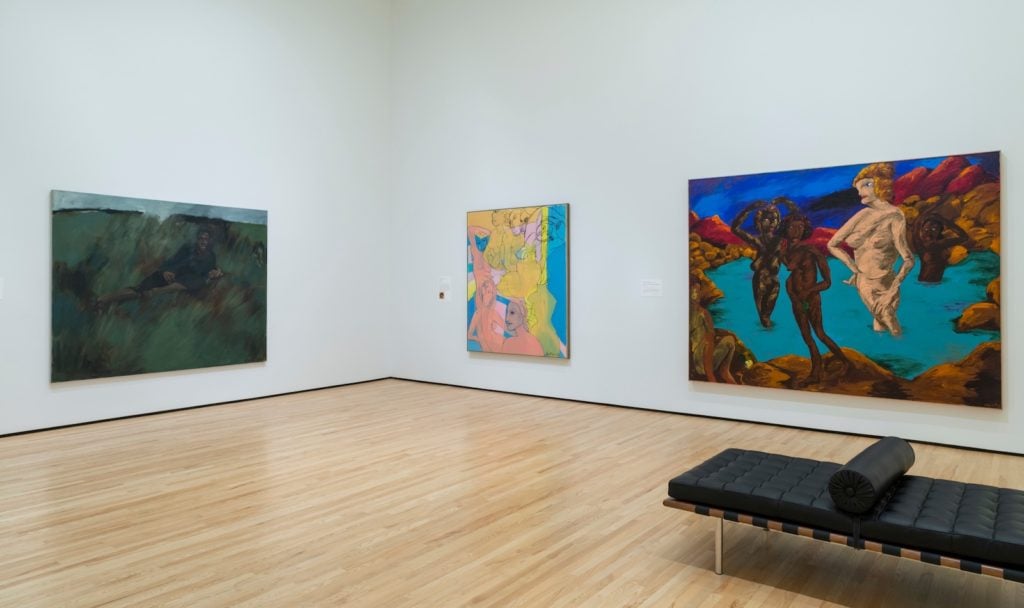
Galleries at the Baltimore Museum of
Art. Photo by Mitro Hood.
There has been some brisk pushback from both men and women.
At BMore Art, several critics weighed in: Maura Callahan worries
about relying on women as spectacle; Jillian Steinhauer says that
$2 million is not enough money, and that you need a plan for beyond
2020; and Suzy Kopf says this is premature bragging, and that she
would rather hear about this initiative after the fact. Did any of
this give you pause?
One criticism had to do with the relationship between my being a
spokesperson for this initiative as a male—and the generations of
preceding women leaders, who have done a lot of good work for many
many years, having made limited headway by comparison or who
garnered limited attention by comparison—and asking, “Isn’t that a
structural problem?” That did cause me to pause. Probably the level
of attention garnered by me and this museum in this announcement is
itself reflective of the systemic sexism we’re trying to combat
with this policy. That doesn’t mean that I would change my
position. I still believe we’re doing the right thing, but it does
throw into high relief the fact that others have been doing the
right thing for many years without the acknowledgement that we’re
getting.
Men have been weighing in, saying this is discrimination,
that women haven’t been discriminated against in the art world, and
so on. What do you make of that?
To suggest that the art world is not subject to the same strains
of sexism that have structured society more broadly would be to
suggest that the art world is not part of society, and of course we
are, so those same structural biases have structured our
activities. So, our exhibition decisions have been reflective of
sexism over decades.
I would rely on simple numbers. If in the present, by a hair,
the majority of the population in the United States is female, and
if historically you’ve had a fifty-fifty split in society, and you
have museums that have single-digit percentages of their
collections being women artists, it would be impossible to make the
claim that that percentage division is based on pure merit. If
merit were the only factor taken into account when making
acquisitions or planning exhibitions, you would see a far more
equitable distribution.
One of the ideas we use at the BMA, particularly with reference
to the representation of artists of color, is that there is a
tremendous difference between fairness and equity. So if we were
being fair, and blind to the past, sure, one would collect, based
on merit, a roughly fifty-fifty split of men and women. But the
fact of the matter is that we have been inequitable for a very long
time. It’s an opportunity to look to holes in our collection and
exhibition history that were made by that bias. So to distort
attention toward that task in the present, to me, is a way to inch
toward equity.
The post Facing Pushback From the Left and Right, the
Baltimore Museum’s Director Defends His Decision to Buy Only
Women’s Art in 2020 appeared first on artnet News.
Read more https://news.artnet.com/art-world/baltimore-museum-women-art-1730058
Further reading


Leave a comment