
Dutch Artist Viviane Sassen Made Her Name Photographing People in Africa. Now, She’s Reconsidering Her Own Legacy
Dutch contemporary photographer Viviane Sassen, who has been the
subject of solo exhibitions at such decorated institutions as the
Museum of Contemporary Photography in Chicago and the ICA London,
has had a lot to think about lately.
Now 47, Sassen made her name by straddling art and fashion with
her vivid photography, which depicted black Africans she met on her
travels across the continent. (Sassen lived in Kenya with her
parents between the ages of two and six, and longed to return to
the country after relocating to her native Netherlands.)
When she first started out as a
photographer in the 1990s, her images of black Africans were
somewhat radical for a western artist. But as the art world
continues to wrestle with the legacy of colonization and the
post-colonial gaze, Sassen has been forced to re-examine her own
work—and consider whether she should be making the kind of imagery
she became best known for at all.
Recently, public scrutiny of her
oeuvre has intensified. Earlier this year, an art critic writing in
the Netherlands’ national newspaper NRC accused Sassen of “cultural appropriation” for
her work in a group show “Freedom – The Fifty Key Dutch Artworks”
at the Museum de Fundatie in Zwolle, the Netherlands. The critic
wrote that Sassen liked to photograph black skin, “and made it her
life’s work, so that black people are once again reduced to their
skin color.”
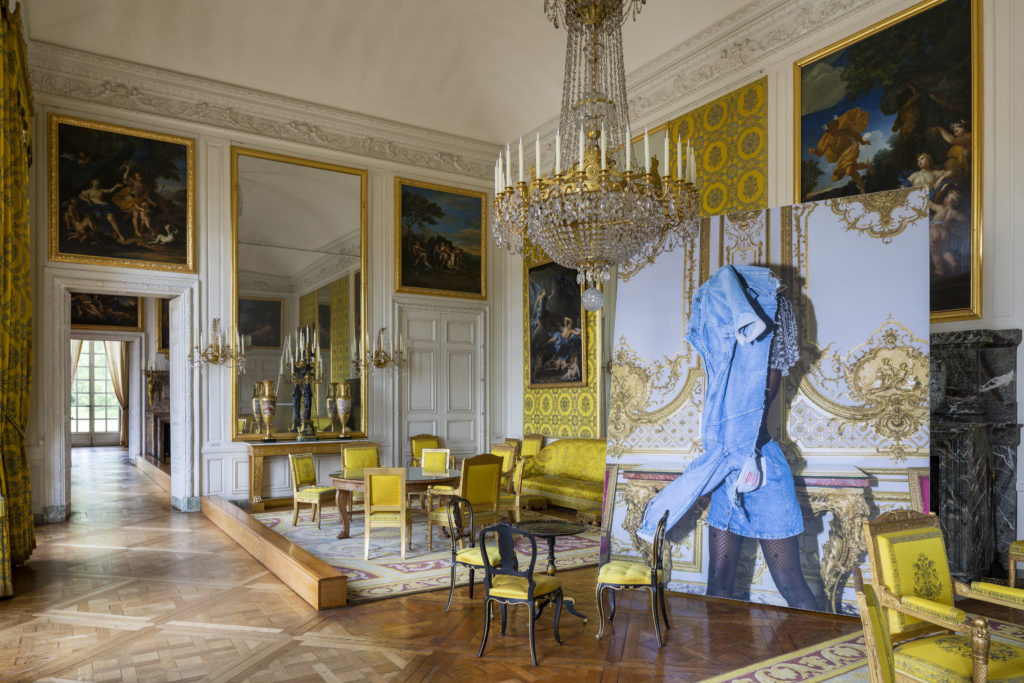
Viviane Sassen’s work in
“Visible/Invisible” at the Palace of Versailles. Courtesy the
artist.
A Complex Legacy
Sassen is now taking on the
delicate task of defending her work while wrestling with her own
complicated feelings about it. The NRC’s characterization is “first of all, untrue,”
she says, sitting at the long table in her studio in the center of
Amsterdam, a large open space with bohemian couches built into the
walls, a hammock, and lots of books. Her use of black models “may
be the part of my work that’s best known, but it’s not most of my
work.” (She also uses white models, as well as photographing bodies
she paints in various hues, like red or blue.)
Still, the artist says she
understands the political, social, and racial dynamics better now
than she did when she was starting out. “Because I’m a white woman
photographing in Africa with this camera, which is already a tool
of power, it raises all these questions about representation,
logically,” she says. “I’m very aware of that and over the years
I’ve been thinking about this in different ways and it still is
something which is very important and something which I can’t
always pinpoint or explain.”
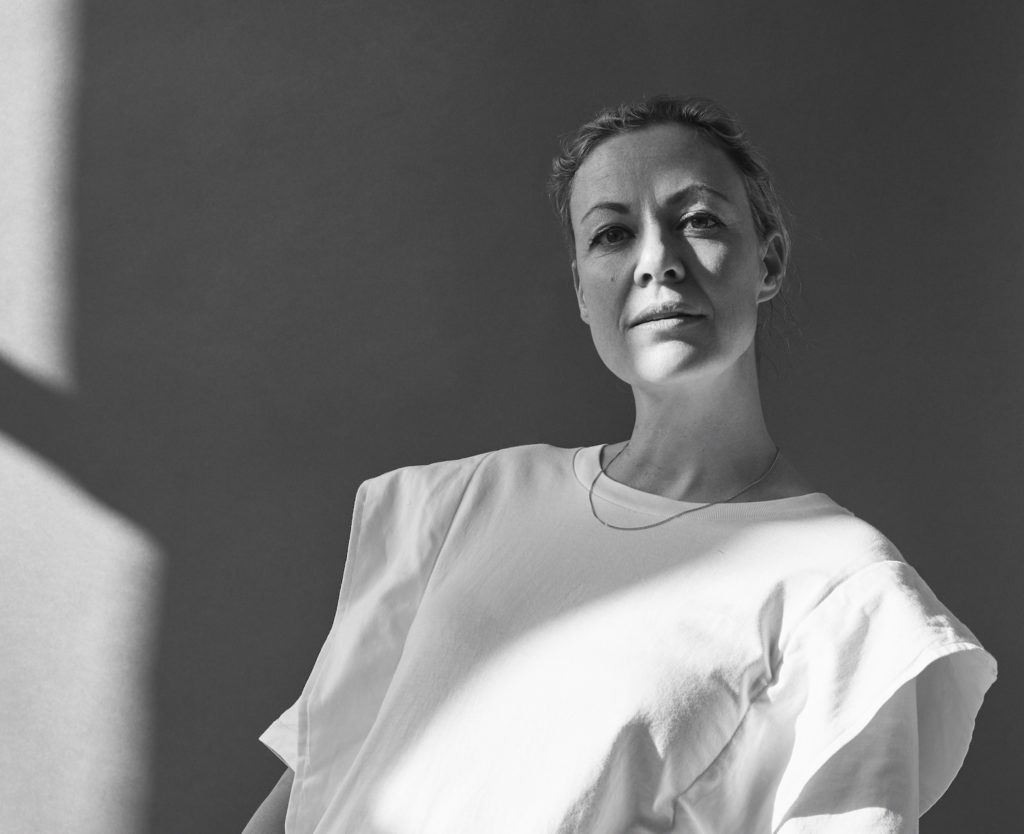
Viviane Sassen by Hanneke van
Leeuwen.
Growing up in the Netherlands,
Sassen feels she may have been somewhat cut off from discussions
related to race and the history of colonialism and slavery, which
were more prevalent in the United States and South Africa. This
kind of post-colonial discourse was not as common in Dutch culture
until fairly recently, since the Netherlands never had a Civil
Rights movement. That is changing now: in September,
the Amsterdam Museum decided to stop using the term “Golden
Age” to refer to the 17th century because the phrase glosses
over the more negative realities of the time.
“It’s very important to ask
yourself those difficult questions and keep on asking them,” Sassen
says. “That’s also what I do and try to do, but I have become much
more cautious about who I photograph, where, and when.” These days,
she says, she tends to photograph people less, opting instead to
depict the body through reflection or shadow.
“I really want to be 100 percent
sure that it’s okay, that people want it,” she says. “You have to
make sure you have that integrity, and look at yourself in a
mirror.”
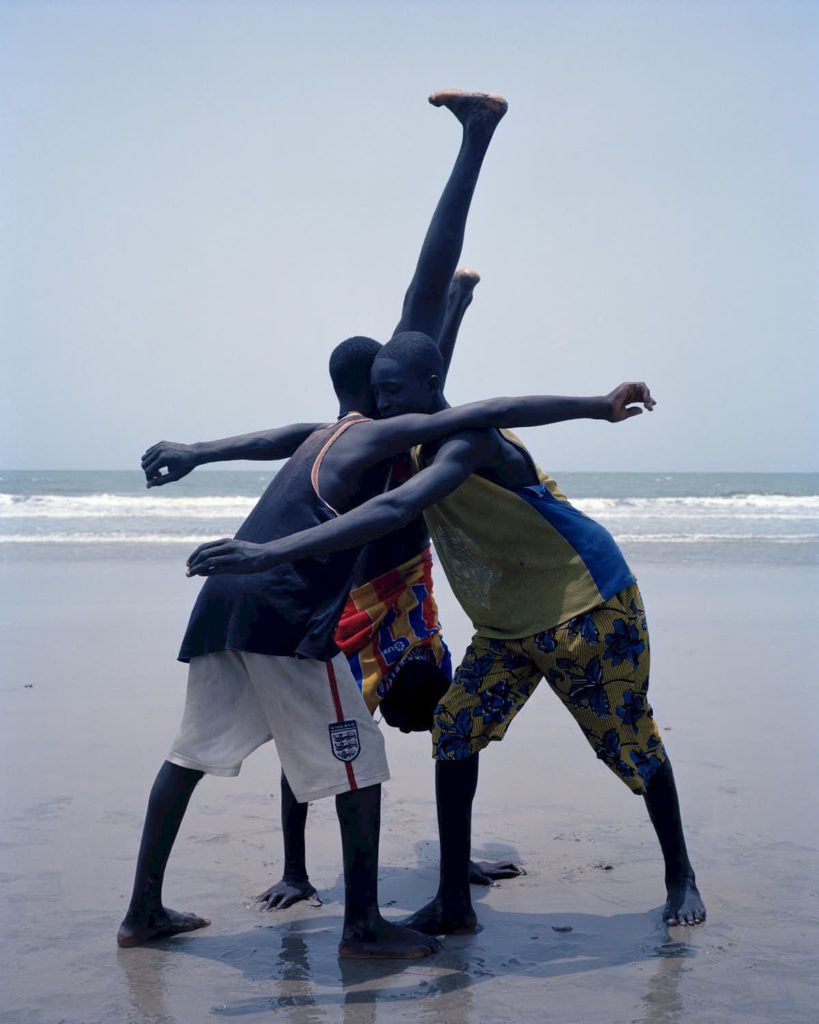
Anansi from Viviane Sassen’s
“Flamboya” series. (2007). Courtesy the artist.
A Global Outlook
To date, Sassen’s career has
struck a balance between commercial and conceptual worlds: She has
had international solo museum shows and worked as a photographer
for luxury brands. She recently completed a clean water campaign for Madagascar-based WaterAid’s
charity partnership with Giorgio Armani and, this March, will have a solo exhibition at the
Huis Marseille in Amsterdam. She is represented by South Africa’s Stevenson
Gallery, and her works are on view at Andrew Kreps Gallery in New
York as part of a joint group show with Stevenson until December
21.
Her path to art truly began with
visit to her childhood home of Kenya in the
1990s. “I lived there
as such a young child, during these years of what they call
‘magical thinking,’” Sassen says. Returning to this environment, “I
suddenly had these very vivid dreams at night and it was super
intense.”
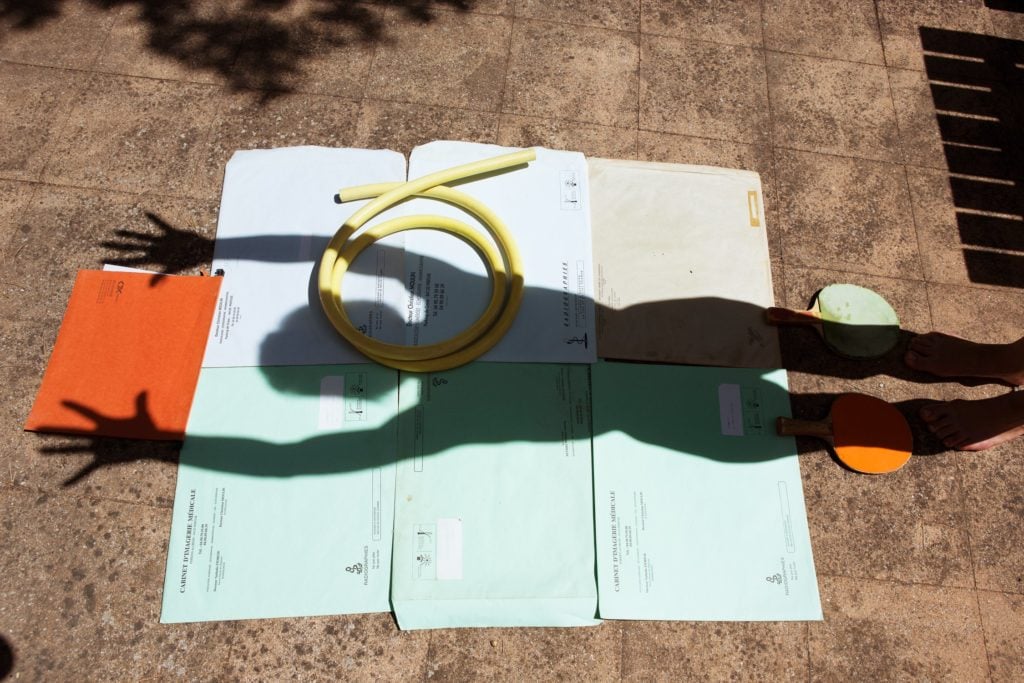
Untitled (2017) from Viviane
Sassen’s series “Roxanne II.” Courtesy the artist.
Her images exude a vivid,
surreal quality, often featuring unusual juxtapositions of human
figures, architecture, and stark landscape. Sassen’s strength has
always been in reimagining perspectives: In the ’90s, she began to
define her approach at a time when most photographers working on
the African continent were photojournalists. The norm was to
capture war or famine, tribal societies and local
customs, often through a lens meant to appear objective
(although nowadays we recognize that it, too, was
subjective).
For a short time, she followed
suit before pioneering her own vision. “It occurred to me that I
could make my own, staged images and work in my own way,” she says.
“I went back to the village of my childhood and had all these ideas
and visions and when I started staging these images, I felt this
was something very new.” She was right.
In the 2000s, she became
internationally recognized for two series, “Flamboya” and
“Parasomnia,” which reflect the “magical thinking” that partially
stemmed from memories of her youth. Both feature black models posed in unnatural
postures, often obscuring their faces.
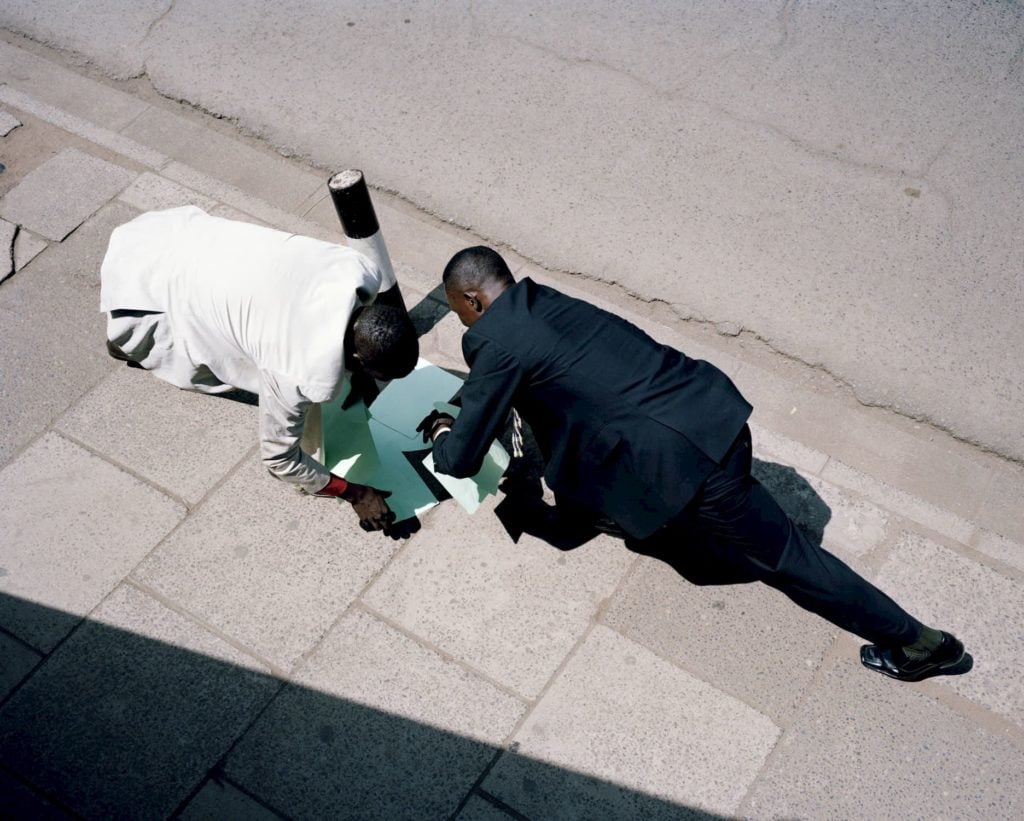
J.F. from Viviane Sassen’s
“Parasomnia” series. (2010). Courtesy the artist.
In 2007, she won the Prix de
Rome, one of the top art prizes in the
Netherlands—the
judges praised her series “Ultra Violet,” which she created while
traveling in Ghana, for breaking through a medium in “deadlock.” By
simultaneously getting close to her subjects and holding them at a
distance, “she creates a new kind of photography, just when
photography seems to reach its limits,” the jury
declared.
Sassen has returned to live in
Africa as an adult; her husband, who is also Dutch, also spent time
on the continent with his doctor father when he was young.
Together, they have traveled extensively and spent a lot of time in
Tanzania, where they raised their son (now 11). A widely reproduced
photo of him as a child is also a self-portrait of Sassen, her body
casting a shadow on his as he walks along a beach in South Africa.
Her past, his past, and his future as a grown adult are all held
within the photograph.
“Ultimately, I make work that is
somehow connected to my life, to my personal life, and Africa has
been a very big influence in my life,” Sassen says. “It’s something
I keep coming back to.”
The post Dutch Artist Viviane Sassen Made Her Name
Photographing People in Africa. Now, She’s Reconsidering Her Own
Legacy appeared first on artnet News.
Read more https://news.artnet.com/art-world/viviane-sassen-profile-1730481
Further reading


Leave a comment