
Some People Think Cattelan’s Banana Is Genius. This Law Professor Thinks It’s Illegal
Just when you thought you would never have to swallow another
banana, here comes a law professor with a jocular legal argument
against Comedian, the artwork that Italian artist Maurizio
Cattelan came out of retirement to offer for sale at Art Basel
Miami Beach earlier this month.
In a brand-new paper, University of Kentucky Law professor
Brian Frye argues not that those three buyers
paid too much to Cattelan and his gallery, Perrotin, for a piece of
fruit and some duct tape. And he’s not arguing that it isn’t art in
the first place. Rather, he’s arguing that it is a financial
instrument that defies rules set down by the Securities and
Exchange Commission. The $120,000 banana, argues Frye, is a
security that Cattelan and his gallery, Perrotin, should never have
been allowed to sell in the first place.
But Frye goes even further, proclaiming in the abstract for his
paper, dryly titled “SEC No-Action Letter Request,” that “this
article is a work of conceptual art in the form of a law review
article.” If Cattelan can call a banana an artwork, Frye figures,
he can call a certificate of authenticity an artwork. But the twist
is that Frye argues that his own letter is an illegal security, and
it’s one that he plans to sell: “I propose to sell certificates of
ownership of the work ‘SEC No-Action Letter Request’ to the general
public in an edition of 50 for $10,000 each,” he says in the
paper.
A “no-action letter” is a request typically sent to the SEC by a
party who wants to sell something that might fall under SEC
regulations. The letter typically asks the SEC to take no action to
stop the sale of the product, service, or certificate. But since
Frye argues, with tongue in cheek, that since a certificate
indicating ownership of an edition of a conceptual artwork is
equivalent to a security certificate, “you should deny my request
for a no-action letter, because I am proposing to sell an
unregistered security.”
In fact, writes Frye, “most conceptual artworks are unregistered
securities and the art market is replete with unwitting violations
of the securities laws.”
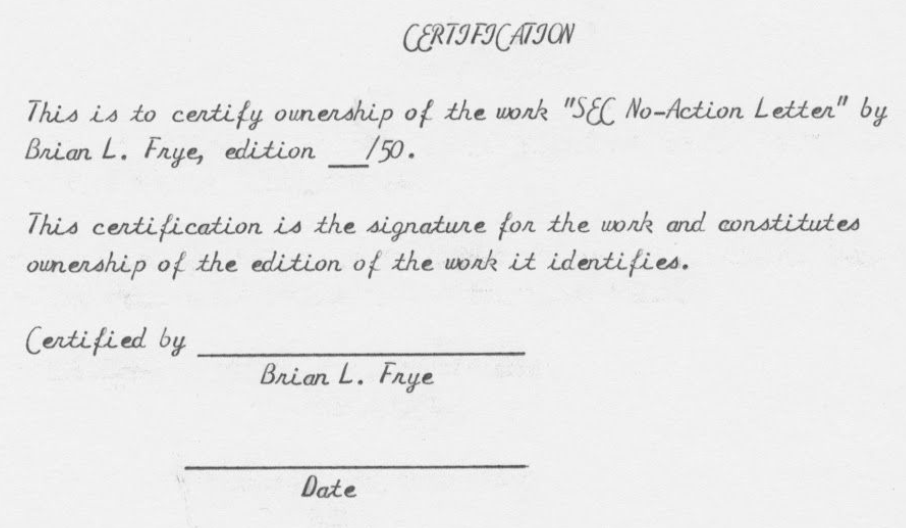
Brian Frye’s certificate of
authenticity.
“As I saw artwork increasingly dematerialize, the more I
realized that what you’re buying literally fits the definition of a
security as adopted by the Supreme Court in the Howey case,”
Frye said in a phone conversation. “You’re buying a fractional
interest in an abstract business proposition. But it’s even truer
to say you’re buying a percentage ownership in the fame. It’s
really like conceptual artists securitizing their own celebrity.”
In S.E.C. v. W.J. Howey Co., Frye points out, the court
observed that “an investment contract for purposes of the
Securities Act means a contract, transaction or scheme whereby a
person invests his money in a common enterprise and is led to
expect profits solely from the efforts of the promoter or a third
party.”
Neither Cattelan nor his dealer, Emmanuel Perrotin, wished to
comment for this article, probably already being hoarse from
speaking to reporters about Cattelan’s stunt, which managed to
drown out practically everything else about the fair this year.
But Frye doesn’t expect the artist or gallerist to face
regulatory challenges. He’s convinced his letter to the SEC will go
into the “crank” folder, he says.
“I was so drunk when I wrote this paper,” said Frye. “It was one
o’clock in the morning and I was three sheets to the wind.”
What’s more, Frye is hardly a populist lobbing bombs at the art
world; this isn’t even the first artwork he’s created. Frye is a
filmmaker who earned an MFA from the San Francisco Art Institute in
1997 before moving to New York and immersing himself in the art
world. He earned a spot in the 2002 Whitney Biennial, in the film section, curated by
Chrissie Iles, and, subsequently, in the museum’s
collection. (The work was also included in the museum’s inaugural exhibition at its new downtown home.) His
writings on film have appeared in the uber-cerebral journal
October, and he co-produced the award-winning documentary
Our Nixon.
Tongue in cheek or not, say three lawyers who have taken a look
at Frye’s paper, it’s easy to poke holes in the argument.
Referring to Howey, which Frye cites as precedent,
University of Michigan professor Joan Kee wrote to Artnet News in
an email that “the Howey test that Brian cites is not just
whether something qualifies as an ‘investment contract’ but also
whether the buyers see the transaction as valuable only because of
the efforts others perform.” Collectors out here buying works by
artists like Felix Gonzalez-Torres, she surmises, are looking less
to turn a profit than to own a piece for what the law might call
“personal use,” which would exempt it from securities law.
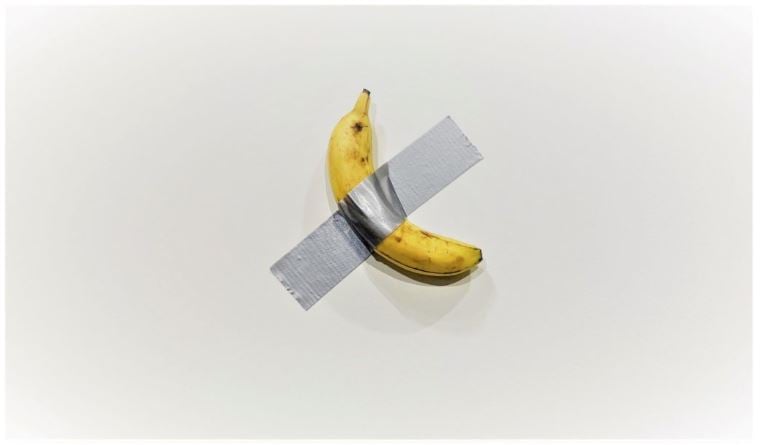
Maurizio Cattelan’s Comedian,
for sale from Perrotin at Art Basel Miami Beach. Photo by Sarah
Cascone.
In the end, says Kee, “I very much doubt that any court would
deem conceptual art as illegal. That said, I like the provocation
Brian is putting forward as it has us think more deeply about art’s
imbrication with capital via the law.”
If you’re unlikely to turn a profit by buying a conceptual
artwork, says New York corporate securities lawyer John Berton,
it’s even less likely you’ll hit the jackpot by buying Frye’s
certificate. “It’s not clear to me that people who buy his
certificates are buying primarily because they’re expecting
profit,” Frye told Artnet News via phone. “They’re going along with
the gag or they think it’s cool to belong to this little club.”
(Moreover, what had started out as a limited-edition
certificate, Frye said, he has decided to produce the certificates
in an unlimited edition, undercutting his own offer.)
New York art attorney Amy Goldrich had a similar response to
Kee’s, pointing out that collectors buying high-concept artworks
are more likely buying for “hedonic purposes,” or, in legal terms,
are acting as hobbyists rather than investors.
“Although he gives short shrift to collectors of conceptual art,
it’s all good fun,” she said in a phone conversation. “And it just
goes to show you, there really is always money in the banana stand.”
The post Some People Think Cattelan’s Banana Is Genius. This
Law Professor Thinks It’s Illegal appeared first on artnet
News.
Read more https://news.artnet.com/art-world/cattelan-banana-basel-illegal-1732932
Further reading


Leave a comment