
The Gray Market: Why the End of Art Berlin Reveals a Weakness in All Art Fairs (and Other Insights)
Every Monday morning, Artnet
News brings you The Gray Market. The column decodes important stories from the
previous week—and offers unparalleled insight into the inner
workings of the art industry in the process.
This week, a case where the cure
can’t be separated from the malady…
CLOSING TIME
On Wednesday, my
colleague Kate
Brown relayed the news that
Art Berlin (formerly known as Art Berlin Contemporary), the German
capital’s premier trade fair for art of the present and recent
past, is no more. Representatives of Koelnmesse, the fair’s
organizer, said that the company felt it could no longer guarantee
that future editions of the event would meet its standards. As a
result, Koelnmesse will shutter Art Berlin and refocus its efforts
on the other trade fair in its portfolio, Art
Cologne.
So what happened? According to
Brown, three factors were to blame. The first (and undoubtedly the
most important) was the disappointing amount of revenue earned from
previous editions. Tied to this, Brown also cites sources close to
the fair emphasizing that Art Berlin “received no support from the
state or city,” unlike similarly sized European fairs including
Vienna Contemporary and ARCO Madrid.
But the third factor may have
hit the fair’s clientele—namely, its galleries—closest to home: real-estate trouble. Although
Art Berlin set up shop inside the decommissioned Tempelhof airport
for its past three editions, Brown relays that the fair’s
organizers only managed to lock in the venue “at the last minute”
in 2019, and strictly for that year alone.
Anyone even passingly familiar
with real estate in the city won’t exactly be knocked out of their
chairs by Art Berlin’s situation. Rents in Berlin
have doubled over the
course of the past decade, and property consultancy Knight Frank
found that the city’s real estate prices
rose more sharply than any on Earth in 2017, with costs
leaping 20.5 percent compared to the previous year. At this point,
Berlin’s famous club scene is as essential for keeping a roof over
people’s heads at night as it is for good-natured
depravity.
But the real lesson here is
about more than just one fair, or even one city. It’s about a
larger, more troubling reality in the sector: although art fairs
evolved specifically to try to help fixed-location galleries
contend in an increasingly global and nomadic
market, they are still
vulnerable to some of the exact same problems they were designed to
solve.
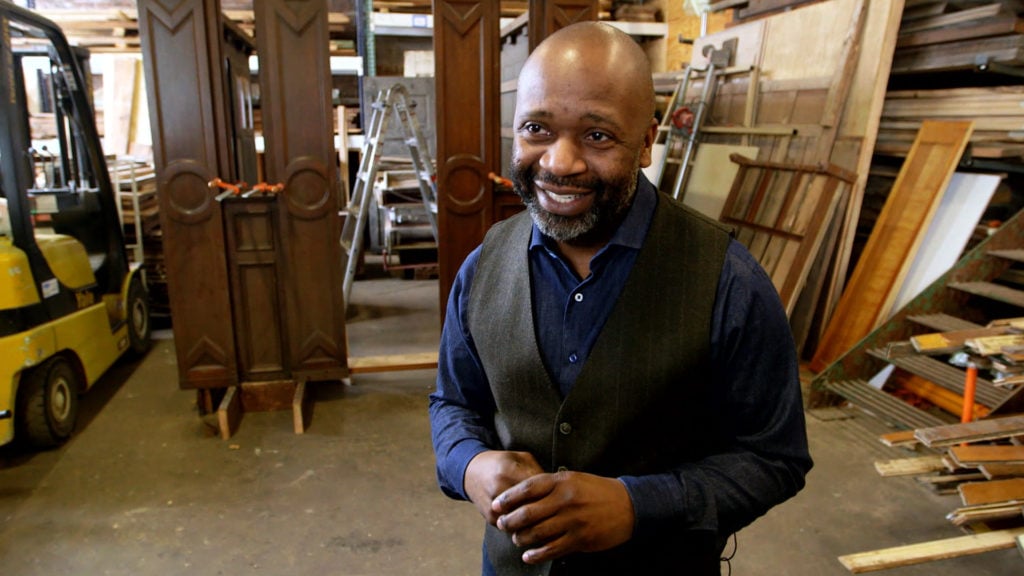
Production still from the Art21
“Extended Play” film, “Theaster Gates: Collecting.” © Art21, Inc.
2017.
LOCATION, LOCATION, LOCATION
Provided a hypnotist hasn’t just
snapped you out of a generation-long trance, you already know that
running a traditional gallery is a maddeningly expensive and risky
proposition. It’s especially true now that the art market is
increasingly morphing into the same barbell shape as the buyer base
in developed countries: a high-value concentration at the top, a
low-value concentration at the bottom, and only a thin connection
running between them.
With more of the world’s wealth
shared among fewer people over a greater geographical spread, it’s
harder and harder for any gallery moored in one place (or even two
or three) to meet, let alone consistently strike deals with, enough
rich people to keep its business afloat.
Enter: art fairs. On the most
transactional level, art-fair organizers justify the high prices
charged to exhibitors by touting the quantity and geographical
breadth of collectors, curators, and other art-world players who
visit their events. Exhibit at an art fair outside your home base,
the pitch goes, and your gallery’s fortunes could change
dramatically.
Fair organizers understand the
value proposition here—and recent, modest
equitability initiatives aside, dealers pay a premium for
it. It’s a brutal calculus
that always makes me think of this indelible quote from artist and
self-proclaimed “hustler” Theaster Gates in a 2014 New
Yorker profile:
“I’m the hustler who’s just
willing to admit this is all a fucking hustle—like, you think that
Basel Miami isn’t a fucking hustle? For 125 square feet we got to
pay $75,000. It’s five-day real estate!”
But it’s short-term real estate
for the fair organizers, too. That means they’re just as
susceptible to property-market tremors as the galleries that make
up their client base. And this quake is being felt by fairs beyond
just Art Berlin.
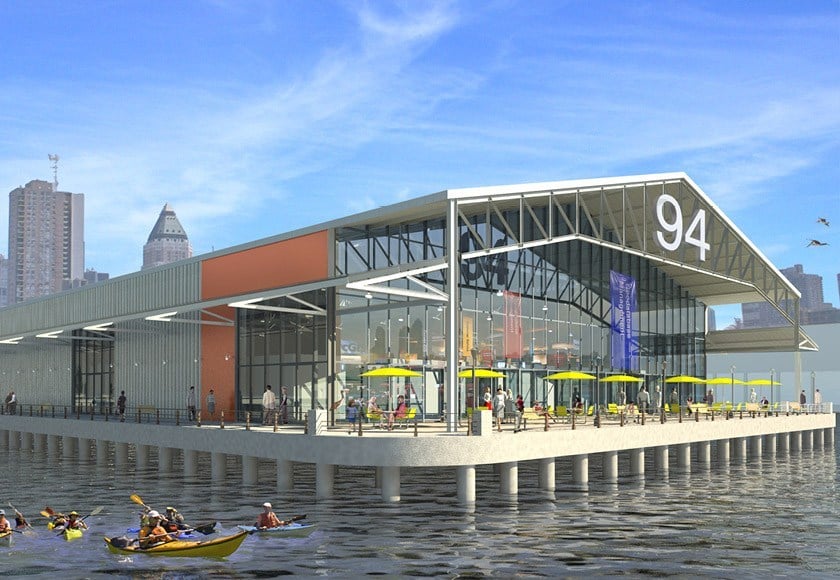
Dattner Architects, rendering of
proposed renovations of Piers 92 and 94. Image courtesy of Dattner
Architects.
EVERYBODY HURTS
A quick survey of the fair
landscape reveals a plethora of location-based problems. Last
year, structural
deficiencies at New York’s Pier 92 forced the Armory Show to move dozens of its
exhibitors—and its sister
fair, Volta, to completely relocate—a week before opening.
Extensive renovations at the Grand
Palais will push FIAC, the Parisian fair whose rise has been
powered at least in part by its residence in that adored Beaux-Arts
building, to an alternate venue on the Champ-de-Mars until at least
2024.
For its fairs in London, New
York, and Los Angeles, Frieze counters its chosen cities’
respective challenges in property availability, cost, and
customizability by purpose-building architecturally
optimized tents… which
have, nevertheless, at various points in the past, overheated in
unseasonable warmth or leaked in
especially punishing rain.
Even Art Basel has suffered some
location-based agita. From 2015 until late 2018, Art Basel Miami
Beach had to work around a colossal renovation of its longtime
venue, the Miami Beach Convention Center. (In 2017, the
construction work memorably led to staffers transporting VIPs
around the building’s exterior in golf carts.) Uncertainty also
swirls around the 2020 edition of Art Basel Hong Kong due to
six months of
ongoing protests that
have sometimes erupted into violence between police and
demonstrators. (Art Basel officials
say the fair will go on as planned.)
Obviously, these problems are
not all exactly alike. But they all stem from the fact that
fairs, like galleries, ultimately depend on occupying very
particular tracts of real estate. Whether the specific issue is
rents rising faster than revenues, an uncomfortable environment
inside the venue, or an unacceptable risk in even traveling to the
metropolitan area the fair calls home, a fair’s need to occupy
specific property can quickly cascade into an existential
problem—less a ripple effect from buyers to exhibitors
to organizers, and more a riptide threatening to pull everyone
underwater together.
Would losing the Tempelhof
airport have been fatal to Art Berlin had its parent company made
more money from recent editions? Would it have lost Tempelhof at
all if the fair had a more robust rental budget? We’ll never know.
But one way or another, the tension between cash and real estate
snapped Art Berlin into oblivion. And gallerists all over the world
should keep that in mind when they look to art fairs to relieve the
same tension in their day-to-day operations.
That’s all for this
week—and this year, at least
on the usual schedule. The Gray Market won’t appear on either of
the next two Mondays, but my annual evaluation of my start-of-year
predictions will land just after Christmas, and my predictions for
2020 will hit just after New Year’s.
‘Til then, remember: changing
scenery doesn’t necessarily change anything else.
The post The Gray Market: Why the End of Art Berlin Reveals
a Weakness in All Art Fairs (and Other Insights) appeared first
on artnet News.
Read more https://news.artnet.com/opinion/gray-market-art-berlin-1733055
Further reading


Leave a comment