
The Artist Whisperer: Legendary Journalist Calvin Tomkins on What Duchamp Taught Him, and How He Managed to Track Down David Hammons
Next week, when Christmas rolls around, the luckiest
boys and girls of the art world may find a hefty, roughly
cube-shaped present under the tree. No, it’s not a new X-Box—it’s a
time machine, in the form of a collection of the dozens of artist
profiles that the journalist Calvin Tomkins has written across his
astonishing 60 years at the New Yorker magazine. Published
in a lavish new multi-volume set by Phaidon, the compendium is
called The Lives of Artists—an intentional reference to
Giorgio Vasari’s revered 16th-century biographical catalogue of the
greatest Renaissance artists of his day.
For Tomkins, however, his quarry has not toiled in
the cathedrals and palaces of Europe, but rather in the cold-water
flats and industrial lofts of the exceedingly secular modern world.
So, instead of Leonardo and Michelangelo, think Damien Hirst,
Georgia O’Keeffe, Andy Warhol, Cindy Sherman… the list goes on and
on.
Now 94 years old, Tomkins—who is universally known as
Tad—has also published 18 books about artists and the art world.
But if there’s one artist he is associated with above all, it is
Marcel Duchamp, the indispensable Modern artist and primogenitor of
what we know today as conceptual art. If you don’t know who Duchamp
is, think of it this way: He’s the guy who made it possible for the
Italian artist Maurizio Cattelan to duct-tape a banana to the wall at Art Basel Miami
Beach, call it art, and sell it for $120,000. Thank you very
much, Marcel. But seriously, few artists are as influential as
Duchamp, and yet few artists are as mysterious, with his later
masterpieces of the Large Glass and Étant donnés
still befuddling droves of art history PhD candidates every
year.
Plumbing art’s mysteries is par for the course for an
arts journalist, but Tomkins approaches his job with a
just-the-facts-ma’am attitude and the hard work of shoe-leather
reporting, accumulating reams of telling details that make even the
most difficult artists seem accessibly human, if not easily
understandable. To talk about his work, and also some of those
artists, I sat down with Tomkins to discuss how he approaches his
particular style of portraiture.
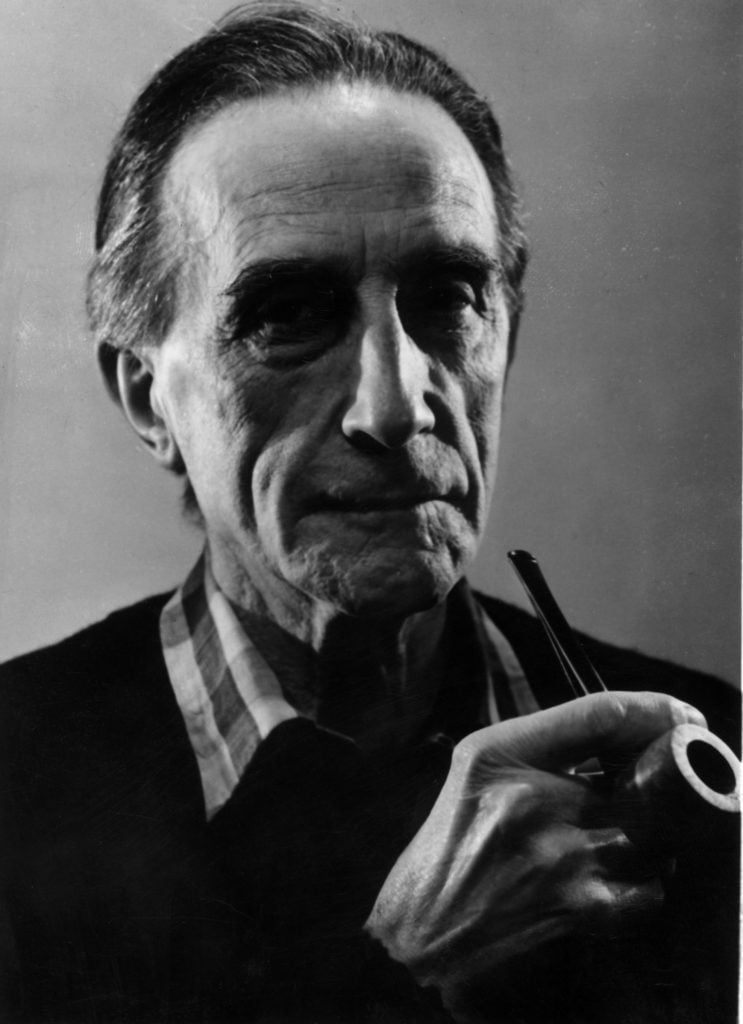
Marcel Duchamp holding a pipe. Photo by
Hulton Archive/Getty Images.
Why don’t we start where your own career did—with
Duchamp. Tell me, how did you first meet Marcel Duchamp?
That is the story of how I became involved in writing
about art. It’s entirely by accident. I had no background in art. I
took one art course in college on the Italian Renaissance. But I
was writing for Newsweek magazine in the mid-’50s, and
Newsweek had no art coverage in those days, and neither did
Time. They covered theater and books and film and sometimes
dance and quite often music, but no regular coverage of art. Once
in a while, an editor would get an idea for an art story and pull
somebody from another department to write it. And that’s how one
day I was called out of the foreign news department and told, “Go
and interview Marcel Duchamp.”
What did that name mean to you?
Well, it didn’t mean as much as it should have. I was
aware of Duchamp. I knew that Nude Descending a Staircase
had been the scandal of the Armory Show in 1915. I don’t think I
knew that he had become an American citizen and was living in New
York. He had sort of dropped out of the art world, and people who
were very involved with the art world knew about him, but people
outside assumed that he disappeared. And so, I came into the
interview—which was in the King Cole Bar of the St. Regis
Hotel—knowing very little, and I asked a lot of pretty dumb
questions as a result.
For instance, I asked, “How do you spend your time
now that you’ve stopped making art?” Because that was the common
perception, that he had quit making art in favor of chess. Entirely
untrue. He’d been working for the last 20 years of his life on a major work,
Étant donnés. In any case, I asked him, and he smiled and
said, “Oh, I’m a breather. A respirateur.” I enjoyed that
very much, and then he went on to talk a bit about, “Why do people
feel that they need to work?” And this is what he did through the
whole interview. I would ask him an innocuous, irrelevant, or
inaccurate question, and he would, without correcting me, turn it
into something strange. As a result, I felt this was the most
interesting person I’d ever met.
This was decades after his signal achievements in
the art world, like his “readymades,” where he tilted a urinal on
its back and called it Fountain, creating a
succès de scandale. You later
did an interview with him over a series of afternoons in 1964 for a
profile you wrote for the New Yorker the following year. At
what point did you figure out that he was actually still making
art, and was not just a respirateur?
Well, certainly not in ’64. I knew more about him by
then, about the breadth and the importance of his career, but
nobody outside of his wife, Teeny, and two other people knew that
he had been at work in secret on a very strange installation. It
took up a whole room and combined things that had never been in
Duchamp before, such as a realistic landscape with what looked like
a little waterfall in the upper-right corner, which was actually an
optical trick he had made. He was a great bricoleur—he liked
to make stuff—and he had taken a cookie box, put a hole in the
bottom, and had a light bulb in it. Then he had a fan running so
that it made a flickering effect of light on this silvery box
surface. It actually looked very much like a waterfall.
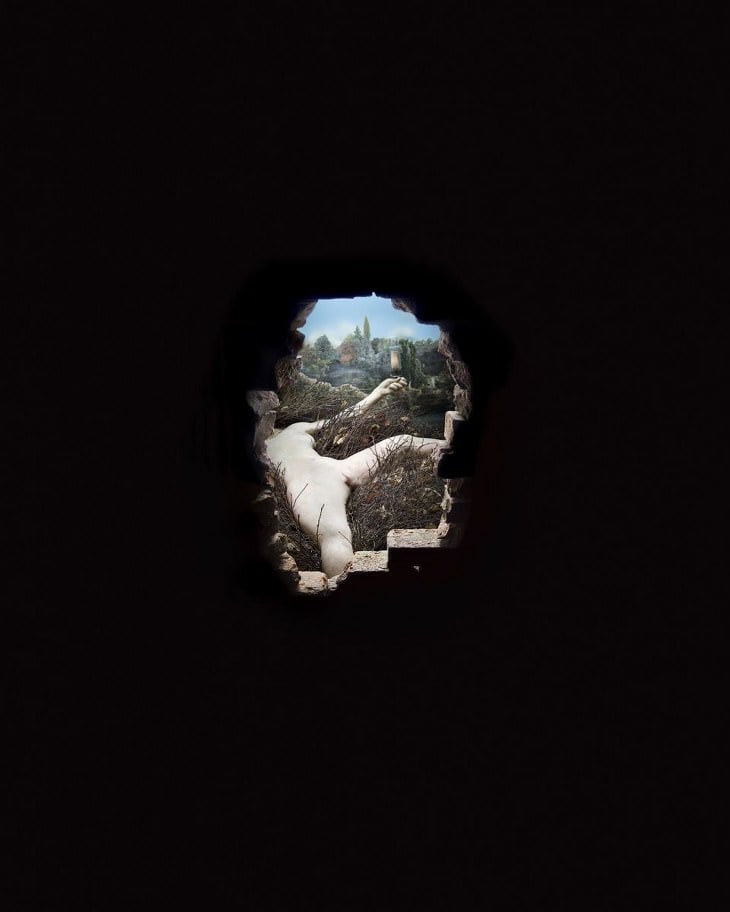
Marcel Duchamp, Étant donnés : 1. la
chute d’eau 2. le gaz d’éclairage (Given: 1. The Waterfall, 2. The
Illuminating Gas)(1946–66). Courtesy of the Philadelphia Museum
of Art.
This artwork is now held in the Philadelphia
Museum of Art, and the way that it is probably best known among the
adolescent boys of Philadelphia is as a door with a peephole
through which you can peer at a naked woman lying amid a surreal,
Leonardo da Vinci-esque landscape. How did you first start to get a
sense that he was secretly laboring on this artwork?
This was long afterward. He didn’t divulge anything
about Étant donnés until the year before he died, and he
only did that because he needed to arrange for what would happen to it
afterward. He died in ‘68, and then it became generally known that
he had actually been at work on this thing for 20 years. But I
certainly didn’t know about it when I wrote the profile [in 1965].
And Arturo Schwarz, the Italian collector and dealer, certainly
didn’t know about it when he wrote his book called The
Definitive Works of Marcel Duchamp.
That’s a fateful name.
The book was about to go to press and he learned
about it. He flew to Philadelphia, spent a whole day looking at it
and making notes, quickly went back and wrote a new chapter and got
it into the second printing. But nobody knew about it [during
Duchamp’s life], which was so amazing at that time, that somebody
could make himself invisible.
Now, of course, the story of his secret act of
creation is a big part of your magisterial 1996 biography, which is
the definitive biography of Duchamp. As somebody who has spent so
much time with this very elusive artist, what was he like as a
person?
He was probably the most delightful person I’ve ever
met. He was so comfortable in his own skin. He didn’t have any axes
to grind, and he was so fascinating to talk to because the
conversation would go off in directions you didn’t expect. He was
unpretentious—he didn’t want to impress you. He was just happy to
be in the present moment, and looking at it with fresh eyes.
It’s clear that he impressed you.
He certainly did.
How did your encounter with Duchamp and his
intellectual world change your life?
A year after the first interview, I moved to the
New Yorker. I had been contributing short pieces to the
New Yorker for a while, and I asked Mr. [William] Shawn, the
editor, if I could come on staff, and he said, “Well, you can’t
make a living with short pieces, but if you can write a long piece,
then we can see.” So I was looking around for a long piece.
In 1959, I was starting to write about Jean Tinguely,
this Swiss sculptor who had made a big, fantastic machine in the
garden of the Museum of Modern Art whose sole purpose was to
destroy itself in an act of mechanical suicide. This was, of
course, a major undertaking—it was very gutsy the Modern to agree
to it—and he had to have help, so he got to know a number
of New York
artists, one of whom was Bob Rauschenberg. And I found
Rauschenberg so riveting that I wrote one of my next profiles on
him. But the profile on Tinguely was what really got me into the
New Yorker. While it didn’t completely set my course for the
next dozen years or so, because I wrote on subjects besides art,
more and more I found that I was primarily interested in artists
and what they did and what they said about it. So it all just sort
of evolved out of that.
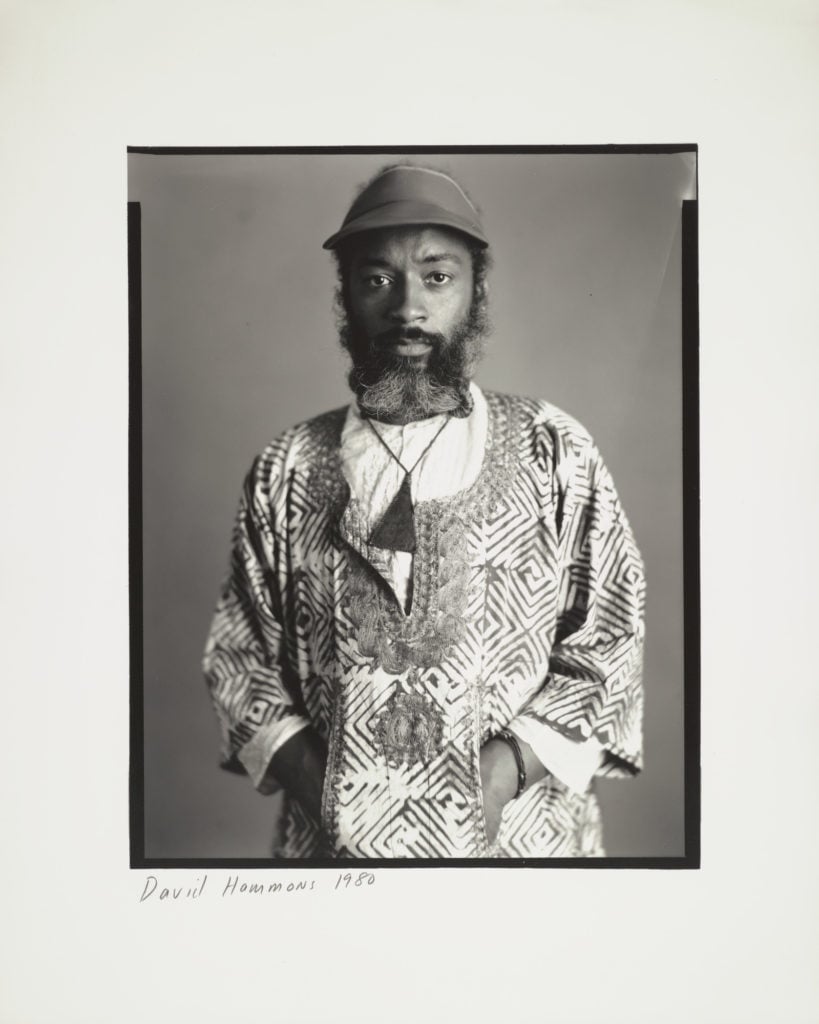
Timothy Greenfield-Sanders,
Photograph of David Hammons (1980). © Timothy
Greenfield-Sanders, courtesy the Museum of Modern Art Archives.
Now, fast-forward another half century, and
you just published your latest profile of an
artist in the New Yorker—and not just any artist, but the
legendary artist David Hammons, whose groundbreaking conceptual
work has earned him comparisons to a modern-day Duchamp. In fact,
he might be even more mysterious and elusive than Duchamp, because
he has only given a small handful of interviews over his entire
life. He’s kind of the J.D. Salinger of the art world.
Yes.
What made you decide to interview him, or to try
to interview him?
What had given me the idea was a new public artwork he is
doing for the Whitney, a sort of ghost image of a pier. I heard
about it a year before the Whitney’s new building was finished,
when they invited a number of artists to walk through the
galleries, and Hammons was invited. Of course, they had a hope that
he would do something for the museum, which was almost completely
ridiculous—what Hammons liked doing most was refusing commissions
from museums and major collectors. Adam Weinberg, the director, was
standing by one of the big windows overlooking the river, and he
said to Hammons, “You know, right down there was the pier that Gordon
Matta-Clark had turned into a public monument in the early
1970s.”
The pier was no longer in use, and Matta-Clark had
gone in without permission and cut three very large openings in the
roof and the walls and the floor and figured out how these would
enable light to come in at different times of day. He saw it as a
public work, and he really hoped it would become a kind of Mecca
for the gay people who had turned this and other piers into meeting
places. And so, according to Adam, Hammons listened carefully, but
he didn’t say anything. Then two days later, the Whitney got a
letter in the mail with no explanation but with the drawing of what
looked like the ghost image of a pier, just a kind of schematic
version of its interior structure floating in the water, and
underneath it said, “A monument to Gordon Matta-Clark.” No further
explanation. Adam and the other curators had no idea what it
meant.
Was this a proposal? Was this a thank you for the
walkthrough? They didn’t know, and because everything was so
frantic getting ready for the museum’s opening, they didn’t answer
the letter for a while. Eventually, one of the curators began
having meetings with Hammons, sounding him out on the idea, and
this led to investigations of whether they could actually build
something like this. Now it is about to become a reality, and the
contractor says it will be finished by next September. It’s not
going to be used for anything. I mean, it’s an image. I asked
Hammons if he wanted it to be lit up at night. He said, “No, it
should disappear.” Anyway, when I first heard about this project, I
thought I would try to write, if not a profile, then some sort of a
piece.

A rendering of David Hammons’s homage to
Gordon Matta-Clark Day’s End (rendering). Image courtesy
of Guy Nordenson and Associates.
He has refused pretty much every journalist who’s
ever reached out to him, and there’s even a kind of a ring of other
artists and collectors and curators and dealers that surrounds him,
almost like the Knights Templar protecting the grail. How did you
manage to crack the defenses around David Hammons?
I don’t think we did. Dodie [Kazanjian], my wife, was
working with me on this, and we went mainly through
Lois Plehn, an amazing woman who works with Hammons. She has
no official position—he’s never had a dealer who represents him,
but she’s the closest thing to that, and one of her main jobs is
keeping the people who want to talk to him away. So we made contact
with her, saying we’d like to talk to David. And that didn’t happen
for quite a while, but she did arrange for us to have dinner with
him at a Japanese restaurant. Later, Hammons agreed to a retrospective in Los
Angeles last summer, not with a museum, but with the
mega-dealer Hauser & Wirth.
He had been refusing museums all over the world for a
long time, and I think the reason David went with them was because
he felt—rightly—that he would be able to control the exhibition,
absolutely himself. And Hauser & Wirth indeed gave him full control
of what he would show, how it would be shown, how it would be
presented, installed, everything. This was big news in the art
world, of course. And so we went out there a few days before the
opening, and Hammons was there. He had been working extremely hard.
He’s one of the hardest-working artists ever—he never stops
working, and he had practically done the whole installation
himself.
There was no possibility to see him during this
frantic period, but on the pre-opening night, there was a small
dinner and—I think through the machinations of Adam Weinberg and
Lois Plehn—I was seated next to him. So there was another
little conversation and, as we were leaving that night, I said, “I
very much would like to sit down and talk with you.” And he said as
he was leaving, “Yes, come to my studio in the fall.”
An unbelievable coup.
Lois was very dubious. She said, “You know, he
changes his mind all the time. He may not do it when you show up.”
But at the end of August, we got a call from Lois saying, “He will
meet with you and your wife in his studio in Yonkers for one hour
on such-and-such a day.”

Calvin Tomkins and Dodie Kazanjian at
the Whitney Museum of American Art. (Photo by Bryan Bedder/Getty
Images for Whitney Museum of American Art)
Here I should point out that your wife, Dodie
Kazanjian, is a very accomplished journalist and curator in her own
right, and she’s your secret weapon,
reportorially speaking.
Yes, and she was crucial in this whole process. We
were early, so we drove around Hoboken until the appointed hour,
and he let us have, not an hour, but an hour and 20 minutes. But no
interview.
Yikes.
He said he doesn’t give interviews, they remind him
too much of interrogations, of being a young black man growing up
and always being stopped by the police, asking questions like, “Is
that your bicycle?” or, “What are you doing in this
neighborhood?”
That’s understandable, of course. But speaking as
a journalist myself, if I had finally reached David Hammons’s inner
sanctum and was standing with him in his studio and he suddenly
said, “Oh, by the way, no interview,” I think I would have probably
had a heart attack. How did you navigate that obstacle and still
manage to get the material for your piece?
After he had made it clear that he would not submit
to an interview, he said, “Well, all right, we’ll have a
conversation.” And we talked a little bit, and then he opened the
door to his studio. We had previously been out in the hallway, and
we went into his studio, which is a very large room with high
ceilings, and we sat down. And we had a conversation. With every
profile, I have learned something. In this profile, I learned that,
yes, it is possible to write about somebody without interviewing
them. We were not allowed to record, but there were enough things
that we were able to piece together from our memory. As he became
more relaxed, he was very jokey this time.
He seems to be somebody who is most comfortable
being in control of every aspect of what he’s doing. Even so, the
profile that you wrested out of him is a great profile, and it’s
not great only because Hammons is this un-track-downable figure.
It’s just a great profile. And you described him as being a kind of
eccentric character, wearing a set of glasses with a lens for his
third eye positioned between his forehead. Can you paint a picture
of what David Hammons is like for all of us who will never get a
chance to meet him?
Once he lets you in, he’s very winning. He speaks
very softly but somehow very audibly—you can hear everything he
says even though he’s talking in a very quiet voice. And he’s very
funny. He has a great sense of humor, and he likes to exercise it.
All of a sudden, he was very pleasant to be around. In this way,
he’s a little bit like Duchamp, where he was so comfortable in his
own skin, never embarrassed or never taken aback by anything.
Hammons’s mind is also very nimble, skipping from subject to
subject in a sort of a dance-like pattern. And the things he says
are very unexpected.
This is the first installment of a two-part interview. To
hear highlights from the conversation, tune in to this week’s
episode of the Art Angle podcast, which will be released on
Tuesday.
The post The Artist Whisperer: Legendary Journalist Calvin
Tomkins on What Duchamp Taught Him, and How He Managed to Track
Down David Hammons appeared first on artnet News.
Read more https://news.artnet.com/the-big-interview/calvin-tomkins-lives-artists-interview-part-1-1734057
Further reading


Leave a comment