
After a Controversy-Filled Year for Public Art in New York, the City Reconsiders Its Approach
New York’s public art program
has never been more ambitious—or more controversial—than it was
this year, as the city worked to expand the number of
monuments that honored women and reckon with others that memorialize
shameful histories.
On Tuesday, the city council
held a hearing to re-examine its approach—and consider whether it
is ever possible to have public art without controversy. “What
folks want is a little more transparency around the public art
process,” said Councilmember Jimmy Van Bramer, who serves as the
chair of the legislature’s committee on cultural affairs, at the
start of the hearing.
Cultural Affairs Commissioner
Tom Finkelpearl—who abruptly announced
his resignation this
fall after five years in the post—aimed to shed more light on the
process. (He received a warm welcome by artists including Hank
Willis Thomas and Jorge Luis Rodriguez, who attended in a show of
support.) In his last official appearance before the legislative
body, Finkelpearl largely defended the public art process, but
admitted that it could be more transparent.
The department, he said, has
already implemented an extra meeting for panelists and community
stakeholders to interface for “all commissions and sensitive
projects.” At the same time, he added: “Having an extra panel
meeting is going to be helpful… but I also don’t think that there’s
any way to avoid controversy in public art.”
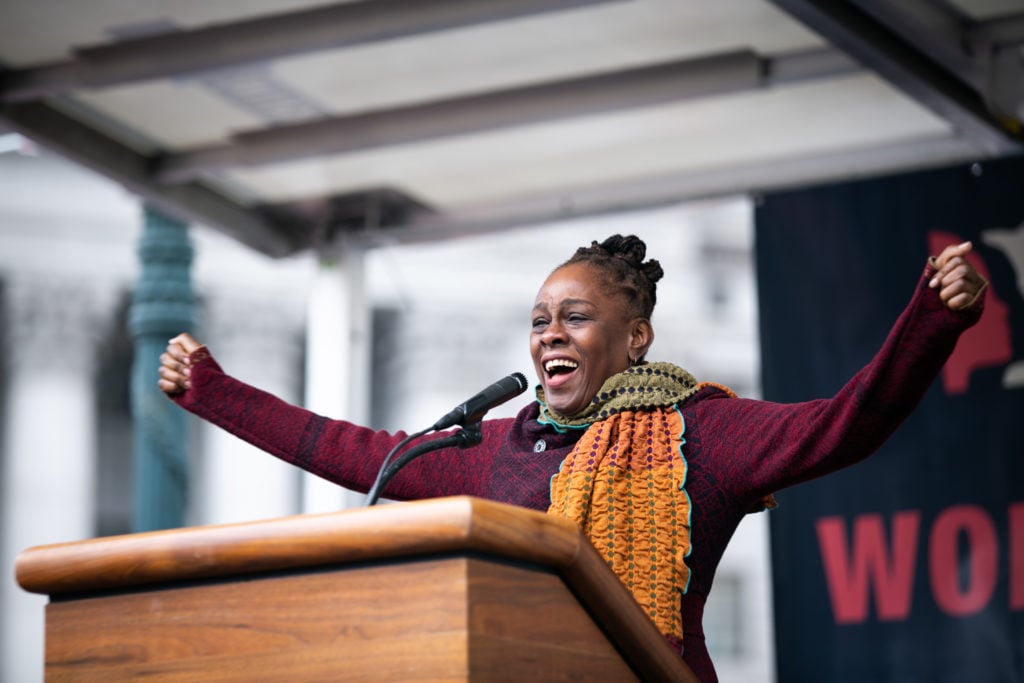
Chirlane McCray speaks during the
Women’s Unity Rally at Foley Square. (Photo by Karla Ann
Cote/NurPhoto via Getty Images)
Indeed, controversies have been
in ample supply this year. Over the summer, several politicians
criticized the decision-making process behind the de Blasio
administration’s $10 million She Built NYC
program—an initiative to commission statues to honor women’s
history—as opaque. The initiative later became tabloid
fodder after the actor
Chazz Palmentieri called the mayor’s wife, Chirlane McCray,
“racist” for not honoring Mother
Cabrini, an Italian-American Catholic saint who received the
most nominations from the public vote soliciting women to
memorialize.
Back in October, East Harlem
residents also accused the Department of Cultural Affairs of
bungling the
process for selecting an
artist create a new work to replace the statue of
Marion J. Sims, the 19th-century doctor who made his
gynecological advances by experimenting on enslaved black women. A
few weeks later, Mayor Bill de Blasio announced that
Finkelpearl would be resigning, though several sources within the
administration say that the culture commissioner was “pushed
out” to divert criticism
from New York’s first lady Chirlane McCray. (Spokespeople for the
city have denied this account; De Blasio and Finkelpearl have said
publicly that the decision to part was mutual.)
But as Finkelpearl testified
this morning, it was McCray and deputy mayor Alicia Glen who were
ultimately responsible for choosing the women who would be honored
with statues. Addressing the Sims controversy, Finkelpearl said
that his staff “took a hard look” at what
happened.
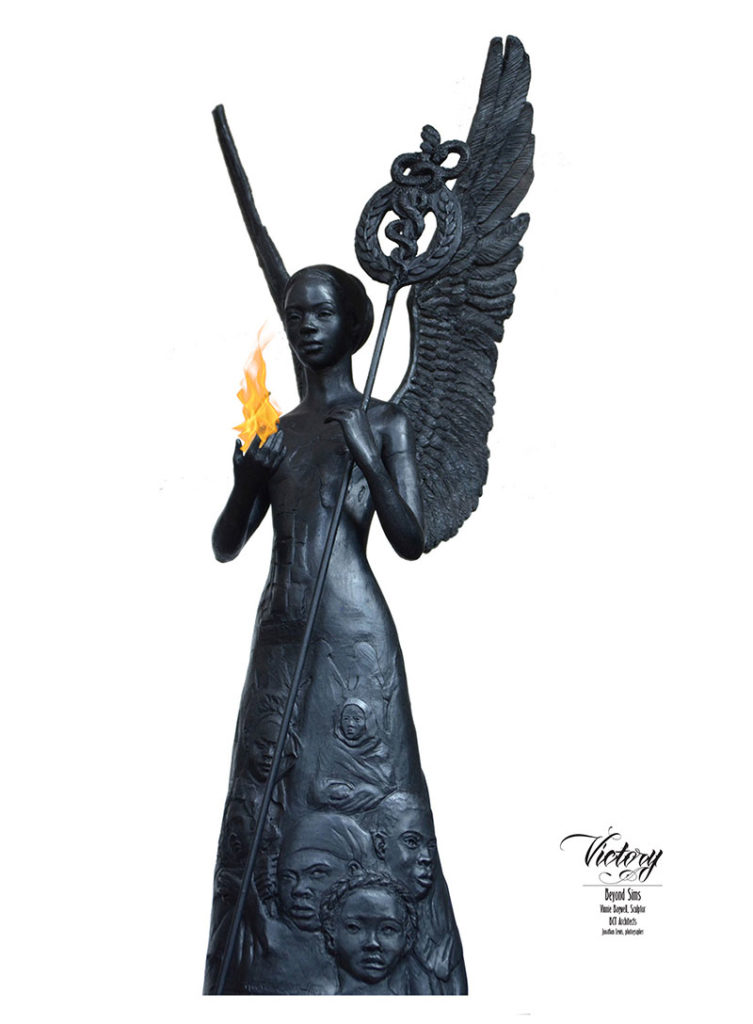
Vinnie Bagwell, Victory Beyond
Sims (rendering). Courtesy of the artist.
Others who testified before the
city council scrutinized the Percent for Art program, which was
established in 1982 and processes the majority of public artworks
erected in the city. The initiative requires that one percent of
budgets for eligible city-funded construction projects be spent on
art. Although virtually every speaker praised the program’s current
director, Kendal Henry, they also described the agency as
overextended and understaffed. Only three employees are tasked with
handling more than 125 active commissions worth millions of
taxpayer dollars.
Janet Zweig, an artist who has
worked with the agency, put the numbers into stark relief by
comparing them with other cities: San Francisco, she said, has 10
staff members overseeing 75 projects, while Austin has seven people
overseeing 70 projects, and Denver has five people overseeing
40.
Ambition has historically
stymied efficiency for the city’s Percent for Art program,
according to former directors who testified at the oversight
hearing. “With over 100 projects in the program’s pipeline and
dozens more on the docket during the years I was there,” said
Charlotte Cohen, who served as director from 1996 to 2005, “it was
challenging to maintain the deep involvement and focus these
projects demand and deserve.”
Despite all the controversy,
Jennifer McGregor, Percent for Art’s first director, is holding out
hope for the program she helped build. “The staff is strong, but
let’s be creative about how to reinforce their efforts,” she
testified. “Now is the time to review what is needed to steward
these important, sensitive projects and to provide the necessary
support in terms of expertise and time.”
The post After a Controversy-Filled Year for Public Art in
New York, the City Reconsiders Its Approach appeared first on
artnet News.
Read more https://news.artnet.com/art-world/new-york-city-public-art-hearing-1736994
Further reading


Leave a comment