
The Millennial Art Star Julie Curtiss’s Paintings Now Sell for Half a Million Dollars. It’s Kind of Freaking Her Out
On a Wednesday in the middle of May, the artist Julie Curtiss
was at her studio in a converted Bushwick warehouse live-streaming
the Contemporary Art afternoon sale at Phillips. Slated at lot 16
was a one-foot-by-one-foot painting that Curtiss had made about
three years earlier, estimated to sell for between $6,000 and
$8,000. Princess (2016) is typical of her output: a
painting of a woman’s head, seen from behind, her hairdo done up in
side cinnamon buns. It was the first Curtiss picture to be
auctioned anywhere, and the young artist watched the stream with
some trepidation.
When the bidding on her worked opened, paddle-wielders in the
room and buyers on their phones quickly pushed the price past the
high estimate, higher and higher, until it hammered at an
astounding $85,000 ($106,250 with fees)—a 7,770 percent
increase over the $1,350 paid by the collector who first bought it
from an artist-run project space just two years ago.
In the span of minutes, Julie Curtiss became an art star
and she was giddy and also a bit horrified.
“I was thinking, it’s scary, and I’m not making a buck on this,”
she told me in her studio earlier this month.
She was sitting on a stool, dressed in painting clothes and a
coat. She chose her words carefully but they came out fast, tinted
by a French accent chipped barely away by a decade in New York. A
playlist was streaming on a laptop: Yo La Tengo, Ariel Pink.
Nearby, sitting on a couch or floating through the studio, was
Brigitte Mulholland, a director at Anton Kern Gallery, which
represents Curtiss.
“When you see those works that are recycled so fast, and you
look at how much a piece generated versus the amount of money I
made on it, it’s almost funny,” Curtiss went on. “It’s
tragicomic.”
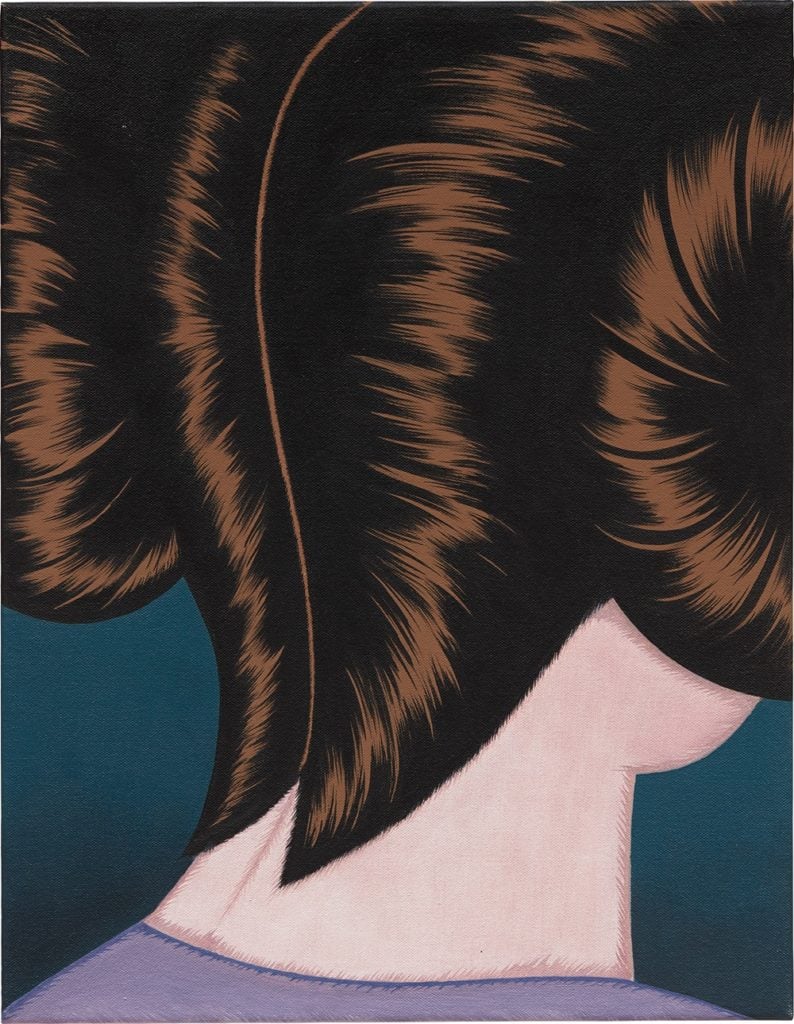
Julie Curtiss, Princess (2016).
Image courtesy of Phillips.
“I’m a Bit Worried”
Such immediate validation from the art market means that an
artist is doing something right. Most never get close. There are
people who want a Julie Curtiss, even if they just want to sell one
to someone else who wants a Julie Curtiss. Some say she’s the
prototypical young artist blowing up in a vicious art market.
Curtiss’s naysayers—and she has a few—predict that the auction
result was a flash in the pan, and that the feverish speculation
will die down before the next cycle.
But who’s to say? Since the sale of Princess at
Phillips, which sources said went to a Middle Eastern
buyer, several more works have sold for prices in the mid-six
figures. In November, Curtiss’s Pas Du Trois (2018) sold
at Christie’s for $423,000, nearly quadruple the record-breaking
figure from a few months earlier. It was one of three Curtiss
paintings to top $200,000 over the course of 24 hours. Together,
they had been sold on the primary market for a combined price of
around $10,000. But over the course of a single day, they generated
nearly $1.1 million in secondary-market sales, an increase in value
of over 10,000 percent.
Earlier this month, while giving her first interview since the
records started toppling, she sat in her studio, fresh off a long
spell in Japan, showing me two as-yet-unfinished paintings, as well
as playful new mini-sculptures that mimic sushi and ramen.
She was chipper, but also a bit embattled. Some high-end dealers
and critics have derided her work in background conversations with
me as derivative of the Chicago Imagists and the “Hairy Who” crew.
Others have negatively associated her work with the perceived
Pop-street tackiness of KAWS, an artist for whom she worked as an
assistant for a large chunk of this decade. Others point out that
Curtiss has yet to be collected by a major institution, and that
the bubble for her market could burst any day now.
Curtiss—speaking defiantly while surrounded by her new
work—dismisses all that. She knows who she is, even if she can’t
quite grapple with the fact that she’s the art world’s new
must-have market darling.
“I’m very lucky and I’m aware of it, because there was nothing
before, and I know how that is,” she said. “But I’m also a bit
worried. I don’t want to be a flash in the pan. I want to have a
sustainable career. I don’t want this to be this big inflation—and
then a collapse.”
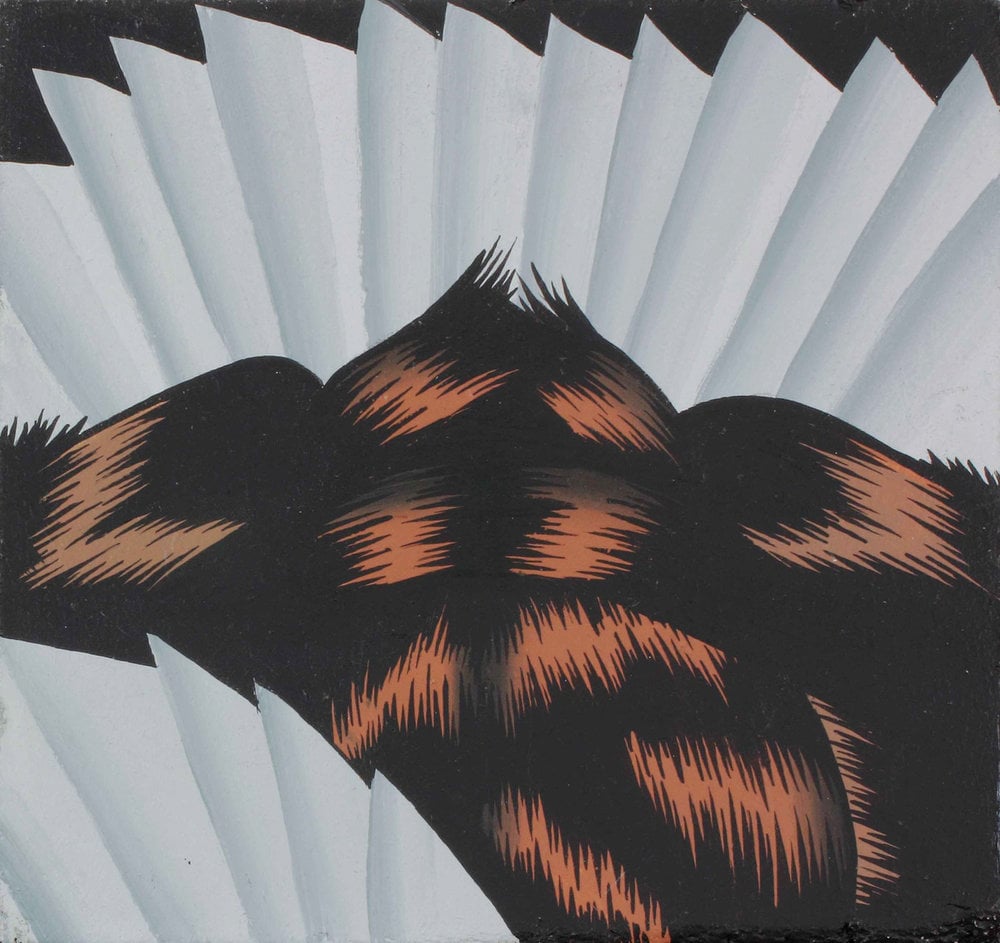
Christina Ramberg, Hair Candy
#2 (1972–73). Courtesy Karen Lennox Gallery.
Working at the KAWS Factory
Julie Curtiss was born in France in 1982, and is of French and
Vietnamese descent. After growing up in Paris, she studied at the
École nationale supérieure des Beaux-Arts, and then at the
Hochschule für Bildende Künste in Dresden. She then made her way to
the School of the Art Institute of Chicago, where she first
encountered Imagists such as Jim Nutt, Ray Yoshida, and Roger
Brown. But it’s Christina Ramberg, more than anyone else, whose
aesthetic most resembles Curtiss’s—a comparison she acknowledges,
though she said she developed her own style before ever coming into
contact with the elder artist’s work.
“I was doing works that were so similar to Ray Yoshida and
Christina Ramberg, and when I saw her work I was so shocked,” she
said. “For artists, it’s hard because sometimes you do something on
your own and you see someone who’s doing it 10 times better than
you, and their work is always there. So I was like, what’s the
fucking point?”
While studying in Chicago, Curtiss met her husband, Clinton
King. After graduating, they went to Japan for a year, where she
came under the influence of comics and Manga, which led her to a
more graphic style. The couple later moved to New York, and for a
fraught year, Curtiss worked as a studio hand for Jeff
Koons. “It wasn’t exactly conducive for an art career,” she
said. She quit after she turned 30.
In 2011, her husband was thumbing through job listings when he
spotted a gig at the studio of Brian Donnelly, better known as
KAWS. At the time, Donnelly was gaining serious momentum, having
been picked up by the continent-conquering Perrotin Gallery two
years earlier, and was in the process of rolling out his
large-scale “Companion” series.
“I sent my visuals, and Brian picked it because he felt a
connection and interest,” she said. “He saw something in the work,
so that’s where we first connected.”
Working for KAWS wasn’t the cog-in-the-machine joint that was
the Jeff Koons factory, but it did require precision. While
they look machine-pressed, all KAWS paintings are hand-made, and
Curtiss was required to recreate by hand his crisp
interpretations of brightly colored cartoon characters.
“His work is really anal, it was so hard to make,” she said.
“But he really made me a more skilled and better painter. And the
flat backgrounds, the shadows—I never did shadows in my work before
working with him.”
Donnelly also provided Curtiss with her first big exposure when
he put some of her works on Instagram, bringing her work to his
millions of followers.
“There’s a lot of KAWS collectors who have followed my work
because Brian promoted my work via Instagram,” she said. “Some of
Brian’s supporters were also early supporters of mine.”
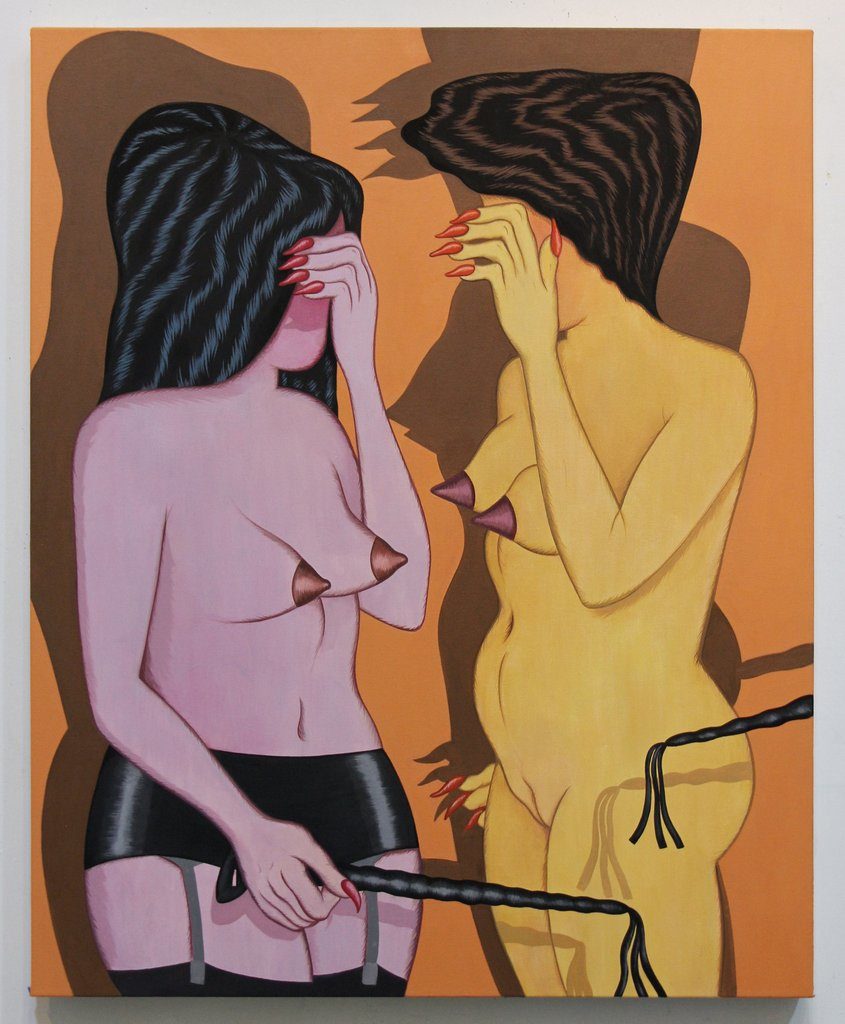
Julie Curtiss, Party
Down (2016). Courtesy of Phillips.
By 2015, Curtiss developed the style that would define her.
There were Dali-esque tropes (lobsters, crocodiles) described with
the Midwestern visual clarity of the Imagists, with a hint of Manga
and a KAWS-ian blend of Pop and street art. But she was hardly
an overnight success.
“For someone like me who had zero for 15 years, not selling a
work, doing shows but not many at all, I know what it’s like,” she
said. “So when it started to pick up, I started getting offers from
Instagram, but I said, ‘I’m going to wait until I have a gallery
show.’”
Spots in group shows led to a solo booth at the 2017 edition of
SPRING/BREAK, the curator-driven satellite fair that runs alongside
Armory Week in New York. And while she didn’t have gallery
representation yet, outfits were circling. That year, Sultana in
Paris and Various Small Fires in Los Angeles included her in group
shows, as did the London powerhouse White Cube.
It was around then that Mulholland, the Anton Kern director,
started talking up Julie’s work to her boss. “I just remember
being in Basel in 2017, and I called you,” Mulholland said to
Curtiss during my visit to her studio. “And I said, ‘Don’t sell
anything.’ I was like, ‘We gotta talk.’ The people who are talking
about you—I knew something was going to happen here.”
That same year, she bought a work by Curtiss out of her first
New York solo show at 106 Green. “I said, I can’t be an idiot
here,” Mulholland told me. “I’m never going to have this
opportunity again.”
Before long, Mulholland convinced Kern to visit Curtiss’s
Bushwick studio. “Pretty much right away, I thought she was
special,” Kern said. “She clearly has one foot in art history and
yet is pushing the envelope of what can be done in painting and
sculpture.” (Curtiss remembers his first visit to her studio
differently. “Anton was like, ‘I don’t know, I don’t
know,’” she recalled.)
In 2018, Mulholland included Curtiss in a group show titled
“10” at Anton Kern, after which Kern went to visit her again at her
studio and formally invited her to join the gallery’s stable. She
accepted, and had her first solo show, “Wildfire,” with the gallery
this past April.
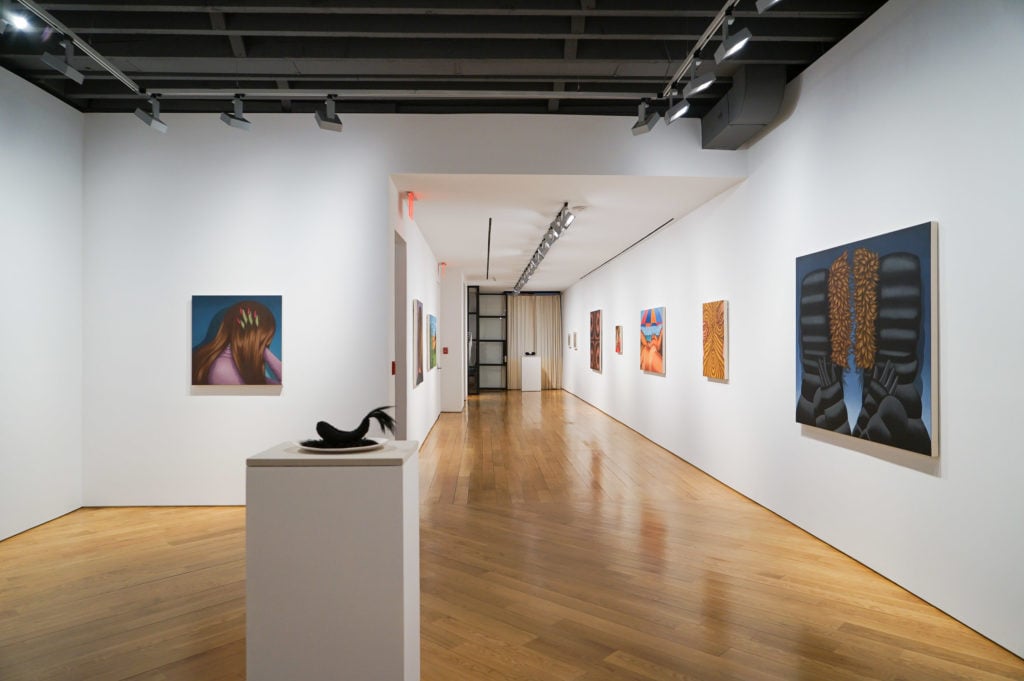
A view of “Julie Curtiss: Wildlife” at
Anton Kern Gallery. Courtesy Anton Kern.
Up, Up, and Away
It was around that time that the secondary market started to
take notice.
“I first saw her work at SPRING/BREAK, and I loved it,” said
Rebekah Bowling, the head of the day sale at Phillips. “I lived
across the street from The Hole, and she was in the ‘Post Analogue
Painting’ group show, and I was like, ‘Oh my God, are any of these
still available?’ And they literally laughed at me. That’s when I
knew how deep the demand was.”
Later, Bowling would become involved in the Curtiss market on
the selling side. Before Curtiss’s first solo show opened at Anton
Kern, the collector who owned Princess consigned
the work to Phillips, and Bowling slotted it into the afternoon
sale, historically a showcase for young artists fresh to
auction.
There was every reason to accept the consignment, but sources
tell me the provenance was a bit tangled.
The catalogue inaccurately lists the consignor as the work’s
original purchaser. In fact, it was first bought by an early
Curtiss supporter from an itinerant space call Field Projects, a
gallery where 80 percent of exhibitions come by way of open
submissions. After purchasing it for $1,350, that supporter sold it
to a collector in Miami for $8,000—and then that collector
flipped it for a price in the range of $20,000. That final
buyer consigned the work to Phillips, even though Anton Kern
Gallery offered to connect them to a private collector.
Despite these backstage machinations, the prices
Princess traded for, in hindsight, all seem astonishingly
low.
“The first time we bring an artist to auction, I want the
estimate to be at the primary, and the primary at that time was
$8,000,” Bowling said, explaining how she priced the work. “That’s
where I was. I was adamant about pricing it there.”
When Curtiss’s show opened at Anton Kern in April, it sold out
quickly, which fed speculation about the Phillips sale. How high
would Princess go?
After it hammered at $85,000, I asked Kern if he had seen such
high prices coming.
“I’m not a taste-maker,” Kern said. “No, I didn’t expect all of
this.”
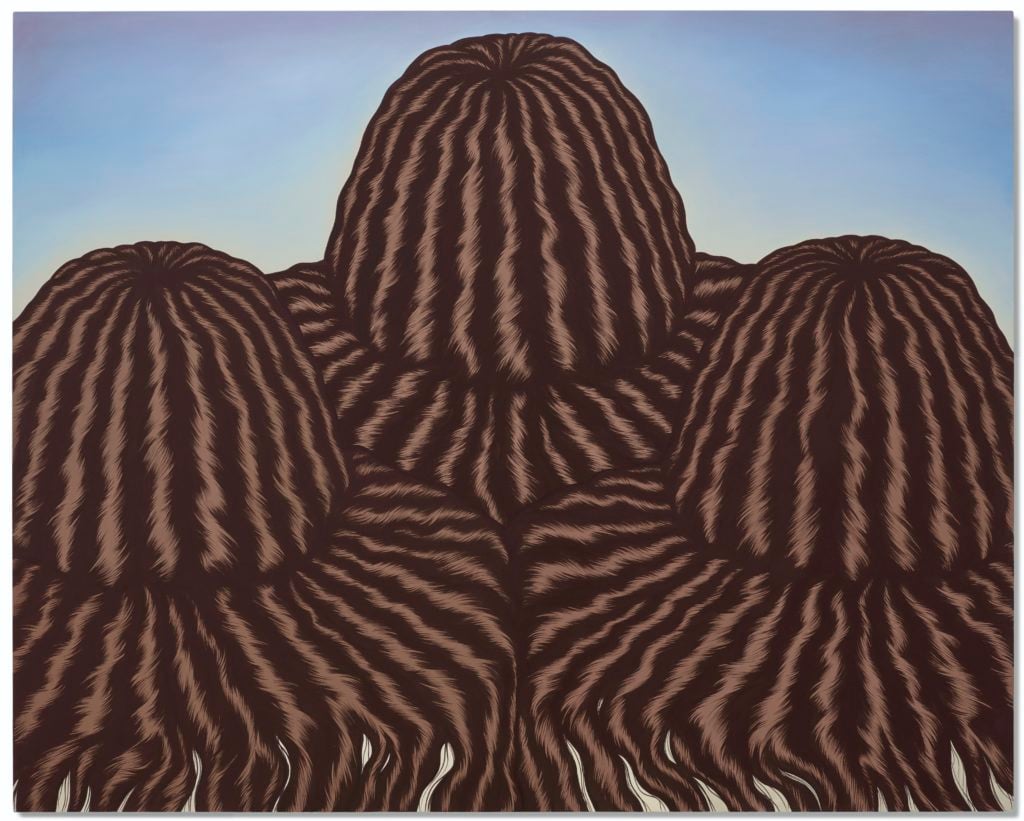
Julie Curtiss, Pas de Trois
(2018). Photo courtesy Christie’s.
In the last six months, prices for Curtiss’s primary market have
inched up. In July, a new painting, Breeders (2019), was
for sale through the Brooklyn gallery Clearing for $24,000. In
December, Kern sold Outlook (2019) at a similar price
point to a collector at Art Basel Miami Beach.
But prices on the secondary market shot up to another
stratosphere.
A collector paid $262,086 for
Hotel (2018) at Christie’s London in October. In November,
Second Thought (2017) sold at Phillips New York for
$250,000. The next day, there were two sales in a single
night: Party Down (2016) sold at Phillips for
$400,000, and Pas De Trois (2018) sold at Christie’s for
$423,000.
It doesn’t help that in the past year, Curtiss’s work has become
a favorite on the flipping set.
Kathy Grayson, who bought Party Down at
SPRING/BREAK for $3,000, sold the work to a fixer who then found a
Miami buyer to purchase it for $165,000.
Then that buyer consigned it to Phillips, where it
sold for $400,000.
Pas de Trois had already changed hands from the person
who bought it from Various Small Fires in early 2018. That original
buyer sold it to the Los Angeles dealer Niels Kantor, who consigned
it to Christie’s in 2019. Estimated at $100,000 to $150,000, the
work sold for $423,000.
By the end of 2019, small paintings were being offered for
$250,000—more than double what Curtiss’s auction record was just a
few months earlier.
Mulholland said that, when people went through her to resell,
she gave Curtiss a cut, but that she actively tried to avoid having
to deal with these issues in the first place.
“When the Various Small Fires show came up, I came to them and I
was like, ‘These need to go to iron-clad homes,’” Mulholland said.
“I suspected there would be something coming to auction in 2019.
We’re trying to protect against flipping as much as possible.”
“It’s figuration, it’s incredible, excellent work, it’s on
trend, and it’s hard to get—and that hunger creates a frenzy,” she
said later. “But that frenzy is dangerous. And you don’t want that
frenzy to affect the way that work is perceived.”
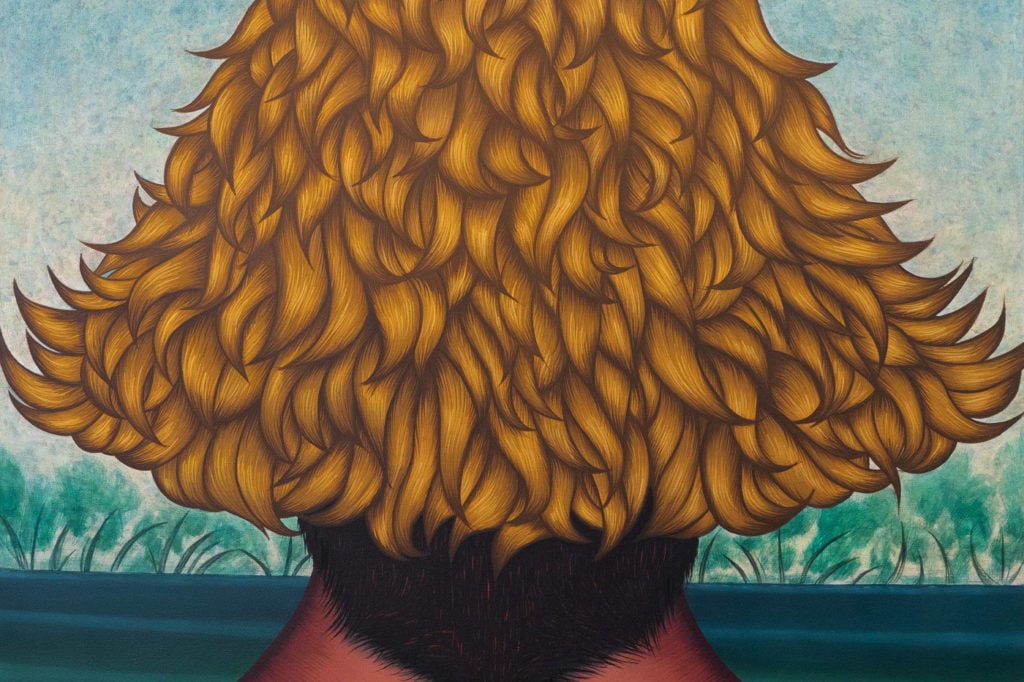
Julie Curtiss, Outlook (2019)
[detail]. Photo: Anton Kern Gallery.
But many remain skeptical—and even hostile. I had sources
tell me they were boycotting even seeing the show at Anton
Kern. It’s been said that Jim Nutt, a Chicago legend, is not a
fan.
“People scoff at it,” Mulholland admitted. “She and I get
trolled on one of those accounts, @itstimetostopnow,” Mulholland
went on, referring to the semi-anonymous call-out Instagram. “I
fought back, and then he deleted my comments and blocked me.”
She then named a few prominent male dealers, names not to be
printed, who have “shit-talked Julie repeatedly, to my
face. And I’m like, ‘Fuck you guys, you’re wrong,’” she
said.
The next step, then, is to pursue legitimacy through inclusion
in museum collections. “We’re always working on getting the
work into institutions, and in today’s landscape that’s
particularly important,” Kern said.
“There’s nothing wrong with being a market artist, but it is
scary for old-school collectors,” Mulholland said. “At a
certain point, if you don’t have institutional support, the
quote-unquote ‘real collectors’ are not going to buy it, because
then it’s something else—it’s not the thing that you know
lasts.”
“And she is the thing that lasts,” Mulholland said.
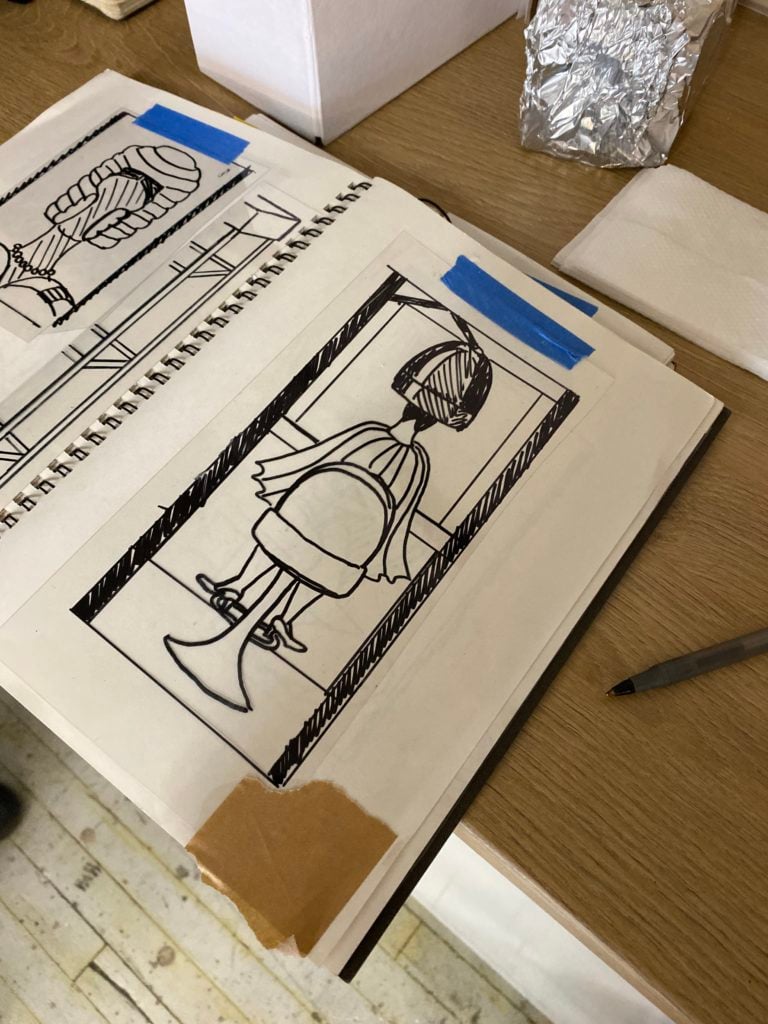
A notebook in Curtiss’s studio. Photo:
Nate Freeman.
“Are You Going to Survive This?”
At one point in our conversation, Curtiss brought up the fact
that many reporters, myself included, have been writing about her
primarily because of auction results.
“All I see in terms of press is just about the auction prices,
and it’s a little frustrating,” she said. “And all the articles are
like, ‘Are you going to survive this?’ Talk about the art
then, if you’re concerned about it.”
I said that I wanted to write about her practice. It was a
privilege to come to the studio and to see her sketchbook. Curtiss
took me through the process of how she layers the canvases over the
course of months. She works on multiple paintings at once,
recoloring them and applying new dimensions of mania, heightening
the surreal qualities to achieve pure eyeball shock, shading in
black and gray for depth that betrays how space works.
But the reality is, the works are selling for a lot of money,
many times the price even the most successful artist can ever hope
for. (Christina Ramberg’s auction record is still just $45,000.)
That is a big part of Curtiss’s story at the moment.
“It’s flattering, but I want a collector to collect my work
because they like it, and they want to live with it,” she said.
“But when there’s so much speculation, people stop seeing the
artwork for what it is, they just see the dollar signs. I’m not
making a product, I’m not hiring 50 people, I’m painting the
paintings myself. Every work is special.”
More work is coming. Curtiss is planning on making the largest
works she has ever attempted. She’s having a solo booth at FIAC in
October with Anton Kern Gallery. And there are also rumors that a
certain gallery that used to represent her mentor is potentially
interested in signing her for European and Asian representation,
alongside Kern. A source initially wouldn’t tell me which gallery
that was, but I guessed it. It wasn’t hard. Julie was included in a
show at Perrotin—the ex-gallery of KAWS—in Seoul in April.
And gradually, she’s being placed in the same context as the
Chicago Imagists—not as an homage or a reference, but as a Julie
Curtiss.
“The highbrow collectors see you in that context,” Mulholland
said in the studio, looking at Curtiss. “You’re in an art
collection where you’re hanging next to a Roger Brown.”
“That’s so amazing,” Curtiss said, looking at her dealer.
“That’s where you should be,” Mulholland said.
The post The Millennial Art Star Julie Curtiss’s Paintings
Now Sell for Half a Million Dollars. It’s Kind of Freaking Her
Out appeared first on artnet News.
Read more https://news.artnet.com/art-world/julie-curtiss-profile-1738224
Further reading


Leave a comment