
Which Emerging Artist Dominated 2019? 12 Art-World Players Share Their Thoughts
There is never any shortage of cutting-edge work by rising art
stars to get your fill of, and this year was no exception. With so
much material to wade through, we asked curators and other art
experts to tell us which names dominated 2019 and are worth keeping
an eye on as we head into the new year. Below, 12 experts share
their thoughts.
Tomashi
Jackson
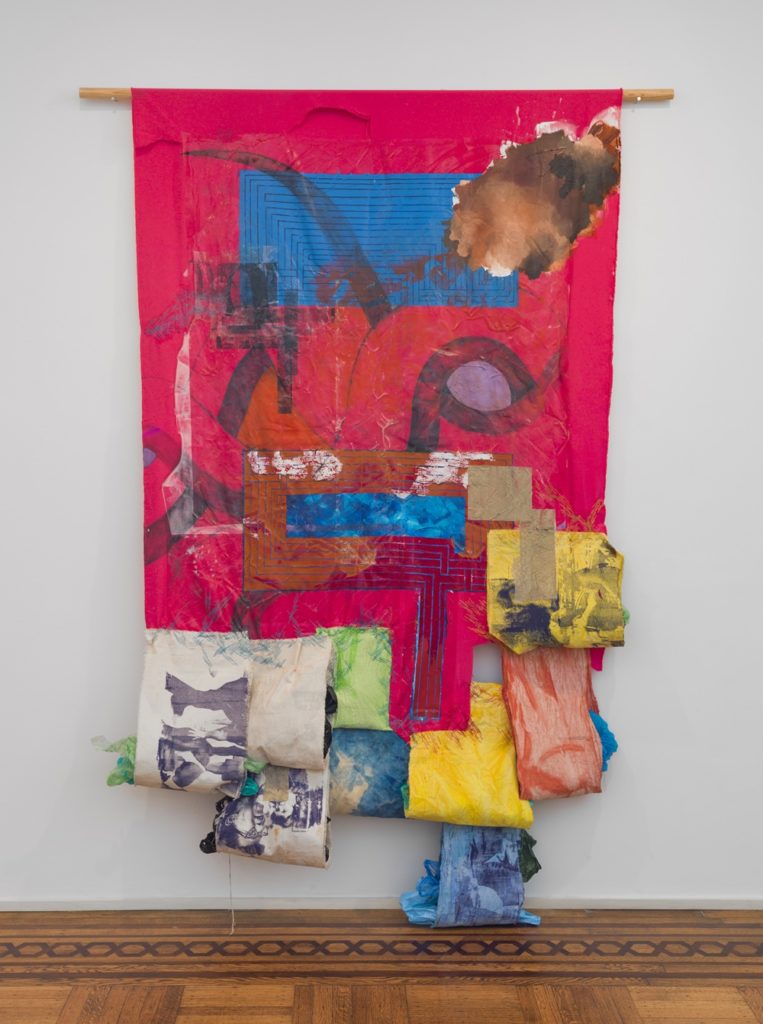
Tomashi Jackson, Dajerria All Alone
(Bolling v Sharpe (District of Columbia))(McKinney Pool Party)
(2016). Courtesy the artist and Tilton Gallery.
Tomashi Jackson has a powerful presence as an artist and a
teacher. Her participation in the 2019 Whitney Biennial drew
critical praise and the attention of many new admirers, but she has
been making powerful work— merging varied media, color theory,
abstraction, found imagery, and historic social and political
content, most recently on the subject of [the 19th-century,
predominantly African American settlement] Seneca Village—for some
time. She also had a successful solo exhibition at Tilton Gallery
in New York and there is loads more to come in 2020, with
forthcoming exhibitions at the Radcliffe Institute for Advanced
Study at Harvard and at the Parrish Art Museum in Water Mill, New
York.
—Abigail Ross Goodman, curator and art
advisor
Anna
Uddenberg
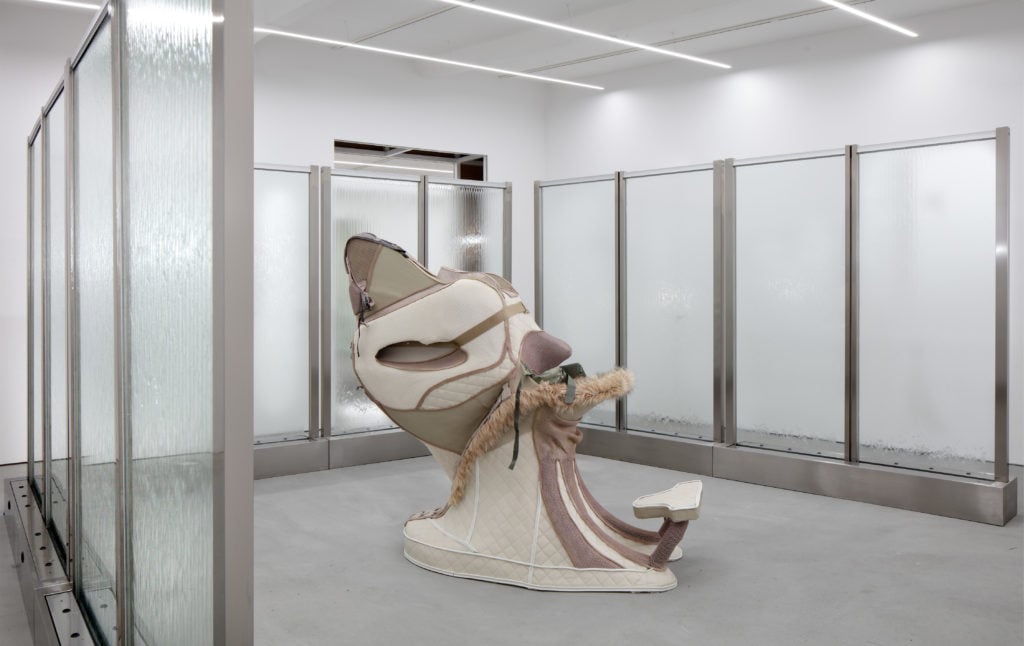
Anna Uddenberg’s Pocket Obes
(2017). Courtesy the artist and Kraupa-Tuskany Zeidler, Berlin.
Photographer: Gunter Lepkowski.
I encountered Anna Uddenberg’s
work at the 9th Berlin Biennale and then in a solo show at
Kraupa-Tuskany Zeidler in 2017. The overstretched figures in
her sculptures integrate earlier approaches to gender theory while
reflecting on the very timely topics of self-optimization, fitness,
and self-presentation in times of social media, it-girls, and
influencers. Based on Judith Butler’s idea of performing gender as
a rehearsed act, Uddenberg’s work continues to confront feminine
identity in consumer culture and to explore performativity by using
sculpture and performance as visual platforms. Her unique work is a
disturbing and yet revealing analysis of today’s gender topics
and existing normalities.
—Maike Cruse, director of Gallery Weekend Berlin.
Theresa
Chromati
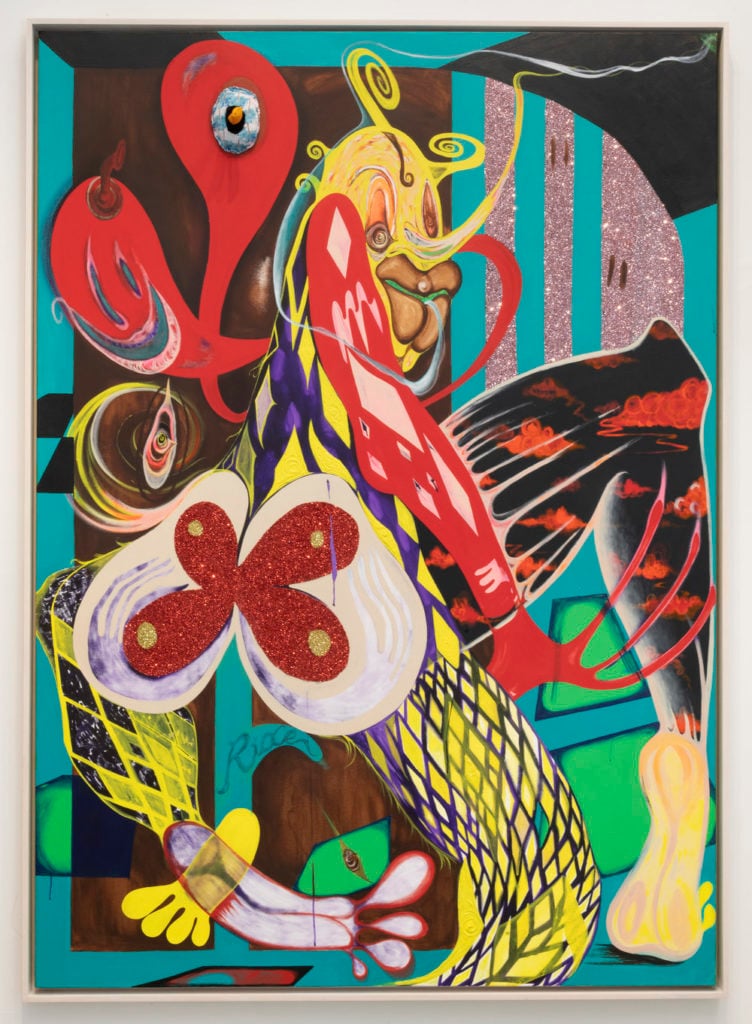
Theresa Chromati, We All Look Back
At it (morning ride), 2019. Courtesy of Kravets Wehby
Gallery.
I’ve loved seeing the growth and appreciation of Theresa
Chromati and her work this year, especially as she was part of my
STONELEAF RETREAT residency program in Kingston, New York, last
year. Theresa feels like an artist of her generation—smart,
stylish, outspoken, and is mastering her own unapologetic visual
language riddled with fragments of self-representation, layers of
emotion, and surreal symbols of sex and power. She had a beautiful
solo show at Kravets Wehby in New York, and both Nina Chanel Abney
and Mickalene Thomas have curated her works into impactful group
shows, which is a testament to her continued success.
—Helen Toomer, cofounder of STONELEAF RETREAT and re:source
Aria Dean
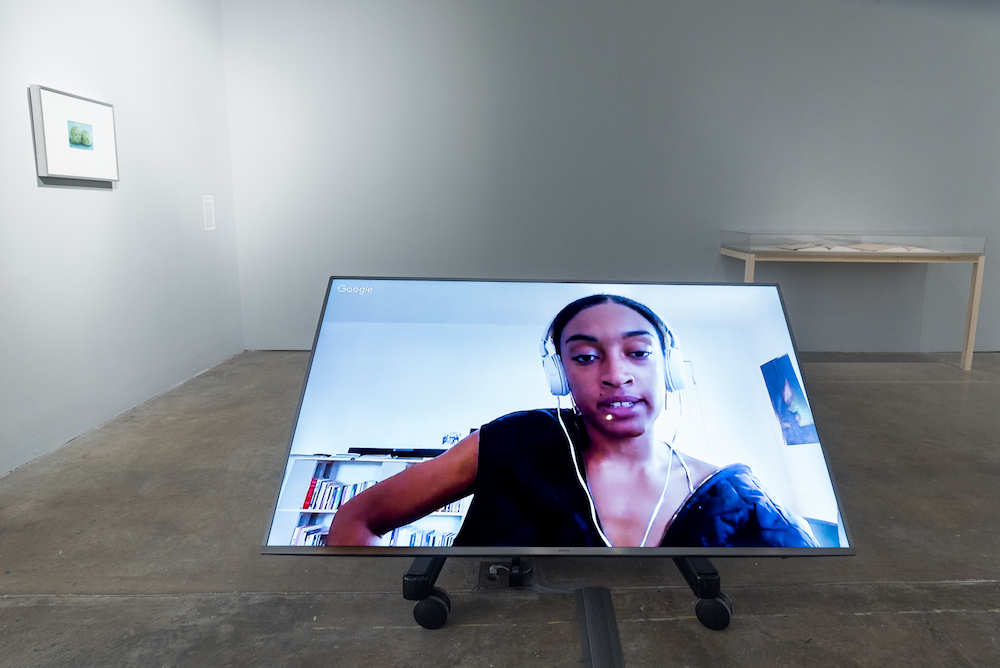
Aria Dean, Notes on
Blaccelerationism (2017). Installation view in “Colored People
Time: Mundane Futures” at the Institute of Contemporary Art,
University of Pennsylvania. Image courtesy of the artist and
Château Shatto, Los Angeles.
In my mind, Aria Dean’s
formidable talent finally came to light in 2019. When the year
started, she was finishing up her very first solo institutional
show at Albright-Knox Gallery, displaying her three major videos to
date. Since then, her work has been on view at museums and
institutions continuously all year long and traveled extensively
across the US, Europe, and Asia. These included:
“On Refusal: Representation
and Resistance in Contemporary American Art” at the MAC Belfast; “Phantom Plane, Cyberpunk in the Year of the
Future” at Tai Kwun,
Hong Kong; and “Great Force”
at the Institute for
Contemporary Art at Virginia Commonwealth
University, as well as
at the International Film Festival in
Rotterdam. She also
presented an original theatrical production titled
Production for a
Circle, at Centre d’Art
Contemporain, Genève. Excitingly, this year, her work was acquired by
the Studio Museum in Harlem and multiple works were designated as
promised gifts to the Hammer Museum in Los
Angeles. Château Shatto
presented a solo booth of Dean’s work at Art Basel Hong Kong in
March 2019, followed promptly by an exhibition at Chapter in New
York, which was written up by Roberta Smith
in the New York
Times.
As for artists I suspect we’ll
be talking about this time next year, I’m very excited by Rebecca
Ness, Antonia Showering, and Lauren Quin. Yes: all female
painters.
—Florie Hutchinson, arts
consultant
Allison Janae
Hamilton
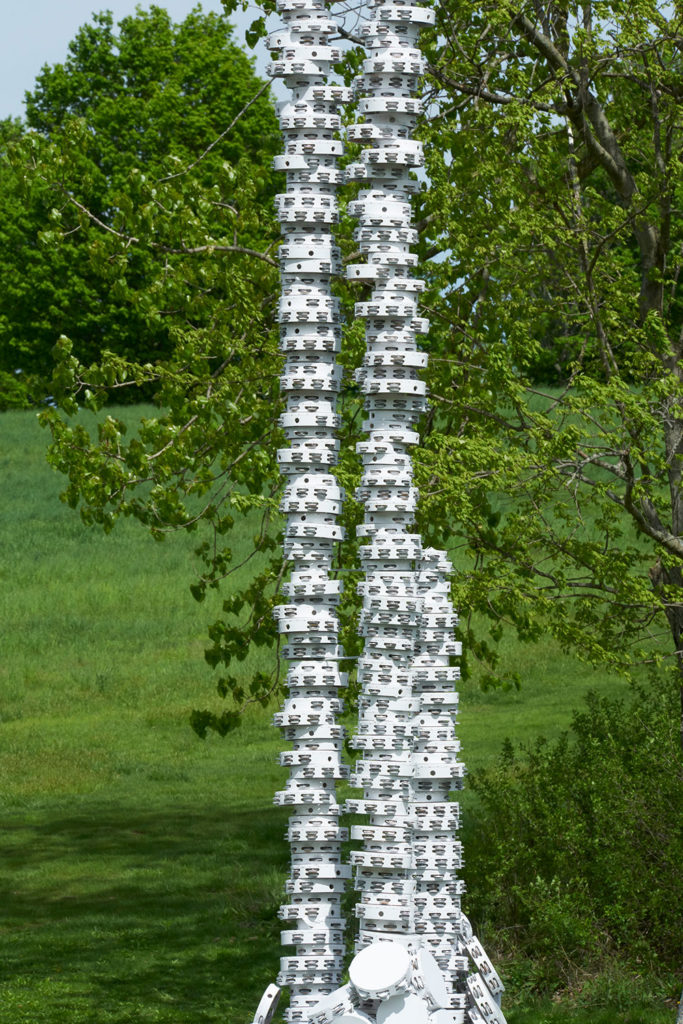
Installation view of Allison Janae
Hamilton’s The peo-ple cried mer-cy in the storm, (2018).
Courtesy of Storm King Art Center.
I was lucky enough to get to know artist Allison Janae Hamilton
when she made a beautiful, resonant sculpture, (The peo-ple
cried mer-cy in the storm), for Storm King Art Center’s recent exhibition Indicators: Artists on Climate
Change. In 2019, she continued to thrive, finishing her
residency at the Studio Museum in Harlem in March and following it
with the exhibition MOOD (with Tschabalala Self
and Sable Elyse Smith) at MoMA PS1. She had a two-person show at
Marianne Boesky Gallery in Aspen, curated by artist Sanford
Biggers, and joined the collection of the Menil Foundation, the
Studio Museum, the Hood Museum, and the Hessel Foundation. The
works she showed at Marianne Boesky Gallery’s booth at
Art Basel Miami Beach—a series of adorned fencing masks—were
breathtaking, and connect to her explorations of the culture,
climate, and history of the rural south in both film and
sculpture.
—Nora Lawrence, senior curator at Storm King Art
Center
Kelly Akashi
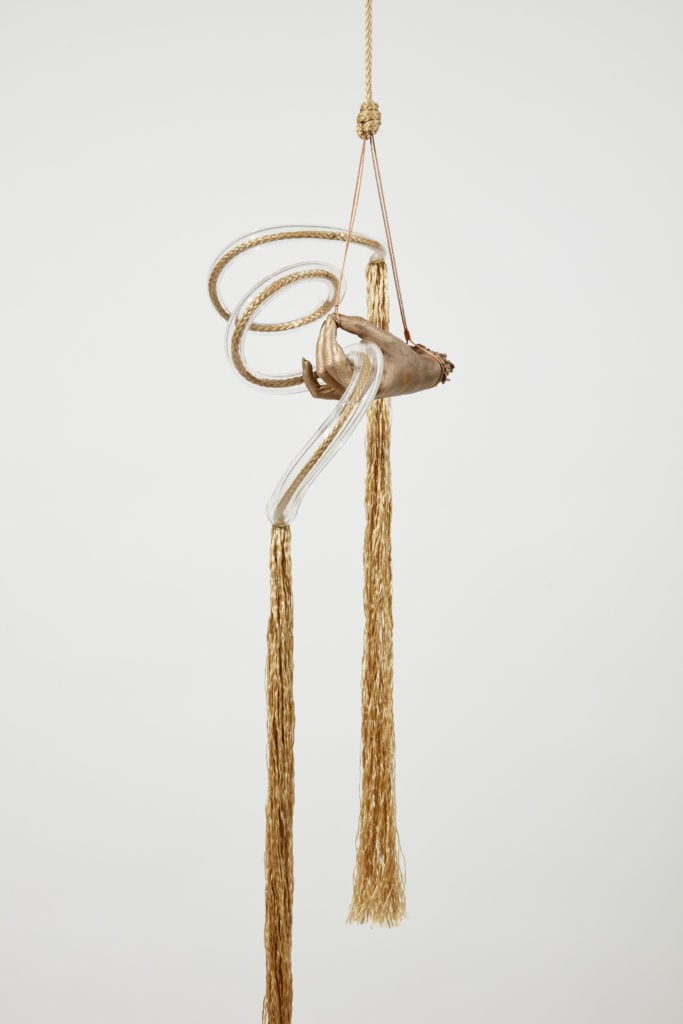
Kelly Akashi, Flowing Figure
(Hooked) (detail) (2019). Courtesy of the artist, Tanya
Bonakdar Gallery, New York and François Ghebaly Gallery, Los
Angeles.
With her materially dynamic and elegiac exhibition last year at
François Ghebaly in Los Angeles and three residencies—at ARCH
Athens, the Ojai Institute, and Headlands Center for the
Arts—LA-based artist Kelly Akashi had a busy and exciting year in
2019. Her practice, which is both conceptually rigorous and
seductively handmade, considers enduring themes which feel
especially resonant in this moment: entropy, deterioration, and the
capacity and fragility of the natural environment and the human
form. The year ahead includes various notable exhibition
projects, including Kelly’s first solo gallery show in New York
(opening in February at Tanya Bonakdar), a project at the Aspen Art
Museum (opening in March), and a new outdoor commission at the
Clark Art Institute in Williamstown, Massachusetts (opening this
summer), all of which will no doubt catalyze new developments in
her work and her audience.
—Molly Epstein, curator and art advisor
Arcmanoro
Niles
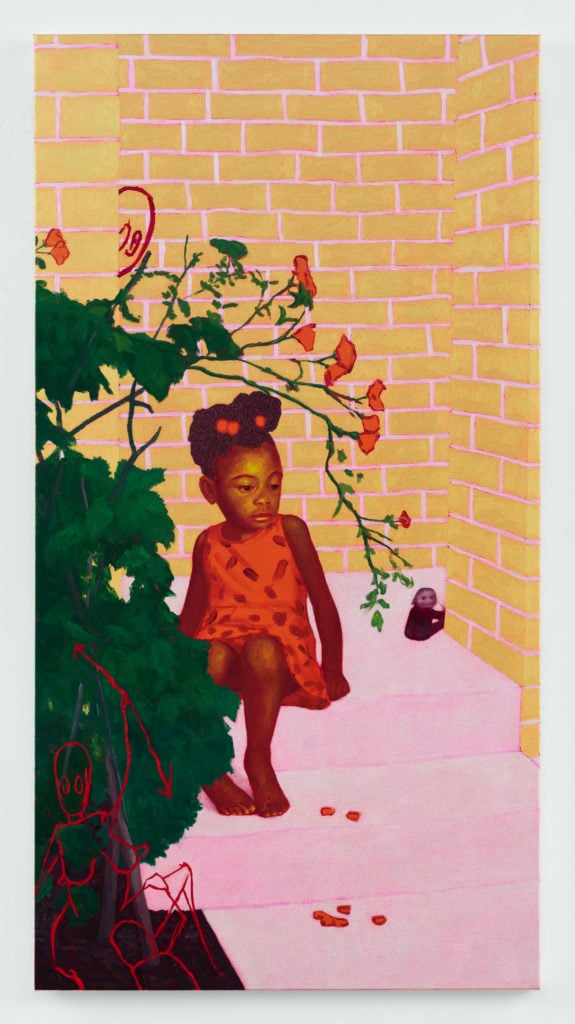
Arcmanoro Niles, When You Give Your
Love Away, 2018. Courtesy the artist and Rachel Uffner
Gallery.
The first time I sat with Arcmanoro Niles’s work was leading up
to the 2018 Dallas Art Fair. There was a studio-visit feature with
him in Patron Magazine that I remember seeing, and I
was captivated by his painting process. He’s proving his staying
power by the number of museums snapping up his work. The Dallas
Museum of Art bought one of his paintings at the fair in April
through our acquisition fund, and he’d been part of the Bronx
Museum’s star-studded Benefit Auction only a few days before.
—Kelly Cornell, director, Dallas Art Fair
Sheida
Soleimani
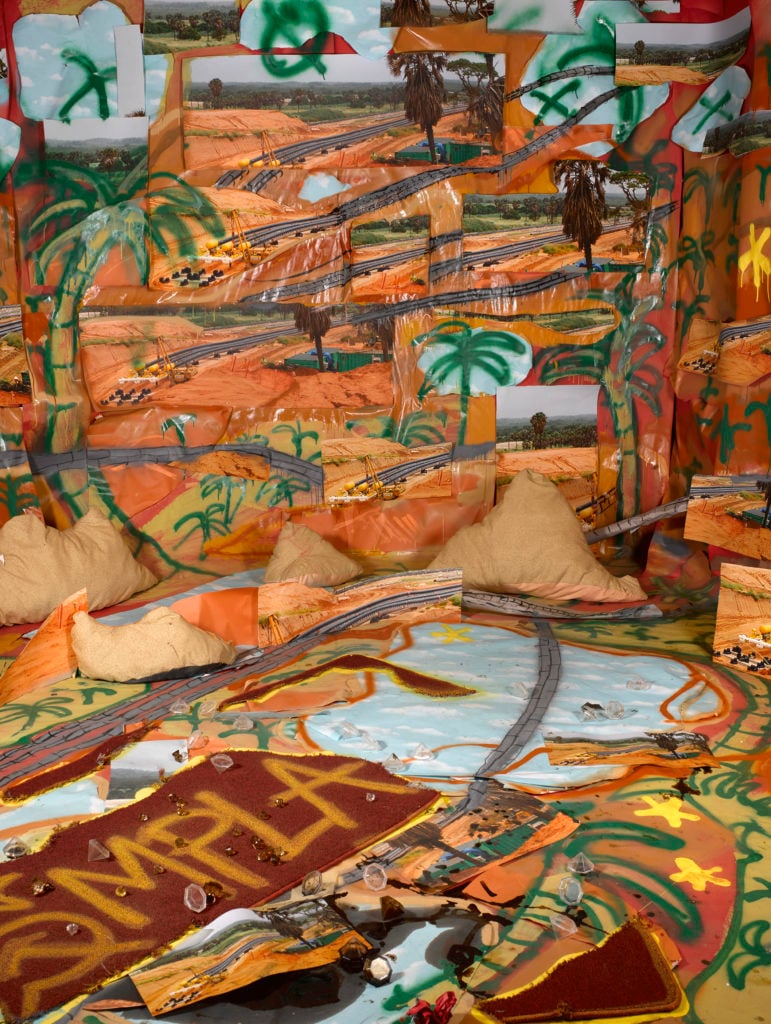
Sheida Soleimani, Dalia Oil Field,
Angola (2019). Courtesy Edel Assanti Gallery.
Sheida Soleimani has been on my radar for over 10 years, from
when she was a young BFA student at the University of Cincinnati. I
recently had the honor of working with her for the latest FotoFocus
Biennial, where she presented her powerfully staged photographs
that tackle global political crises, especially in her parents’
origin country of Iran. I’m proud to celebrate the artists of our
region and their successes, which for Sheida have extended from
Cincinnati to London, Brussels, and Cologne.
—Mary Ellen Goeke, executive director, Fotofocus
Biennial
Vaughn Spann
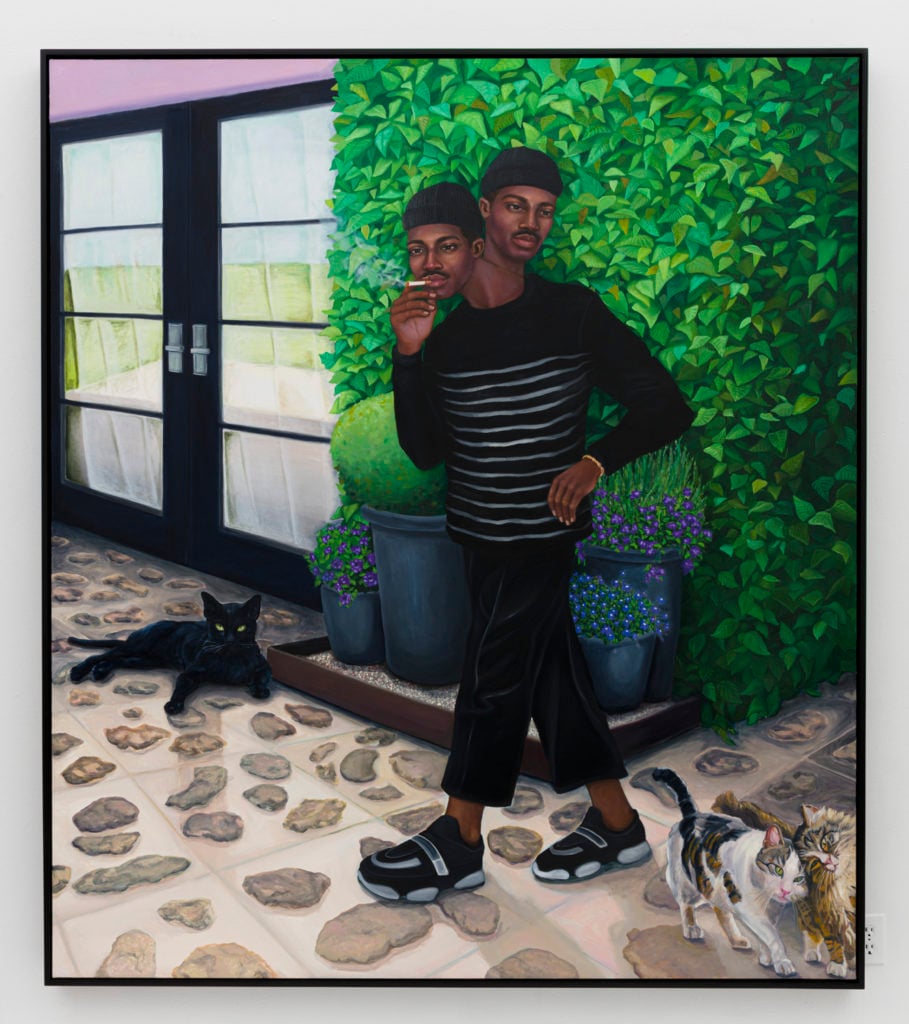
Vaughn Spann, Black Catz, (2019).
Photo by Jeff McLane. Courtesy of UTA Artist Space.
Vaughn Spann is a brilliant painter and storyteller. His work
explores themes of blackness that are both abstract thoughts and
monumental movements, and he beautifully captures the duality that
exists in each of us. I first encountered his work at a new gallery
in Los Angeles called Residency Art. I was left breathless by the
beautiful landscapes and spectacular universe depicted around the
human figure. Vaughn’s practice continues to evolve, yet he has
created a body of work that is instantly recognizable. I am proud
to show his work in our “Disembodiment” exhibition so the Los
Angeles art community can engage with the captivating world he has
created.
—Arthur Lewis, creative director, UTA Fine Arts and UTA
Artist Space
Kambui
Olujimi
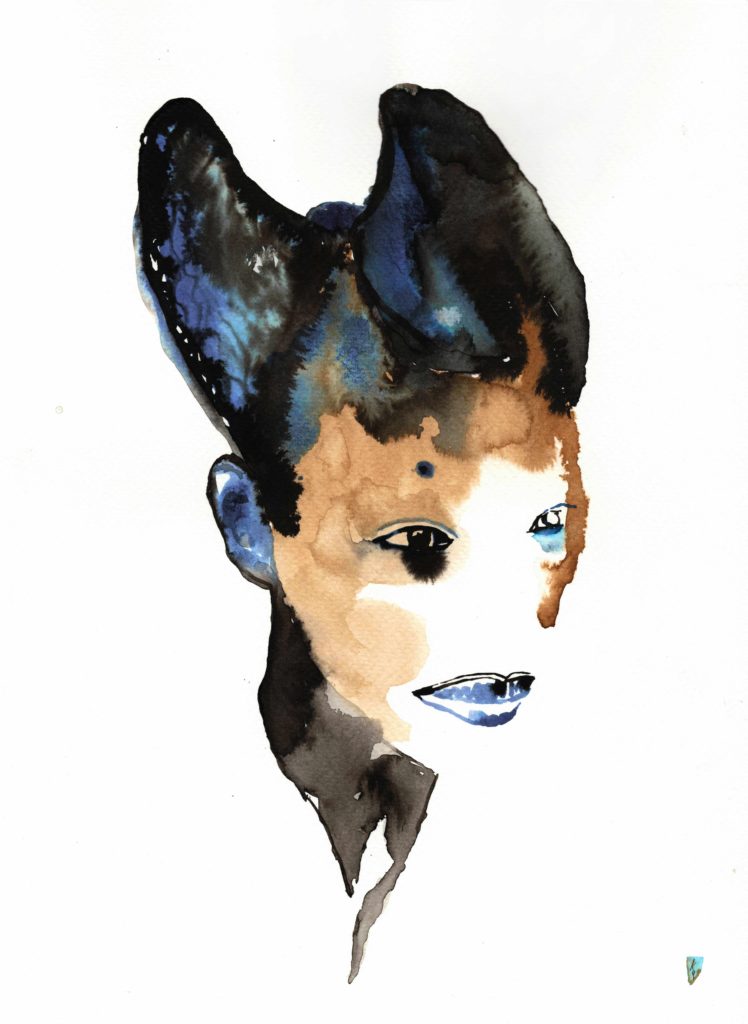
Kambui Olujimi, Fresh Cuts No.
6 (2019). Courtesy Kambui Olujimi and Absolut Art.
I started to really pay attention to Kambui Olujimi this summer
when our collaborator Kehinde Wiley announced Kambui had been
accepted into the first group of artists in the Black Rock Senegal
residency program. It was about the same time that he signed on to
our Wu-Tang print collection and I got to know him personally. He’s
experimental, engages with socially critical content, and keeps
switching up mediums to tackle issues of race and politics in new,
inventive ways.
—Nahema Mehta, CEO, Absolut Art
Lily
Cox-Richard
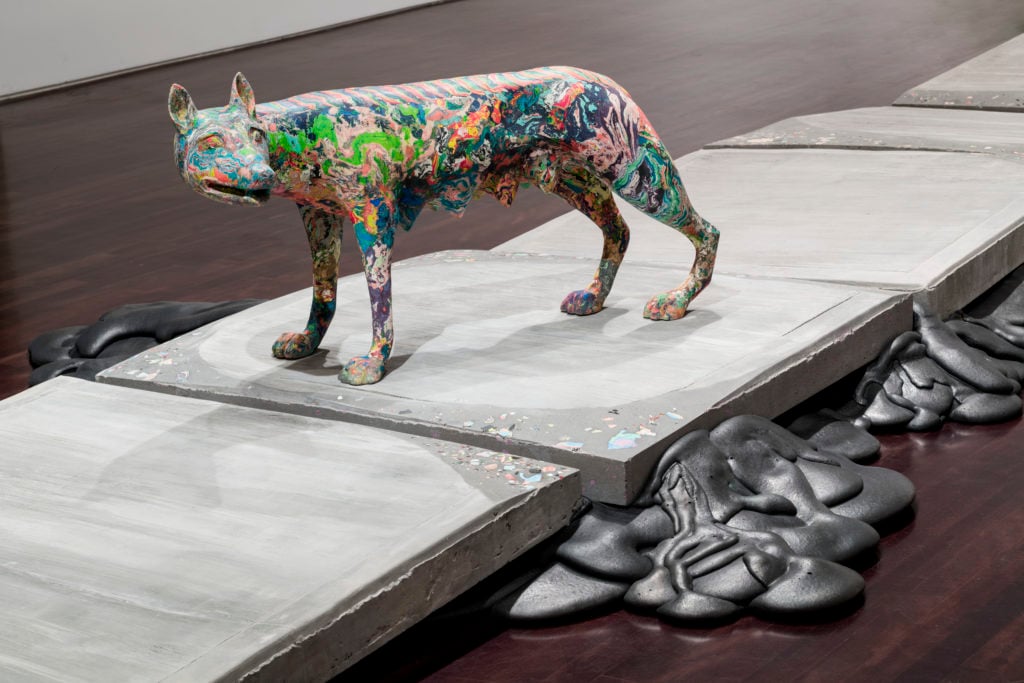
Lily Cox-Richard, installation view of
She-Wolf (2019) and Ramp (2019). Photo by Colin
Doyle. Courtesy of the Blanton Museum of Art.
I became aware of Lily Cox-Richard’s sculpture in 2016, when she
had solo shows at Artpace in San Antonio and She Works Flexible in
Houston; I appreciated her work’s wit and attention to detail, but
above all, its rigorous engagement with the histories of sculpture
and materials. Her new work for the Blanton’s Contemporary Project
responds to the museum’s collection of plaster casts of classical
sculpture, using 3D scanning and an ancient faux-marble technique
to prompt critical thinking about whiteness. As artists and
curators continue to interrogate the canon, Lily’s incisive
material investigations, which will be the subject of a MASS MoCA
show in 2021, will continue to resonate.
—Claire Howard, assistant curator, Blanton Museum of
Art
Baseera Khan
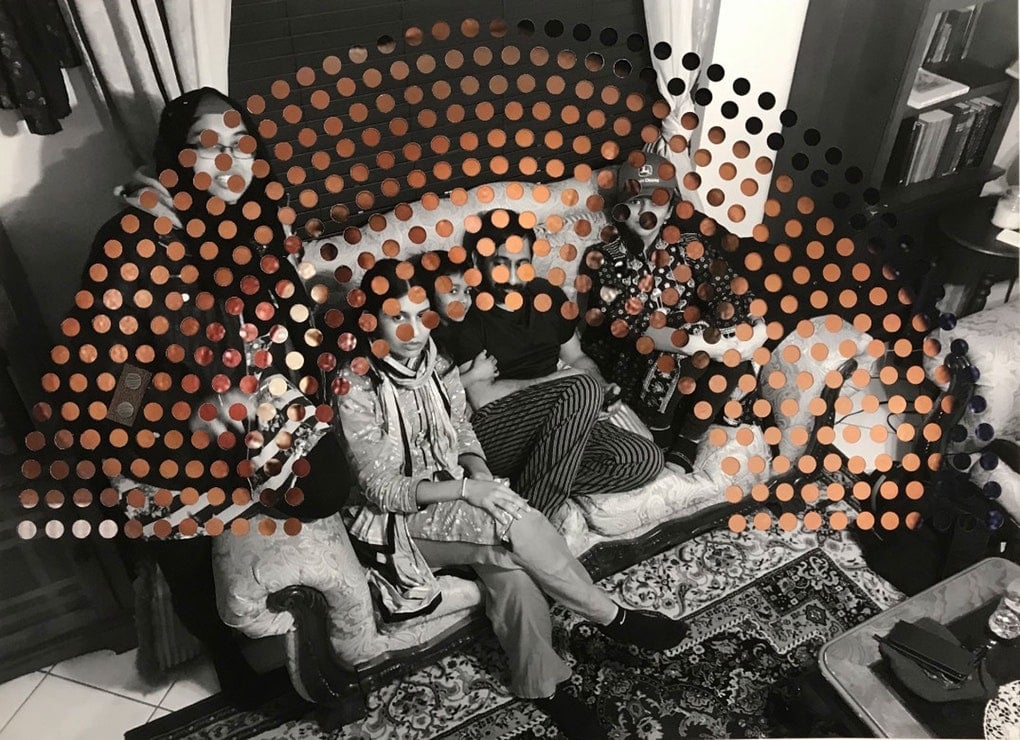
Baseera Khan, My Family Seated
(2019). Courtesy Baseera Khan and BRIC.
I was introduced to Baseera Khan’s work this fall in the process
of organizing a major exhibition at BRIC, “Beyond Geographies:
Contemporary Art and Muslim Experience.” She
incorporates both consumer objects and culturally significant forms
in her work, ranging from customized Nike Air Force 1s to
prayer blankets and traditional fabrics, to engage with
intersectionality and identity politics in a way that feels
fresh and relevant to current conversations on race, religion,
and identity. She had a big 2019, as her work was exhibited at
the Studio Museum and the Ford Foundation Gallery, and she is now
closing out the year with a remarkable solo show at Simone
Subal Gallery. She also received both a Joan Mitchell
Foundation award and the Colene Brown Art Prize this year. I am
certain her work will continue to communicate personal
experiences that, in their truth, are universally understood.
—Kristina Newman-Scott, president, BRIC
The post Which Emerging Artist Dominated 2019? 12 Art-World
Players Share Their Thoughts appeared first on artnet
News.
Read more https://news.artnet.com/art-world/breakout-artists-2019-1710882
Further reading


Leave a comment