
Who Was the Most Influential Artist of the Decade? We Surveyed Dozens of Art-World Experts to Find Out
As the turbulent and event-filled 2010s come to an end, we
asked more than 100 artists, curators, gallerists, and other
art-world figures to tell us their picks of the most influential
art and art-makers of the decade. Here is a selection of their
responses.
Louise
Bourgeois
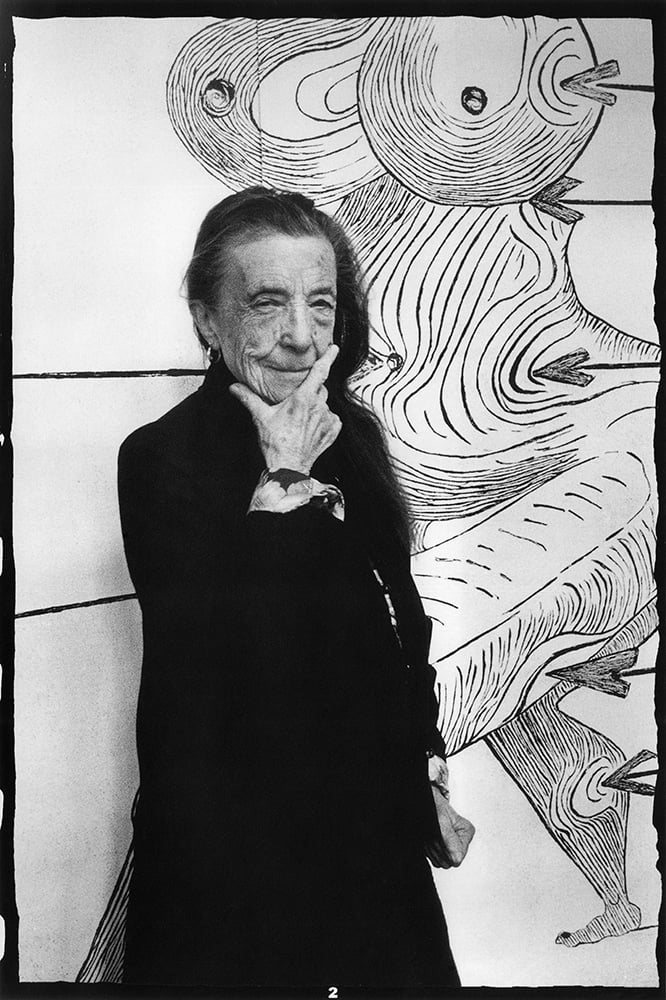
Louise Bourgeois in front of STE
SÉBASTIENNE in her Brooklyn studio (1993). Photo: © Vera Isler,
© The Easton Foundation/VAGA, NY.
At the beginning of this decade we lost an artist whose work has
a deep personal significance for me and is a source of inspiration
for younger generations of artists: Louise Bourgeois.
—Manuela Wirth, president, co-founder of Hauser and Wirth
Hito Steyerl
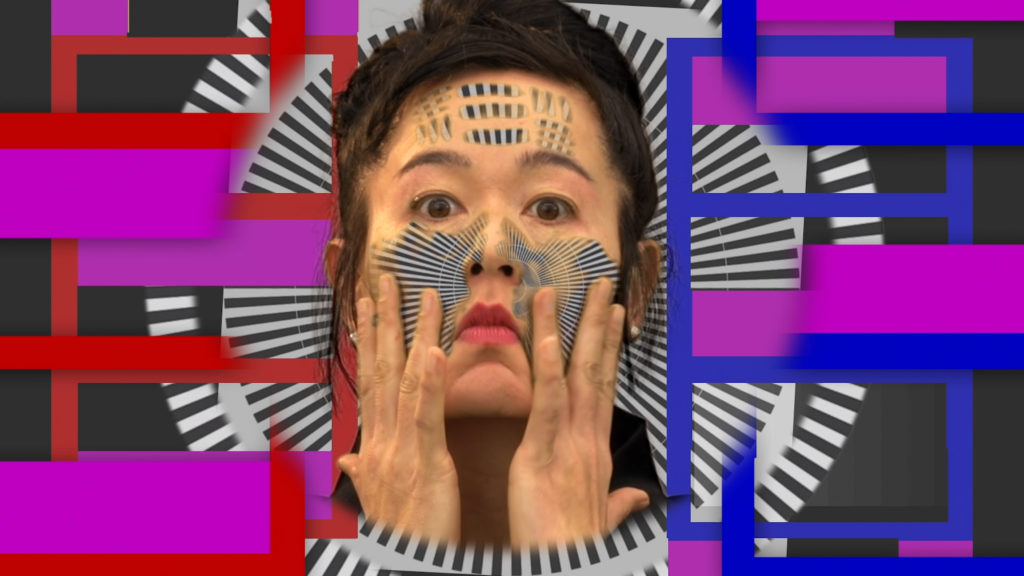
Hito Steyerl, still from How Not
to Be Seen: A Fucking Didactic Educational, (2013). Image CC
4.0 Courtesy of the Artist, Andrew Kreps Gallery (New York) and
Esther Schipper Gallery (Berlin).
Hito Steyerl has re-defined the
conversation around politics and digitization through the lens of
theory and artistic production and therefore re-positions the
function of an artist in society.
—Krist Gruijthuijsen,
director of the KW Institute for
Contemporary Art
As both a compelling visual
artist and remarkable writer, Hito Steyerl is a true
multi-hyphenate. Her books Wretched of the Screen (2012) and Duty Free Art (2019) helped frame the way that we look at art
today. For the past decade, she has been a staple of
high-visibility exhibitions globally including this year’s Venice
Biennale. Videos like How
Not to be Seen (2013)
and Liquidity
Inc. (2014) look at the
complex interminglings of socio-political tensions, economics, and
corporate aesthetics. Steyerl’s work is so clearly and powerfully
of the time in which it was created. Her solo show at Artists Space
in 2015 remains one of my favorite exhibitions of the last
decade.
—Justine Ludwig, executive director of Creative
Time
Cameron Rowland and Hito
Steryl

Cameron Rowland, courtesy of the
artist.
The artist Lorraine O’Grady has spent decades making clear that
the best way to see something is to situate it against something
else, in the form of a diptych. Arthur Jafa has also proven that
the way to understand an image is to see it contextualized by other
images. Taking up the cause of Both/And, rather than Either/Or, I
offer the following juxtapositions.
The most influential artist to emerge in this decade is Cameron
Rowland. Over the last few years his projects have reactivated the
apparatus of conceptual art toward vitally important conversations
about the politics of black subjectivity and the insidious civic
systems of oppression that are the legacy of the United States.
Hito Steyerl has spent the
decade mining networks, surveilling surveillance and
militarization, and investigating alternative economies. Their
shared brilliance points to future uses of critique.
—Catherine Morris, curator of the Elizabeth A. Sackler
Center for Feminist Art at the Brooklyn Museum
Zanele Muholi
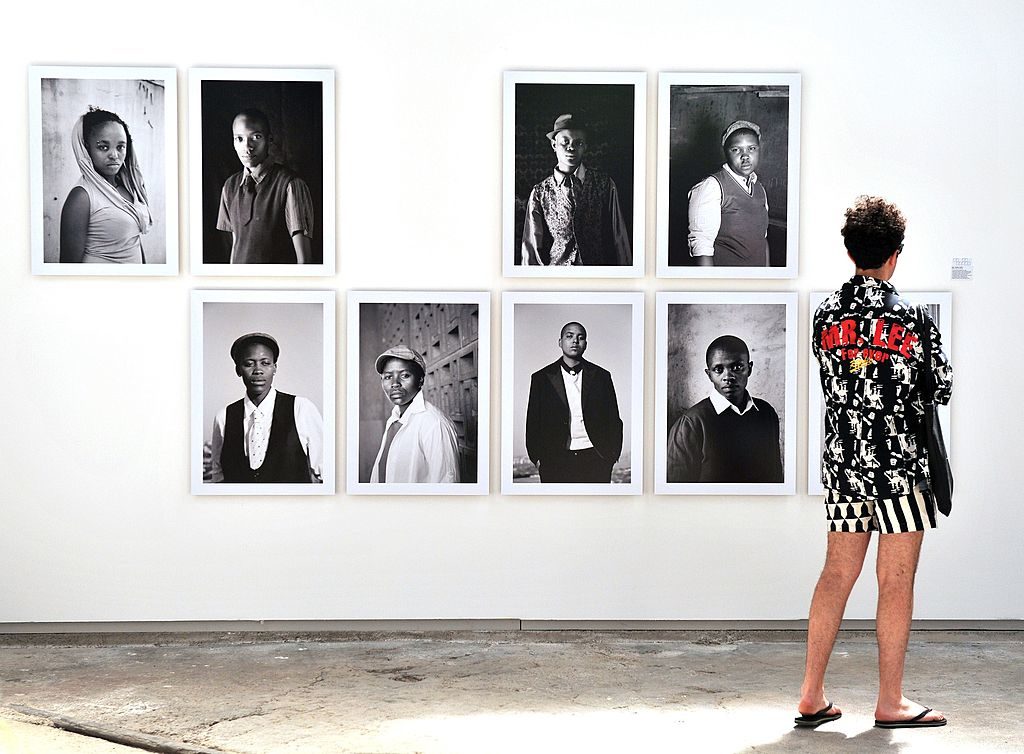
Pictures by South African photographer
Zanele Muholi at the 43rd annual Rencontres d’Arles photography
festival in France. Photo by Gerard Julien/AFP/Getty Images.
With an upcoming major
mid-career survey exhibition at the Tate Modern, Muholi’s career
has gone from strength to strength over the last decade. Starting
the decade with their “Faces and Phases” exhibition at Stevenson,
an exhibition that has since traveled to galleries globally, their
work has been included in more than 150 group exhibitions and 50
solo shows all over the world. Muholi has been a prominent voice in
the LGBTQI+ community, both in South Africa and over the world,
primarily confronting issues of race, gender and sexuality in their
work.
—Touria El Glaoui, founding director of the 1-54
fair
El Anatsui
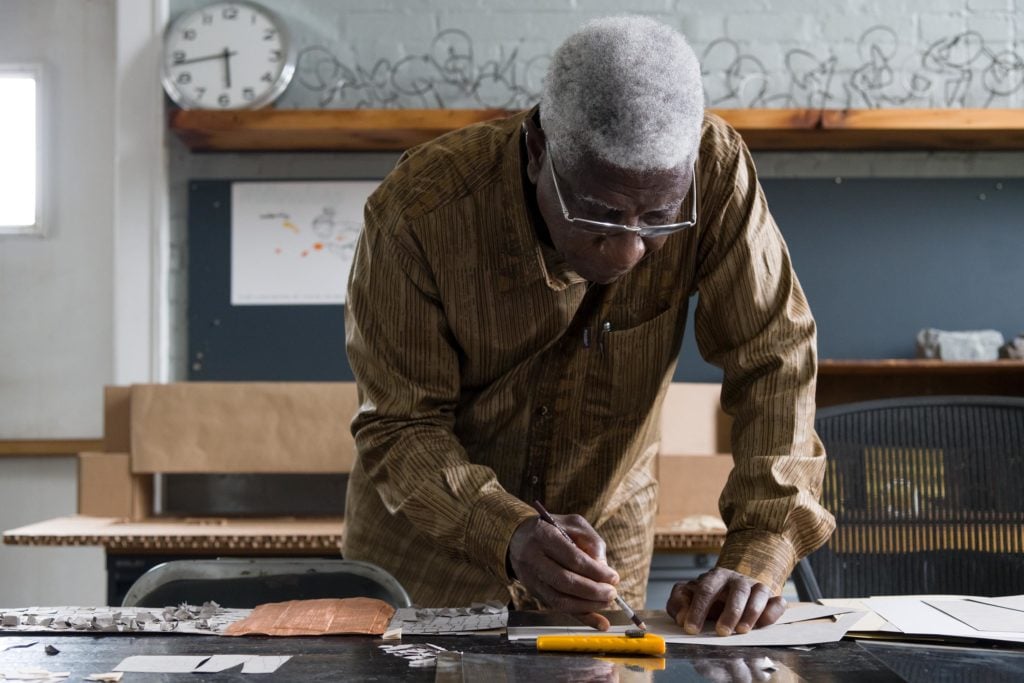
El Anatsui working on his installation
for the 57th Carnegie International. Photo: Bryan Conley, courtesy
of the Carnegie Museum of Art.
In these times with dubious and
easy agreement, I’m careful with lists and normative questioning as
they tend to the middle and to arrive at some sort of consensus,
which I find to be revisionist and not really in solidarity with
the underdog. So, I will respond to these with a caveat to say that
I deliberately will avoid mentioning Okwui Enwezor and his
unquestionable influence over the last decade and beyond because he
does not need further deification.
El Anatsui and a close second
would be jointly Zanele Muholi and Emeka Ogboh. Others with more
acclaim and influence achieved this before this period. El’s
influence on the younger generation of great artists from the
Nsukka school is immense and on artists like Ibrahim Mahama and a
few others while not so obvious is massive.
—Azu Nwagbogu, founder and director of the African
Artists’ Foundation
Kara Walker
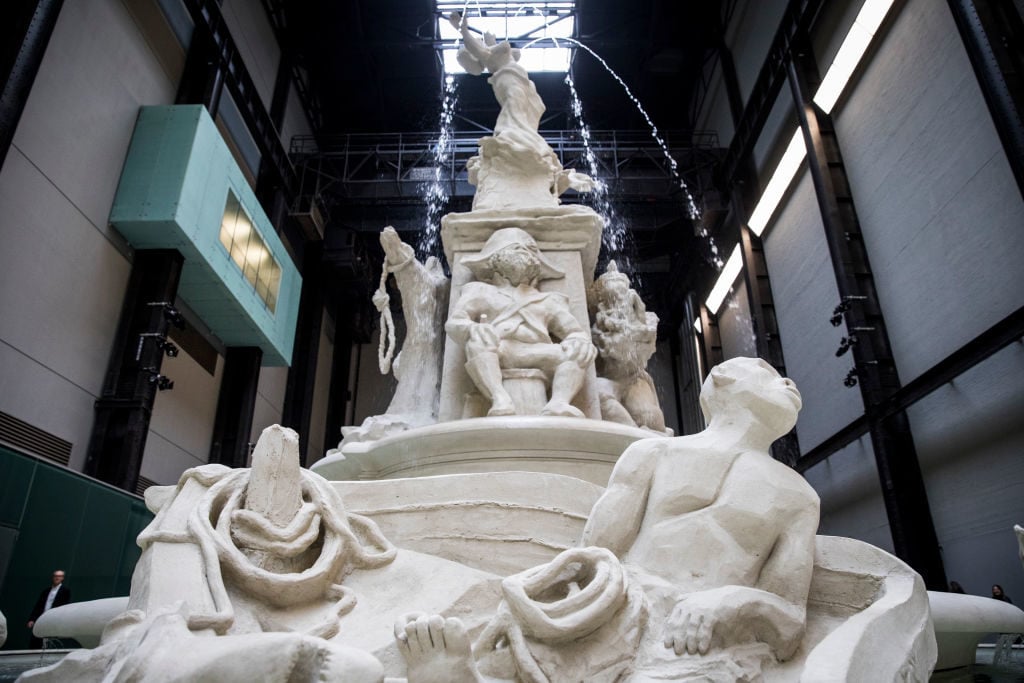
Fons Americanus by Kara Walker is
unveiled as the latest Hyundai Commission at Tate Modern on
September 30, 2019 in London, England. Photo by Tristan
Fewings/Getty Images.
The first part of the decade saw
her monumental, elegiac installation Sugar Baby at the
Domino Sugar Factory and the decade ended with the opening of her
triumphant installation Fons Americanus at the Tate
Turbine Hall. She was already influential before this decade, but
she owned the teens by continually pushing herself to new heights
without repeating herself, and she shows no signs of slowing
down.
—Eva Respini, chief curator
at ICA Boston
It is not an accident that Kara
Walker is currently exhibiting in the Turbine Hall of Tate Modern
because her style of politically motivated art, exploring issues of
race, slavery and colonialism, has been such a dominant
characteristic of art of the last decade.
—Charles Saumarez Smith, chairman of the Royal Drawing
School and Watercolour World
Beyoncé
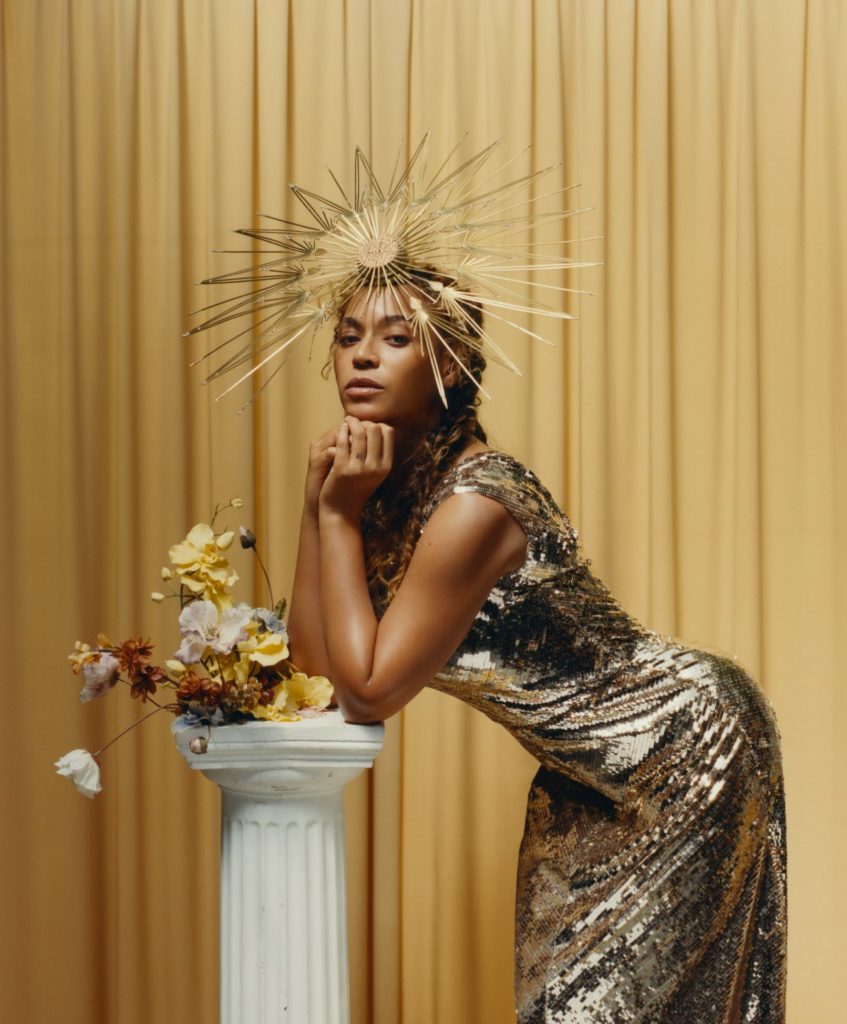
Tyler Mitchell’s portrait of Beyoncé for
Vogue magazine. Courtesy of the artist.
There isn’t anyone who has been
more influential across more industries, landscapes, or genres in
the 2010s. Among many other things, she has created new industry
standards (with Beyoncé, her 2013 surprise visual album, for example);
delved into the fine art world, collaborating directly with artists
like Awol Erizku and Tyler Mitchell, and drawing inspiration from
others like Julie Dash and Arthur Jafa—and then used her massive
platform to bring new audiences to their work; and staged a
complete takeover of Coachella 2018 (i.e. Beychella) less than a
year after giving birth to twins, highlighting the indelible
contributions of African Americans, from “Lift Ev’ry Voice and
Sing” to HBCU Marching Bands. Through it all she has maintained
full creative license and control, offering a powerful vision of
what and how an artist can be in the 21st century.
—Rujeko Hockley, curator at the Whitney Museum of American
Art
Theaster
Gates
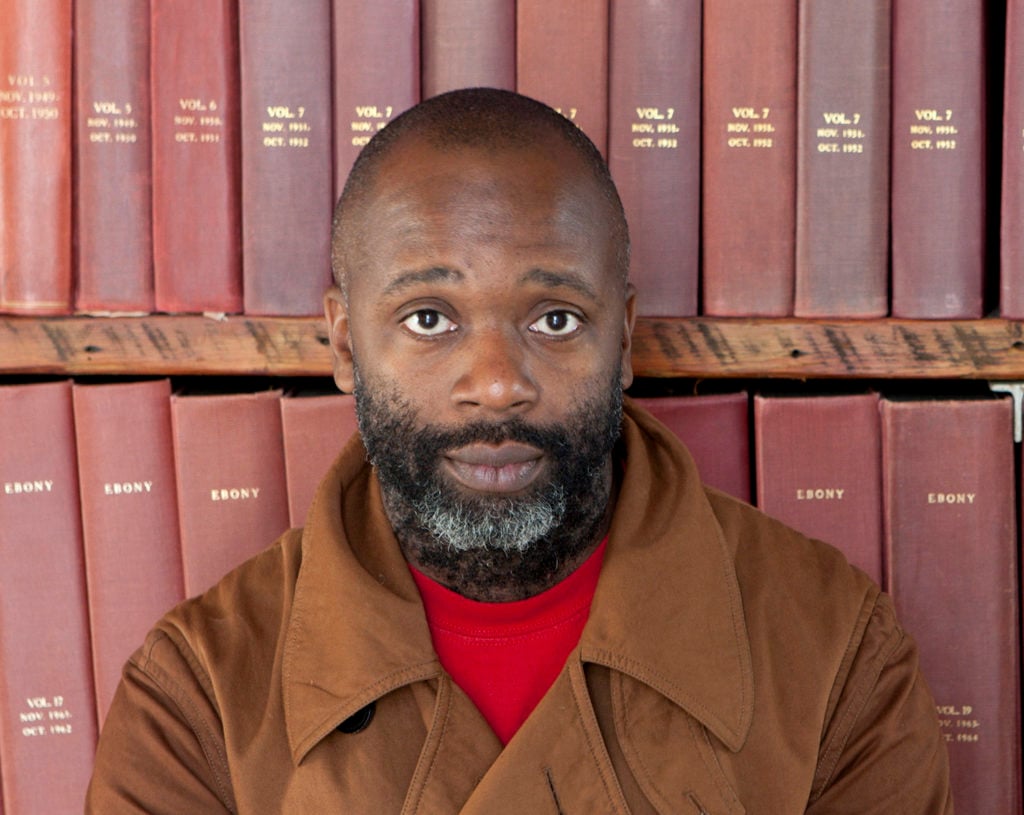
Theaster Gates with part of the Johnson
Publishing Archive. Photo by Sarah Pooley, courtesy of the
artist.
Theaster Gates expanded the
practice of the artist studio to include community engagement in
ways that had not been possible previously.
—Elizabeth Dee, co-founder and CEO of the Independent Art
Fair
To be an influential artist is
to recalibrate what art might be, where it might be seen, why it
might be relevant, and with this to bring about structural change
in museums. Theaster Gates does all this and more. His is an
artwork that is erudite and restless, with porous boundaries that
keep on transforming in response to art and the world that holds
it. Pointing to Gates’s work is like pointing to an idea: it is
fugitive, fleeting, and forceful.
—Lisa Le Feuvre, executive
director of the Holt/Smithson Foundation
Arthur Jafa
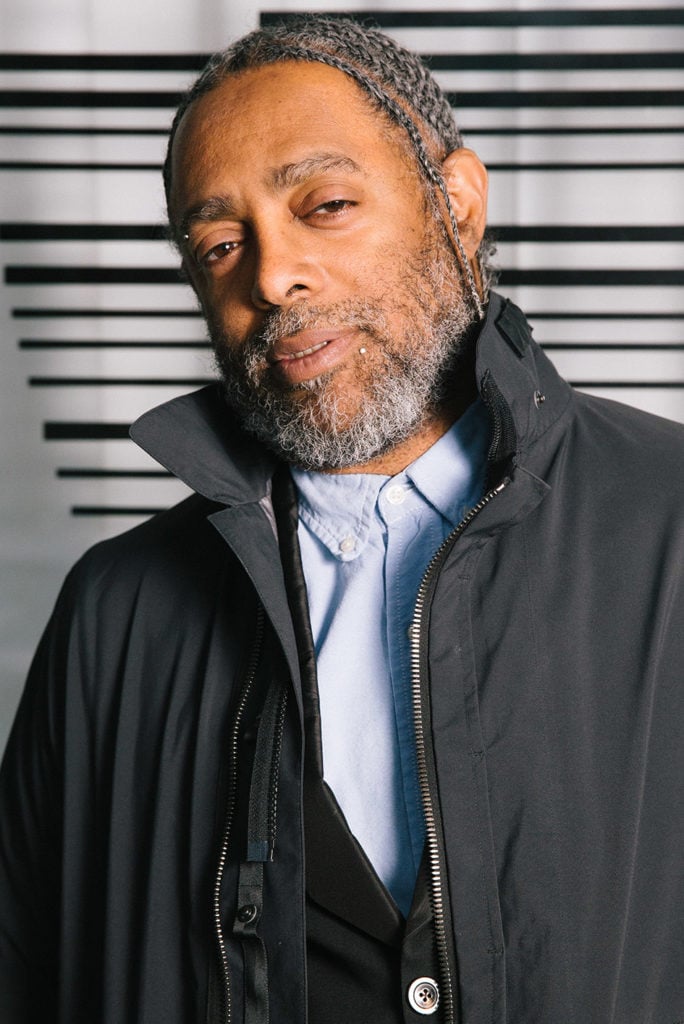
Arthur Jafa. Photo by Robert
Hamacher.
Jafa’s Apex, a never-ending photo sequence set to hypnotic
Detroit techno beats by Robert Hood, and his now widely shown
video Love is the
Message, The Message is Death basically break all the rules I was taught in
undergrad New Genres: no children, no animals, no sex, no violence,
and no popular music (the idea being viewers would be too
distracted to receive the real message), but the effect is that the
cells in your body seem to rearrange so that you are not the same
person as before. If that is not a “most influential” visual
experience then I don’t know what is.
—Anna Glantz, artist
Robin Meier
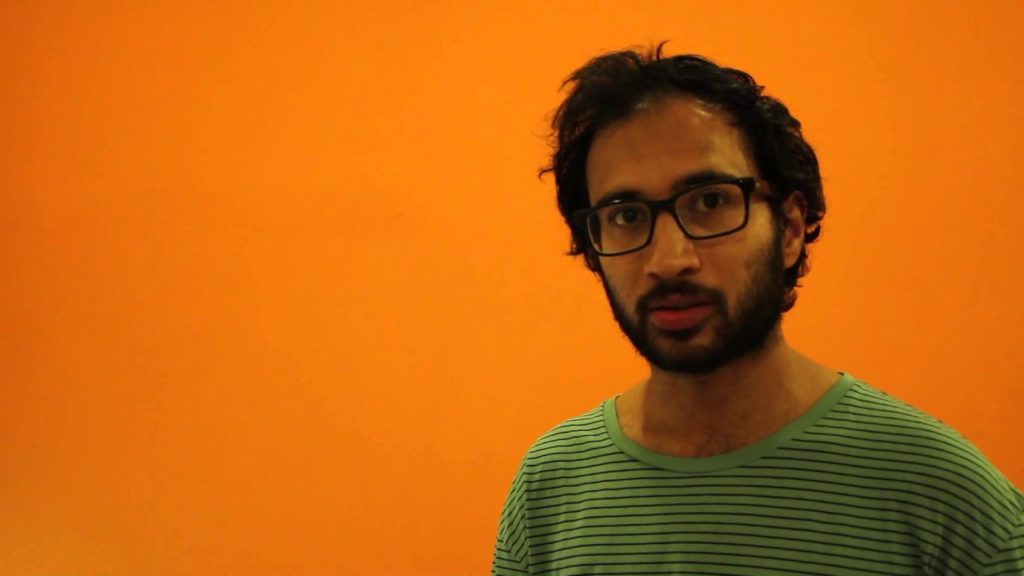
Still of Robin Meier, courtesy of
YouTube.
In collaboration with some of
the world’s most advanced science labs, Meier has created during
this last decade concertos for mosquitoes, choreographies with
ants, and installations where flashing fireflies synchronized
chirping crickets and generative music.
—Marc-Olivier Wahler, director of the Geneva
Museum of Art and History
Wade Guyton
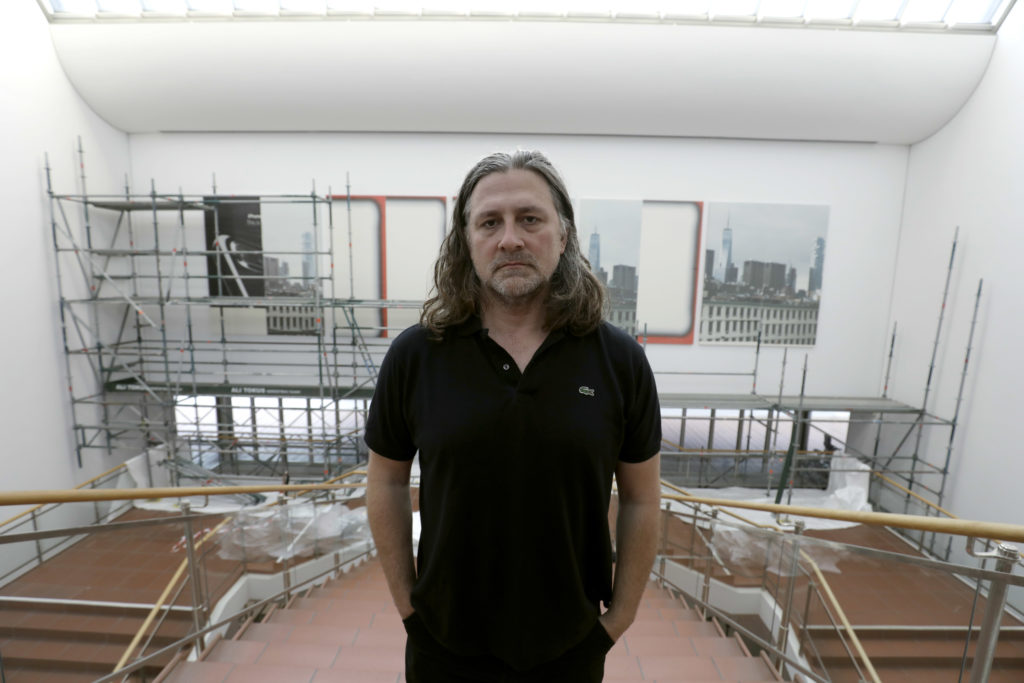
Wade Guyton. Photo by Brill/ullstein
bild via Getty Images.
From my perspective Wade Guyton
is the most influential artist of the decade because he is able to
combine the very current discourse of the digital age with art
history. There are so
many young artists who are tremendously influenced by
him.
—Yilmaz Dziewior, director of Museum Ludwig,
Cologne
Forensic
Architecture
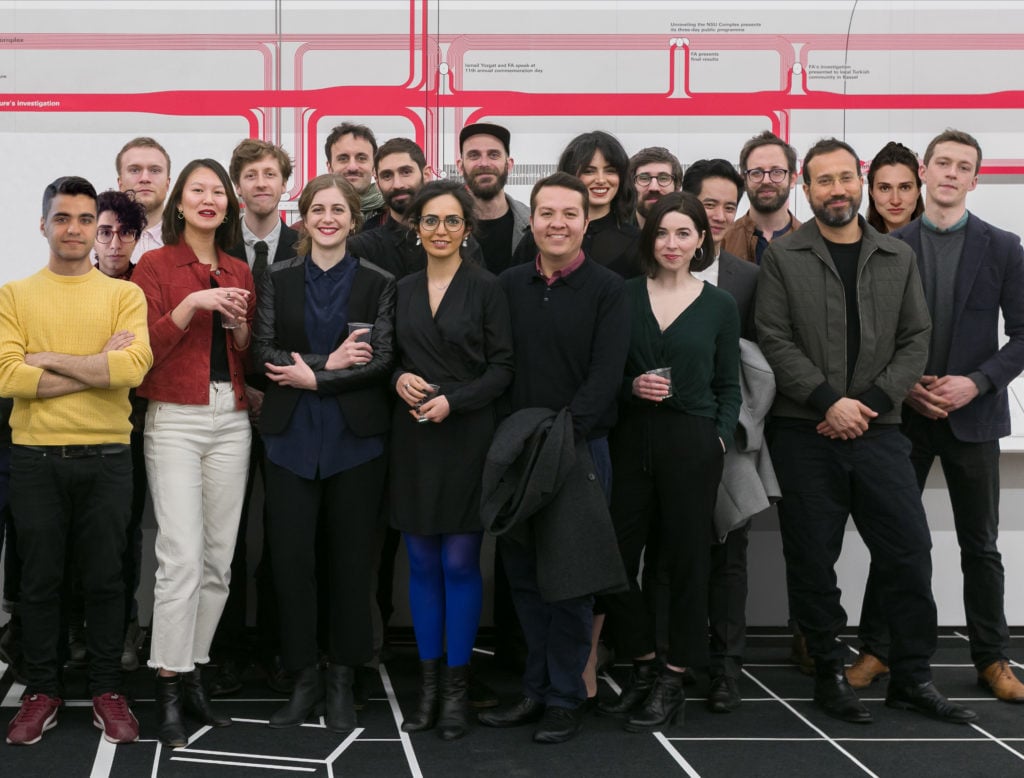
Collage by Forensic Architecture,
2018.
We live in a world being ripped
apart by violence, most of which is carried out by states and
corporate conglomerates. Forensic Architecture’s visually
compelling and technologically sophisticated application of a
“counter-forensic gaze” demonstrates how art can unmask the
workings of state power in our time.
—Coco Fusco, artist and activist
2019 Turner Prize
Winners
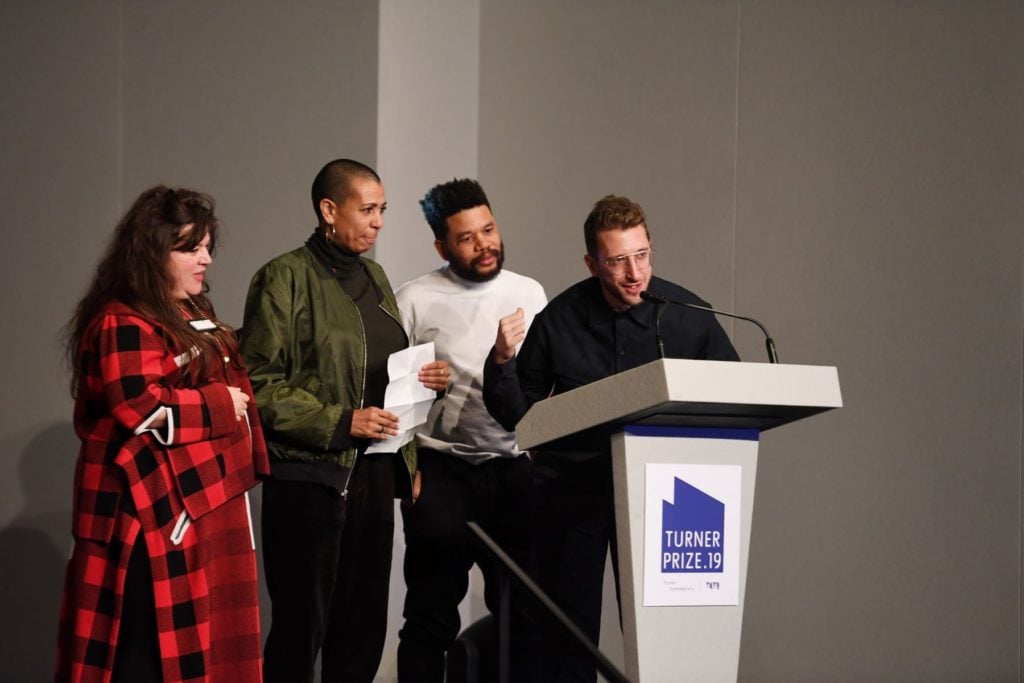
Tai Shani, Helen Cammock, Oscar Murillo
and Lawrence Abu Hamdan. Photo by Stuart C. Wilson/Stuart
Wilson/Getty Images for Turner Contemporary.
Collectives, alliances,
initiatives and artists-run spaces, such as Art Labor Collective,
Chimurenga, Dirt Palace, Forensic Architecture, Green Papaya,
Lifepatch, Mujeres Creando, and, last but not least: this year’s
Turner Prize nominees. These collectives do not even necessarily
produce artworks, but rather devote their collaboration to critical
debate, and to the sparking of public critical discussions on
social and political issues above all else. This is a clear
statement for solidarity and social responsibility, and the only
way out at a time where environmental change and social injustice
are the biggest problems of the entire planet, which can only be
faced collectively.
—Anna-Catharina Gebbers, curator of the Nationalgalerie im
Hamburger Bahnhof – Museum für Gegenwart – Berlin
In our society, there are very
few fields left that are free from the acceleration caused by
economic interests, and that have the power to guide our senses,
thoughts, and perceptions of the world around us into new
categories. What art has taught us in the last 10 years is to
understand how important diversity is, to constantly change our
point of view, to face the unknown (and
thus try to meet it as often as possible), to
show solidarity and humanity, and to refuse to exclude one
another.
Today, at the end of 2019, as I
sit at my desk and think about which artworks, exhibitions, and
people in the art world have been most influential this decade,
I’ve come to the conclusion that it is a multitude of each rather
than just a few. So I’d like to emphasize that none of the
following examples can claim to be superlative, objective, or
unique. For me, all those who recognize the crisis and are ready to
face it resonate between the lines of my answers, too.
As the joint winners of the 2019 Turner Prize wrote in a
letter: “At this time of
political crisis in Britain and much of the world, when there is
already so much that divides and isolates people and communities,
we feel strongly motivated to use the occasion of the Prize to make
a collective statement in the name of commonality, multiplicity,
and solidarity—in art as in society.”
—Joanna Kamm,
director of Liste
Steve McQueen
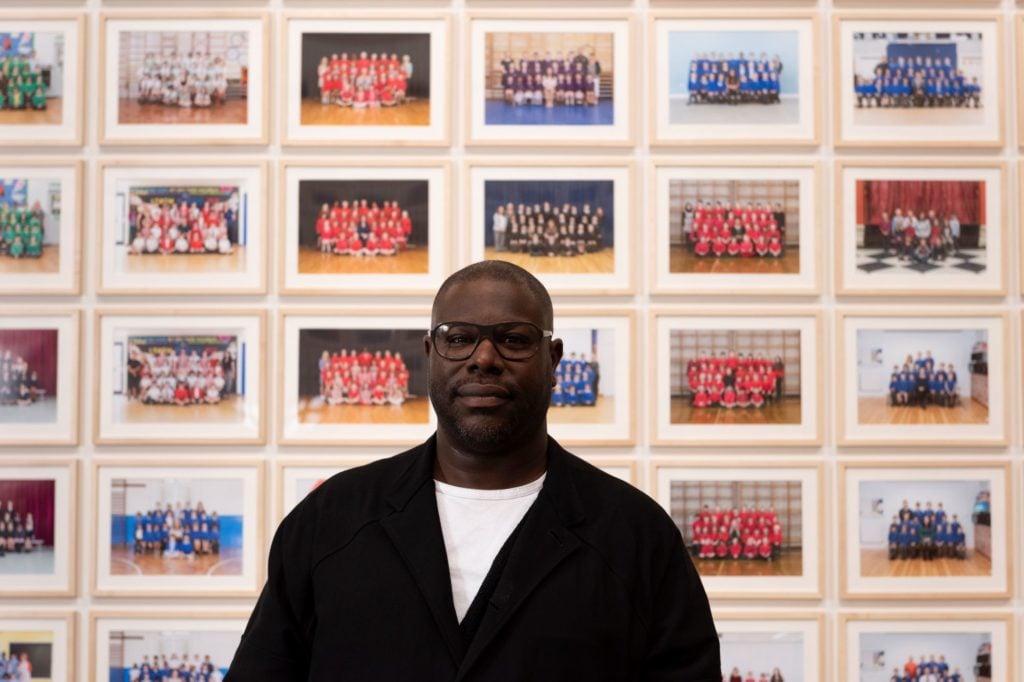
Steve McQueen in Year 3 at Tate
Britain. ©Tate. Photo Jessica McDermott.
Steve Rodney McQueen, British
artist, film director, and screenwriter who won an Oscar, among
other prizes, has transcended all possible boundaries of what it
means to be an artist of global influence at a time when
boundaries are there to be broken. He is an exemplar of what is
possible.
—Julia Peyton-Jones, senior global director at Thaddaeus
Ropac
Lisa Reihana
![Installation view of Lisa Reihana's <i> In Pursuit of Venus [infected]</i> (2015-17). Courtesy of Auckland Art Gallery.](https://news.artnet.com/app/news-upload/2019/12/maxresdefault-2-1024x576.jpg)
Installation view of Lisa Reihana’s
In Pursuit of Venus [infected] (2015-17). Courtesy of
Auckland Art Gallery.
Having
been a leader in the development of contemporary art and
contemporary Māori art in Aotearoa New Zealand since the 1990s,
Lisa Reihana has planted those interests firmly on the global stage
with her work In Pursuit of Venus [infected] that
evolved from a two-channel video in 2012 to the 60-foot-long hit of
the 2017 Venice Biennale (Auckland Art Gallery Toi o Tāmaki, New
Zealand). Through such persuasive storytelling and the
groundbreaking use of highly sophisticated technology, she has both
challenged outdated colonial views of the Pacific, and created new
ways for artists to create in the coming decade.
—Michael Brand, director of the Art Gallery of
New South Wales
Anne Imhof
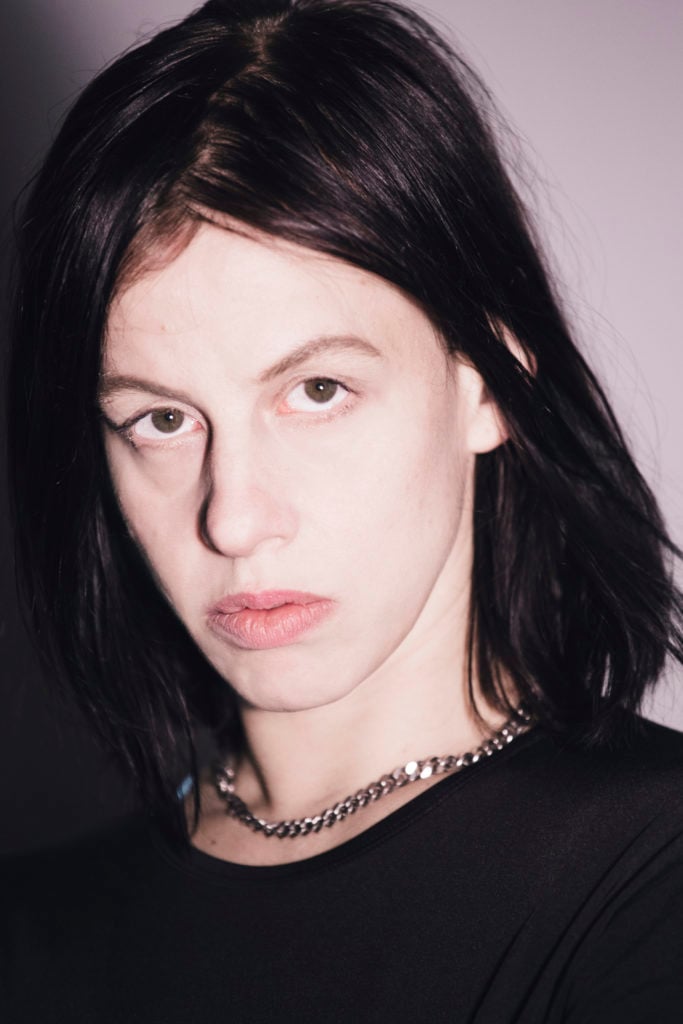
Anne Imhof. Photo by Nadine
Fraczkowski.
Terrible question. If you twist
my arm to name one, I would single out Anne Imhof for the intensely charged performance-installations she created, inventing a new format of an exhibition, a veritable
post-internet experience.
—Nina Zimmer, director of the Zentrum Paul Klee and the
Museum of Fine Arts Bern
Wu Tsang
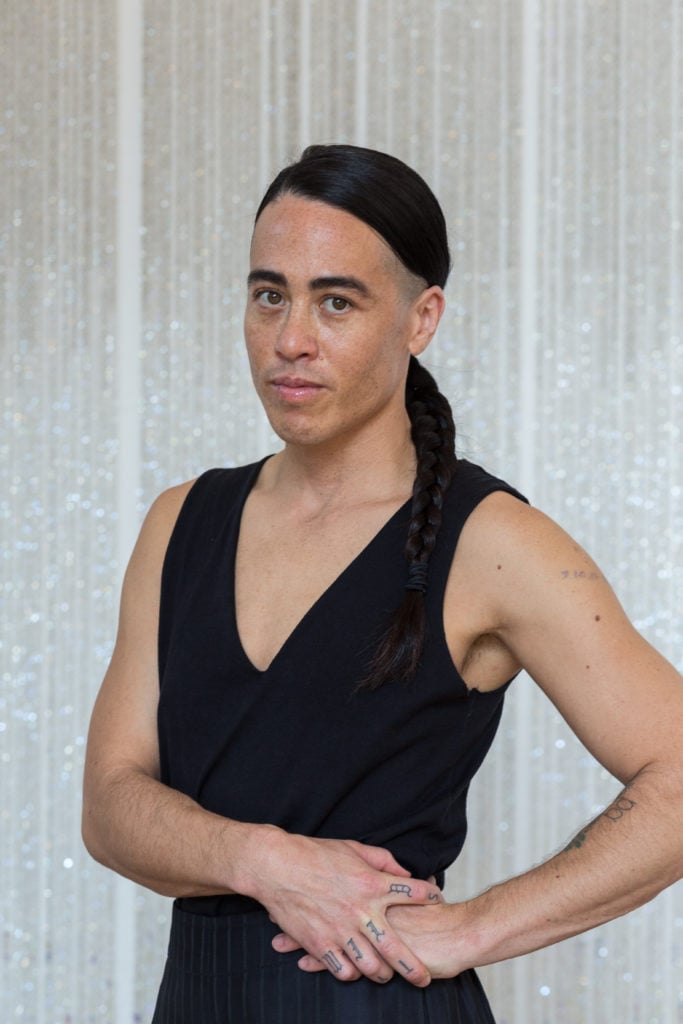
Germany Berlin American artist Wu Tsang
during her stay at the Martin-Gropius-Bau. Photo by: Karsten
Thielker MacArthur Foundation, Courtesy of John D. & Catherine T.
MacArthur Foundation.
A crucial aspect of Wu Tsang’s
practice is her radical approach to documentary film. Her work
allows cinematic parallels to emerge between the construction of
the moving image, the movement of the performing body and the
movement inherent to migration. The way she uses the camera enables
gesture, choreography, and dance to serve as narrative
forces.
—Stephanie Rosenthal, director of Gropius Bau,
Berlin
Cory Arcangel, Kerry James Marshall, Wu
Tsang, Maurizio Cattelan.
—Lisa Schiff, art advisor
Kerry James
Marshall
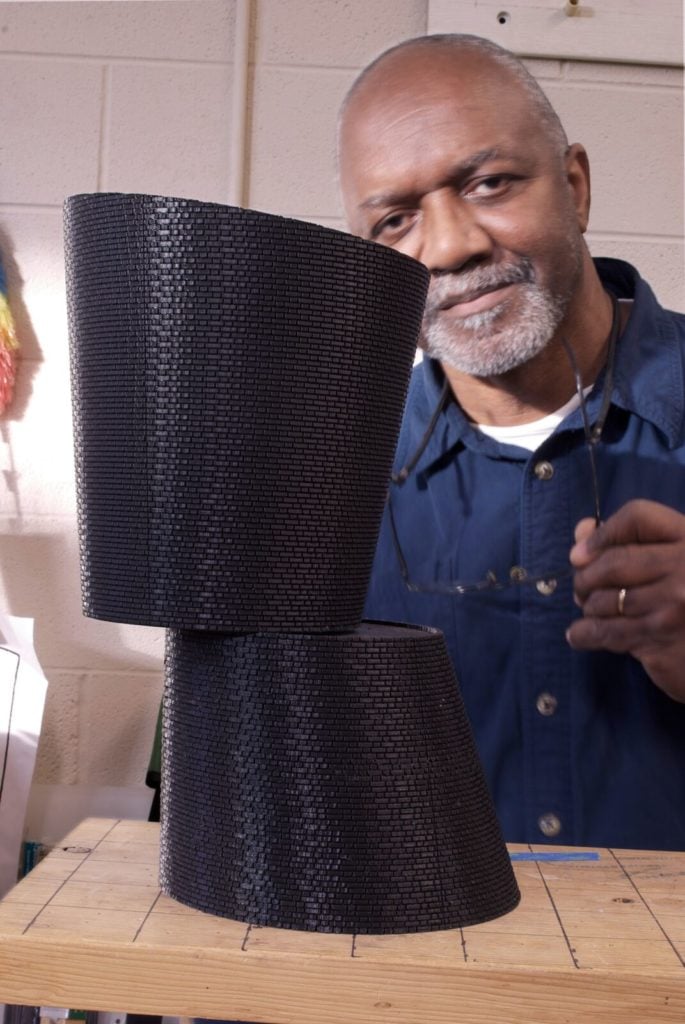
Kerry James Marshall with A
Monumental Journey model. Photo courtesy of Kerry James
Marshall Studio.
Chicago-based artist Kerry James
Marshall most certainly paved a path for the much-needed increased
visibility of artists from the Black diaspora this decade,
particularly those working in figurative painting. A major touring
exhibition of his paintings, “Kerry James Marshall: Mastry,” was
one of the highlights of the decade and gave context for a wave of
artists from a younger generation such as Amy Sherald, Kehinde
Wiley, Jordan Casteel, Lynette Yiadom-Boakye, among others, but
also opened doors to overlooked artists from the 1960s and 1970s
such as the Africobra artists from the south side of
Chicago.
—Julie Roidrigues Windholm, director and chief curator of
the DePaul Art Museum
Even though Marshall’s career
has been established for a while now, it really hasn’t been until
the past decade that we’ve seen his influence spread so widely. In
just about every graduate school I’ve visited recently, there is
someone making representational, allegorical paintings about
identity.
—Jason Stopa, artist
Marshall’s mission to represent
the black figure and black life within the wholly white painting
canon has been hugely influential on all aspects of current art
making and art narratives. It is nothing less than an imperative to
recognize black humanity. His influence has made certain modes of
painting a political act.
—Gina Beavers, artist
Kerry James Marshall set a sea change in motion in 2018 when,
with the sale of Marshall’s monumentally scaled “Past Times”, a
record was set at Sotheby’s for the highest price
paid, $21m, for a work of art by a living African
American artist. In Marshall’s wake the art world became
hungry for a new generation of African and African American artists
whose figurative paintings depict black people in everyday scenes
at home in urban, suburban, and interior settings, in states of
rest and leisure. Marshall also set a high bar for anyone
interested in pictures and picture making. His 2016 retrospective
at the MCA Chicago and the Metropolitan Museum of Art was
universally praised and led to the beautiful 2018 retrospective of
one of Marshall’s teachers, Charles White, at the Art Institute of
Chicago and the Met.
—Arnold Kemp, dean of graduate studies, School of the Art
Institute of Chicago
Nan Goldin
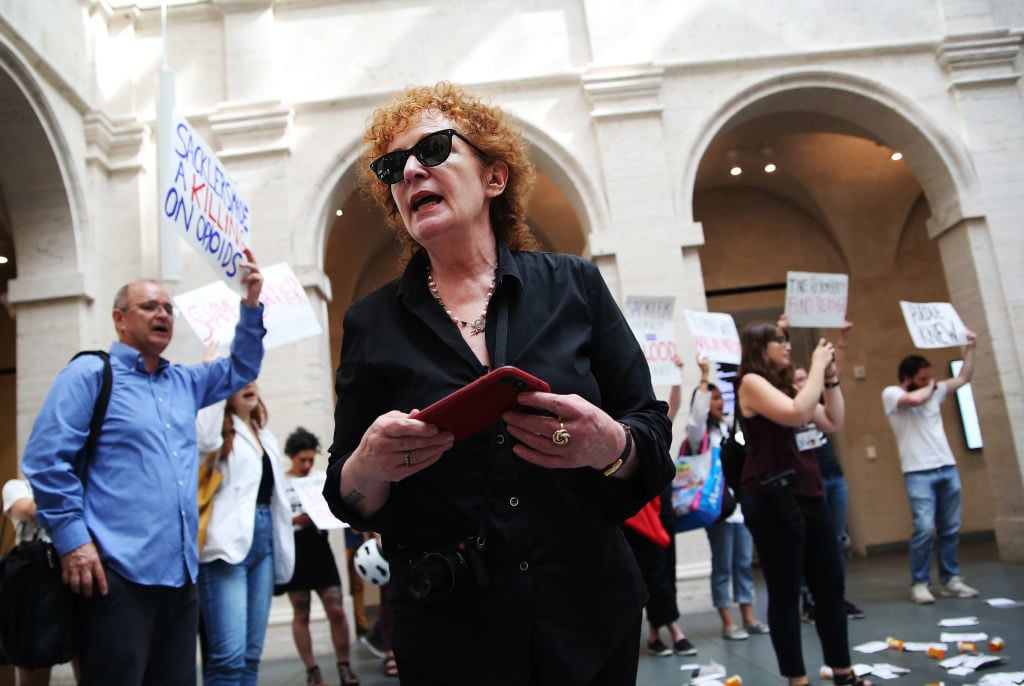
Nan Goldin leads a demonstration at the
Harvard Art Museums on July 20, 2018, to protest the benefactor of
the Sackler Art Museum. Photo by Erin Clark for The Boston Globe
via Getty Images.
The rise in artistic action and
activism centered on museum ethics and governance has marked the
last half of the decade. The protests against Big Pharma staged at
major museums around the world by Nan Goldin’s P.A.I.N.
(Prescription Addiction
Intervention Now) demonstrate the power of art and one individual
to make change.
—Olga Viso, independent curator
Zhang Enli
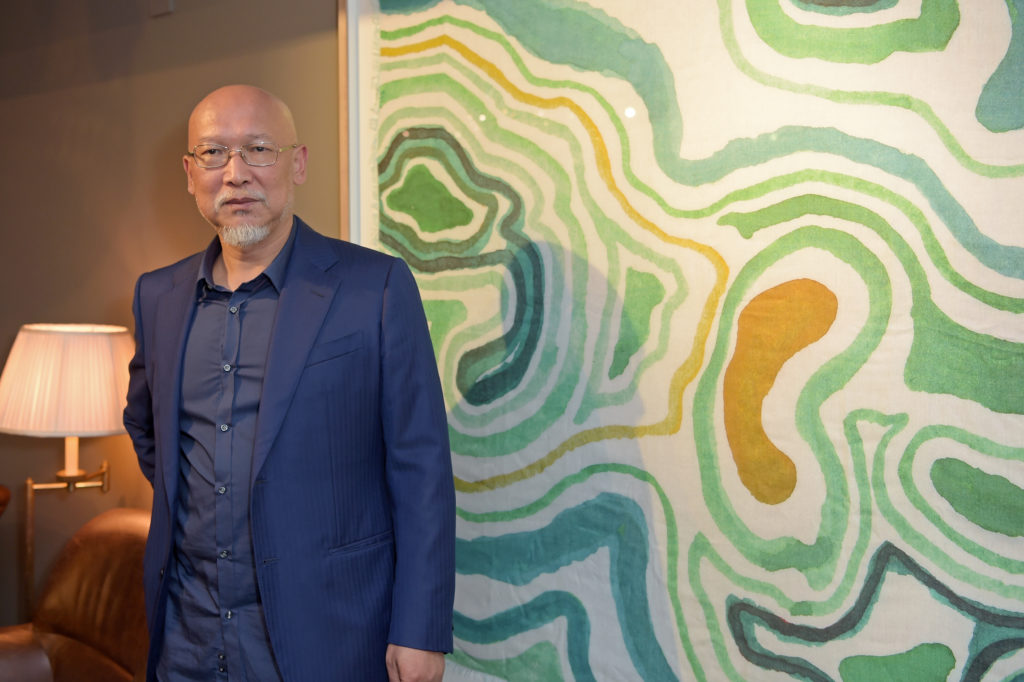
Zhang Enli in London, 2019. Photo by
David M. Benett/Dave Benett/Getty Images for Fortnum & Mason.
To say Zhang Enli is a leading
Chinese contemporary artist is an understatement. His work in the
past decade is the lens through which the world sees China’s
meteoric social and economic advancement, and how that has changed
people’s lives.
—Adrian Cheng, founder of the K11 Art Foundation and
K11
Yayoi Kusama
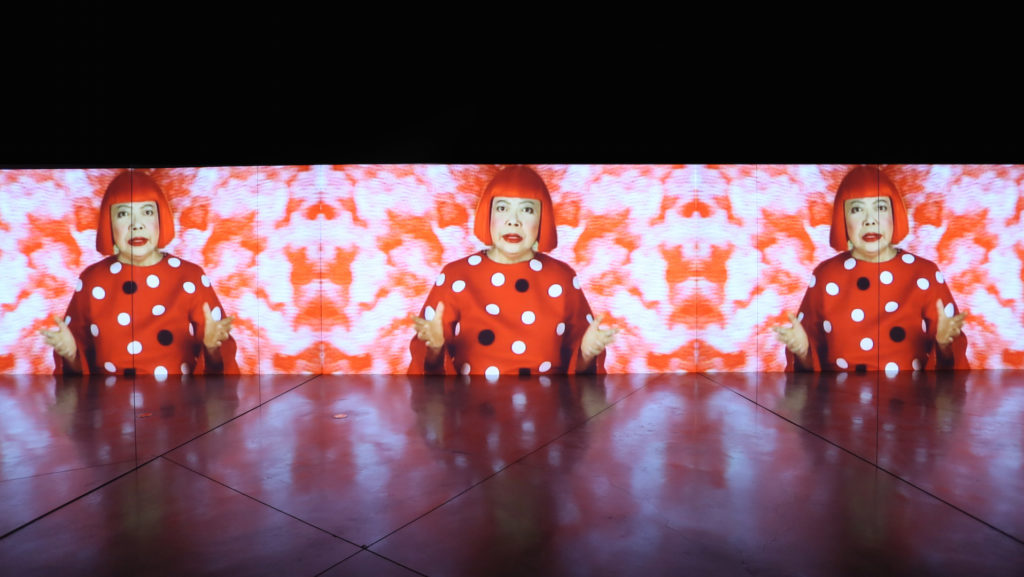
Installation view of “YAYOI KUSAMA: Life
is the Heart of the Rainbow” at the National Gallery Singapore.
Courtesy of the Museum.
There are few artists in their
nineties who can speak to a new generation about the importance of
art and life!
—Melissa Chiu, director of the Hirshhorn Museum & Sculpture
Garden
Oscar Murillo
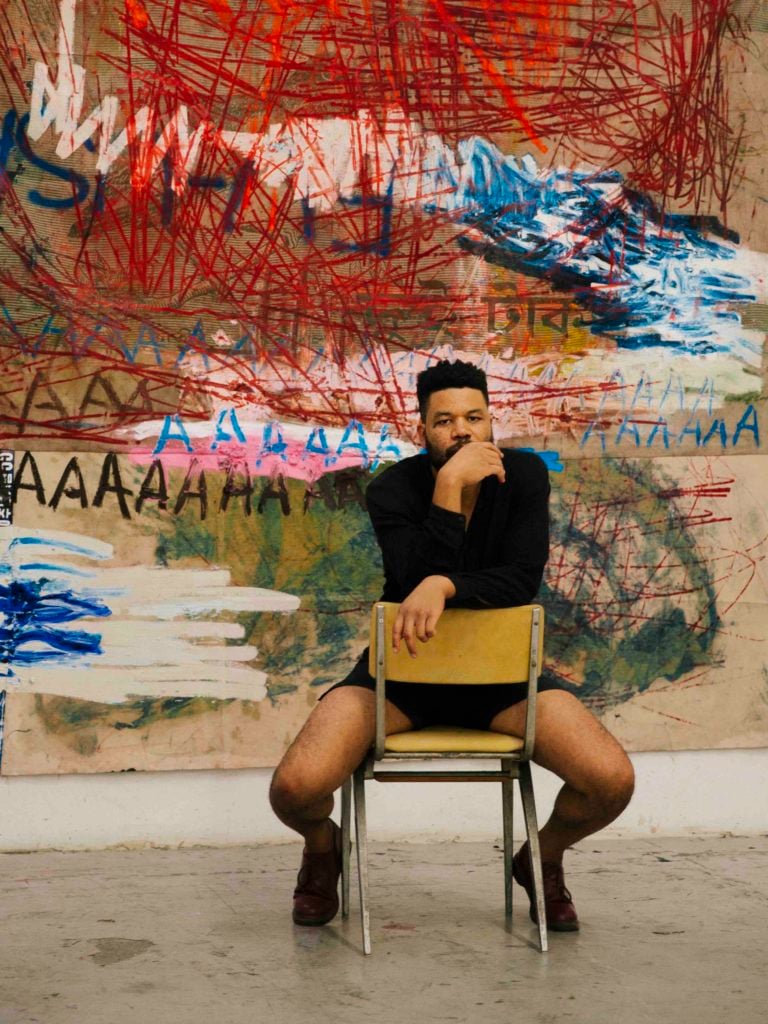
Oscar Murillo, 2018. Photograph by Greg
Lin Jiajie. © Oscar Murillo. Courtesy the artist and David
Zwirner.
Oscar Murillo is an inspiring
and inspired artist that continues to thrill me with every new body
of work.
—Javier Peres, founder of Peres Projects
Kehinde Wiley
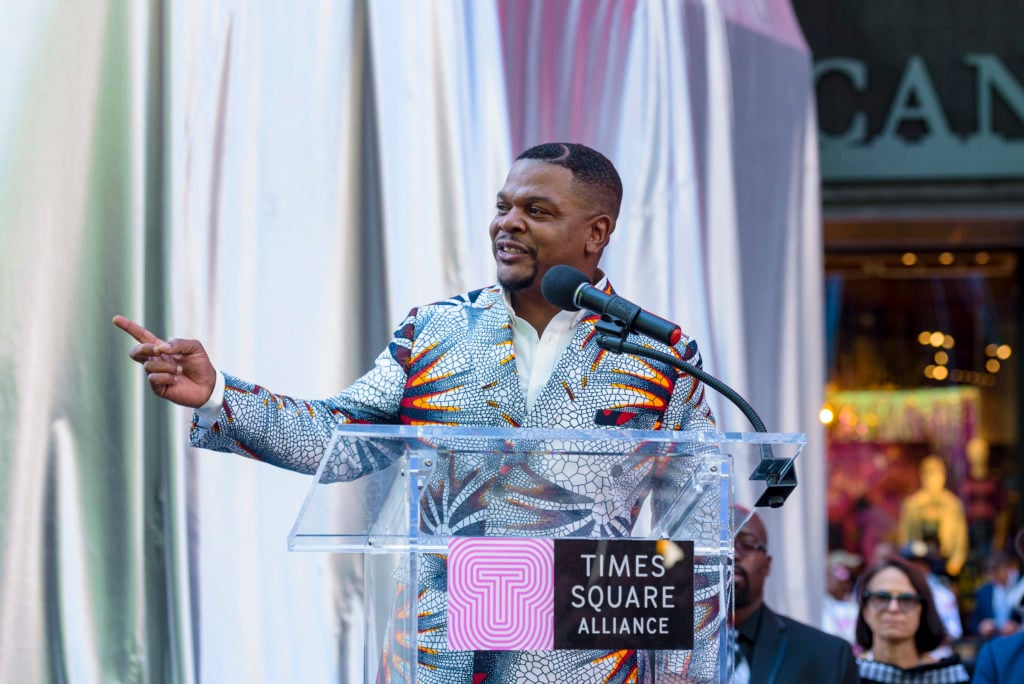
Kehinde Wiley at the opening ceremony
for Rumors of War (2019). Photo: Ian Douglas for Times
Square Arts.
From this year’s
Rumors of War
to his portrait of President Barack
Obama and Kehinde Wiley’s inclusion in the ground-breaking touring
exhibition “30
Americans,” Wiley’s artwork
has touched nearly every critical aspect of American society over
the past decade: politics, history, social justice, inclusion, and
more.
—Salvator Salort-Pons, director of the Detroit
Institute of Arts
Carmen
Herrera
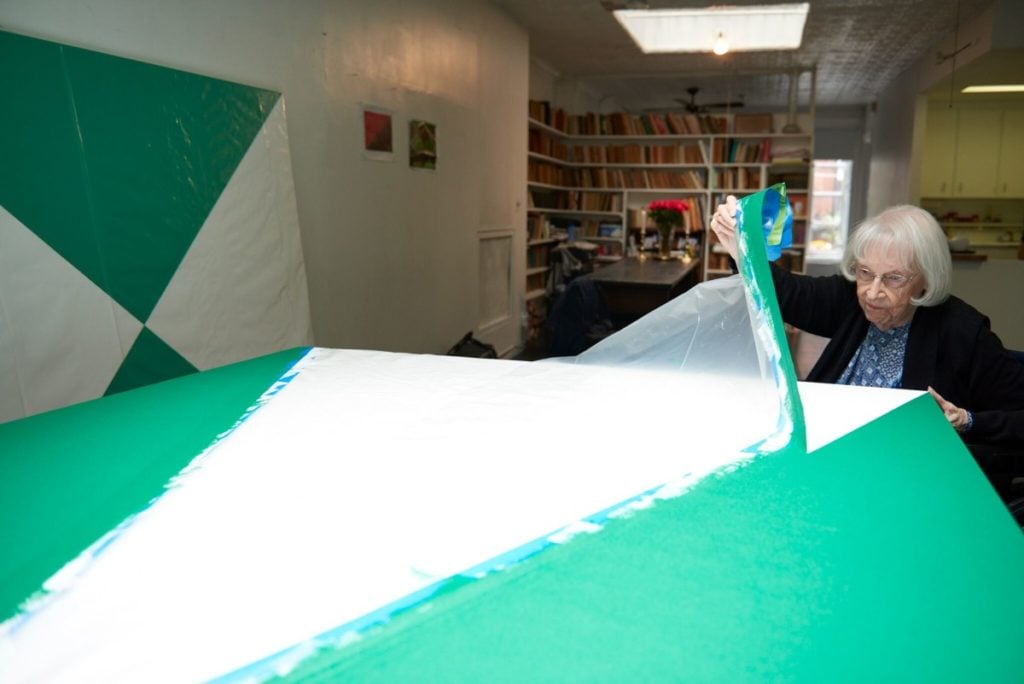
Carmen Herrera in her New York studio.
Photo: Jason Schmidt © Lisson Gallery
Although she’s been working for
almost seven decades, she was only “discovered” quite recently. Her
story— as a Cuban-born woman abstract artist working in a male,
Euro-US-dominated art world even still at age 104—has opened the
floodgates of galleries and museums reexamining the work of let’s
say “non-young” artists, many of whom have been under-recognized
for decades.
—Estrellita Brodsky, collector and art historian
Mark Bradford
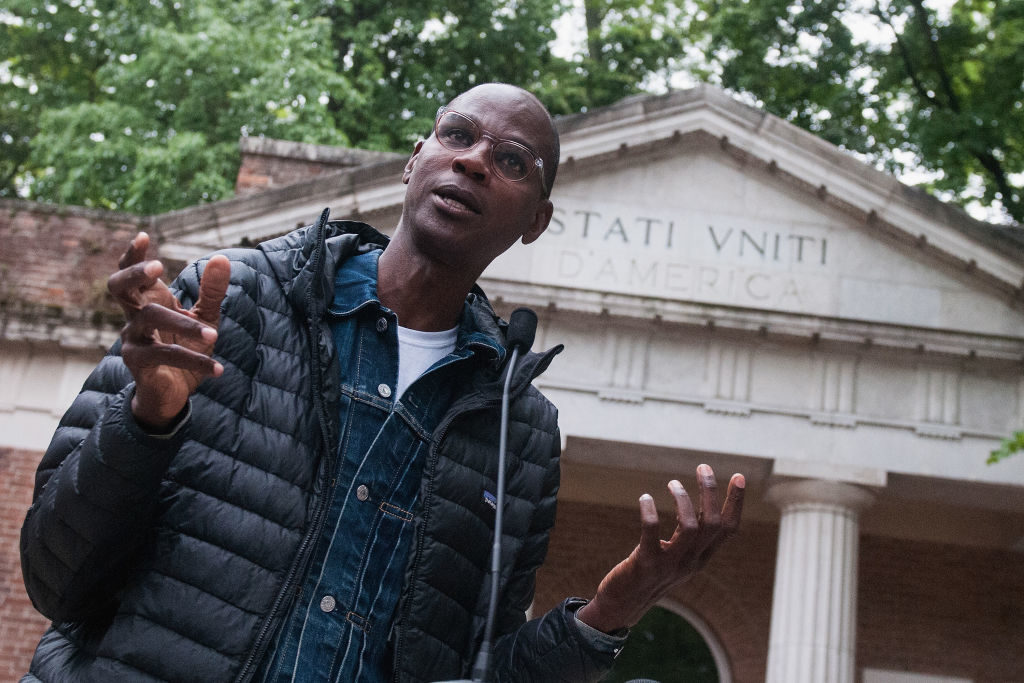
Mark Bradford speaks in front of
“Tomorrow Is Another Day,” his project for the U.S. Pavilion at the
2017 Venice Biennale. Photo by Awakening/Getty Images.
There is a broad recognition
that Mark Bradford has redefined and expanded the terms of abstract
painting, opening that rarefied world to the themes and concerns of
mainstream culture, and making those concerns co-equal on his
complex surfaces. His social abstraction, rendered entirely
in paper, directs us back to Norman Lewis and Alma Thomas, and
forward to Kevin Beasley and Firelei Báez, all of whom refuse (and
refused) the division between the socio-political and the draw of
pure formal invention to conjure riveting worlds that exist right
on that threshold.
While his work on canvas is an
ongoing analysis of our present, Bradford’s work as co-founder and
visionary force behind the LA-based not-for-profit Art + Practice
sees the artist investing in social change itself by supporting the
needs of the foster youth community in his native Los Angeles.
Bradford’s daily dual focus on studio work and on need-based
philanthropy has redefined what it means to be an artist in the
21st century.
—Christopher Bradford, director of the Baltimore Museum of
Art
Ai Weiwei
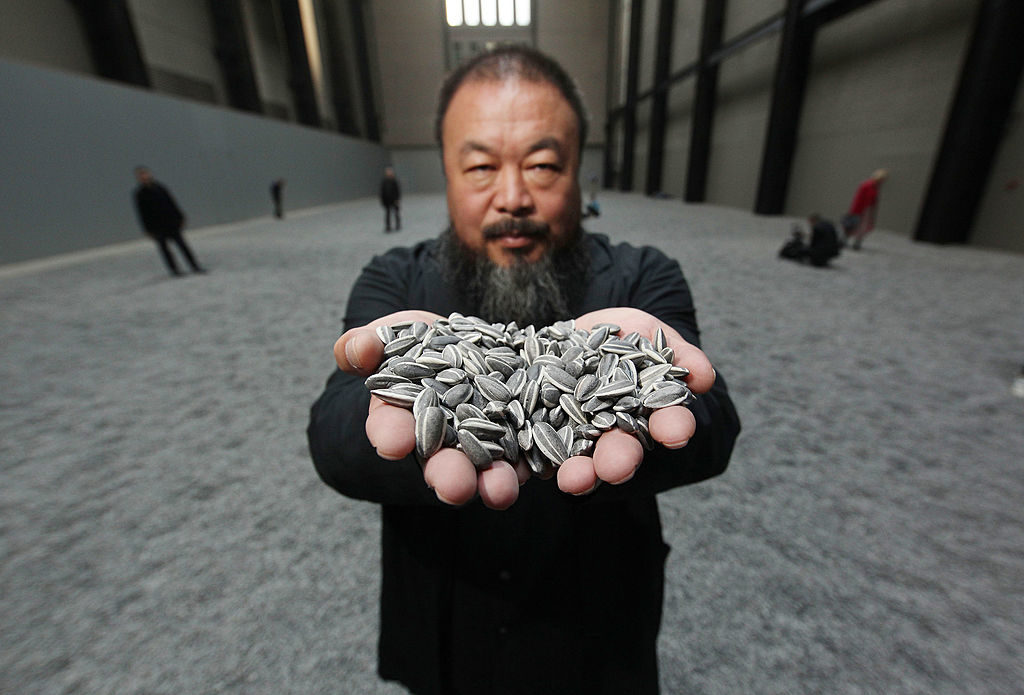
Chinese Artist Ai Weiwei holds some
seeds from his installation Sunflower Seeds at The Tate
Modern in 2010. Photo by Peter Macdiarmid/Getty Images.
Gosh, influential can mean so
many different things. In terms of global reach, Ai Weiwei has
transformed how social media is used by artists, harnessing
platforms like Instagram for both his artwork and perhaps more
importantly, for his activism in China and abroad.
—Alexis Lowry, curator at Dia Art Foundation
In the last years, Chinese artist and dissident Ai Weiwei has
been one of the most bald and influential voice inside and outside
the artworld. He was one of the first using the web and social
media as an artistic/political tool and his art, bridging and
challenging western and Chinese culture, became internationally
acclaimed when China was growing as the main playground of the art
system.
—Arturo Galansino, director of Palazzo Strozzi in
Florence
James
Turrell
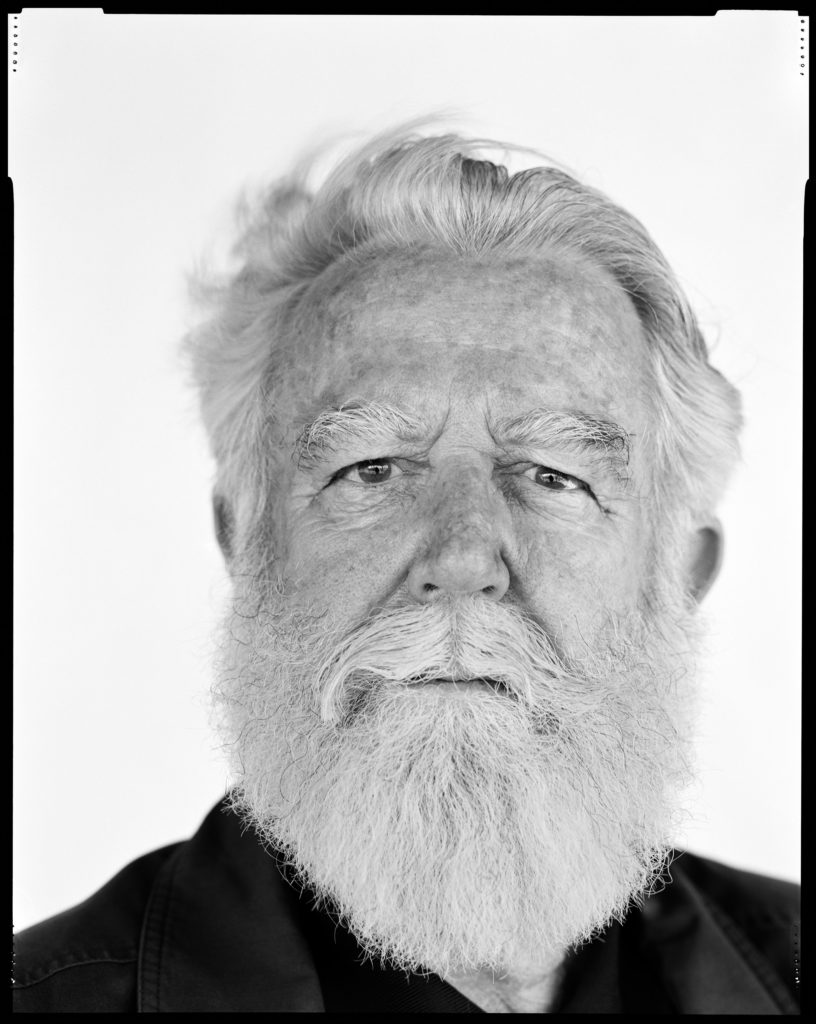
Portrait of James Turrell. Photo by
Grant Delin.
Calder, of course! But if I must
choose a living artist, I would say James Turrell. His work,
including his decades-long Roden Crater project located in the
middle of nowhere, has inspired people far outside the bounds of
the art world. His genius lies in creating, through his
installations, a real-time experience unique to each viewer—and to
every moment.
—Alexander S.C. Rower, president of the Calder
Foundation
Titus Kaphar
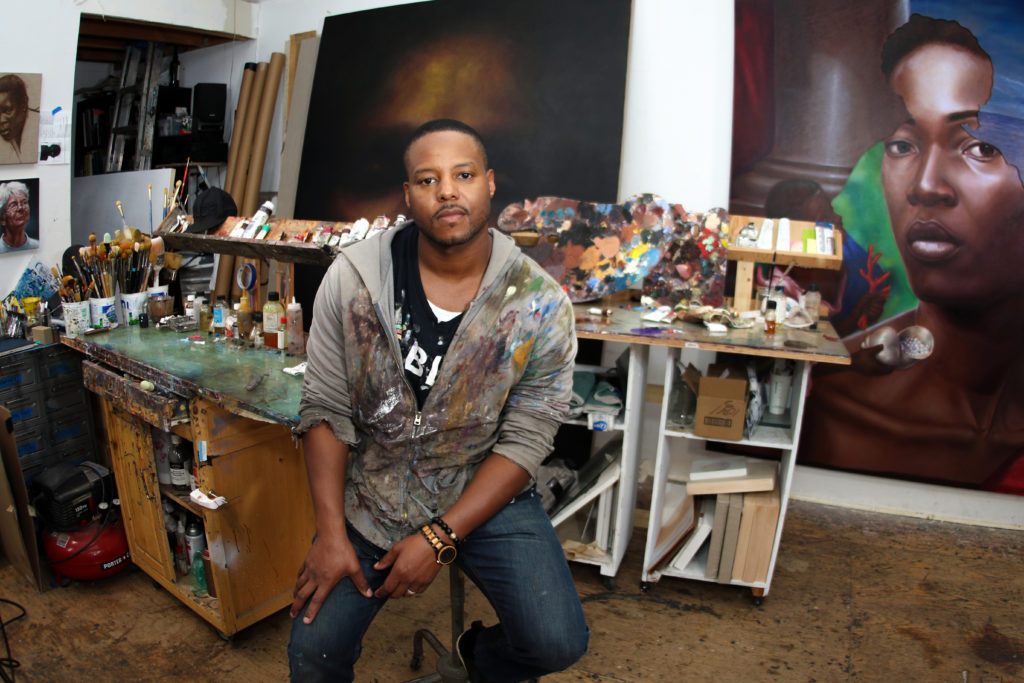
Titus Kaphar, a painter and sculptor at
his studio in New haven, CT. Courtesy of John D. and Catherine T.
MacArthur Foundation.
Titus Kaphar. Between the
development of his work in painting and to sculpture and installation; the MacArthur Genius Award;
the development of NXTHVN, Kaphar’s success has had a ripple effect on
the next generation of public artists and
curators.
—Bridget Cooks,
professor of African American
studies and art history, University of California,
Irvine
Duchamp was right:
The artist may shout from all the
rooftops that he is a genius but posterity will have a word to say.
We simply don’t know who is significant yet.
—Daniel Birnbaum, artistic director of Acute
Art
The post Who Was the Most Influential Artist of the Decade?
We Surveyed Dozens of Art-World Experts to Find Out appeared
first on artnet News.
Read more https://news.artnet.com/art-world/most-influential-artist-of-the-decade-1728387
Further reading


Leave a comment