
The Gray Market: What the Craze for Holograms of Dead Pop Stars Could Mean for the Market for Performance Art (and Other Insights)
Every Monday morning, artnet
News brings you The Gray Market. The column decodes important stories from the
previous week—and offers unparalleled insight into the inner
workings of the art industry in the process.
This week, extending the art
business into the afterlife…
PHANTOM THREAD
On Tuesday, the New York Times
Magazine published
Mark Binelli’s deep dive into the weird,
wild world of dead
music stars “touring” as holograms. And if this same technological
(and entrepreneurial) innovation doesn’t cross over into the art
market in the coming years, I’ll be so stunned that my own heart
just might give out.
For the uninitiated, this
surreal new chapter in pop stardom essentially began at the 2012
edition of Coachella, the annual pop-culture-shaping music festival
in California’s Indio Valley, when visual-effects studio Digital
Domain created a three-dimensional hologram of slain rapper Tupac
Shakur that “performed” a pair of of his songs onstage with Snoop
Dogg (whose metamorphosis from west-coast-rap
firebrand and
murder-trial
defendant into
middle-aged
lifestyle guru and Martha Stewart
bestie is more
mind-blowing than any VFX I’ve ever seen).
Although Digital Domain went
bankrupt shortly after the festival, Pac’s digital ghost—along with
the good old-fashioned power of the dollar—dynamited the gates to
the musical hereafter. A slew of new venture-backed businesses rose
up to begin crafting holograms and striking pacts with artist’s
estates for the rights to represent late stars onstage, in both
senses of the word “represent.”
In the years since, the list of
dead pop icons who have re-materialized for adoring fans includes
Michael Jackson (at the 2014 Billboard Music
Awards), Buddy
Holly, Roy
Orbison, Frank
Zappa, Ronnie James
Dio (who replaced Ozzy
Osbourne as Black Sabbath’s frontman and enabled one very metal
auction), and
even legendary opera singer
Maria Callas. And if you
think this phantom express is slowing down anytime soon, I would
advise you to get the hell off the tracks; a hologram of
Whitney Houston will set
out on an international tour starting in February.
Although this situation sounds
absurd, the most stunning aspect may be that, based on the early
returns, it appears to be absurd in the same way that selling milk
from an almond once was. Here’s Binelli:
Deborah Speer, a features
editor at Pollstar, which covers the live-entertainment industry,
told me that based on the numbers she has seen for the Orbison and
Zappa tours, “obviously, there’s a market” for hologram shows.
According to the trade publication, the solo Orbison tour grossed
nearly $1.7 million over 16 shows, selling 71 percent of the seats
available, while Zappa sold an average of 973 seats per show,
nearly selling out venues in Amsterdam and
London.
It turns out that if you’re a
famous performer, you don’t need to be drawing breath to draw a
paying audience. And that apparent fact is emerging at an
especially opportune moment in contemporary art.
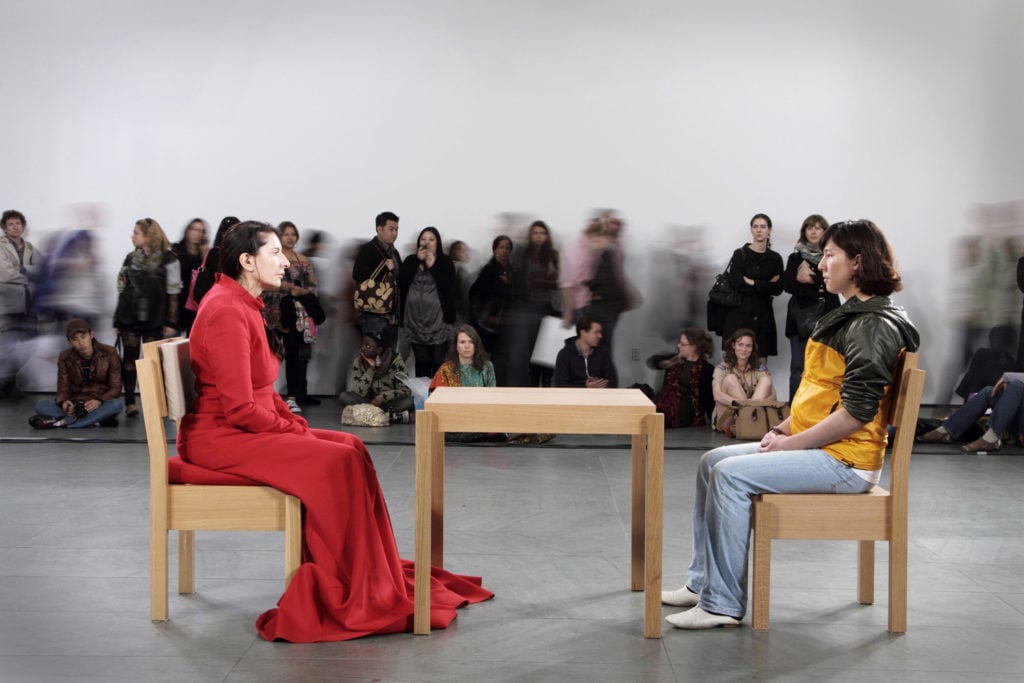
Marina Abramović, The Artist is
Present (2010). Courtesy of the artist and Sean Kelly
Gallery,.
ALL THE (ART) WORLD’S A STAGE
Now, plenty of painters,
sculptors, and other makers of discrete objects continue selling
briskly even after they’ve
died; their
corporeal absence creates little to no drag on business (sometimes,
it boosts it). But historically, we haven’t been able to say the
same for performance artists. And this is especially important
given the strong gravitation
toward live art by
artists, industry insiders, and even the general public over the
past decade.
As my colleague Ben
Davis argues, the
inflection point was Marina Abramović’s “The Artist Is Present,”
the zeitgeist-puncturing 2010 retrospective at the Museum of Modern
Art. The show certainly didn’t elevate performance art beyond
parody—see Fred Armisen’s mockumentary TV series Documentary
Now! or Ruben
Östlund’s festival-conquering film The
Square—but it did
propel the genre to a level of familiarity that made it a
justifiable, sometimes loving, touchstone for an audience outside
the traditional art world. For every satire, there also seemed to
be at least one earnest celebrity homage that lodged performance
art deeper in the popular consciousness. Fans include hip hop
mogul Jay-Z, actor/director/artist Shia
Labeouf, runway-rap
pioneer A$AP
Rocky, John Cheever’s
favorite indie-rock band, the
National… the list goes
on.
Enthusiasm for artists or trends
within the art world hasn’t always tracked with enthusiasm outside
it. The tired specter of the “sell-out” keeps haunting us. However,
the recent trajectory of performance art has avoided this
turbulence.
Judges at the last two Venice
Biennales awarded top prizes to performance works: Anne Imhof’s
Faust won the
Golden Lion in 2017, and the Lithuanian Pavilion’s climate-change
opera Sun & Sea took home the trophy for best national
presentation in 2019. Mega-gallery Pace is making a
high-stakes live-performance
program a central pillar
of its mainstream-targeting future strategy. And although
MoMA eventually
scrapped the
performance-focused “Art
Bay” once set to be the
nucleus of its latest renovation, New York’s newest (and most
controversial) cultural space, the
Shed, largely exists to
champion the genre.
All of the above (and much more)
reinforces that performance has become a major force in
contemporary art’s evolution, and will continue to shape its
future. Which leads us back to those hologram tours.
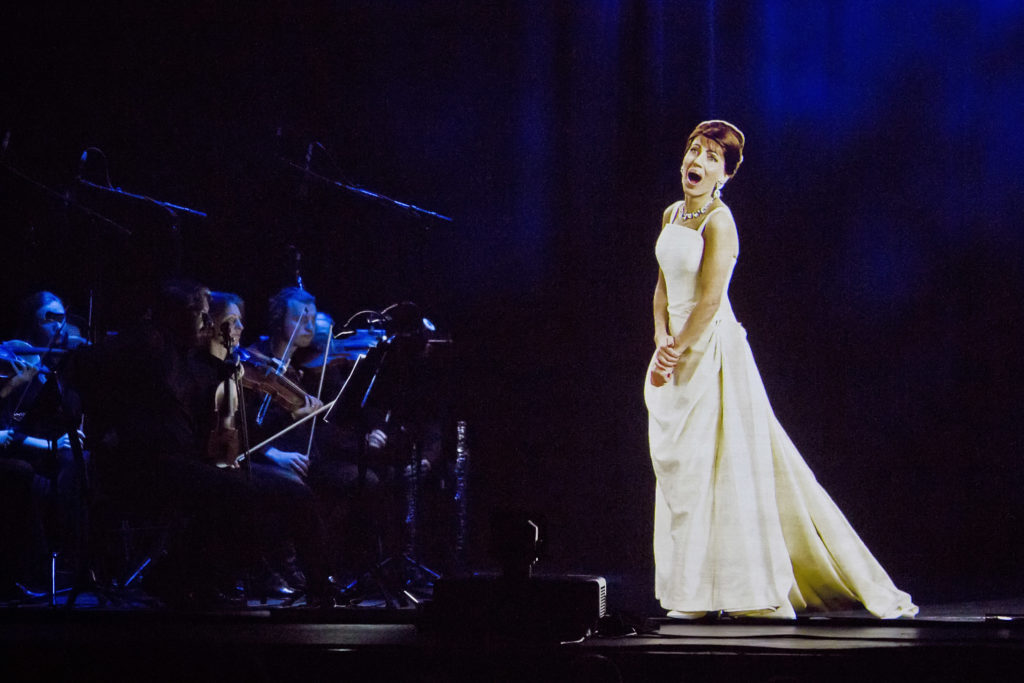
A hologram of dead opera star Maria
Callas “singing” onstage during a concert at Berlin’s
Admiralspalast in 2019. (Photo by Frank Hoensch/Redferns)
BREAK ON THROUGH TO THE OTHER SIDE
Pop-star holograms are exploding
out of a chemical reaction between three elements that have been
influencing human decision-making for thousands of years: supply,
demand, and survival instinct. Binelli points out in
the Times that, per Pollstar, “roughly half of the 20 top-grossing North
American touring acts of 2019 were led by artists who were at least
60 years old,” including the top three: the Rolling Stones, Elton
John, and Bob Seger. His conversation with a member of one major
hologram-production company suggests this technology could
transform those data points from evidence of an imminent
music-industry crisis into evidence of an enduring business
opportunity:
“If you’re an estate in the
age of streaming and algorithms, you’re thinking: Where is our
revenue coming from?” Brian Baumley, who handles publicity for
Eyellusion, told me. Some of those estates, Baumley bets, will
arrive at a reasonable conclusion about the dead artists whose
legacies they hope to extend: “We have to put them back on the
road.”
The art industry has just as
much of a stake in extending the legacies—and profit windows—of
major talents approaching (or past) the ends of their productive
lives. By this point in time, the interplay between aesthetic
evangelism and financial opportunism has been incentivizing choices
within artists’ studios and estates for over a century, with each
project finding its ethical level based on weighing those two
factors.
Consider that every single
plaster, bronze, or marble cast by Auguste Rodin
was actually fabricated by another
skilled artisan using only Rodin’s small clay models. Or that the
Dia Art Foundation and the artist’s estate (with funding from
Gagosian) completed Walter De
Maria’s installation Truck Trilogy four years after his
death. Or that
the estates of Roy
Lichtenstein and Constantin Brancusi both produced new editions of important
sculptures decades past the dates their respective creators beamed
up to that big studio in the sky.
Assuming performance art’s
popularity surge continues, then, why wouldn’t a major gallery
and/or institution be tempted to restage, say, the centerpiece of
Abramović’s “The Artist Is Present” via hologram for a paying
audience? Abramović herself might—might—be appalled by the idea as she lives and
breathes now, but anything can happen when opportunities present
themselves to estate executors. After all, visitors to the Dalí
Museum in St. Petersburg, Florida can already interact with a ghost
of its namesake digitally
resurrected on flat screens throughout the
institution.
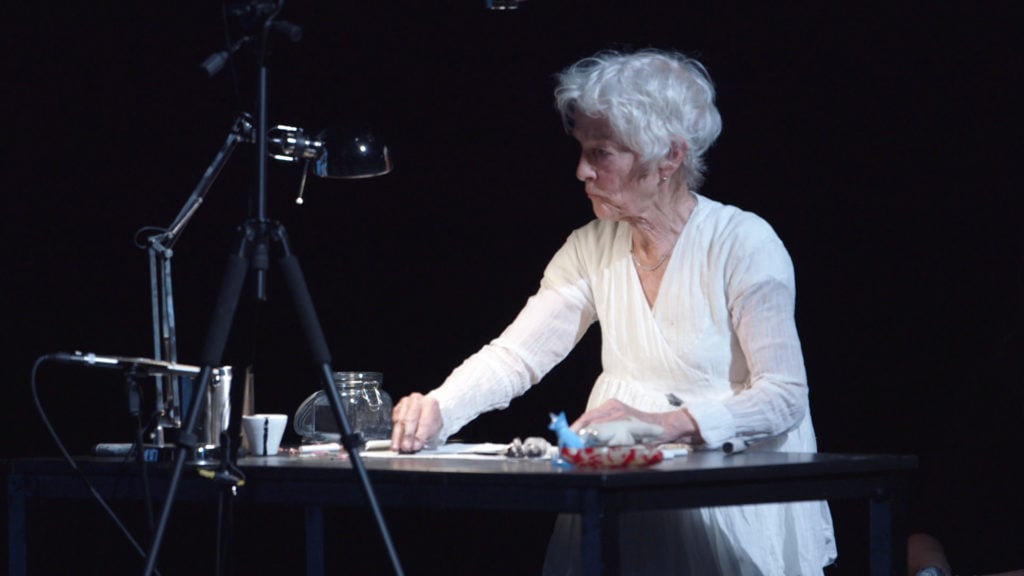
Joan Jonas performing
Reanimation, still from Art21 “Fiction” (2014). Courtesy of
Art21.
The potential here isn’t limited
to postmortem programming, either. Holograms could also be
used during performance
artists’ lifetimes to
stage their pieces farther, wider, and more frequently than if they
had to physically make the trips themselves.
Precedents already exist for
this. Binelli mentions in his piece that Chicago drill-rap
standard-bearer Chief Keef performed by
hologram at an out-of-state music festival to avoid arrest while he had active warrants
looming over him in 2015, and Indian prime minister Narendra Modi
has campaigned by
hologram in multiple
locations at once for years.
Obviously, these possibilities
are only possibilities right now. But they are made more likely by
the music industry’s rush to embrace—and monetize—hologram
technology to overcome its biggest stars’ deaths. Continued public
demand for performance works will only increase the pressure on the
art industry to follow suit in the future. And if the genre’s most
physically punishing works have taught us nothing else, it’s that
we should never underestimate humanity’s ability to transcend the
seemingly impossible.
That’s all for this week. ‘Til
next time, remember: whether the result is a hologram, a painting,
or a kid, anyone who creates anything is on some level trying to
beat the reaper.
The post The Gray Market: What the Craze for Holograms of
Dead Pop Stars Could Mean for the Market for Performance Art (and
Other Insights) appeared first on artnet News.
Read more https://news.artnet.com/opinion/pop-star-holograms-performance-art-1750800
Further reading


Leave a comment