
‘They See What We Would Never Be Able to See’: Bay Area Collector Wayee Chu on What Venture Capitalists and Art Collectors Have in Common
With art dealers still trying to find a way to sustainably court
wealthy Silicon Valley entrepreneurs, the latest editions of San
Francisco’s major art fairs, FOG Design + Art, now in its seventh
year, and Untitled, now in its fourth year, are set to open and run
through the weekend.
Both fairs boast top-notch dealers showing blue-chip art and
appear to be gaining more traction with each passing year. One
collector said last year’s editions felt like a full-blown art week,
noting the plethora of gallery and private foundation shows and
events held alongside the fairs.
Indeed, the fairs are expanding their reach. Last week, as
part of a partnership between Untitled and the Battery arts club in
San Francisco, Wayee Chu, a collector and SFMOMA board member who
is a general partner at Reach Capital, a venture fund focused on
early-stage education technology start-ups, spoke on a panel about
how private collections are built.
Along with her husband Ethan
Beard, she collects works by artists such as LaToya Ruby Frazier,
Arthur Jafa, Deanna Lawson, Derrick Adams, Matthew Wong, and Vija
Celmins, among ohers. Recent additions to their collection include
examples by Jaune Quick-to-see Smith, Sheila Hicks, and Eamon
Ore-Giron. But don’t ask Chu to pick favorites: “Artworks are like
your children,” she says. “I can’t pick a
favorite.”
On the eve of the San Francisco fair openings, we spoke
with Chu about what she looks for in emerging artists, what
her board membership at SFMOMA has taught her, and how investing
can inform collecting.
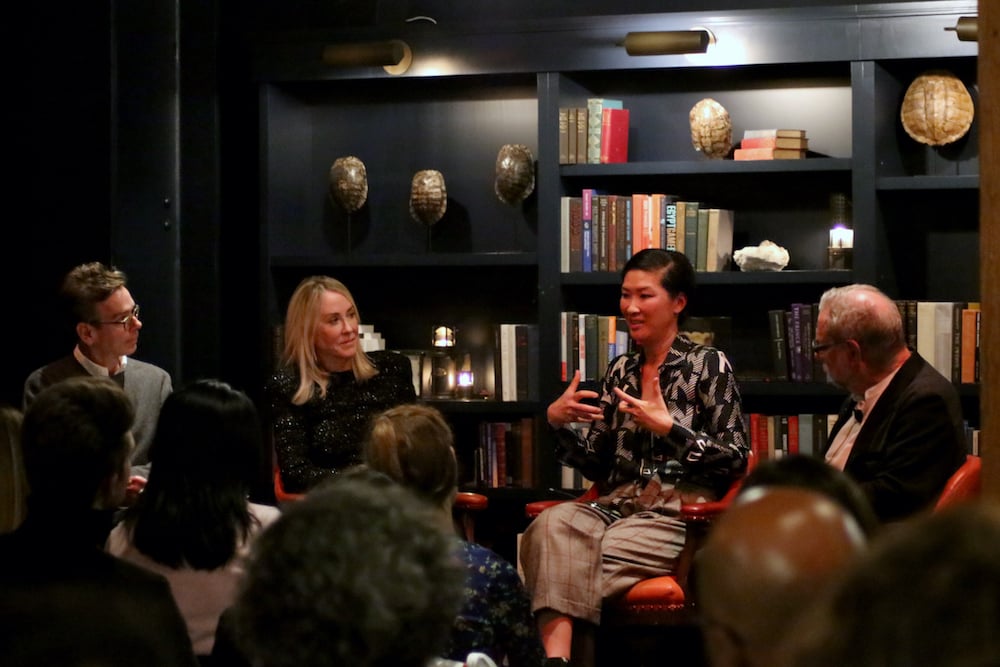
Wayee Chu, second from left, on a panel
hosted by Untitled and the Battery arts club.
How did you first become interested in art?
My parents both emigrated from China through Brazil and Macau.
My mother studied art as an undergrad, but like most practical
Asian parents, she took an office job and pursued her passion for
art in other ways. Growing up in Connecticut, near New York City,
we had access to so many wonderful art institutions, so that was an
integral part of my upbringing. My mother always pushed me to be
patient and present with art, and that planted a seed. But
it wasn’t until I was in my
20s, when I moved to New York and was working in finance, that I
tried finding other outlets to pursue. Around the same time I met
my husband, whose sister started the Wooster Street Collective, in
2003, and their narrative really resonated with us. We started
attending salons with [street artists] Shepard Fairey, Faile, JR,
and the London Police.
Tell us about a major acquisition you made.
One that really pushed our thinking was Rirkrit Tiravanija’s
work on newspaper print, The Tyranny of Common Sense Has
Reached Its Final Stage, which came out around the Trump
election. We were drawn to his art because when you learn about his
practice, you realize it’s never linear or binary, and it’s really
about bringing people together. It’s never an isolating experience,
even if you’re alone with it. That piece has anchored some of our thinking about how we want
to collect.
How do you think your venture-capital skills translate
into collecting?
Broadly speaking, whether you are in venture capital or in the
early-stage startup ecosystem, in my mind, there are similarities:
how I’m attracted to founders is also how I look for emerging
artists. It’s about pushing boundaries. These founders and artists
see what we would never be able to see because it’s their calling.
The Bay Area is always about innovation. But we have a very
rigorous due-diligence process, whether it’s [looking at] a startup
or an artist. I see those parallels and I’ve lived those
parallels.
Do you feel like you’re part of a collecting community
in the Bay Area?
I do have a small group, members
of my generation. But everyone’s angle is so deeply personal. There
is a group that collects around what SFMOMA and [museum patrons
Doris and Donald Fisher] collected, and for good reason. They kind
of led the charge, and during a period of time, put certain artists
on the map. But I have not found deep patterns or parallels. I feel
like we’re either backing individual artists, or having a more
thematic focus on emerging art and counter-narratives. Others are
driven purely by aesthetics, which is important when you’re living
with art. The art world is trying to figure out who the Bay Area
buyers are, and I don’t know, and I love that I don’t know. They
come out of the woodwork. Their decision-making may not always
follow traditional rule books.
How has being on the SFMOMA board shaped your outlook as
a collector?
I want to be informed, I want to learn, and I want to be
inspired. I learn a ton by being on the SFMOMA board with these
pivotal collectors. It gives you confidence to find your own
identity. No big institution is perfect, but the effort and
openness in wanting to change is authentic and honest. I think
there is a need for criticism around institutions today, but some
of it can be super unproductive. So you have to balance and ask the
right questions while being productive and acknowledging all the
stakeholders and hard work and commitment they’ve made over the
decades in creating this institution.
The post ‘They See What We Would Never Be Able to See’: Bay
Area Collector Wayee Chu on What Venture Capitalists and Art
Collectors Have in Common appeared first on artnet
News.
Read more https://news.artnet.com/art-world/wayee-chu-interview-1753824
Further reading


Leave a comment