
‘There Is No Sense of Privacy Anymore’: After Kim Gordon’s Personal Life Went Public, She Decided to Tackle Surveillance in Her Art
Before she was Sonic Youth’s iconic bassist, sing-speaking
recondite poetry over squealing guitars, and before she published
her memoir, started a fashion line, and acted in films, Kim
Gordon was an art-school kid staging interventions in friends’
apartments. The goal, she wrote at the time, was to use “art to
deconstruct design.”
40 years later, the impulses behind those interventions still
inform Gordon’s art making. Following the rather public dissolution of her
band and marriage in 2011, Gordon moved to her hometown of Los
Angeles and refocused on her art practice,
which enacts some of
the same public-vs-private tension that’s ungirded her personal
life over the past decade.
“It’s kind of ironic that I
ended up as a public person who’s sort of uncomfortable with it
all,” Gordon tells Artnet News over the phone from her home in
California. She’s just returned from New York, where her show
“The
Bonfire” opened at 303
Gallery. She’s battling a rough head cold from the trip, but her
voice is unmistakably familiar.
Lining 303’s walls are blurry,
amber-tinted photographs of friends encircling a beachside bonfire.
The scene is jovial, but the context is not. Subjects are framed by
digitized rectangles—the type that pop up when facial recognition
software hones in on a known pixel pattern; others have crosshairs
trained on them, like the targets of a drone strike. It’s all a
reminder that even the most intimate of moments are threatened by
technocapitalism’s watching eye.
Meanwhile, a recent performance
piece, Los Angeles June 6, 2019, blares from a stack of
monitors in the center of the gallery. In it, Gordon uses LA’s
municipal architecture—handrails, benches, cornices—to play a
screeching guitar, reclaiming the space through a kind of
earsplitting ritual that’s part Vito Acconci, part Glenn
Branca.
about her new show, the evolution of her art practice over the
years, and her unease with being a private person in the public
eye.
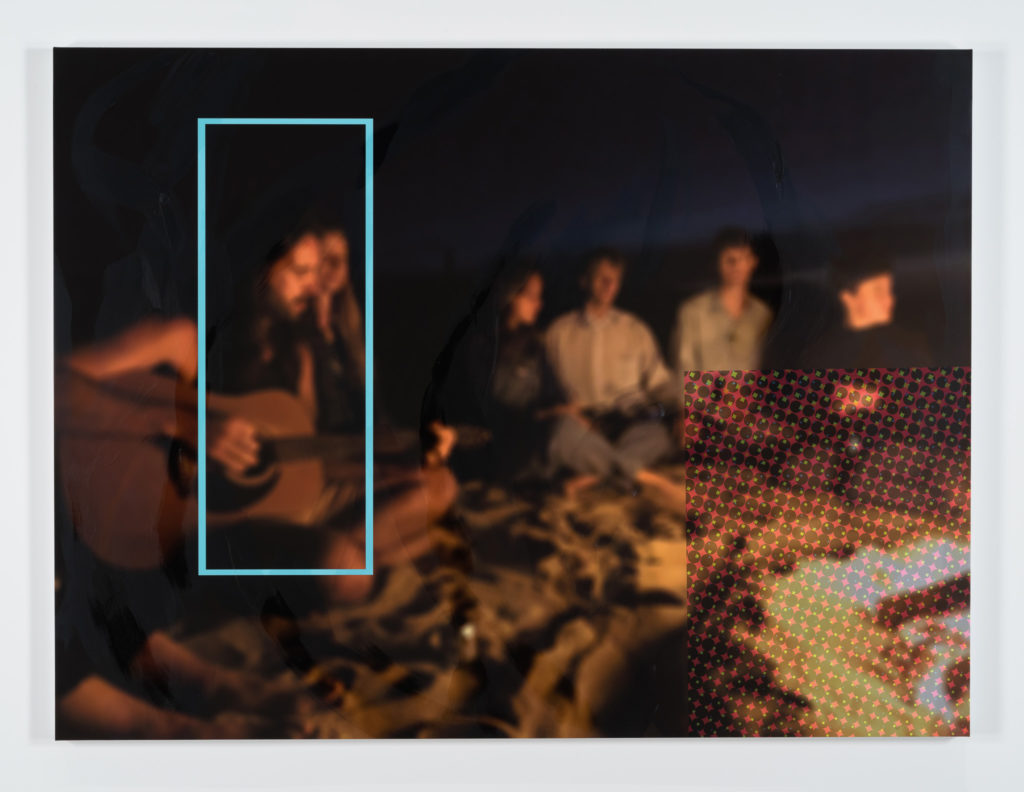
Kim Gordon, The Bonfire 7 (2019).
© Kim Gordon. Courtesy 303 Gallery, New York.
Let’s start with the bonfire images. What is it about this
scene that interested you?
It’s just an archetypal image.
Last summer I was in Provincetown and my friend organized a
bonfire. She had to get a license just to have it on the beach. I
took those pictures as it was happening and I just thought they
looked really cool. The lighting reminded me of Old Master
paintings.
I had been thinking a lot about
the branding of different experiences. For example, the way Airbnb
now rents out things like camping trips, selling you on the idea
that you’ll live like a cowboy. These are special private moments
that are being highlighted and sold. In actuality, there is no
sense of real privacy anymore. And people don’t care until it turns
into something bad.
Atop the canvas prints are swathes of acrylic medium. They’re
almost unnoticeable until the light hits them. What was the
intention of using the acrylic on those works?
I wanted them to be more than
just photographs. It’s almost like a shadow painting. Creating a
secret painting in public is interesting to
me. There are also
overlaid, Photoshopped digital surveillance lines. They tie in with
a video that Loretta
Fahrenholz did for one of my songs,
“Earthquake.”
She had these special effects
people use those graphics to hide people’s faces because we didn’t
have release forms. I liked the idea of tying it in with that. I’ve
always had my art and music so separate, but they’re starting to
merge together more.
Those Photoshop graphics kind of
create a hybrid design and an abstraction within a representational
picture. You see that a lot in design—everything is designed to tie
together. It’s all kind of like a modern-day landscape to
me.
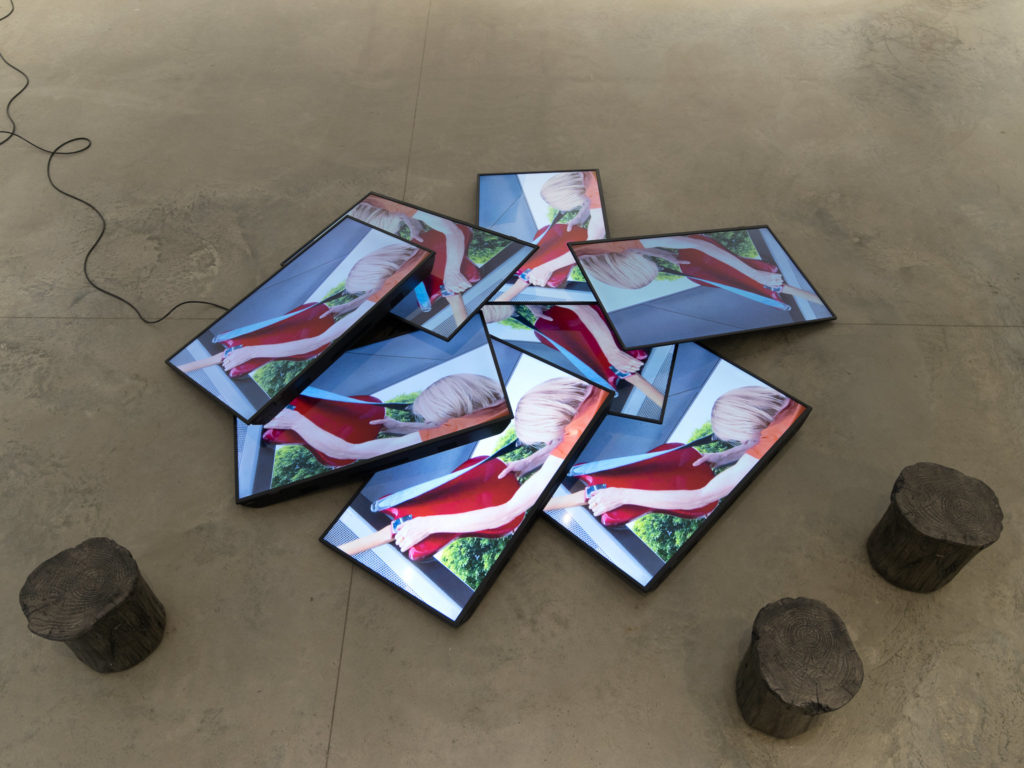
Kim Gordon, Los Angeles June 6,
2019 (2019). © Kim Gordon. Courtesy of 303 Gallery, New
York.
There’s a great dialogue between the video installation
and the bonfire prints. In the video, while you’re roving around
LA with your guitar, the viewer becomes hyper-aware of all the
security cameras in the background and the way that public and
municipal space is being controlled and privatized.
And the security guards were
everywhere. It was like I was a terrorist. Understandably, I
guess—when you do something like that… [Laughs]
I’m interested in the gardens
and the waterfalls and the way landscaping works in those corporate
plazas throughout the city. It’s something I’m particularly aware
of in LA—even more than New York—how those things disguise this
corporatization of city life.
You conceived this work, Los Angeles June 6,
2019, as a one-off performance. How does its current
form as a video installation change the piece for
you?
I actually made it for this show
that took place between Sète, France, and LA. It was an idea I’d had for a
long time. I always liked
the way skaters repurposed those corporate buildings, the stairways
and the railings. I wanted to do the same thing, reclaim the space
using those same railings as giant guitar slides.
I asked a documentary filmmaker
friend to shoot it and she did such a great job. She shot it with
three iPhones. It was originally shown in a storefront on Sunset
Boulevard, which was pretty cool because the sound of the traffic
going by added to the experience and we didn’t start showing it
until the sun was setting so the light was interesting and then it
got dark. I knew I wanted to include it in the New York show but I
didn’t want it to be this giant image of me on the wall, so I put
them on the floor. Then the director of exhibitions at the gallery
came up with the idea of arranging them like a bonfire and putting
some fake tree stumps nearby.
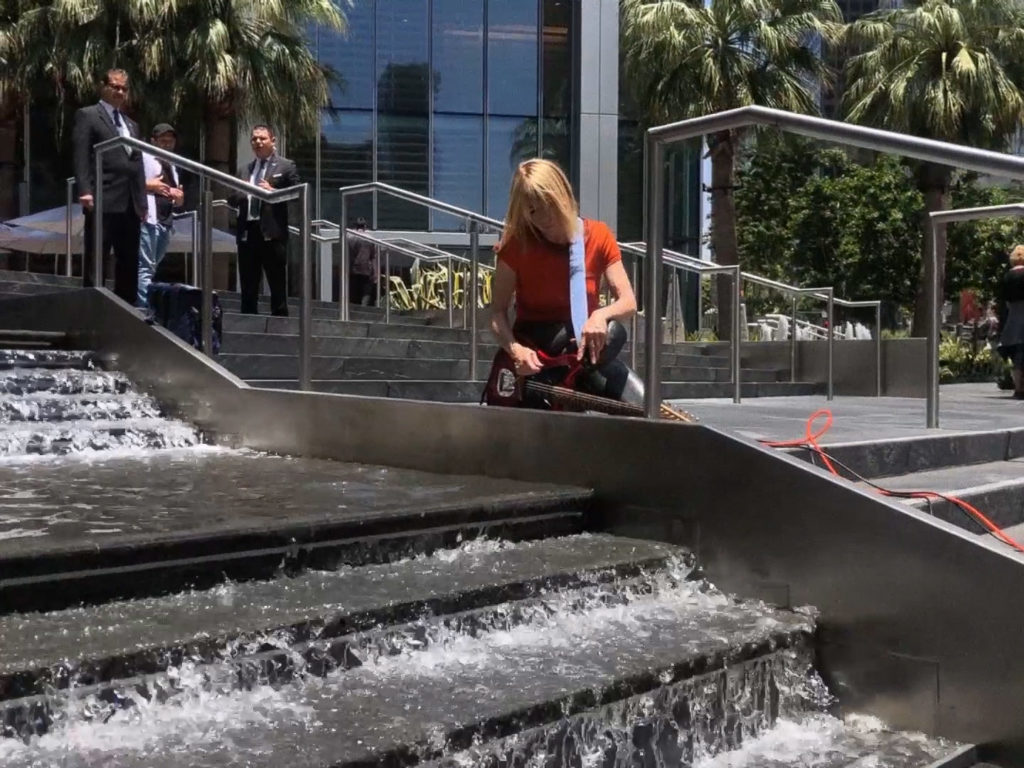
Kim Gordon, Los Angeles June 6,
2019 (2019), still. © Kim Gordon. Courtesy 303 Gallery, New
York.
Even though the piece isn’t explicitly about L.A., the
subtext is there—you’re engaging with the bones of the city itself.
You spent decades on the East Coast before moving back to LA in
2016. Since then, what influence has the city had on your
work?
I don’t know if LA has really
influenced my work. I kind of feel like I always carried a bit of
LA with me in New York. I don’t think it really changed in that
way. I always liked the architecture, the weird customized houses,
how you can have a tutor house next to a ranch. LA is a melting pot
anyway. People move here from all over and the architecture
reflects that. I also find it interesting how customizing one’s
house or car is kind of the ultimate freedom of expression for
people here. It’s always been my favorite city to look at. There’s
so much space and distance; it’s very voyeuristic. But I think LA
influenced my record more than my art.
Your history with art is longer than your history with music.
Do you feel more comfortable in the art world than you do the music
world?
Yeah, I do actually. Like a lot
of people, I just kind of fell into music as a way to escape the
art world. It was the spirit of post-punk do it yourself. I didn’t
have any training in music at all. But I did go to art school, and
I grew up wanting to be an artist since I was five, as cliche as
that sounds. That’s why I moved to New York.
I don’t really think about the
music world at all today. I’ve had to recently because I did the
solo record, but I still don’t interact that much with the music
scene in LA.
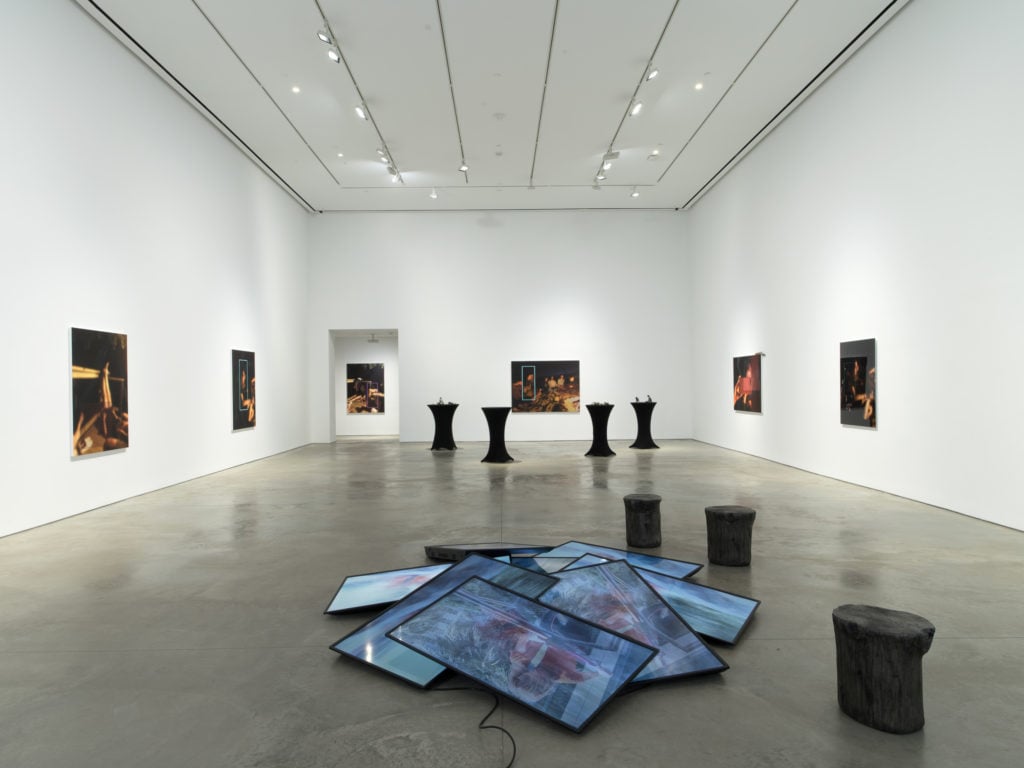
Installation view of “Kim Gordon: The
Bonfire,” 303 Gallery, New York. Photo: John Berens. Courtesy of
303 Gallery.
When doing research for this interview, I found that most of
the pieces of writing that were ostensibly about your art tended to
focus more on your fashion and your time in bands. Rarely did they
address your artwork critically. Do you find that people have a
hard time separating, say, Sonic Youth Kim Gordon from artist Kim
Gordon, or past Kim from present Kim?
Oh yeah, totally. It’s just
something I feel like I always have to overcome. I should probably
have more fun with it. [Laughs] I do feel like a lot of the pieces
have been like the kind of journalism you often get in the music
world, where it’s clear the writer just read the press release or
something. But I haven’t had a straightforward, conventional art
career. You have to really dig around to actually know what my work
is. It’s kind of a drag. I think it’s just something I have to work
out for myself. I don’t want to worry about what other people are
thinking.
Your work is also quite disparate. Your word and wreath
paintings, your sound and performance pieces, your abstract and
figurative sculptures—if these were all to share the same room,
unknowing visitors would conceivably be surprised to realize they
were done by one person. Do you feel the same way?
For me it all goes back to
design. When I did the survey show at White Columns in 2013, I
brought it all together under the title “Design Office With Kim
Gordon” and I was actually surprised at just how clearly you could
really see a thread running through the whole thing. It was a lot
of lo-fi design.
In the early ’80s, when I
started Design Office, the idea was to do interventions in people’s
apartments that were part psychological—I would take something
personal about them and turn it into an art object, then physically
alter the space in some way and write about it all in a magazine. I
did a few of those. And if you look at the materials in the rest of
my work since, the logic behind it, you can see those roots in some
way. I’m still interested in interiors and I’ve always been
influenced by how art and design interacts. It’s all somewhat
performative.
Maybe I’m more of a sociologist.
Think of me as a sociologist and it all makes more sense.
[Laughs]
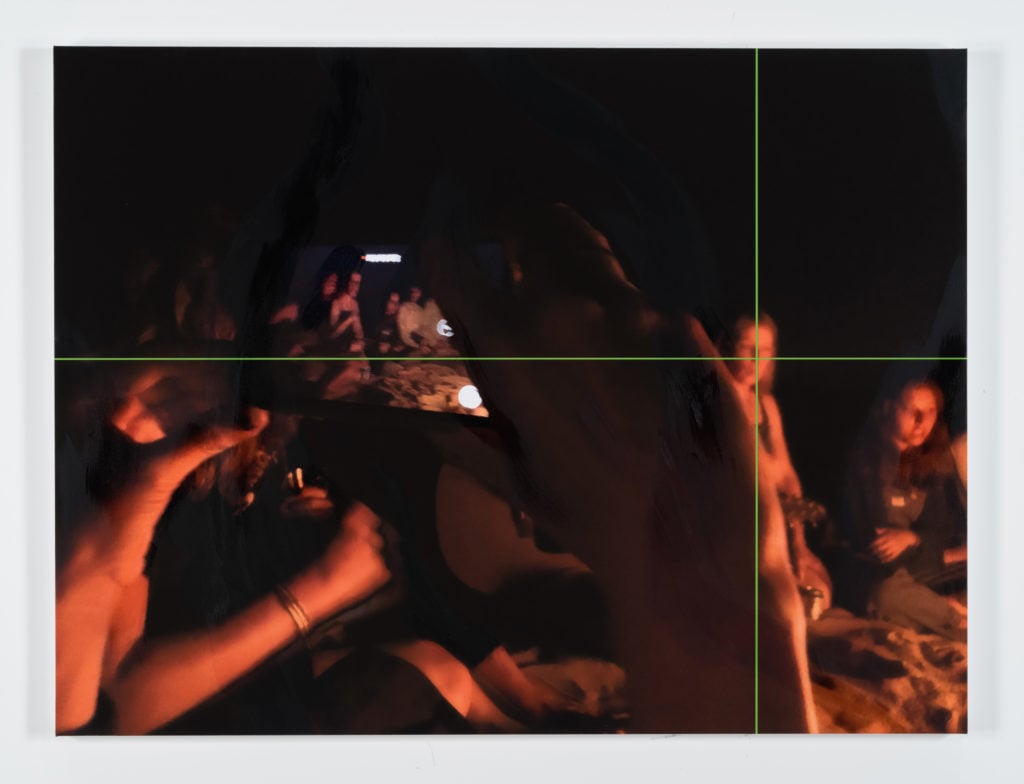
Kim Gordon, The Bonfire 10
(2019). © Kim Gordon. Courtesy 303 Gallery, New York.
You’ve spoken about the stranglehold the market has over the
art world. Is this something you contend with in your own work or
do you make things with the understanding that you can’t control
their life after they leave the studio?
It’s definitely something I
contend with, especially with installations. There’s something
about professionalism in art that I just want to resist. It’s hard
to make art that’s awkward anymore, or to make something that’s
unexpected or surprising or unsettling in a way that’s not like
blatantly offensive or sexual or cheap, especially in spaces like
commercial galleries which are just white boxes.
“Kim Gordon: The
Bonfire” is on
view through February 22, 2020 at 303 Gallery.
The post ‘There Is No Sense of Privacy Anymore’: After Kim
Gordon’s Personal Life Went Public, She Decided to Tackle
Surveillance in Her Art appeared first on artnet
News.
Read more https://news.artnet.com/art-world/kim-gordon-303-surveillance-1761783
Further reading


Leave a comment