
A Brief History of Perishable Art: How Darren Bader’s Divisive Fruit Salad at the Whitney Fits Into a Ripe Tradition
The title of Darren Bader’s new Whitney Museum installation,
“Fruits, Vegetables; Fruit
and Vegetable Salad” is fully self-explanatory. Through
February 17, a vibrant array of produce—a bushy bulb of fennel,
exotic elongated grapes, and more—will sit on 40 individual plinths
across the museum’s eighth floor. Four times a week, per the
artist’s instructions, they’ll be harvested, chopped, and handed
out as tiny salads with a side of olive oil, sea salt, and black
pepper.
The museum acquired the work in 2015, purchasing a certificate
of authenticity with instructions for installation. “The work
consists of fruits and vegetables totaling any even number between
twelve and infinity,” it read, not specifying the exact types but
emphasizing the importance of variety. The point, according to
Whitney senior curatorial assistant Christie Mitchell, is to
highlight the inherent formal qualities of the titular items—in
Bader’s words, “nature’s impeccable sculpture.”
“They do look so beautiful and kind of uncanny when they’re on
these pedestals in the gallery,” Mitchell says. For the five-week
duration of the show, she and a team of art handlers will
thoughtfully source the produce from Chelsea Market and FreshDirect
themselves. Eating the work, Mitchell adds, creates a
transformative, “alchemical” moment.
Online, however, where commentary about “ridiculing the gullible
viewer” and eating the “worst salad of my life”
abounds, skeptics pose an important question: Are we just being
trolled?
The Ongoing Prank of Perishable Art
Historically, fruits, vegetables and other edibles have been the
favorite subject of still-life painters, colorful symbols of bounty
and wealth. But actual food as sculpture, the lovechild between the
still life and the readymade, is so often a particularly obnoxious
product: conceptual art that plays out as a practical joke—or the
other way around.
The prankster associations with food art run deep. And O.P.
(Original Prankster) Piero Manzoni “consecrated” 70 hard-boiled
eggs with his thumbprint in his 1960 piece, Consumption of
Dynamic Art by the Art-devouring Public, then fed them to
viewers in a quasi-communion ritual, another farce on the alleged
sanctity of art. (He too used the word “alchemical” when describing
his cans of “Artist’s Shit,” where are exactly what they said they
were.
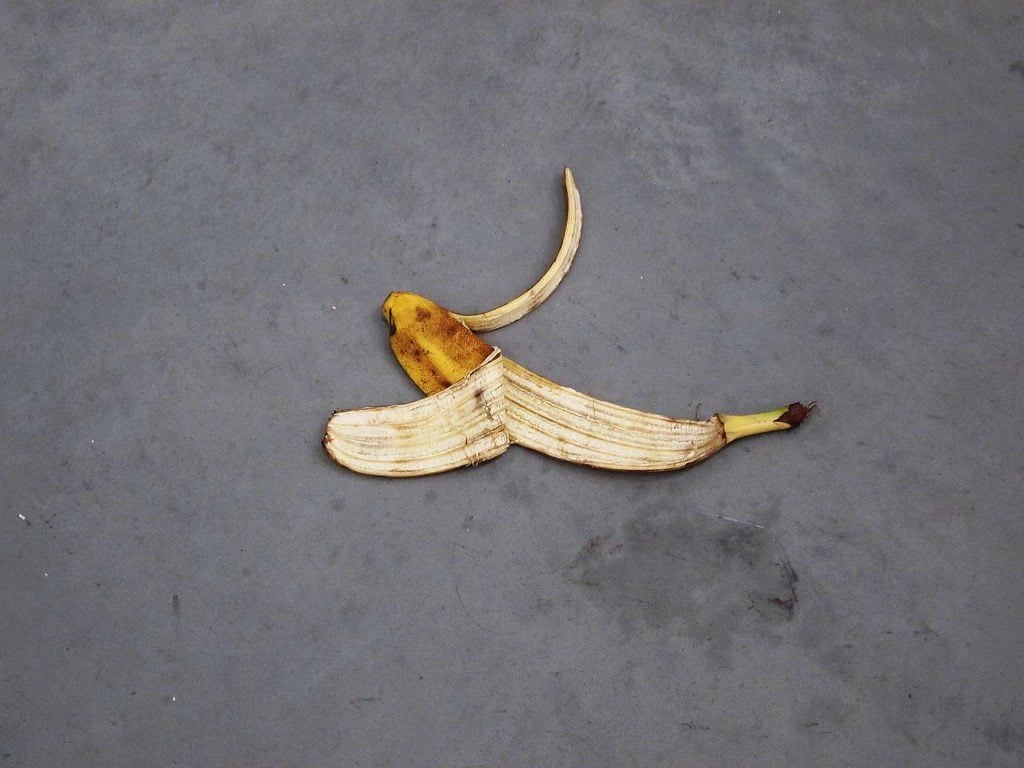
Adriana Lara, Installation (Banana
Peel) (2008) at the New Museum Triennial. Courtesy of Flickr
Creative Commons.
A decade ago, Adriana Lara deployed the banana peel as the
ultimate sight gag on the floor of the New Museum triennial: She
instructed that a security guard would eat one banana every day
then randomly toss the skin, violating the immaculate gallery space
with literal (and to detractors, conceptual) garbage. When
collectors would buy images of bundled hot dogs and padlocked Taco
Bell tacos from Brad Troemel’s Etsy, he would mail them the actual
sculptures—moldy or dripping with grease—rather than the
photographs.
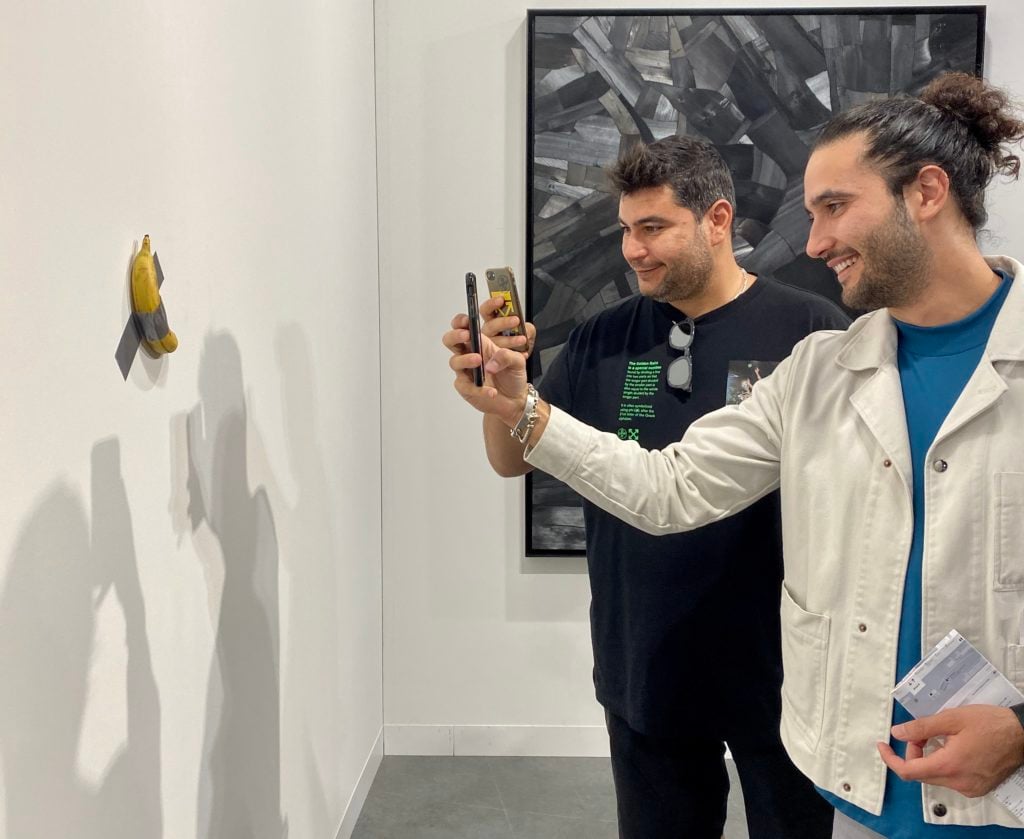
Fairgoers take pictures of Maurizio
Cattelan’s Comedian, for sale from Perrotin at Art Basel
Miami Beach. Photo by Sarah Cascone.
But it’s Maurizio Cattelan’s Comedian that still stings
in the collective memory. Depending on whom you asked, it was
either a brilliant gesture or the nadir of artistic privilege: a
banana duct-taped to a piece of art fair drywall, yours to recreate
at home for the arbitrary price of $120,000. As the previous decade
drew to a close, Comedian left us with questions about the
art market’s place in the latest of late-stage capitalism, our own
pretentiousness, and whether these questions would count as the
work’s true substance. As Comedian’s image subsumed the
mainstream news cycle, the artist had achieved a true feat: for at
least a full week, he held our attention captive, and with
seemingly little effort.
Fruit Sold Separately
Decades before Bader’s salad, Fluxus artist Alison Knowles
served her own. Her performance piece Make a Salad debuted
at the ICA London in 1962 as a kind of participatory concert—30
people eating her dressed vegetables to a musical arrangement.
“Whenever you eat a salad, you are performing the piece,” Knowles
has said, presumably including Bader’s, too. The work has been
scaled up and restaged to feed thousands: at the Tate in 2009, on the High Line for Earth Day
2012, and at Art Basel in 2016.
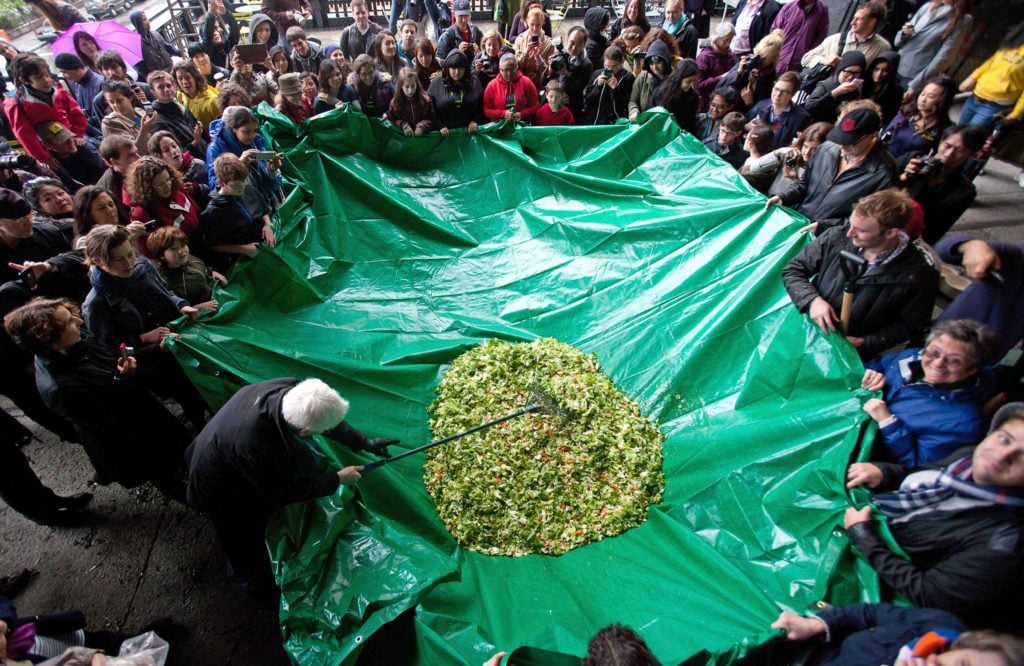
Alison Knowles, Make a Salad at
the Highline in New York. Courtesy of the High Line.
These aforementioned works that are eaten or thrown away have no
permanent physical body—they exist as documentation, sometimes an
image, sometimes instructions referred to as an “event score.” In
conceptual art, it’s the thought that counts, according to critic
Lucy Lippard, who literally wrote the book on dematerialization in
1973. She described a new groundswell of works in which “[t]he idea
is paramount and the material form is secondary, lightweight,
ephemeral, cheap and/or ‘dematerialized’”—or edible. She also
envisioned immateriality as an escape route from “art-world
commodity status,” unable to foresee the kinds of prices a
certificate could pull.
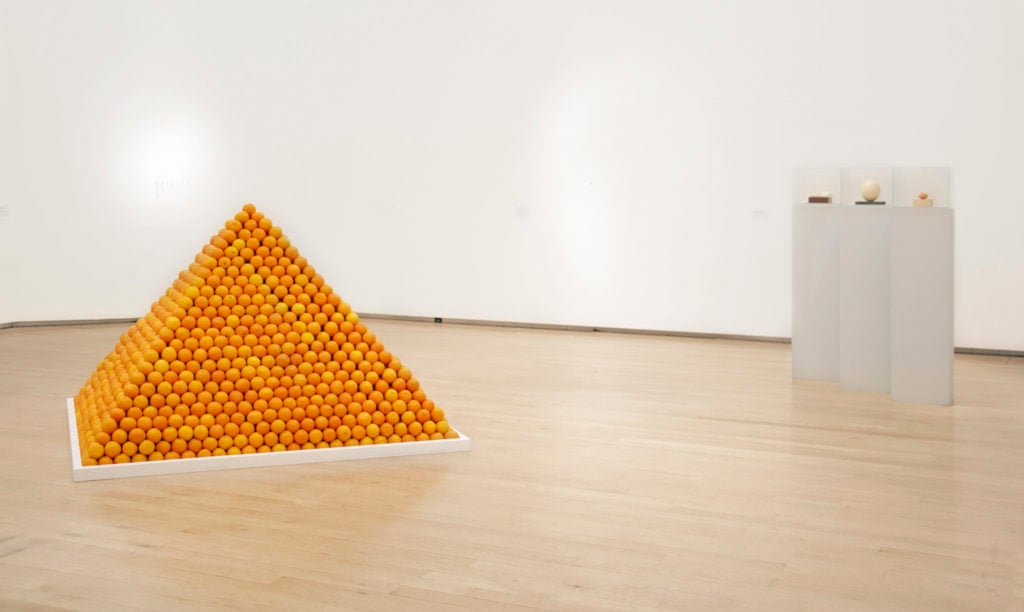
Roelof Louw’s Soul City (Pyramid of
Oranges) (1967). Courtesy of Flickr Creative Commons.
Lippard wrote of the late Roelof Louw, whose in 1967 Soul City (Pyramid of
Oranges), holds another clear precedent for Bader’s
“Fruits, Vegetables.” In its original iteration, Louw had stacked
almost 6,000 oranges into the shape of a pyramid, inviting viewers
to take an orange and eat it, and to consider questions of viewer
participation and the impermanence of form. Scottsdale Museum of
Contemporary Art curator Lauren Best, who exhibited Soul
City in 2014, recalls all of the extremely cool visitors
who have taken their orange from the bottom, sending the entire
pyramid rolling across the museum floor. “That is the interesting
point of the piece,” she assures. “It’s the patron who alters the
form of the sculpture.”
When the Tate acquired Soul City in 2014, the press
balked at its £30,000 price tag. A Daily Mail article
headlined “Is this the craziest art
installation yet?” worked out the price to about £5 per orange,
which is wholly inaccurate. On top of the £30,000, the museum also
shoulders the cost of buying the oranges themselves. Over its
four-month exhibition, SMoCA estimates it went through about
15,000.
The Unpredictable Nature of Perishable
Goods
The hazards of fresh products in a gallery setting have been
well documented. Fuzzy fruits are bound to appear towards the
bottom of Louw’s pile of oranges. And Lee Bul’s Majestic
Splendor, an installation of sequined dead fish in plastic
bags, has been pulled from exhibitions not once, but twice: first
due to a refrigeration failure in 1997 that filled MoMA with an
unbearable stench, then again at the Hayward Gallery in
2018, this time when its chemical antiseptic treatment
spontaneously burst into flames.
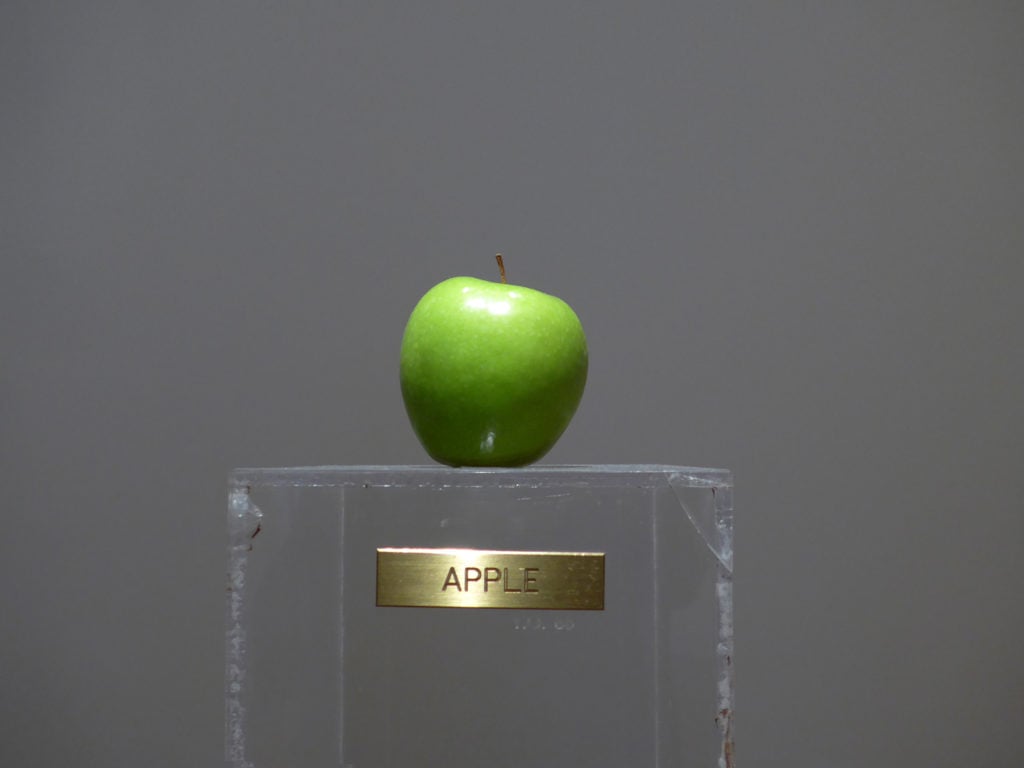
Yoko Ono, Apple (1966). Courtesy
of the Museum of Modern Art.
Art destined to perish, however, does nicely lend itself to
institutional critique: food’s propensity to rot is also a potent
vehicle for political allegory and existential quandaries. The
replaceable ton of bananas in Paulo Nazareth’s 2011 Banana Market/Art
Market evoke sentiments of labor and resource exploitation
in Latin America. Yoko Ono’s 1966 Apple—an apple left to
decay on a pedestal—is a symbol of mortality. (John Lennon actually
took a bite, later remembering, “I didn’t
have much knowledge about avant garde or underground art, but the
humor got me straight away.”) And the 2,755 oily bologna slices
pegged to Pope.L’s Claim (Whitney Version) initially
smelled at the opening of the 2017 Whitney Biennial, but the odor
reportedly improved as they cured—a pun that refers to both the
maturation of preserved meat and the act of healing.
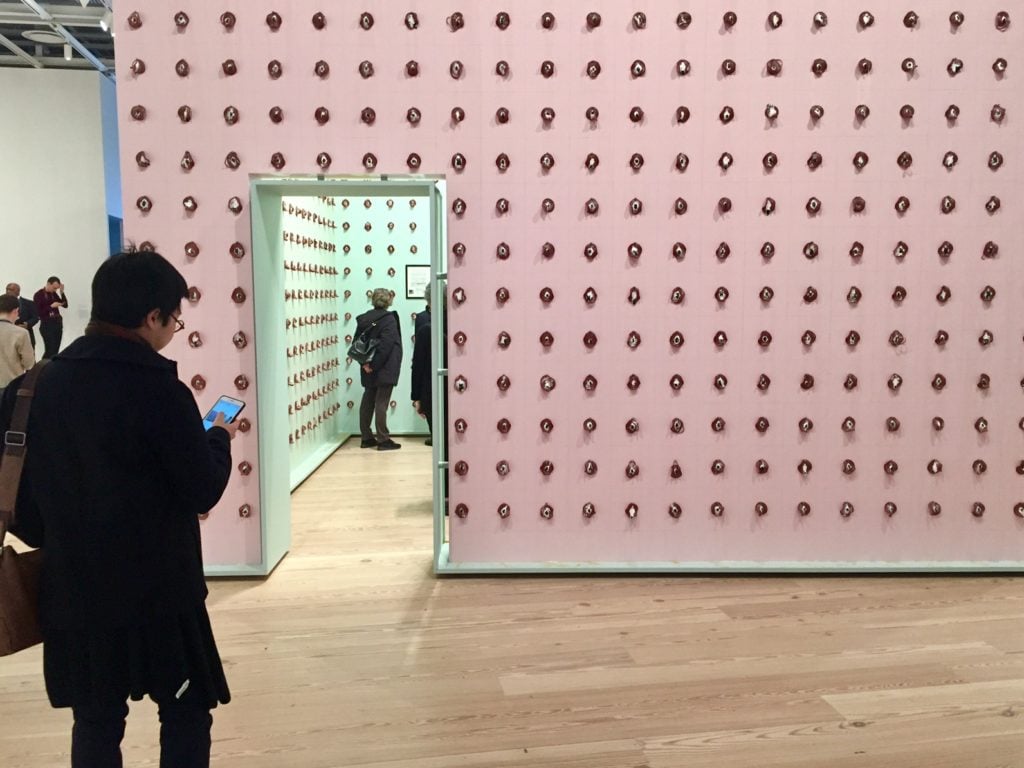
Installation view of William Pope.L,
Claim (Whitney Version) (2017). Image: Ben Davis.
Bader’s “Fruits, Vegetables” isn’t “a candidate for a long term
collection display,” Mitchell says, given the constant trips to
Chelsea Market required to keep it fresh. It’s also most definitely
a troll. Works like this prod us for a reaction, towards the outer
limits of what we’ll accept as art—especially the volatile,
ephemeral work that ripens, wilts, spoils, and disappears. “There
can be an exceptional visual, conceptual, and aesthetic merit to so
many things in the world,” the artist has said, including
pineapples, fennel, and exotic elongated grapes. The resulting
salad is a very polarizing joke. And if you don’t like it, you
don’t have to eat it.
The post A Brief History of Perishable Art: How Darren
Bader’s Divisive Fruit Salad at the Whitney Fits Into a Ripe
Tradition appeared first on artnet News.
Read more https://news.artnet.com/art-world/darren-bader-fruits-vegetables-food-art-1763388
Further reading


Leave a comment