
‘I’m Not Really Addressing the Fine-Art Audience’: How Rising Star Artist Tyler Mitchell Is Reaching a Wide Public With His First US Museum Show
On the second floor of the newly opened International Center of Photography in New
York, a soundtrack of plaintive synth chords plays as part
of Chasing Pink, Found Red (2019), a video installation
by 24-year-old artist Tyler Mitchell.
The video depicts a bucolic
picnic scene where young black men and women lounge on a red
checkered blanket, sun-drunk and blissful. But snippets of jarring
audio also play throughout, with speakers describing instances
where they were made to feel inferior because of their
race.
“The stories came from all over
the world, but they were very similar,” says Mitchell, who put out
a call for the recordings to
his 265,000 Instagram followers last year. “They were usually
stories from someone’s childhood, a memory or a small moment that I
call a micro-trauma, in which you’re reminded of the ways in which
you’re not able to be as free as you want to be.”
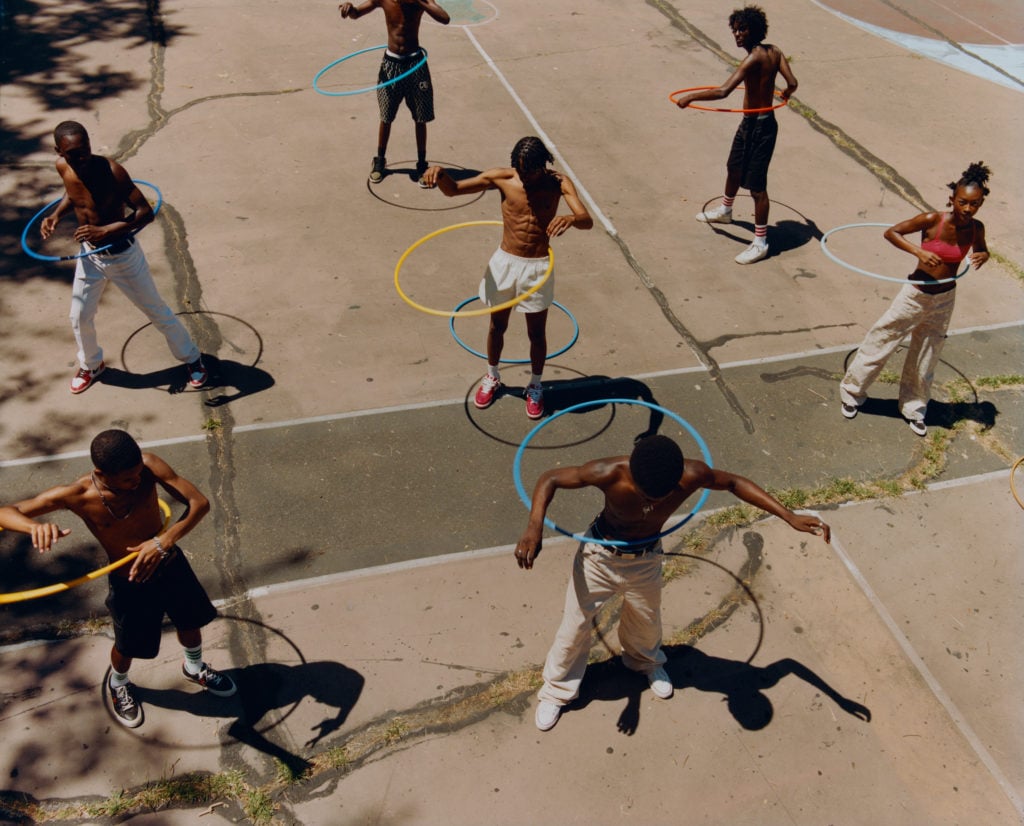
Tyler Mitchell, Untitled (Group Hula
Hoop) (2019). © Tyler Mitchell. Courtesy of the International
Center of Photography.
Mitchell has quickly and
suddenly become one of the most in-demand photographers in the
world. The poster child of the “new black
vanguard,” a term coined
by writer Antwaun Sargent, Mitchell has shot spreads for magazines
like i-D and the Fader and fashion campaigns
for Marc Jacobs and Comme des Garçons. In 2018, his pastoral portrait of Beyoncé in
the English countryside graced the front of
Vogue, making
him the first black photographer—and one of the youngest people
ever—to create a cover in the magazine’s 125-year history. Later
that year, a photo from the series was acquired by the
Smithsonian National Portrait Gallery. Mitchell was just 23.
The title of his new show, “I
Can Make You Feel Good,” comes from a Shalamar song of the same
name, which Mitchell
heard in the Atlanta airport in 2018. It has since become a kind of
credo for the young artist—a pledge that he makes to his audience.
(It also served as the title of his first exhibition at the
Fotografiemuseum in Amsterdam.)
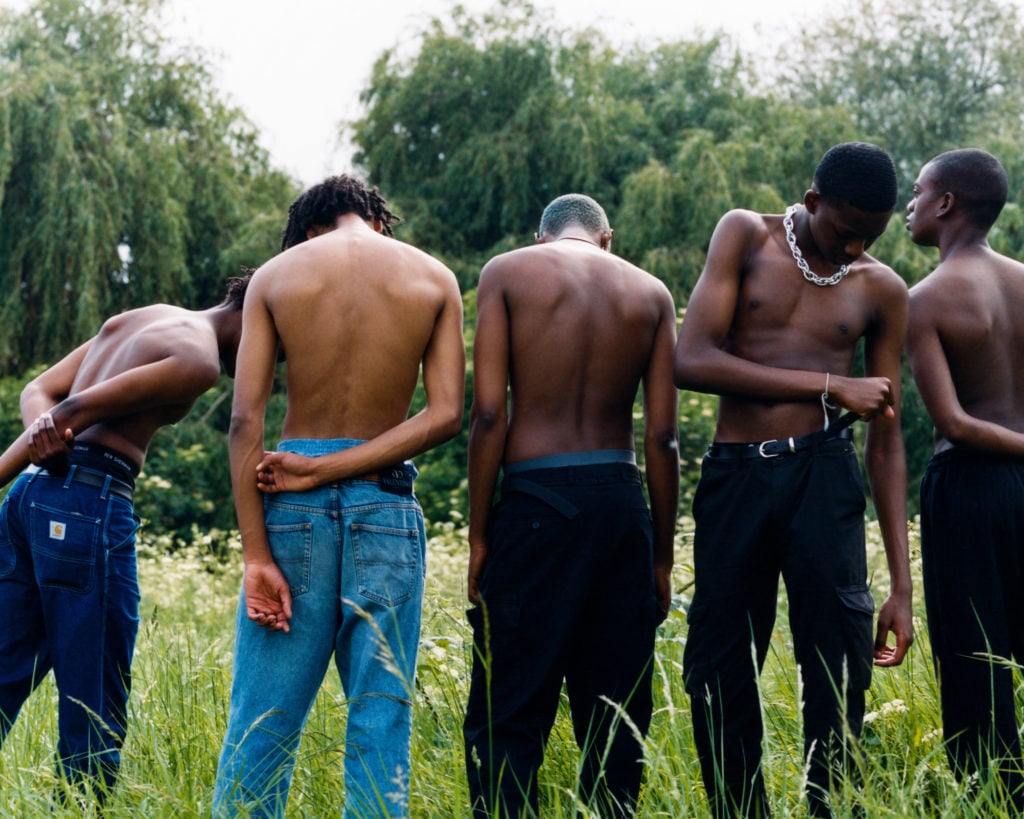
Tyler Mitchell, Boys of
Walthamstow (2018). © Tyler Mitchell. Courtesy of the
International Center of Photography.
“It’s a literal statement for
what the show is trying to do,” Mitchell says of the show’s
title.
We’re sitting in one of the
museums janitors’ closets, which has been turned into a makeshift
green room with a card table and a cluster of water bottles. Beads
of water descend from a network of pipes and wires in the open
ceiling above (the building’s renovation is still being finished).
Even so, with his pink socks and pink nails and matching vintage
shirt, Tyler is glamorous.
“Some exhibitions have very
cryptic titles,” he says. “It’s all just smoke and mirrors. A lot
of my work is about removing all that. I’m not really addressing
the fine-art audience in a direct way. I’m addressing a wider
audience while using the institution as a way to build a more
critical dialogue.”
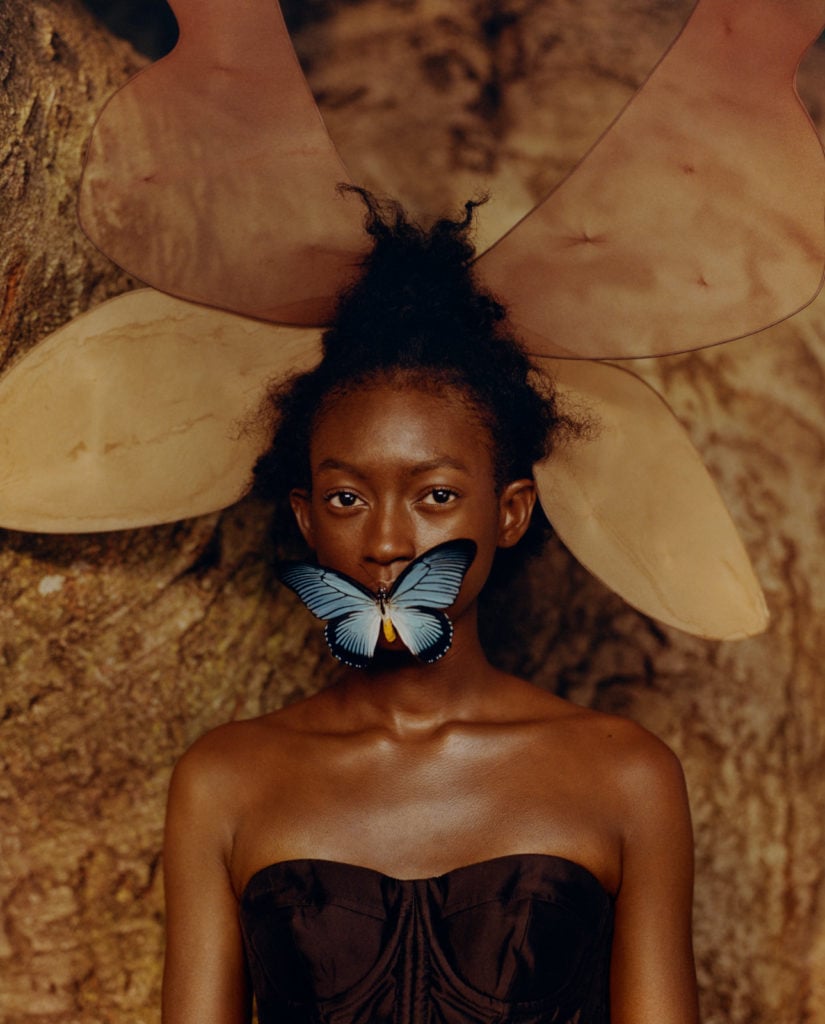
Tyler Mitchell, Untitled
(Butterfly) (2019). © Tyler Mitchell. Courtesy of the
International Center of Photography.
Mitchell grew up in Marietta,
Georgia, a sprawling suburb of Atlanta. He picked up his first
camera at 13, wanting to make videos of his friends skateboarding.
He learned to use the camera through Youtube tutorials and posted
his videos on Tumblr, where he found a loyal following.
“I don’t know if talent was the
word,” he says, considering his early forays into photography. “I
don’t even know if I have talent now, necessarily. I just think I
have a point of view. I have a stylized way of
working.”
Indeed, the roots of those early
videos still peek through Mitchell’s work today: sunny scenes and
phatic expressions of youthful community; an interest in the body
in motion; and an intimate look at unadulterated joy.
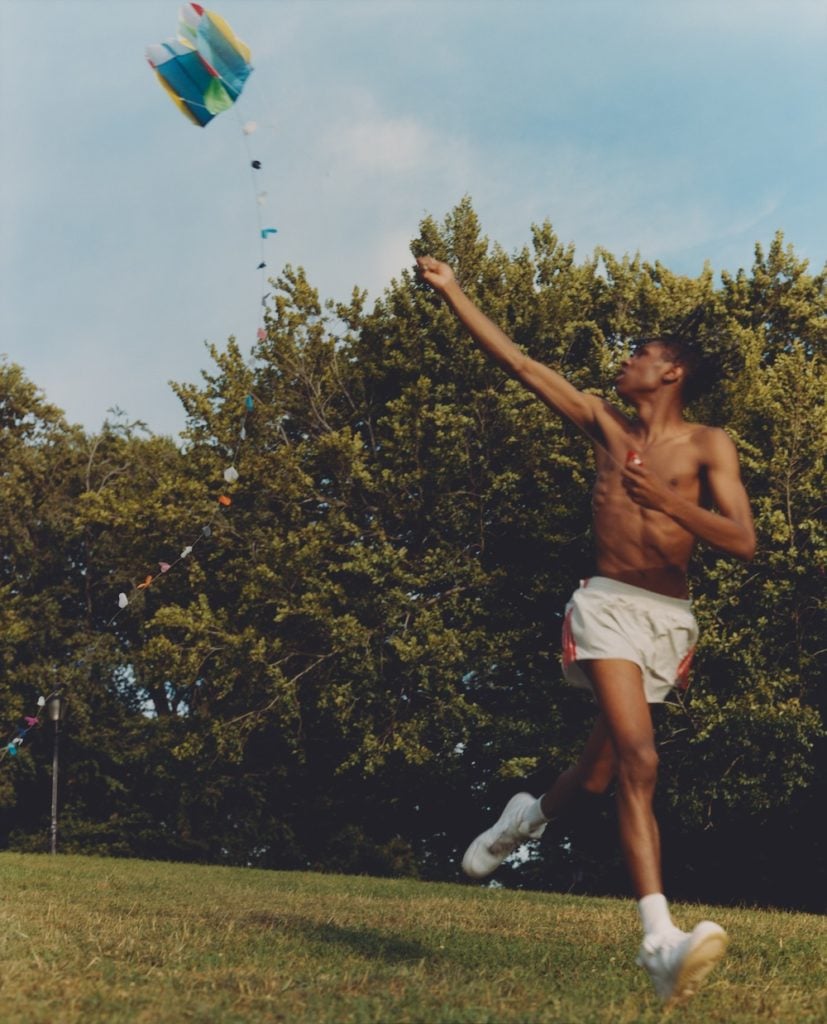
Tyler Mitchell, Untitled (Kite)
(2019). © Tyler Mitchell. Courtesy of the International Center of
Photography.
“The candy-colored pallets and
use of natural light—these are ways to maintain legibility in my
images,” he says. “That’s what commercial means: legible. I like to
play with that level of accessibility in
photography.”
He studied film at NYU’s Tisch
School of the Arts, though he spent a lot of time in the photo
department as well. In his sophomore year, an assignment to
photograph Kevin Abstract, a founding member
of Brockhampton, for
the Fader put him on many photo editors’ radars,
which he parlayed into additional assignments. By the time he
graduated in 2017, he was a rising star. The Beyoncé shoot came a year later.
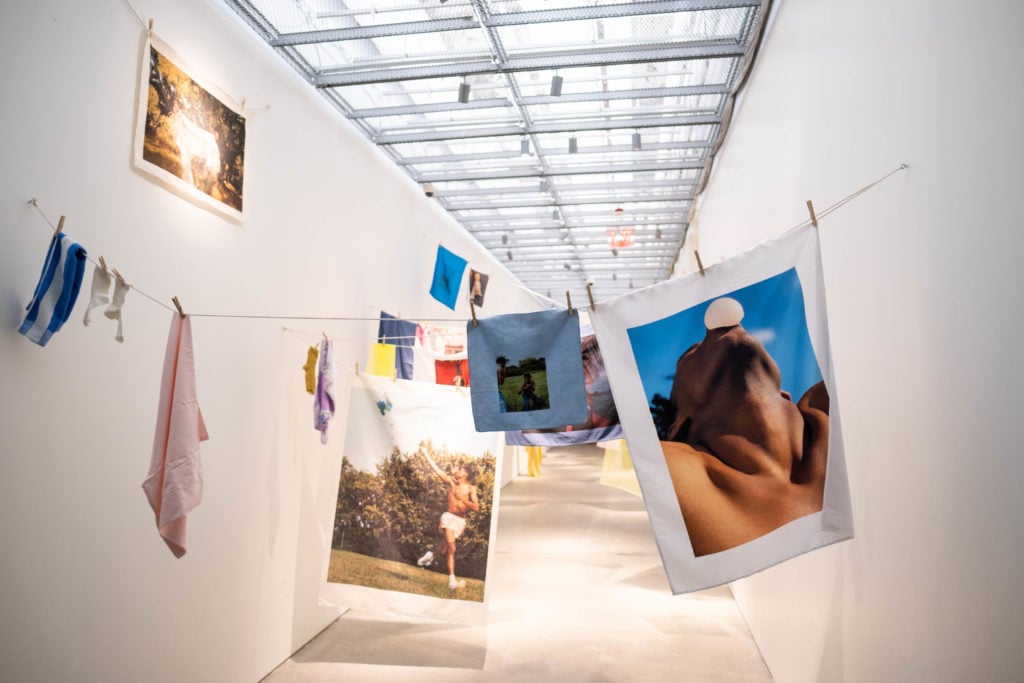
Installation view of “Tyler Mitchell: I
Can Make You Feel Good” at the International Center of Photography,
2020. © ICP. Photo: Michael C Mooney.
The ICP show is, technically,
just Mitchell’s second solo art-world outing. But that distinction
doesn’t mean much to him.
“Tyler’s from a generation of artists that don’t
see the same boundaries that we once did,” says Isolde Brielmaier, the show’s curator.
“They’re not burdened with the same
conceptual, aesthetic, and genre definitions that artists have
traditionally had to contend with. That’s one of the reasons I was
drawn to his work, because he is so fluid.”
Brielmaier points to a
hallway-spanning installation where Mitchell’s portraits are
printed on various found fabrics, from pastel pillowcases and
washcloths, to sateen swatches that twinkle at the right angles,
all hung from clotheslines.
The installation, which is also
the highlight of the show, fuses fashion with fine art, photography
with sculpture, art-historical references with the 2020 zeitgeist.
Like Chasing Pink, Found
Red, it evinces a dreamy
landscape undercut by the insidious intrusion of
reality.
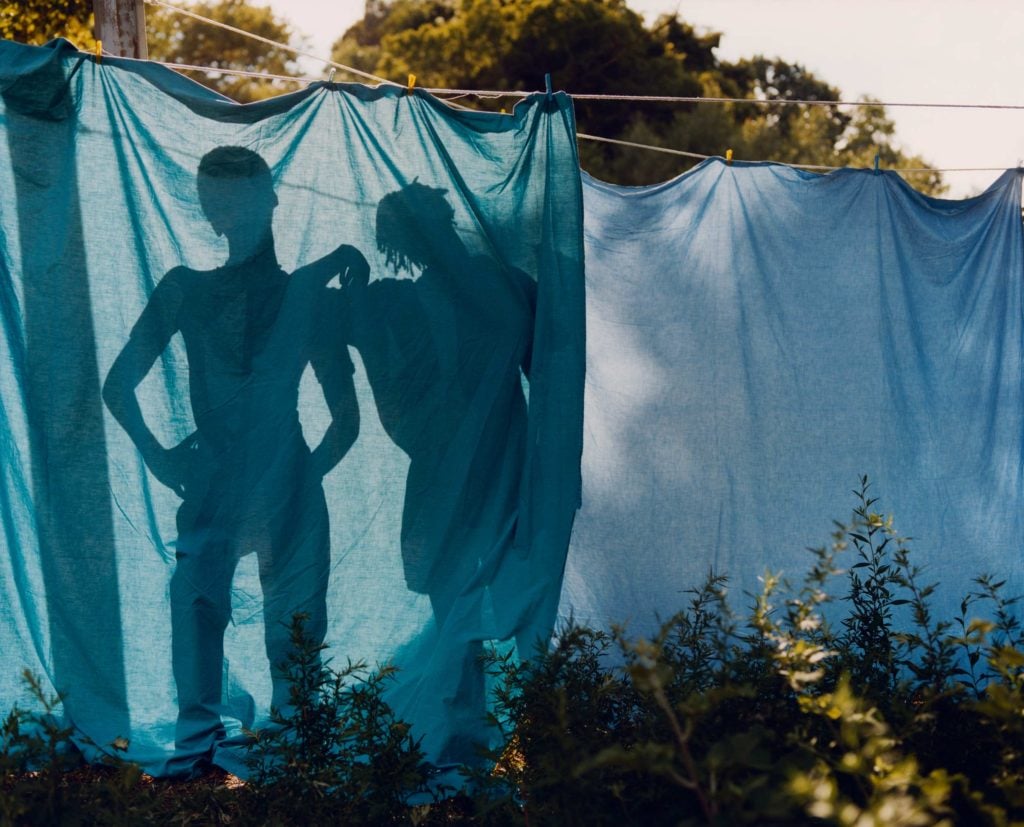
Tyler Mitchell, Untitled (Blue
Laundry Line) (2019). © Tyler Mitchell. Courtesy of the
International Center of Photography.
“He’s positing an idea of what a
black paradise could look like, but it’s multi-layered,” Brielmaier
says. “It references domesticity, servitude, and other positions
that black people have been relegated to in this
country.”
Many people, the curator notes,
have been quick to consider Mitchell’s images as joyful forms of
resistance. “Particularly for black people, we’re always
represented striving, struggling, suffering, or
fighting,” Brielmaier says. “So having joy is incredibly
powerful.”
But that doesn’t capture the
complexities of the young artist’s work.
“People say that black utopia is
a counter-narrative, but it can only be a counter-narrative if
that’s your operative narrative to begin with. I don’t think it is
for Tyler,” Brielmaier says. “If you move beyond that narrative,
you enter into this whole new space.”
“I think that space is where
Tyler’s artistic and conceptual head is at.”
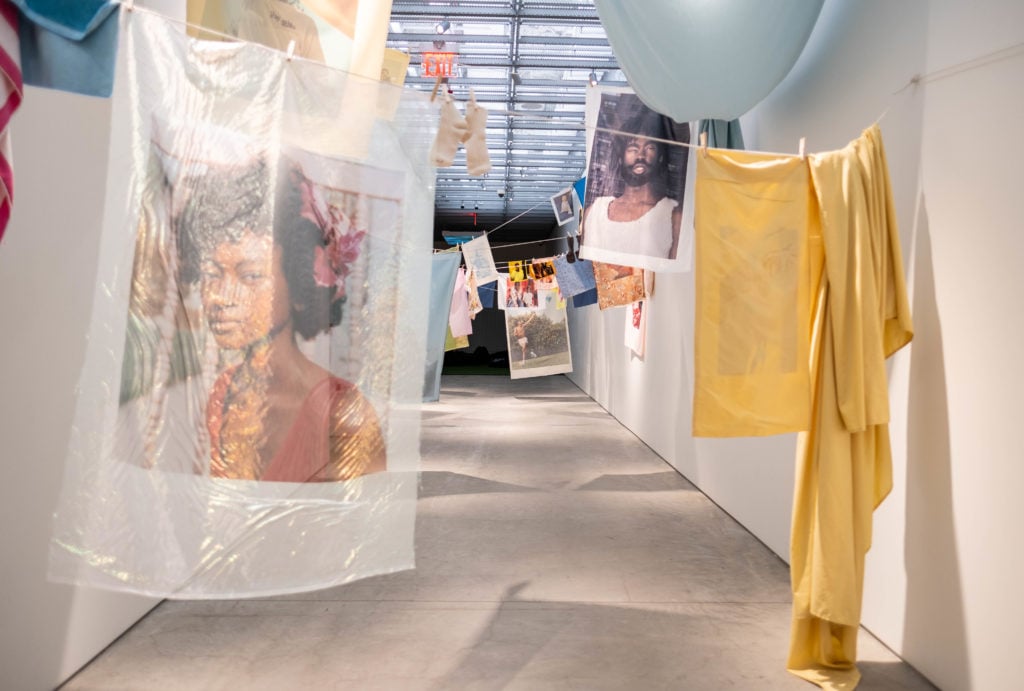
Installation view of “Tyler Mitchell: I
Can Make You Feel Good” at the International Center of Photography,
2020. © ICP. Photo: Michael C Mooney.
“Tyler Mitchell:
I Can Make You Feel Good” is on view now through May 18, 2020, at
the International
Center of Photography.
The post ‘I’m Not Really Addressing the Fine-Art Audience’:
How Rising Star Artist Tyler Mitchell Is Reaching a Wide Public
With His First US Museum Show appeared first on artnet
News.
Read more https://news.artnet.com/art-world/tyler-mitchell-interview-1765059
Further reading


Leave a comment