
A Leading Old Masters Scholar Is Accusing London’s National Gallery of Unwittingly Inflating the Price of the ‘Salvator Mundi’
If you thought you’d heard the
last of Leonardo’s contested final masterpiece Salvator
Mundi, you have another thing coming.
A leading art historian has
accused London’s National Gallery of helping to inflate the price
of the painting, which sold for $450.3 million at
Christie’s in 2017, by exhibiting it as an autograph Leonardo
without properly informing the public about the doubts surrounding
its attribution. The historian, Charles Hope, argues in a recent
London Review of Books article that the work’s
presentation was particularly egregious given that it was available
for sale both immediately before and after its inclusion in the
show, “Leonardo da Vinci: Painter in the Court of
Milan.”
In a flurry of spirited letters
published in response to the article, two sides duke it
out: Hope and fellow art historian Ben Lewis argue
that the picture was effectively for sale during the
exhibition—a somewhat unusual and frowned upon practice—while a
former owner of the painting, dealer Robert Simon, and the former
director of the National Gallery, Nicholas Penny, say it was
not.
While the debate hinges on some
rather technical issues, it boils down to one big question: Who
gets to control the narrative about Old Masters (and Leonardo in
particular): scholars or those with a vested financial interest in
the work?
The now-infamous painting was
originally purchased in 2005 by a consortium of collector-dealers
for less than $10,000 when it was still thought to be a copy. The
exhibition of the painting at the London gallery in 2011 was key to
elevating its status as a genuine Leonardo before it went on to
become the most expensive work of art ever sold at
auction.
In an article published in the review’s
January issue, Hope suggests the painting’s attribution was
based on “misleading or unsubstantiated assertions about the
provenance of the picture and a public statement by the
then-owner.” He claims that
Simon, who purchased the work in 2005 as part of a consortium,
“exploited” the National Gallery into exhibiting the contested work
as a Leonardo without properly qualifying it. He writes that in
doing so, the publicly funded institution was participating more in
“a marketing ploy than a contribution to knowledge.”
In a retort to Hope’s article,
Robert Simon reiterates an earlier claim that the picture “was not”
for sale at the time of the exhibition and that a press release he
issued at the time responded to inaccuracies in the press in a
“purely corrective, not promotional” manner. And in fact, he points
out, the loan of Salvator Mundi to the exhibition was
actually requested by the gallery, not the reverse. The National
Gallery’s former director, Nicholas Penny, confirmed that account
in a letter of his own.
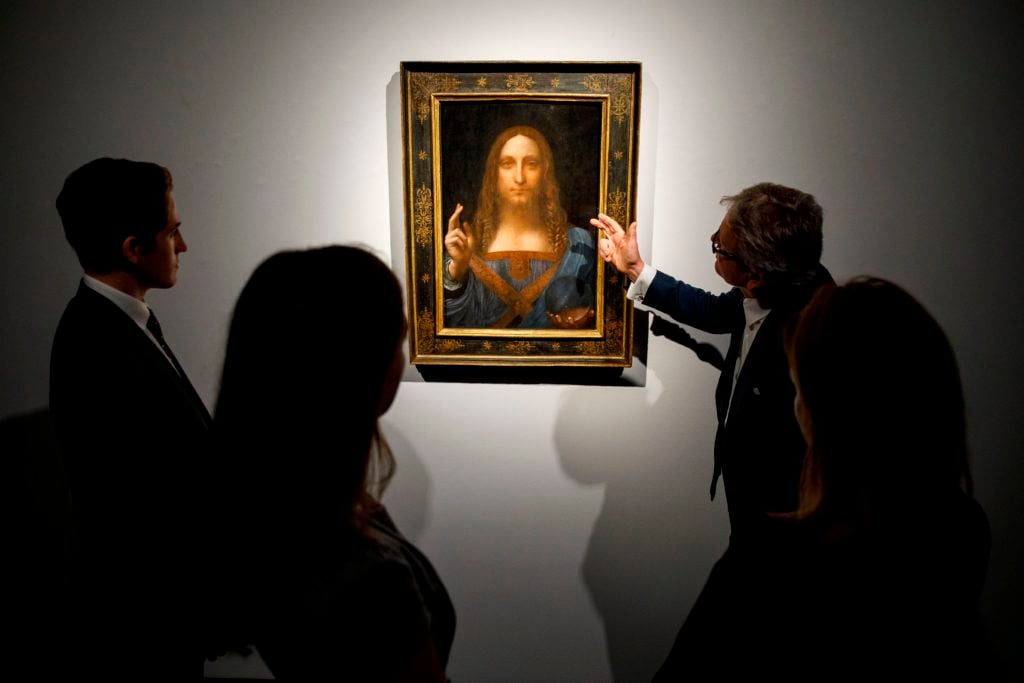
Christie’s employees pose in front of
Salvator Mundi ahead of its sale at Christie’s New York on
November 15, 2017. Photo: Tolga Akmena/AFP/Getty Images.
With that, the saga might have
been over—but instead it took a fascinating turn when Ben Lewis,
the author of a book on the painting
titled The Last
Leonardo, threw his hat
into the ring. In his own response letter, Lewis calls Simon’s
claim that the work was not for sale “disingenuous.”
He says that since the
publication of his book, he has received “testimony” from an
antiques dealer, Michael Franses, claiming that he had been working
to sell Salvator Mundi on behalf of some of its co-owners
in 2009 and 2010, just before it went on view in the National
Gallery, and that Simon was “aware” of this. Franses, Lewis claims,
even assembled dossiers about the painting’s provenance and
condition and reached out to such museums as the
Louvre, the Hermitage, the Vatican,
Berlin’s Gemäldegalerie, the Qatar Museums Authority, as well as
the Prado.
“The plan was to get a museum to
agree to accept it as a Leonardo and then find wealthy donors who
would pay for it for that museum,” Lewis writes. He goes on to
suggest that “perhaps what Simon means is that he briefly took the
Salvator Mundi off the market between July 2011 and
February 2012 to avoid any embarrassment to the National
Gallery.”
Since Lewis’s explosive claim, Simon has attempted to play down
Franses’s involvement. He told
the Guardian that
Franses had “proposed to offer the painting to a single museum with
which he claimed to have a special relationship,” but that he had
been unaware of any conversations with other institutions. Simon
acknowledged he shared some information about the painting with
Franses, although he never met him. Simon and Franses did not
immediately return requests for further comment.
Contacted by Artnet News, a
spokesman for the National Gallery said that during the period that
Salvator Mundi was on display in the gallery, “the owners
said that the painting was not presently for sale.” The spokesman
explained that when the
gallery considers a painting for a loan exhibition that is owned by
a dealer or known to be for sale, it considers the benefit to the
public and the contribution to scholarship of the exhibition, but
that “the work should be included solely on its own
merits.”
The post A Leading Old Masters Scholar Is Accusing London’s
National Gallery of Unwittingly Inflating the Price of the
‘Salvator Mundi’ appeared first on artnet News.
Read more https://news.artnet.com/art-world/salvator-mundi-national-gallery-price-1765539
Further reading


Leave a comment