
‘I Am a Photographer, Not an Artist’: Legendary War Photographer Don McCullin on Why the Distinction Matters
Don McCullin is not afraid of
the dark.
The 84-year-old British
photographer, who is famed for his haunting images, is best known
for his salient photographs of war and conflict, taken around the
world. For 60 years, he has reported on battles and destruction,
chronicled starvation and inner-city poverty, and traveled the
world working for
newspapers including
the Observer and the
Sunday Times Magazine.
But I met him a long way from all that, in the
peaceful countryside setting of Somerset, where he’s having an
exhibition at an outpost of the mega-gallery Hauser & Wirth. We
were surrounded by McCullin’s signature black-and-white images,
none of which depict starving children or shell-shocked marines.
Instead, these dark prints are of landscapes, many taken in the
quiet fields surrounding his home.
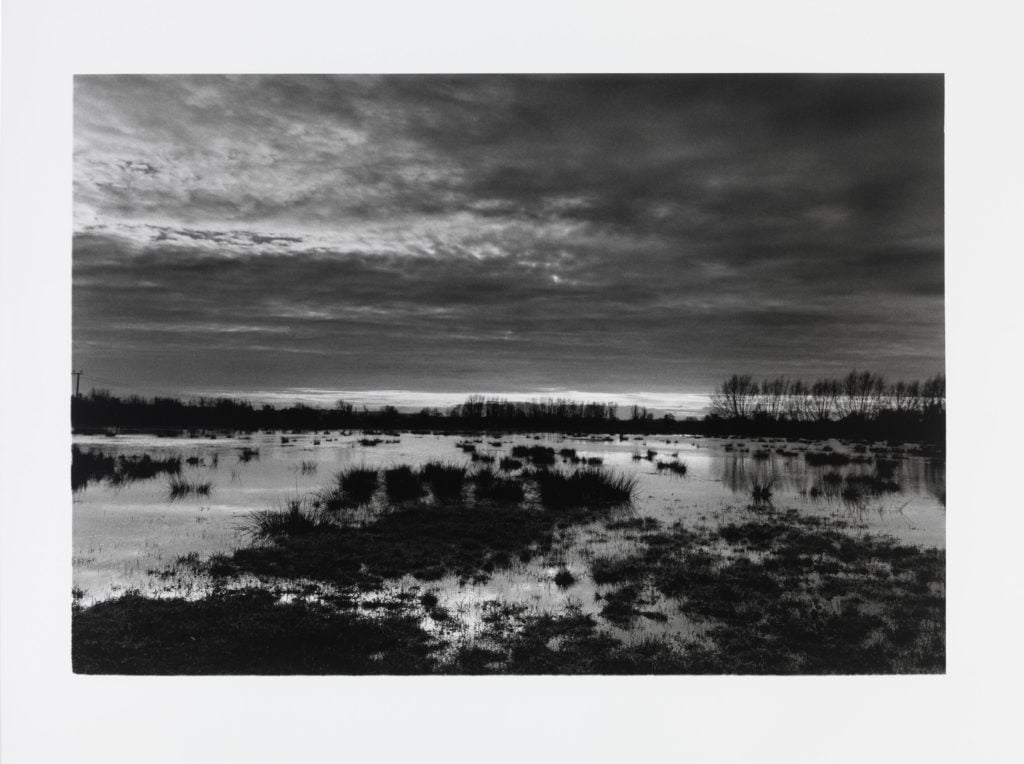
Don McCullin, The Somerset levels at
dusk (1998). © Don McCullin. Courtesy of the artist and Hauser
& Wirth.
“I owe something to Somerset,”
McCullin says. This countryside gave him refuge during World War
II, when he and other children were evacuated there from London
during the Blitz. He only stayed for a few years, but the landscape
stuck with him, and years of travel eventually brought him
back.
When he first returned he was
“very depressed,” traumatized from years of witnessing unimaginable
horrors, and found it difficult to escape the guilt of covering
wars that never seemed to stop coming. The landscape once again
offered him asylum, and he has now been living there for the past
three decades. He is still sharp in his 80s, and teases people with
gallows humor, cracking jokes about his own death.
McCullin has been taking
landscape photographs since the 1990s, capturing scenes from across
the United Kingdom, Europe, and Asia when not on
assignment.
The years of dodging bullets and
photographing subjects on the move trained his eye to be quick, but
this slower work hinges more on patience. Inspired by John
Constable’s landscapes, he says it’s all about waiting for the
right sky—and sometimes that can take months.
“I don’t work in the summer,” he
says. He prefers the “much more expressive” wintertime
sky.
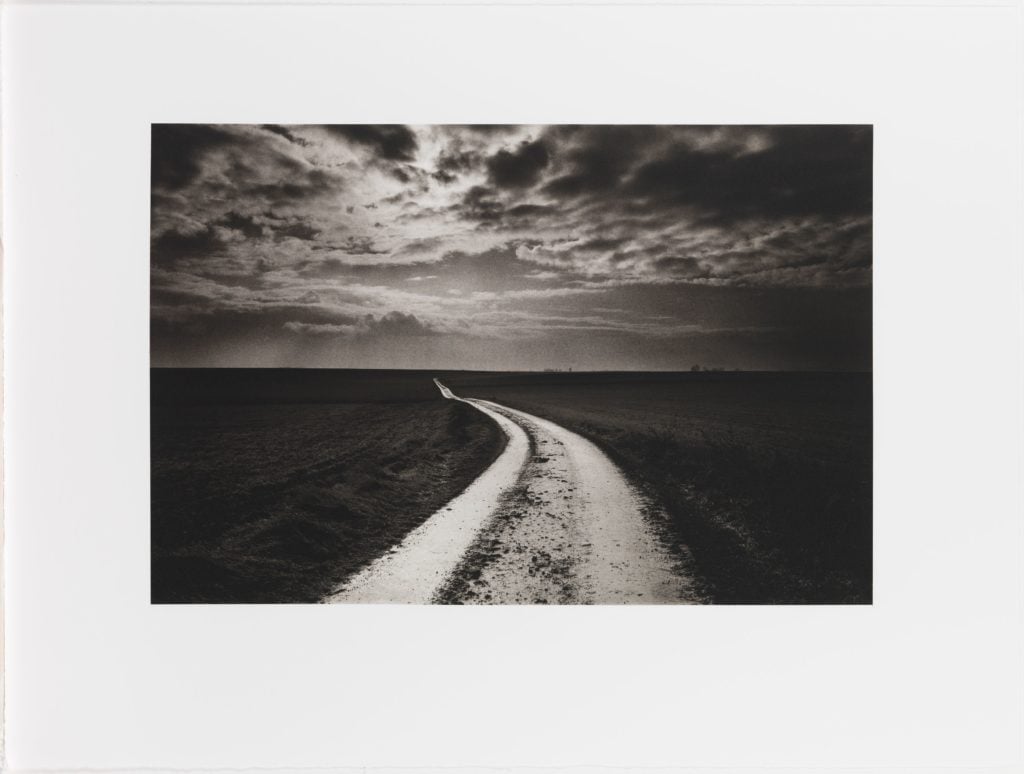
Don McCullin, The Road to the Somme,
France (1999). ©Don McCullin. Courtesy of the artist and Hauser
& Wirth.
But somehow, the stark
black-and-white images still look like muddy battlefields. Pools of
water form in a set of tire tracks across a field, summoning up a
muddy trench, and reflect a moody sky. A dead sparrow resting on a
snowbank is a poignant memento mori.
“A lot of people who look at my
landscapes think they look like wars,” McCullin says. “I don’t do
this intentionally. It’s a subconscious act.”
McCullin selected the 70-odd
works on view from some 60,000 negatives, and he personally printed
all of them in his dark room at home. In the beginning, the manual
labor was a sort of therapy, distracting him from thoughts of the
horrors he had witnessed.
“There’s a lot of me in these
pictures,” he says. “A lot of my integrity and a lot of my
emotional thoughts.”
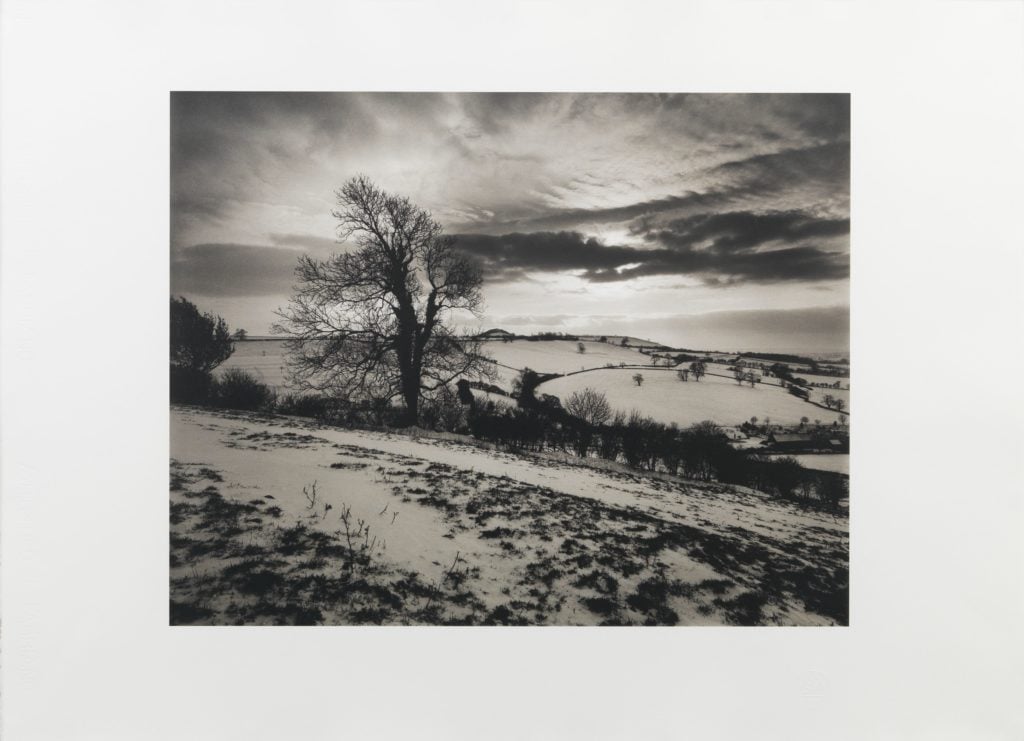
Don McCullin, Batcombe Vale
(1992/93). ©Don McCullin. Courtesy of the artist and Hauser &
Wirth.
Unsurprisingly, a darkness
pervades the images, and he says some people are confused about
whether he is trying to frighten them or bring them pleasure. In
the end, it is a little bit of both.
“I want my pictures to have an
impact. I don’t want people to walk away without remembering
them.”
This summer, McCullin’s hugely
successful retrospective, which opened at Tate Britain last year,
travels to Tate
Liverpool. But he is adamant that his photographs are not
art.
Not even—he insists on this
point—the still-life compositions that he shot in his garden, which
were inspired by the Dutch Old Masters.
“I am a photographer, not an
artist,” he says. He deems the conflation a “very American” way of
thinking. “A lot of American photographers call themselves artists.
I don’t make art. I use composition, but it is not art.”
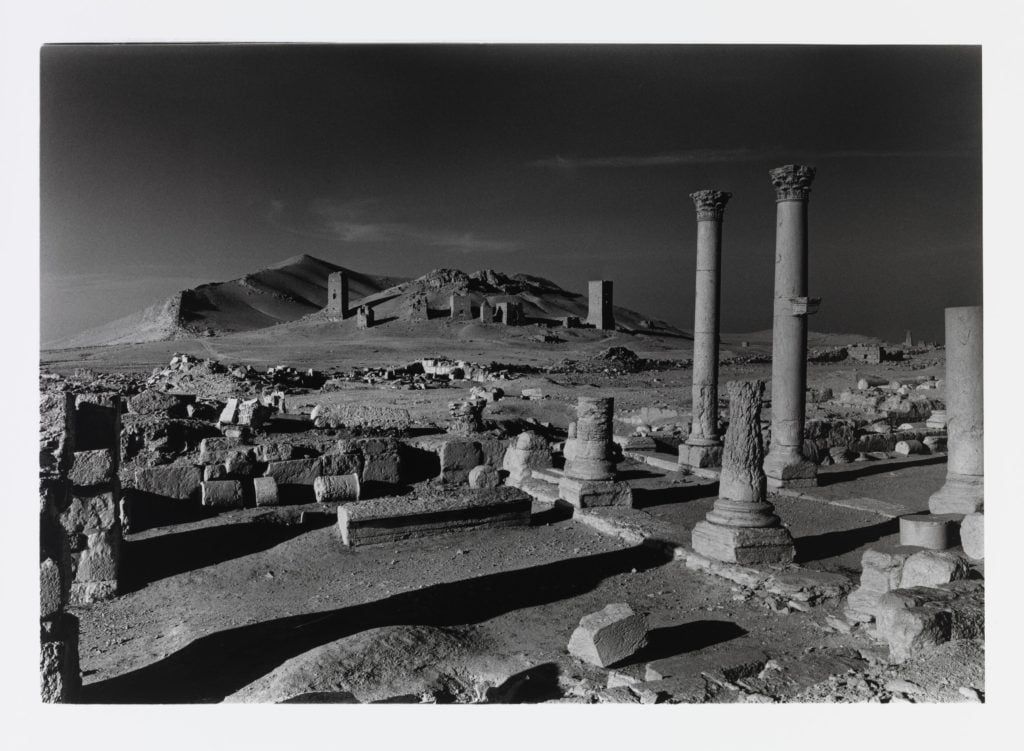
Don McCullin, Looking forward to the
valley of the tombs which Isis have destroyed (2016). ©Don
McCullin. Courtesy of the artist and Hauser & Wirth.
Some of McCullin’s
recent landscapes include
photographs from his ongoing “Southern Frontiers” series. He has
documented Roman ruins in North Africa and the Levant, including
the recent deliberate destruction of the ancient site of Palmyra in
Syria by ISIS.
The images seem to tie together
the two strands of his practice: war and landscapes.
Back home in Somerset, he sees a
new battlefront forming. There is a plague of development projects
impinging on the beautiful landscape where he has found a
home.
“It is such a euphemism; they’re
not developers at all,” McCullin says. “They want to dig the land
up and build on it. They want to frack it.”
“Don McCullin. The Stillness
of Life” is on view through May 4 at Hauser & Wirth
Somerset. Watch McCullin speaking about his
landscape pictures below.
The post ‘I Am a Photographer, Not an Artist’: Legendary War
Photographer Don McCullin on Why the Distinction Matters
appeared first on artnet News.
Read more https://news.artnet.com/exhibitions/don-mccullin-hauser-wirth-1766997
Further reading


Leave a comment