
After Traces of Toxic Lead Are Removed, Notre Dame Could Partially Reopen to the Public as Early as Next Month
Paris officials have announced
that the forecourt in front of the fire-damaged Notre Dame
cathedral could reopen to the public as early as next month. Local
authorities said on Wednesday that the square will be accessible as
soon as it gets the all-clear from health and safety officials, who
are still concerned about the presence of toxic lead particles in
the area.
Speaking in front of the French
parliament on Wednesday, the prefect of the Île-de-France region,
Michel Cadot, and the secretary general of the Paris prefecture,
Magali Charbonneau, said that they hoped to reopen the square in
March, although health and safety remains a priority.
“We want to return the square to
Parisians as quickly as possible, and we want to ensure that they
walk on it safely,” Charbonneau said, according to AFP.
When the cathedral burned down
in last April’s devastating blaze, hundreds of tons of lead from
its iconic spire melted, dispersing lead particles into the air,
which settled in the structure’s nooks and crannies as well as the
surrounding area.
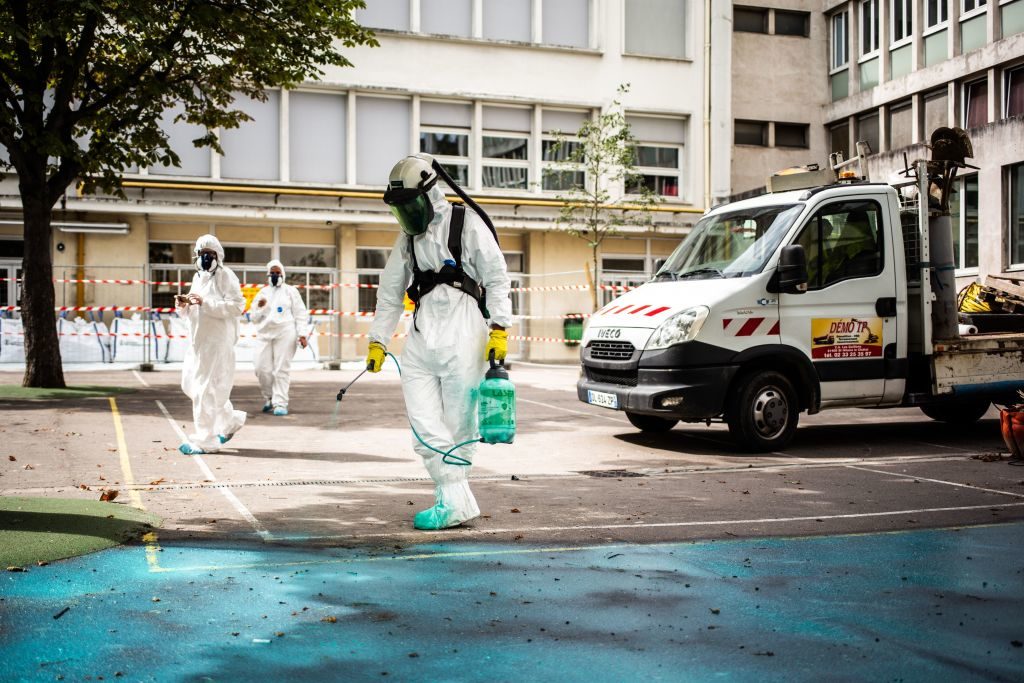
A worker sprays a gel on the ground to
absorb lead as he takes part in a clean-up operation at Saint
Benoit school near Notre-Dame cathedral. Photo: Martin
Bureau/AFP/Getty Images.
Lead pollution has been a source
of concern for many residents and businesses operating in the areas
surrounding the cathedral. Restoration work on the cathedral was
halted during the summer months to focus on a clean-up operation in
the surrounding area, and an environmental
group launched a suit against the government
over the public health risk from
the toxic fallout.
While many conservation experts
and worshippers are keen to regain access to the cathedral as soon
as possible, health and safety officials are still not satisfied
that every trace of lead has been removed.
Several efforts have already
been made to decontaminate the square, including power-washing, but
none have been deemed thorough enough, partly because some lead
particles have settled into the porous surface of the cathedral,
and it is difficult to access these small holes. Experts are now
experimenting with a new method, which involves pouring a
transparent resin onto the site to remove lead particles from those
difficult-to-access spaces.
The special procedure is
expected to begin mid-February, and the Regional Health Agency will
then rule on whether it is safe for the public. The speed at which
this cleaning operation will be carried out depends on the weather,
as the resin can’t be applied in the rain or when it is too
cold.
In the aftermath of the fire,
the restoration effort attracted millions in donations, and the
restoration pot now sits at €922 million (more than $1 billion).
The French president Emmanuel Macron has put a tight timeline on
the restoration, vowing in 2019 that the cathedral will be rebuilt
“more beautiful than before” within five years.
The cultural authorities in
charge of the cathedral’s restoration, the ministry of culture, and
the regional directorate of cultural affairs, are keen to press on
with the efforts to keep to the president’s timeline, but health
and safety concerns have slowed the process.
At the National Assembly
yesterday, the Île-de-France prefect Michel Cadot admitted that
there have been a number of “tensions” between the different
authorities responsible for restoration and health and safety. The
rigorous measures enacted to protect people from lead pollution
triggered several arguments, such as over the necessity for the
drastic decontamination procedures that construction workers were
subjected to. “I don’t think I could have acted any faster or
differently,” Cadot said.
The post After Traces of Toxic Lead Are Removed, Notre Dame
Could Partially Reopen to the Public as Early as Next Month
appeared first on artnet News.
Read more https://news.artnet.com/art-world/notre-dame-square-reopen-lead-pollution-1771161
Further reading


Leave a comment