
What Shaker Furniture Can Teach Us About the ‘New Minimalist’ Trend + Two Other Illuminating Pieces of Criticism From Around the Web
What ideas are percolating out there in the world of art media?
This week, here are three essays (well, an essay, a podcast, and an
interview) worth thinking about. Enjoy!
“Every Force Evolves a
Form” by Alessandro Bava, Mousse
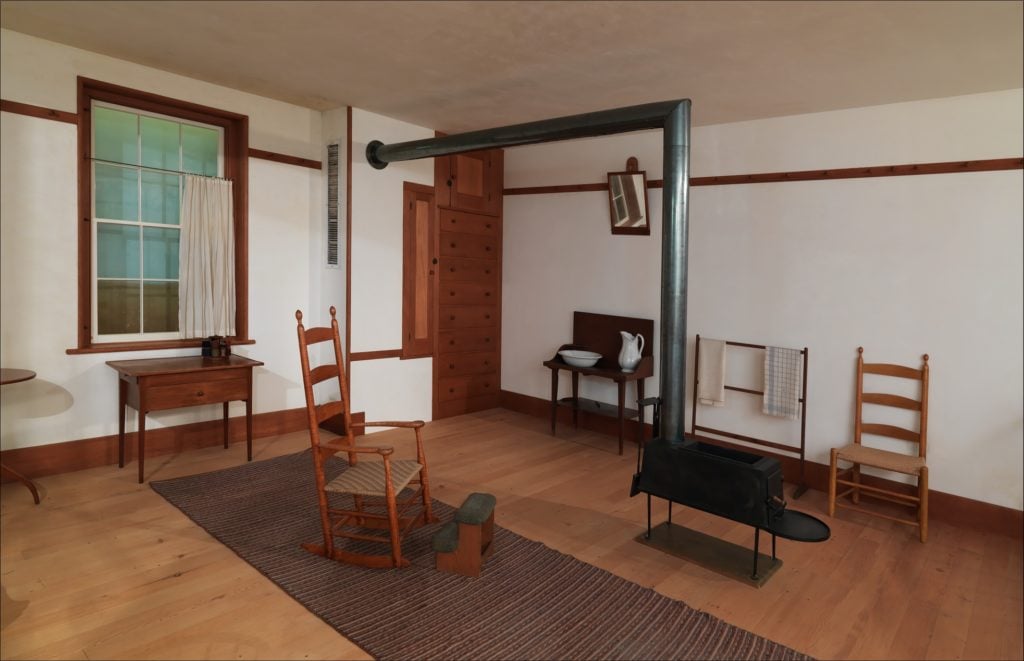
The Shaker Retiring Room at the
Metropolitan Museum of Art. Image: Public domain.
Lately, a lot of talk has orbited the “New Minimalism,” a vogue
captured and amplified by Kyle Chayka’s buzzy new
book, The Longing for
Less.
An essay from Mousse‘s winter issue by Alessandro
Bava comes at the same conversation from a different angle,
looking at the history and newly refreshed popularity of
Shaker furniture (seen recently, for instance, in “Concerning Superfluities: Shaker Material
Culture and Affinities” at Essex Street gallery in New York,
which put Shaker objects in conversation with works by Robert
Gober, Agnes Martin, and Rosemarie Trockel).
“A new minimalistic material dimension is emerging that defines
new habits… yet distinctly recalls much older kinds of minimalism,”
Bava heralds. This seems to be indisputably true, as does his
explanation of the background against which this new austere
sensibility takes its appeal: the “explosion of spiritual
practices such as mindfulness (and their ambiguous purposing) that
have arisen in response to the extreme demands of cognitive work
and the commodification of affect and emotion.”
Shaker furniture’s gorgeously spare forms have long stood as
icons of homegrown American functionalism: no-nonsense usefulness
as beauty. The newness of the New Minimal sensibility, in Bava’s
telling, is that instead of detaching it from its rootedness in
religious experience to turn its objects into prototypes of
streamlined mass-produced “good design,” the emphasis increasingly
falls specifically on the spiritual, ethereal dimension of Shaker
aesthetics: these are not just things optimized for efficiency, but
pieces that fit into a spiritually rich way of life, where each
object is charged with symbolic meaning as part of a holistic,
anti-materialistic way of living.
Bava emphasizes the proto-political aspects of Shaker
aesthetics. The Shakers were, after all, proto-socialist, holding
property in common. The Shaker experiment was one of the utopian,
religious, communitarian, and millennarian reactions that
accompanied the disruptions of the early Industrial era. So there’s
a direct link between contemporary New Minimalist ways of living as
a rejection of ultra-consumerist, ecologically wasteful lifestyles,
and pre-20th century religious forbearers.
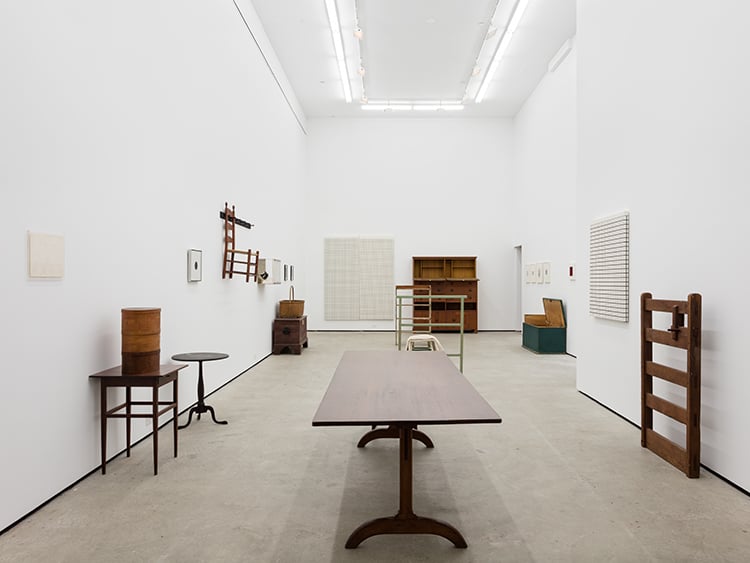
Installation view, “Concerning
Superfluities: Shaker Material Culture and Affinities,” ESSEX
STREET, New York, 2019
It’s worth adding that 19th-century “scientific socialism”—the
political movement associated with Marx and Engels, the
Communist Manifesto, and the workers’ movement—defined itself as both
inspired by and critical of “utopian socialist”
communities. Marx and Engels thought such alternative lifestyles
had inspiring insights and captured powerful currents of
alienation; but they also thought the utopians were deflecting that
alienation into small-scale experiments that avoided confrontation
with the more powerful institutions of society, the ones that
actually had the resources to make large numbers of lives better.
Small-scale solutions, they argued, were doomed to remain fragile
and dependent.
Which is exactly the problem that plagued the Shakers (that and
the fact that they were against procreation). The reason the world
even knows about Shaker chairs, chests, ladders, and so on in
the first place is because the utopian project was never able to
achieve autonomy from the outside world. “[T]heir economy could
only properly function thanks to the production of surplus goods to
be sold to the outside world, and what made these goods
particularly attractive and expensive was their impeccable
manufacture, supported by a labor culture that aimed for perfection
as ‘making the way of God your own,’” Bava writes. “Thus Shaker
communism was possible only as an island immersed in a market
economy perceived as a necessary outside evil.”
Bava views Shaker Minimalism as a resource to “imagine
alternative models” for new, less disposable relations to material
culture. But he also ends up concluding, somewhat cryptically, that
“of course this cannot be achieved simply by design, because also
in politics every force evolves a form.” Basically,
you can’t just design your way out of alienation, because
alienation is not solely a matter of bad design. It’s bound up with
political economy: who has power and how money is earned or
allocated.
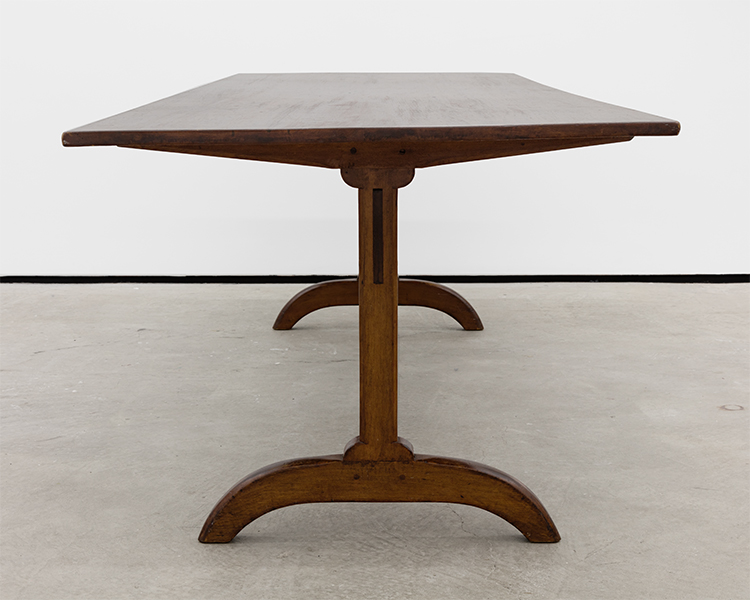
Shaker Trestle Table (ca. 1840). Likely
Watervliet, New York.
A rare example of a classic Shaker trestle table having a two board
top above two beveled tapering cleats supported by carved standards
mortised into an arched footed base. Image courtesy Essex Street
Gallery.
I’d add that, ultimately, it isn’t clear to me whether the
aesthetic and “ethical” sides of spiritual Minimalism can fully be
reconciled with the political reading of them.
If you take, for example, contemporary “mindfulness” practices
as an avatar of New Minimalist thinking, it is clearly a way for
alienated urbanites to register the strains of a very fragmented
and commodified world and to reconnect with a sense of place,
presence, and community.
At the same time, mindfulness tends to become both a boutique
luxury commodity and a cheapo replacement for mental health care,
and can turn devotees away from bigger thinking about how to change
systems that produce so much mental strain, and towards individual
self-help, mental hacks, and spiritual hoodoo. (An interesting
debate raged on the openDemocracy website all last year about how
mindfulness practices might be disconnected from “magical
thinking,” and attached more fully to political perspectives.)
In any case, I think it clear that this New Minimalist vogue is
definitely interesting to explore, and also that you’ll be seeing
more and more emphasis on spiritual minimalism in contemporary art.
It’s just worth untangling what in it is a symptom of a problem,
and what is an actual answer to a problem. When all you have is a
hammer, every problem looks like a nail; when you’re an art critic,
it’s possible that every problem looks like a smartly designed
Shaker chair.
“4’33”” by Twenty Thousand
Hertz
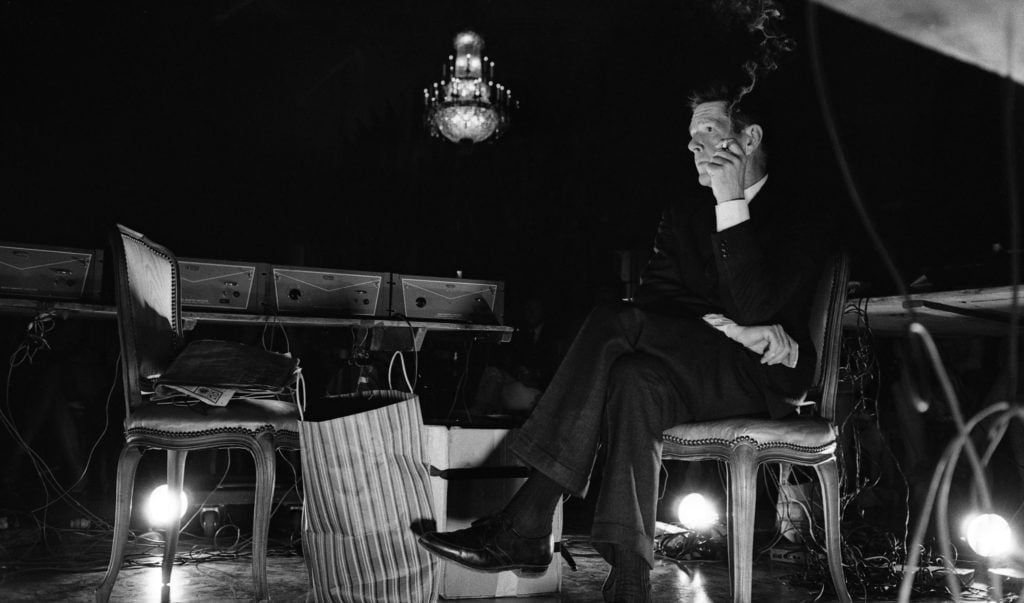
Composer John Cage during a concert of
his at the opening of the National Arts Foundation, Washington, DC,
1966. Photo by Rowland Scherman/Getty Images.
This Dallas Taylor-hosted podcast focuses on sound, but this
episode’s exploration of silence—and
specifically 4’33”, John Cage’s silent masterwork—is
really worth the listen. I’ve always
understood 4’33” as Cage’s attempt to tie
avant-garde provocation to his explorations of randomness and the
I-Ching, but Taylor makes what I consider to be a more contemporary
and interesting case for it.
You need to understand 4’33”, the argument goes,
against the history of… Muzak. The increasing presence of
pre-recorded mood music in public spaces outraged musicians in the
1950s, and led to lots of anxiety about sonic pollution and the
loss of an audience’s ability to actually pay attention, as music
was bleached of meaning and treated as wallpaper. Apparently,
in 1952, the same year 4’33” premiered, “a college student
in the Midwest… started selling silent records for jukeboxes. So if
you didn’t want to listen to the jukebox for a moment, you could
put in your nickel.” 4’33”‘s intensified focus on
just listening to your sonic environment as an artistic
act in itself emerges from that sense of revolt against too much
music, too much stimulus.
To me, that’s a convincing argument that links up Cage’s
interests in Zen practice to—projecting forward—the contemporary
New Minimalist mindfulness foment. (Chayka’s The Longing for
Less, incidentally, also digs into 4’33”.)
“The Manifesto of Rural
Futurism,” interview with Leandro Pisano, We Make Money Not
Art
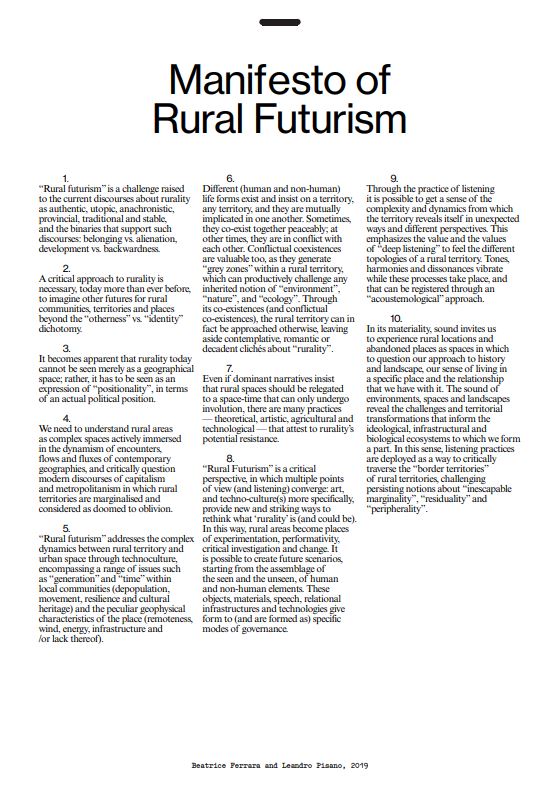
“Manifesto of Rural Futurism,” by
Beatrice Ferrara and Leandro Pisano.
Régine Debatty’s We Make Money Not Art blog leads me to the
“Rural Futurism”
manifesto, launched by Beatrice Ferrara and Leandro Pisano last
year (and emerging from Manifesta 12 from 2018).
With Rem Koolhaas’s “Countryside, The Future” show about to
debut at the Guggenheim (exploring “radical changes in the rural,
remote, and wild territories collectively identified here as
‘countryside’”), this focus on rural avant-gardism seems like
another vogue worth marking.
Basically, Ferrara and Pisano are making the case that we should
treat rural areas not as raw suppliers of goods for
metropolitan life, nor as areas that have been left behind, but as
places participating fully in what it means to live in the present,
and full of knowledge about how different forms of life cross one
another.
The interesting thing to me is that, thus far, as an art style
“Rural Futurism” seems mainly to involve audio art as a practice of
“deep listening.” (You can hear examples here). Classic early 20th-century Italian
Futurist art was all about celebrating the collision of images and
people in the city, advocating for the beauty of technology, taking
traditional forms of art-making and giving them a technological
makeover. It represented the technophilia of an underdeveloped
society.
“Rural Futurism,” also rooted in Italy, so far has focused on
oral histories, field recordings, and audio collages of landscapes
meant to focus attention on the different aspects of the actually
existing rural world. In essence, it is a reflex of an
overdeveloped society that is realizing that it may have to listen
to what it thought was its past to find its actual future.
The post What Shaker Furniture Can Teach Us About the ‘New
Minimalist’ Trend + Two Other Illuminating Pieces of Criticism From
Around the Web appeared first on artnet News.
Read more https://news.artnet.com/opinion/shaker-furniture-new-minimalism-1771839
Further reading


Leave a comment