
10 Beginner’s Tips for How to See—and Understand—the Rich Complexities of Byzantine Textiles
At Dumbarton Oaks in Washington, DC, having pored over a group of Byzantine textiles
from the 4th to 12th centuries with
curator Elizabeth
Dospel Williams, I took away this general rule for non-specialists:
don’t trust your lying eyes.
In this era of “fake news” and
deepfake videos, this bears explanation. You’ll see dazzling colors
and compelling details in the more than 250 Byzantine textiles in
the museum’s new online
catalogue, but every
textile isn’t created equal. Some are fake; others are slapdash. Transcendent materials
and techniques rarely broadcast their rarity, so you must know
where—and how—to look.
To help guide you, we’ve put together 10 tips for how to
approach Byzantine textiles as a novice.
1. Think like Indiana Jones and Look Past the
Surface
In Indiana Jones and the
Last Crusade, the guardian of the holy grail tells Harrison
Ford’s character that he chose wisely when he spotted the coveted
object among an ostentatious lineup of vessels. And when eyeing
Byzantine textiles, you similarly need to look past surface
beauty.
At Dumbarton Oaks, a
simple-looking child’s
tunic with coarse thread
doesn’t seem to offer much. But this humble garment with ancient and
modern repairs—which Williams calls “the ultimate hand-me-down”—has
a complex and painful story attached to it.
Like most surviving Byzantine
textiles, the tunic comes from an Egyptian grave, where it was
buried with an infant or a toddler, underscoring a deep tragedy.
Someone embroidered two crosses on the tunic (one above the child’s
chest, and one on the back), perhaps for amuletic
purposes.
“My heart is always so touched
by the slit,” Williams says. “I think of baby onesies today. It
just transports you.” (So does a green child’s hooded “poncho”
at the Metropolitan
Museum.)
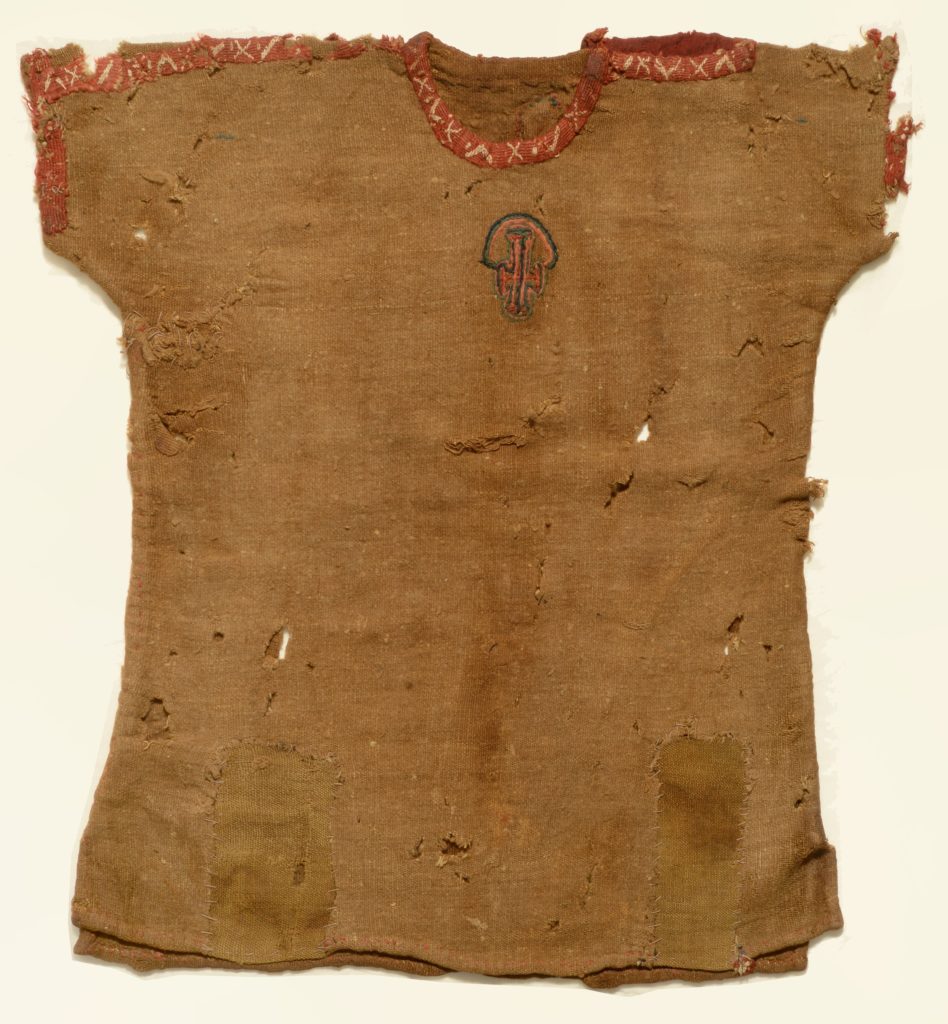
Egyptian child’s tunic, circa the 4th to
10th century.
2. Consider the Many Meanings of Crosses
The Christian connotations of
the crosses on the above child’s tunic are unambiguous. But the
meaning of a cross is not always so obvious.
In one drawer Williams opened, a
rectangular embroidered fragment
contained a small yellow cross
circumscribed within a larger red-brown one. (Many dealers cut
fragments out of larger pieces either to discard stains or to split
up and sell particularly attractive
parts.) The piece, from
Egypt and made between the 7th and 10th centuries, is unusual in
that explicit religious connotations are uncommon in textiles of
that era. But the item doesn’t necessarily only carry Christian
meaning.
“While a Christian connotation
may indeed be intended here, it is not certain that the piece came
from a fabric exclusively for Christian use or meaning,” according
to a catalogue entry.
Williams, whose dissertation was
on jewelry, says overt Christian imagery is surprisingly rare on
textiles as compared to on jewelry, especially given that both were
worn. Even into the early Islamic period, Dionysius was a popular
textile motif.
In the museum’s
Hestia hanging, a star of the collection, a hearth
goddess is portrayed with Marian echoes. “Egypt is such a
fascinating microcosm of Christianization,” Williams says. “They’re
not one moment not-Christian, and the next moment Christian. In
fact, they keep beliefs that continue for a very long time. The
textiles really bear witness to that.”
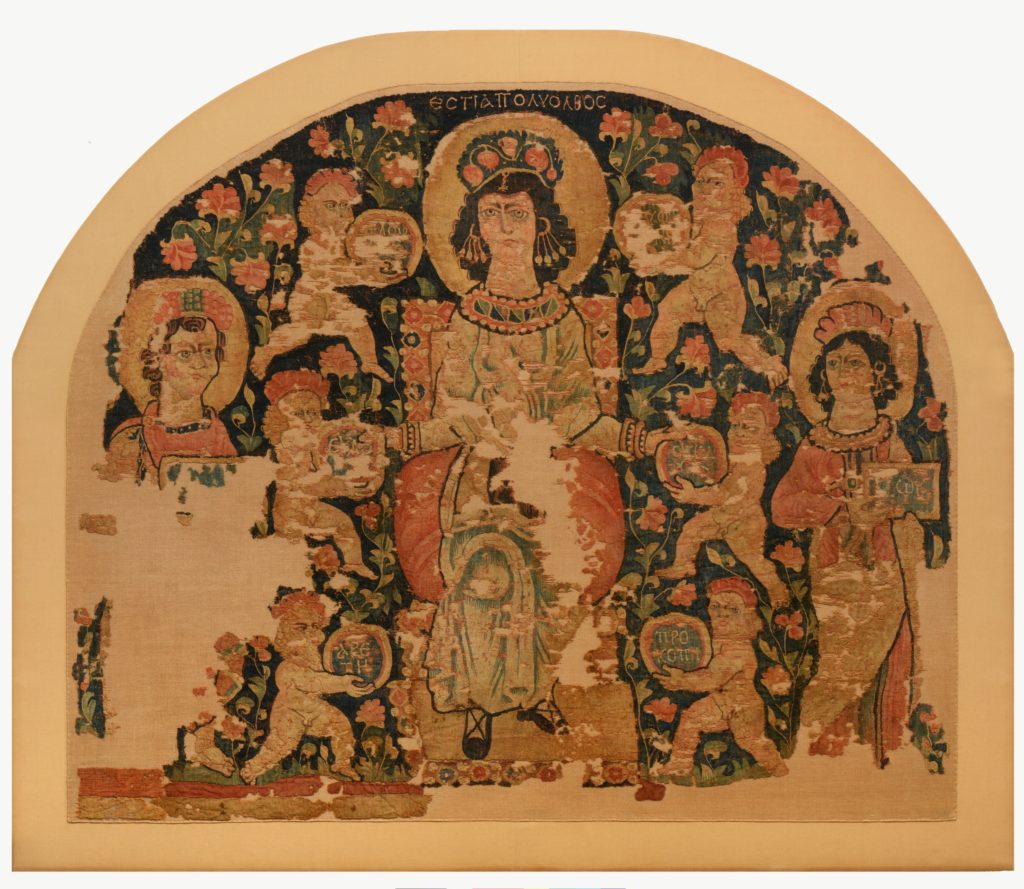
Hanging with Hestia Polyolbus, an
Egyptian textile circa the 6th century.
3. Some Images Are Like Rorschach Tests
Williams often finds that
iconographic symbols are like over-Xeroxed photocopies. “You kind
of get to an end stage of the iconography, and it starts looking
like monster fish heads that might have been, in an earlier
iteration, a very nicely woven flower,” she says.
In the center of a
roundel in the Dumbarton Oaks
collection, a rabbit-gazelle hybrid
displays sharp claws and ears evoking Ren (you know, of
Ren &
Stimpy). In
another fragment, animals may be dogs, rabbits, or gazelles—it
isn’t clear. The museum catalogue doesn’t hazard a guess at the
kind of long-necked animal a hunter holds in the roundel below. “It’s like a Rorschach test,” she
says.
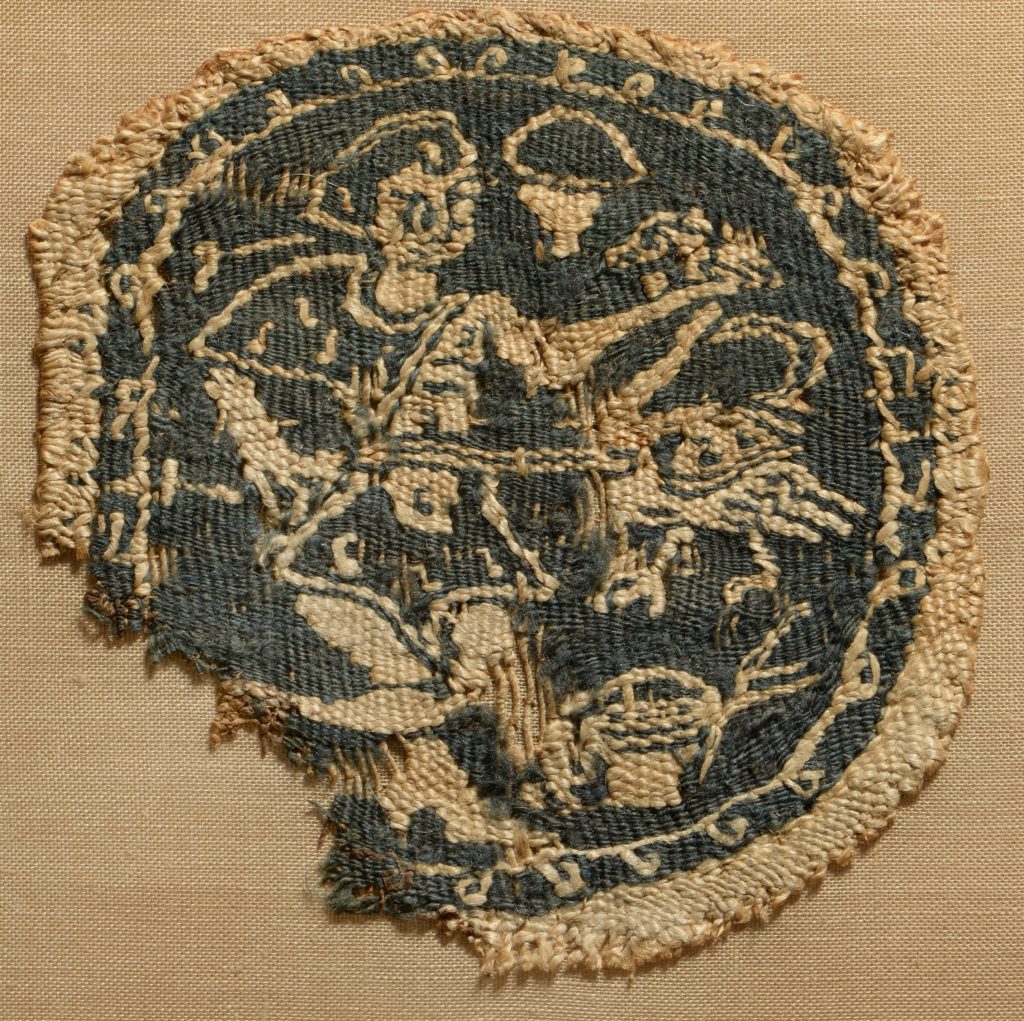
A roundel from the 4th to 7th
century.
4. Size Really Does Matter
Looking at textiles in
reproduction makes scale tough to gauge. Williams notes that
a fragment
depicting a figure’s face, neck,
and chest—all measuring nearly eight by four inches—is too large to
have been worn, so it could have been a hanging. “You don’t ever
see this type of figure on a tunic,” she says.
Another fragment (see below) is part of a tunic sleeve, which Williams
identifies based on a basic pattern—a figure flanked by plants and
animals in a rectangular configuration—that surfaces in other
sleeves. Most textiles are multiples, so one can generally do
detective work by comparing pairs.
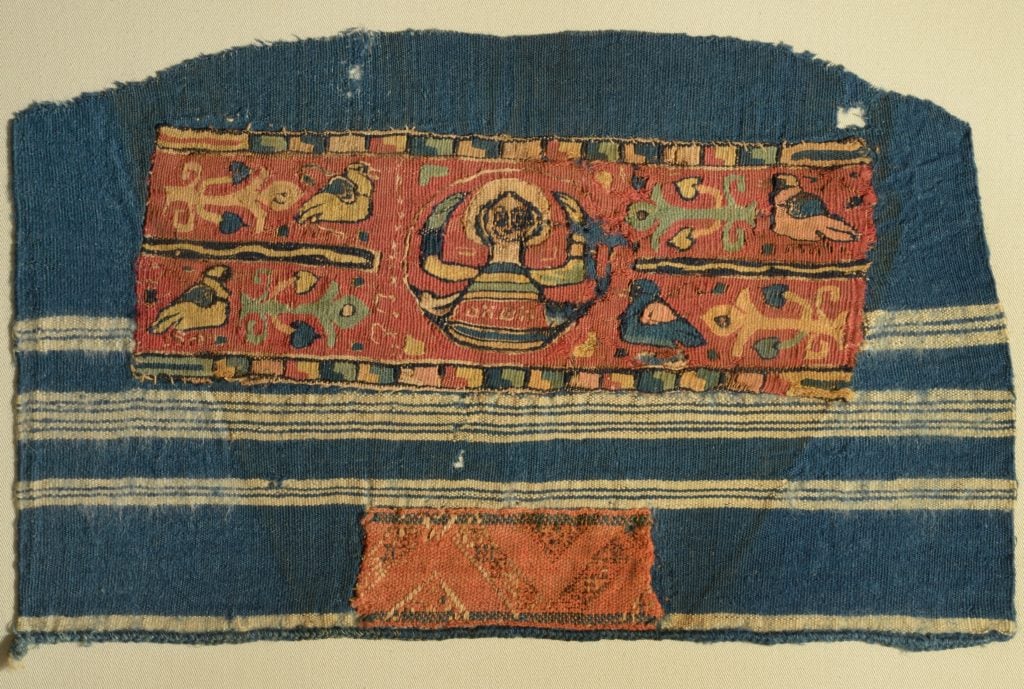
A tunic fragment from the 7th to 10th
century
5. Words Carry Tremendous Power
Most Byzantine textiles don’t
have inscriptions, as very few people at the time could read them.
“Just having script on it made it very valuable,” Williams says.
She says that after Islam spread to Egypt in the 7th and 8th
centuries, inscriptions proliferated, and people began to recognize
that a phrase invoked the name of God or a ruler, even if they
couldn’t literally read the words.
“They treated these textiles
with a lot of respect,” she says. “When we find them in burials,
they’re often wrapped around the head of the deceased, right over
the eyes. The writing itself has this kind of draw or
power.”
6. This Isn’t Forever 21
Most of the textiles in the
Dumbarton Oaks collection belonged to wealthy people, who could
afford to be buried in them. But in the Byzantine period, most
people likely only owned a few garments across their entire
lifetimes. “They didn’t go through tunics every year,” Williams
says. “We are accustomed to H&M, fast fashion, and cheap
materials. You can buy a t-shirt really cheaply and that’s just not
how people in that time understood fabrics.”
The ways we consume (and
discard) clothing today, as well as our disconnection from their
manufacture, makes it harder for us to understand Byzantine
textiles. “I think that people, maybe even as recently as their
grandparents’ generation, had a better appreciation for fabrics and
textiles,” Williams says. “It’s sort of lost today,
somehow.”
7. Scars Tell Luxurious Stories
It’s tempting to focus on the
parts of a textile that remain preserved and beautiful, but
deterioration reveals a piece’s bones. “The best place to look at
textiles to see the structure is where there is decay or fray,”
Williams says.
In a particularly fine,
five-colored silk
textile, a hero (Samson?
Hercules?) wrestles a lion. Some edges look like they could have
emerged from a fight with a great cat, but examining unraveled
threads reveals how luxury objects were made. “It doesn’t get more
glam than that silk,” Williams says of the work, which was
preserved in a European monastery treasury, perhaps wrapping a
relic.
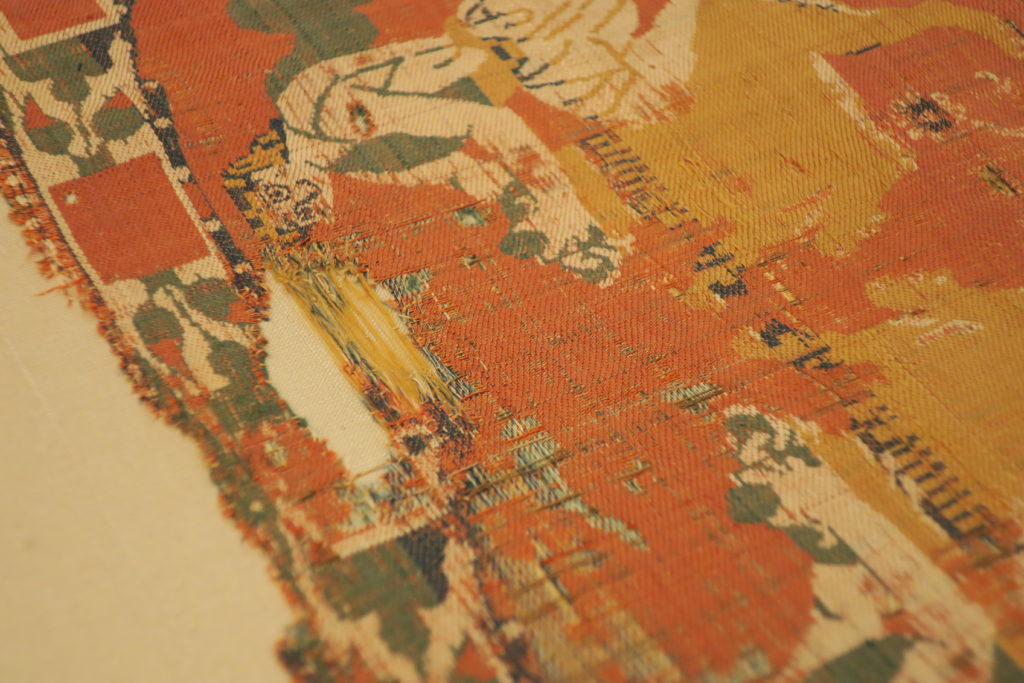
Detail of fraying on the “Hero and Lion”
silk from Constantinople, Egypt,or Syria, circa the 7th to 9th
century. Photo by Menachem Wecker.
8. Some Pieces Are Seriously High-Tech
“Textiles were some of the most
valuable objects in people’s lives,” Williams says. The most
valuable would be five-colored silks, and the techniques for making such works would have been
kept secret, and the style trickled-down to imitation
silks. The technology
used for silk was cutting-edge. “A drawloom is basically a
computer,” Williams says. “I think [the drawloom was] almost like
the new Apple watch right now.”
9. Color It Green
Some of the pigments Byzantine
artists used were chemically unstable; certain greens in particular
have eaten away at the wool, and have disappeared. That’s the case
with what appears to have been a lighter green shade that’s missing
from fragments of a
hanging in the Dumbarton Oaks
collection.
“It’s often really hard to tell,
just looking at the color today, what the color was back then,”
Williams says. Many people are surprised that Byzantine textiles
from Egypt—which they associate with desert sand—have bright colors
at all. “They think terracotta, but in fact they’re really
vibrant.”
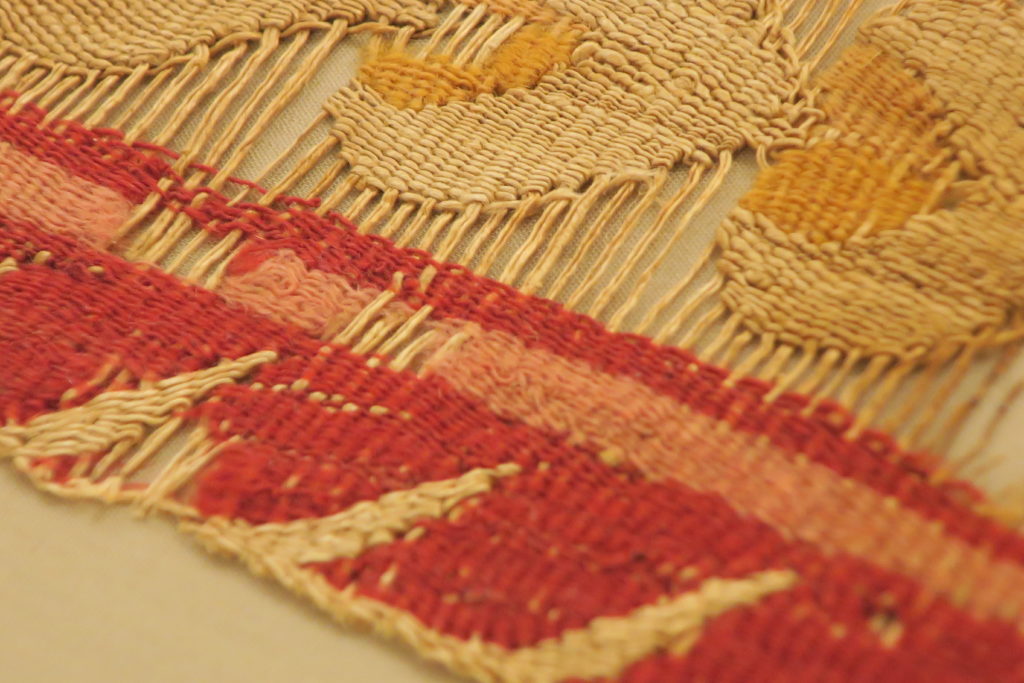
Detail of a fragment of an Egyptian band
from the 4th to 10th century. Photo by Menachem Wecker.
10. Give Credit Where It’s Due
Many fashion histories begin
with the Renaissance and don’t give the Byzantine period credit for
globalization. “We have a tendency to think of pre-modern people as
being very entrenched in their dress habits, that they were wearing
a toga for centuries,” Williams says. “It’s clear that that’s just
not true.”
Indian-export
textiles—many of which
were thought to be from the 15th century, but which carbon dating
reveals were made up to five centuries earlier—demonstrate how
widely textiles traveled.
“They’re importing textiles
really early on,” Williams says. “The scholarship is kind of
catching up with that.”
The post 10 Beginner’s Tips for How to See—and
Understand—the Rich Complexities of Byzantine Textiles appeared
first on artnet News.
Read more https://news.artnet.com/art-world/byzantine-textiles-1771263
Further reading


Leave a comment